PumpPill — token safety and measured outcomes
Lectures de sécurité des tokens, historique des déployeurs, soldes des baleines et résultats mesurés prospectifs pour Robinhood Chain et Solana. Lecture seule, sans clé.
Serveur MCP hébergé
npx add-mcp 'https://api.pumppill.org/mcp'S’installe dans Claude Code, Codex, Cursor et plus
Documentation
Ask PumpPill about any token, as JSON
PumpPill reads Robinhood Chain (chainId 4663) and Solana tokens straight from the chain and files the result: who deployed it, where the launch money went, whether the liquidity is locked and who gets it back, whether it can be sold, and whether anyone uses the product. Every page below has a JSON twin. No key, no sign-up, read-only. A failed read is reported as unknown, never turned into a flag.
MCP server
If your client speaks the Model Context Protocol, connect to https://api.pumppill.org/mcp (Streamable HTTP, no key, no account) and the endpoints below arrive as fifteen read-only tools with their limits attached — including search and fetch, the pair ChatGPT connectors call. Every result carries a citation and the timestamp the read was taken.
No public tool can trigger a live scan; it answers from stored reads, and a miss is queued for reading rather than invented. 240 requests a minute per address, 60 a minute per client.
Connect it
One click installs the server in the editor; the same lines are below for a hand edit.
Claude on the web or desktop (Pro, Max, Team, Enterprise): Settings → Connectors → Add custom connector, name it PumpPill, paste https://api.pumppill.org/mcp, leave the OAuth fields empty. The public tools then work in any chat; the member tools need a header that claude.ai cannot send, so use an editor client for those.
ChatGPT: add it as a connector with the same URL; search and fetch are the tools it calls.
Claude Code, in one line:
claude mcp add --transport http pumppill https://api.pumppill.org/mcp
Cursor (~/.cursor/mcp.json), Windsurf, Cline and anything else that takes a remote MCP server:
{
  "mcpServers": {
    "pumppill": { "url": "https://api.pumppill.org/mcp" }
  }
}
VS Code (.vscode/mcp.json) names the transport explicitly:
{
  "servers": {
    "pumppill": { "type": "http", "url": "https://api.pumppill.org/mcp" }
  }
}
A client that only speaks stdio can bridge to it with npx -y mcp-remote https://api.pumppill.org/mcp. Registry name: org.pumppill/token-safety.
Member tools
Five tools on the same server answer only a PumpPill member: a fresh scan of a Robinhood Chain contract on demand, the premium call table, what X is saying about a contract (who names it, their reach, and what those accounts called before), the Robinhood Chain wallets that member follows, and their membership status. They are listed for everyone — an unauthenticated call answers with what sits behind them and a link, never an error. A member sends their sign-in token as a header, Authorization: Bearer <claim>, and copies the whole line from their premium page. In Cursor that is a "headers" object beside the URL. Everything else here needs no membership and no key.
Written out for a human, with every client's connect line and the rules the tools keep: the MCP server, explained.
Product demo
Ask your AI assistant about a token
Eighty-three seconds: connecting a client, the questions the tools answer, and the limits every answer carries.
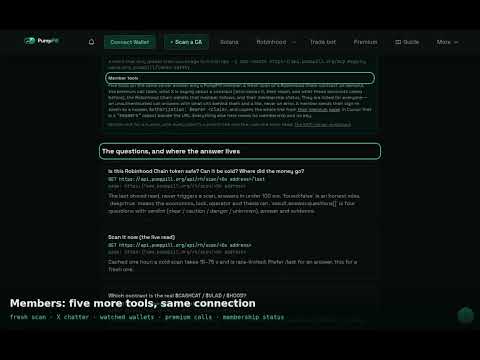
83s · a recording of the live page · narration is a synthetic voice by ElevenLabs
The questions, and where the answer lives
Is this Robinhood Chain token safe? Can it be sold? Where did the money go?
GET https://api.pumppill.org/api/rh/scan/<0x address>/last
page: https://www.pumppill.org/rh/scan/<0x address>
The last stored read, never triggers a scan, answers in under 100 ms. `found:false` is an honest miss. `deep:true` means the economics, lock, operator and thesis ran. `result.answer.questions[]` is four questions with verdict (clear / caution / danger / unknown), answer and evidence.
Scan it now (the live read)
GET https://api.pumppill.org/api/rh/scan/<0x address>
page: https://www.pumppill.org/rh/scan/<0x address>
Cached one hour; a cold scan takes 15–75 s and is rate-limited. Prefer /last for an answer, this for a fresh one.
Which contract is the real $CASHCAT / $VLAD / $HOOD?
GET https://api.pumppill.org/api/rh/ticker/<symbol>
page: https://www.pumppill.org/rh/ticker/<symbol>
Names ONE contract per ticker: alive, at least $10K in the pool, not flagged HIGH or CRITICAL. The other contracts using that name are a count (`contracts_other`), never a list. `found:false` means no contract clears the gate.
Which memecoins are paired with tokenized NVDA / SPY / TSLA?
GET https://api.pumppill.org/api/rh/pairs/<STOCK>
page: https://www.pumppill.org/rh/pairs/<STOCK>
The trading, unflagged tokens quoted in that tokenized stock, with liquidity and the latest scan risk. `/api/rh/pairs` lists every stock with counts.
How does Robinhood Chain measure? Launches a day, how many survive, how many double?
GET https://api.pumppill.org/api/rh/stats
page: https://www.pumppill.org/rh/stats
Recomputed hourly from PumpPill's own tables, method stated in the payload. Free to quote with attribution.
Which Robinhood Chain tokens were flagged this month?
GET https://api.pumppill.org/api/rh/flagged
page: https://www.pumppill.org/rh/flagged
Latest scan per token in 30 days that found HIGH or CRITICAL structural risk, findings named. A flag is a finding with evidence, not a verdict.
What did the tokens PumpPill logged actually do? (outcomes, both chains)
GET https://api.pumppill.org/api/research/outcomes
page: https://www.pumppill.org/research
Forward-measured outcomes: share that doubled, reached 5x, 10x, never moved. Entry is the market cap at logging, never backfilled; losers are in the denominator.
Any Solana token: holders, bundle, dev wallet, socials
GET https://api.pumppill.org/api/token/<mint>/detail
page: https://www.pumppill.org/token/<mint>
`meta.verdict` is one plain-English sentence: trading or not, sellable or not, what the dev still holds, how far it has run.
Which Robinhood Chain wallets hold enough to move a pool?
GET https://api.pumppill.org/api/rh/wallets/whales
page: https://www.pumppill.org/wallets
Balance and token holdings read on chain, not activity inferred: 10 ETH or $50,000 in tokens to join, and every removal carries its reason. Tiers are by dollars held (mega / whale / mini / large) — $100,000 of one of the chain's largest tokens makes a mini whale — and `positions_top` names each wallet's three largest holdings. Measures who CAN move a pool, never who is right. `?sort=active` orders by trades instead of balance — most listed wallets hold rather than trade, and `meta.trading_30d` says how many actually did. Trades are counted from `meta.trading_since`, the moment we began recording the chain's feed, not over a fixed 30-day history.
Which Robinhood Chain wallets were early on tokens that went on to cross $100K?
GET https://api.pumppill.org/api/rh/wallets/early
page: https://www.pumppill.org/wallets#early-on-winners
A first buy inside the first 30 minutes of a token's first sight on the chain's feed, on tokens that later crossed $100K. Read every rate against `meta.early_base_rate`, the share of ALL judged feed tokens that crossed. Culled for spraying, for falling below that rate on five or more judged entries, and for silence. A fact about timing, not a forecast. `realized_fill_eth` is what the wallet's sells actually received on chain; null means the sells are still being read.
Which Solana wallets were early buyers of tokens that did 5x?
GET https://api.pumppill.org/api/sol/wallets/early
page: https://www.pumppill.org/wallets#solana
Wallets the launch scan recorded among a token's first buyers, on tokens whose peak reached 5x the scan cap. Read `hit_rate_5x` against `meta.base_5x` (about one judged token in twenty). Culled for buying more than a token a day, for sitting at or below the base rate, and for silence. Wallet identity showed no out-of-sample edge on Solana when tested; this answers who was early, not who to copy.
What does one Robinhood Chain wallet hold, and what has it traded?
GET https://api.pumppill.org/api/rh/wallet/<0x address>
page: https://www.pumppill.org/rh/wallet/<0x address>
Balance, holdings in called tokens, trade history off the chain's own feed, and what has fired on it. `listing` carries what the wallet lists say — capital (holdings read on chain, with read times) and record (the tape, with the base rate) — and `state` is `listed` when the lists know a wallet the scan ledger does not. A sell's size comes from the router's minimum-out, so it is a floor and is never reported as profit.
How to read the payloads
- Addresses are lower-case. A Robinhood Chain contract is
0xplus 40 hex characters; a 64-hex string is a transaction hash, not a contract. - Every per-token payload carries
scanned_at(UTC) — say when the read was taken. Market cap and liquidity are as of that moment. links.alertsnames the open Telegram channel for that token's chain;links.buynames PumpPill's own trading bot with the contract loaded.- A ticker page names one contract on purpose. When a user pastes a different address with the same name, answer from the scan of the address they pasted, and tell them the ticker page names another contract as the one with the liquidity.
- Rate limits exist on the live scan only.
/last, the ticker, pairs, stats and flagged endpoints are cached and cheap.
Citing it
Free to quote with attribution and a link to the page (not the API URL). The machine-readable summary of the site is at /llms.txt. Research, not advice: a clear read is evidence, not a recommendation.
Robinhood Chain scanner · the chain, measured · outcome data · Solana scanner