Buddie
Vérification des preuves et diagnostics d'environnement basés sur les autorisations pour les agents IA.
Documentation

Verify the claim. Know the context.
AI agent reliability toolkit






Why buddie?
An agent finishes a task and tells you that CI passed, that a source supports its summary, or that your laptop has CUDA and Python 3.12. It sounds certain, and often it is right. When it is wrong, the mistake hides inside a confident sentence.
buddie separates what can be checked from what is only claimed. It checks supported claims against the evidence itself, gives the agent real observations of your machine instead of guesses, and marks what it could not check as unchecked. In 929 checkable quotations from published deep-research reports, 212 were altered or absent from the page they cited; buddie flagged 207 of them (research).
What buddie does
Verify. buddie checks supported claims against their evidence: a quotation against the page it links to, a file or commit against your repository, a merged PR or a green CI run against GitHub, a test result against the session's record of the command. No language model takes part in the check, so the agent cannot argue its way to a different verdict.
Catch mismatches. In Claude Code and Codex, buddie's hook checks supported claims at Stop and returns failures
with the reason. In Claude Code the answer is already visible at that point; buddie asks for corrected lines
instead of another copy of the whole answer. Supported message checks before delivery retain their existing
behavior. Other clients call the checks through MCP or the command line and decide what to do with the result.
Observe. Before it suggests a command, an agent can ask buddie for the parts of your machine the task needs: the operating system, CPU, memory, GPU, Python, runtimes, tools. buddie reads only the categories you have granted, changes nothing, and records how each value was observed.
Discover. The compact Claude plugin includes a Discovery skill for evidence triage with the tools available in the current session. It uses real Core verification when connected, performs independent checks otherwise, and marks unavailable checks as not checked. Local hooks and MCP capabilities vary by surface; Cowork, Chat and mobile require separate live verification. Projects/Context remains a future design.
See it in action
Verify an agent's claim
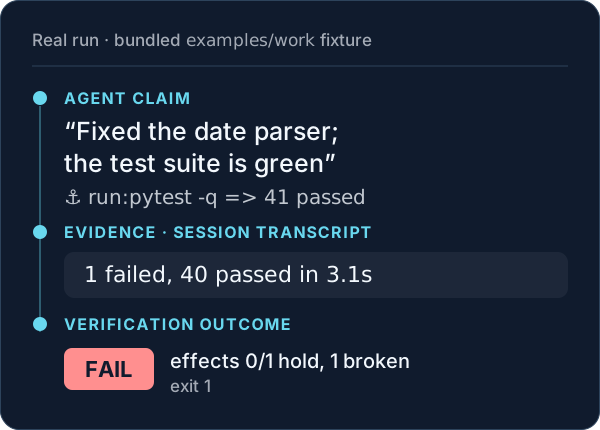
An agent reports that it fixed a date parser and that the test suite is green. It marks the claim with a small
anchor, ⚓ run:pytest -q => 41 passed, that buddie can check. The session transcript records what the test command
actually printed:
Run it yourself from a clone; the report and transcript are in examples/work:
cd buddie/examples/work
buddie verify report.md --transcript session.jsonl --no-github
BLOCK anchor line 3 ⚓ run:pytest -q => 41 passed: output has no '41 passed'; it ends: ….......................................... 1 failed, 40 passed in 3.1s
note  pr:/ci:/run: anchors show what happened (PR state, checks on a commit, a command and its output), not that the code is correct
buddie FAIL: effects 0/1 hold, 1 broken
The files are a teaching fixture: buddie reads the recorded output rather than rerunning pytest. --json receipt.json
also writes a receipt naming the evidence behind the verdict. Quotation, PR and CI examples, and which integration
checks what: verification guide.
Know the environment
An agent is asked to set up a local development environment. Instead of guessing the operating system, GPU or Python version, it asks buddie for three categories, which the person has granted:
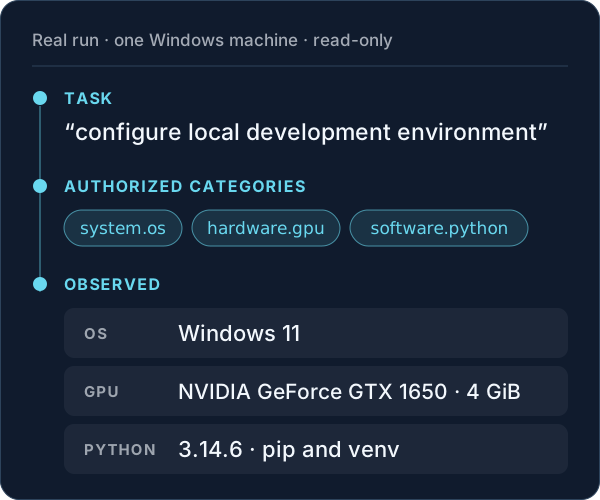
buddie snapshot --category system.os --category hardware.gpu --category software.python \
  --task "configure local development environment" --json diagnostics.json
buddie snapshot: diagnostics of 3 categories (grants active, policy absent; these govern the categories only)
  system.os: collected
    name: Windows 11  [os_interface]
  hardware.gpu: collected
    adapters: [model NVIDIA GeForce GTX 1650, source nvidia_smi_gpus, vendor NVIDIA, vram_bytes 4294967296]  [fixed_program]
  software.python: collected
    buddie_runtime: implementation cpython, pip True, venv True, version 3.14.6  [buddie]
Abridged from a run of buddie 2.0.0: the lines shown are unedited, and the machine's other observed values are left
out. diagnostics.json holds the full document, with the method and time of each value.
A category you have not granted is reported as denied, and its collector never runs. A value buddie cannot read is marked unavailable, with the reason. Diagnostics is read-only and installs nothing; it gives the agent better facts, not a guarantee that its next command is right. Categories, grants and the document.
Get started
buddie needs Python 3.11 or newer and has no dependencies.
Claude Code
The recommended start. The plugin adds the answer check, the MCP tools including environment diagnostics, and
run: checks against the session transcript:
/plugin marketplace add tsyyan/buddie
/plugin install buddie@buddie
It installs the latest released plugin (the plugin-stable branch), not unreleased work on main. To allow diagnostics, save the categories you choose as
environment.toml in ~/.config/buddie/ (%APPDATA%\buddie\ on Windows). For the demo above:
version = 1
allow = ["system.os", "hardware.gpu", "software.python"]
roots = []
Levels, the intro mode and what the hook reads: Claude Code guide.
Other integrations
- Codex:
codex plugin marketplace add tsyyan/buddie, thencodex plugin add buddie@buddie, and enable its hook in/hooks. The check runs atStop;run:claims stay unchecked. Codex guide - Any MCP client:
uvx buddie servestarts the stdio server. There is no gate: the agent calls the tools. Integrations - Command line and CI:
pip install buddie, thenbuddie verify REPORT.md --json receipt.json. It exits 1 onFAIL;GAPSandEMPTYexit 0, so a CI step that requiresPASSshould read the receipt's outcome. - Claude Desktop: the
.mcpbbundle from Releases, without a gate. Desktop guide
Every surface in detail: getting started.
Release status
| Version | |
|---|---|
| Release described here: PyPI, GitHub Releases, the Desktop bundle, the MCP Registry | 2.0.5 |
Upgrading from 2.0.4 changes nothing you have to do: 2.0.5 gives every listing one name, buddie, a smaller icon, and makes Claude Code's marketplace install only released plugins (from plugin-stable); Codex keeps installing from the repository.
Upgrading from 2.0.2: 2.0.4 includes canonical Discovery, the README-style dog icon and Toolkit positioning, Linux worker guard hardening, and Stop-hook guidance that asks for corrections without repeating the already displayed answer. No new permissions are required; on Linux a failed parent-death guard now prevents the regex worker from running. Discovery leaves unavailable checks unverified. The 2.0.3 candidate was superseded before publication.
Upgrading from 2.0.1 changes nothing you have to do: 2.0.2 adds the local feedback tools (feedback_start,
feedback_resolve, feedback_accept), GitHub citation checks and versioned public release notes. Upgrading from
2.0.0 changes nothing; 2.0.1 fixed how the MCP server reads its input on Windows systems whose code page is not
UTF-8. Upgrading from 1.1.1 changes nothing for a 1.x setup. What can differ, and why, is in the
changelog.
Documentation
| Topic | Read |
|---|---|
| Install on every surface | Getting started |
| What each integration does | Integrations |
| Checks, outcomes and receipts | Verification, receipts |
| Environment diagnostics | Environment |
| Security and privacy | Limitations, security, privacy |
| Contributing | CONTRIBUTING.md |
| Everything else | Documentation index |
Limitations
buddie is not a truth detector. It checks claims in the forms it recognises, such as quotations with links and
anchored claims about files, PRs, CI and commands, against the evidence it can read. Paraphrases and unanchored claims
stay unchecked. PASS covers only what was checked, and GAPS and EMPTY are not passes.
The answer check exists only in Claude Code and Codex, and it returns an answer rather than locking it: the agent fixes the claim or discloses it as unverified. An agent running as your user can edit local evidence, settings and the diagnostics grants file; only an administrator's protected policy sets limits it cannot raise.
buddie runs locally, with no model calls and no telemetry. It fetches the pages a report cites and calls GitHub for PR and CI claims. All limitations · Security boundaries · Privacy
Apache-2.0 · Changelog · Citation · Issues