Knowl
Mémoire locale d'abord, toujours à jour pour les agents IA
Documentation
Your CLAUDE.md only grows. Knowl retires facts when they change.








Quick start · Why supersession · What gets stored · Features · Agent setup · Viewer · Requirements · Full reference →
Your agent starts every session blank, so you keep a CLAUDE.md. It only grows. Six months in it
still names the database you migrated off last spring, and now the agent gets both answers.
Knowl is persistent memory for Claude Code, Cursor and Codex, over
MCP or the CLI. When a fact is replaced, the old one is retired
instead of competing with the new one. No API key needed. When Knowl isn't sure the new fact
replaces the old, it leaves both active and hands you the knowl supersede command to say so.
Turn that off and retrieval drops from 98% to 47%. End to end, 90 to 73. How it was measured ↓
Forty seconds, one decision, three agents:

Quick start
Requires Node.js 22 or later. macOS, Linux and Windows.
npm install -g @dat999zx/knowl
cd your-project
knowl init
Other package managers
The published package is the same one in every case; each of these installs it and puts knowl
on your PATH.
pnpm add -g @dat999zx/knowl
yarn global add @dat999zx/knowl
bun add -g @dat999zx/knowl
Or run it without installing:
npx @dat999zx/knowl init
Knowl runs on Node.js in all of these — Bun installs it, Node executes it. It bundles native addons (SQLite, tree-sitter, the embedding runtime), so running the CLI under the Bun or Deno runtime directly is not supported.
knowl init creates .knowl/, installs the project guidance files, updates .gitignore, and
registers Knowl with whichever agents it detects. It also warms a local embedding model (~53 MB)
in the background — init succeeds either way, and without it you still get keyword search.
That is the whole setup. You do not record memory by hand: your agent reads and writes it as it works.
Connecting an agent
 Claude Code MCP · lifecycle · gate |
 Codex MCP · lifecycle · gate |
 Hermes MCP · lifecycle · gate |
 OpenClaw in-process · plugin · gate |
 Copilot MCP · lifecycle · gate |
 Cursor MCP · lifecycle · gate |
 OpenHands MCP · lifecycle · gate |
 Antigravity MCP · lifecycle · gate |
 Windsurf MCP · lifecycle · gate |
 Cline MCP · lifecycle · plugin |
 Zed MCP · capture · ACP |
 JetBrains MCP · capture · ACP |
 OpenCode MCP · manual loop |
Claude Desktop MCP · manual loop |
knowl init registers the MCP server for every host it finds. Start a new session afterwards so
the agent picks up its guidance, and it will query and write memory on its own.
gate means Knowl can refuse an edit that invalidates code another session is holding.
Neovim and Kiro work the same way as Zed and JetBrains, through knowl acp. Cline needs one
line pointing it at the shipped plugin. Hermes Agent gets a Python plugin, installed for you,
that works in the terminal and in Hermes Desktop alike, and can additionally be picked as
Hermes' memory provider. OpenClaw runs in-process inside its gateway via an extension plugin,
evaluating write gates without subprocess overhead — knowl init openclaw copies it and prints
the two commands that register it. Any other MCP client works with
no integration at all.
Running agents in parallel? Every git worktree resolves to the main checkout's store —
Conductor workspaces, Claude Code's isolation: "worktree", or your
own scripts all share one memory, with nothing to configure.
How that works, and its one limit →
→ Every host, and what each one can do · How agents use it · MCP tools and resources
The idea: memory that retires itself
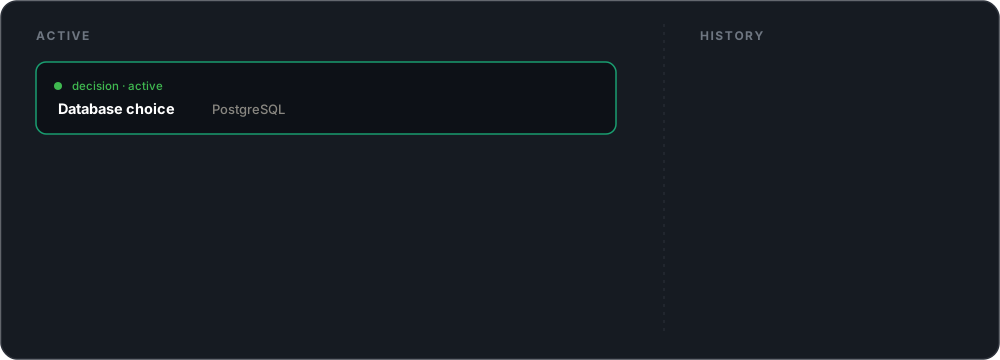
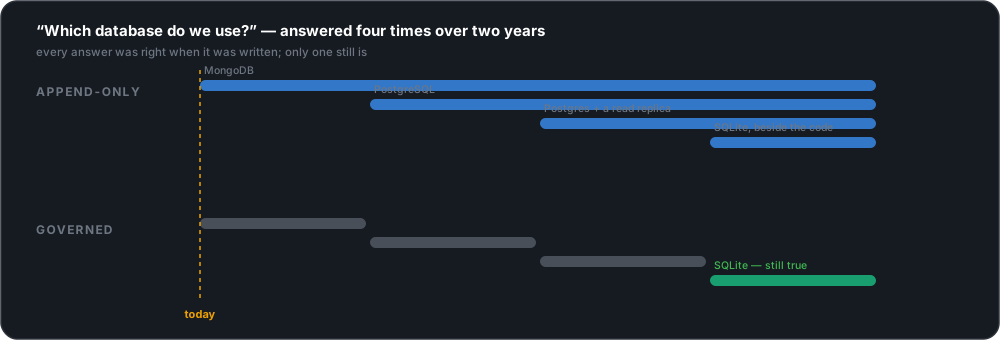
Most memory systems are append-only. Storing "we moved to SQLite" leaves "we use PostgreSQL"
active and retrievable, so the agent gets both and picks by rank. Knowl treats a same-subject write
as a correction: the predecessor is marked superseded, drops out of normal retrieval, and stays
queryable through knowl timeline.
That single behavior is most of the accuracy difference. On the MemoryAgentBench Conflict Resolution corpus — 455 facts, 100 questions about which fact is current, top-5 retrieval, no LLM reader:
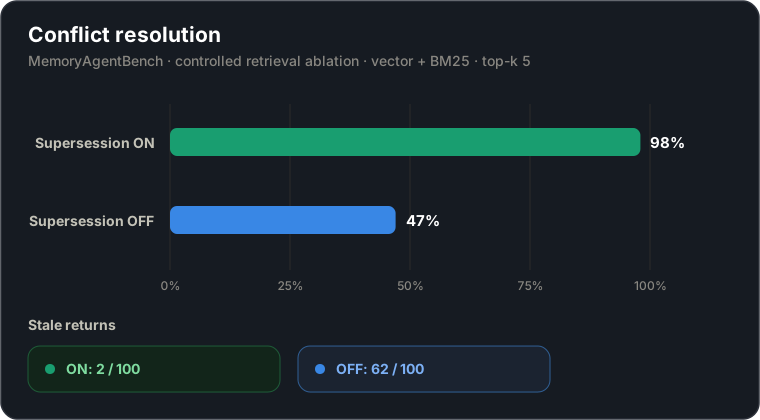
| Configuration | Top-1 | Stale returns | Active atoms |
|---|---|---|---|
| Supersession ON | 98.0% | 2 / 100 | 306 |
| Supersession OFF | 47.0% | 62 / 100 | 455 |
Same corpus, same ranker, same query path. The only variable is whether the outdated fact is still active. This is a retrieval-level measurement in Knowl's own harness: it asks whether the current fact comes back first, with no model in the loop.
Verified end-to-end, in the benchmark's own harness
Because a number you score yourself is worth less than one somebody else scores, the same claim was re-run inside MemoryAgentBench's harness, scored by its own code, with an LLM reading what Knowl returned — the harder, fully end-to-end setup, at the largest context the task offers:
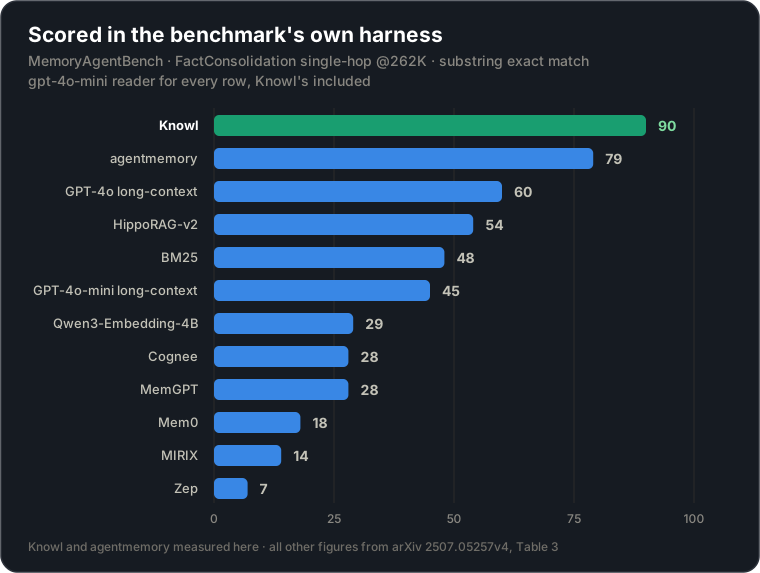
| System | FactConsolidation-SH @262K |
|---|---|
| Knowl | 90 |
| agentmemory | 79 |
| GPT-4o (long-context) | 60 |
| HippoRAG-v2 | 54 |
| BM25 | 48 |
| GPT-4o-mini (long-context) | 45 |
| Qwen3-Embedding-4B | 29 |
| Cognee | 28 |
| MemGPT | 28 |
| Mem0 | 18 |
| MIRIX | 14 |
| Zep | 7 |
18,332 facts, 100 questions, substring exact match. Every row uses gpt-4o-mini as the reader, Knowl's included — the paper states it for all RAG and memory agents, so these are like-for-like. Knowl and agentmemory were measured here; every other figure is from the MemoryAgentBench paper, arXiv 2507.05257v4, Table 3. agentmemory is not evaluated in that paper — its published numbers are LongMemEval-S retrieval recall, a different task — so it was run through the same harness with the same config, and both adapters share one reader code path so neither can drift from the paper's own RAG handler. Method, mechanism and reproduction steps: FINDINGS.md.
Otherwise shown are every commercial memory system the paper evaluates, plus the highest scorer from each baseline family. The paper's table has changed between versions — BM25 read 56 in v1 and reads 48 in v4 — so the version is cited, not just the table.
Knowl's 90 was measured 2026-08-08 and independently reproduced at 89.0 on 2026-08-19 with the
checked-in adapter; agentmemory's 79 is a single run. Every figure here is one run at
temperature: 0.7, and the ablation gap moved 4 points between two runs of the same 6k cell, so
read them to the point rather than the decimal.
Switching supersession off in that same harness drops Knowl to 73, and the gap holds across a 40× change in corpus size:
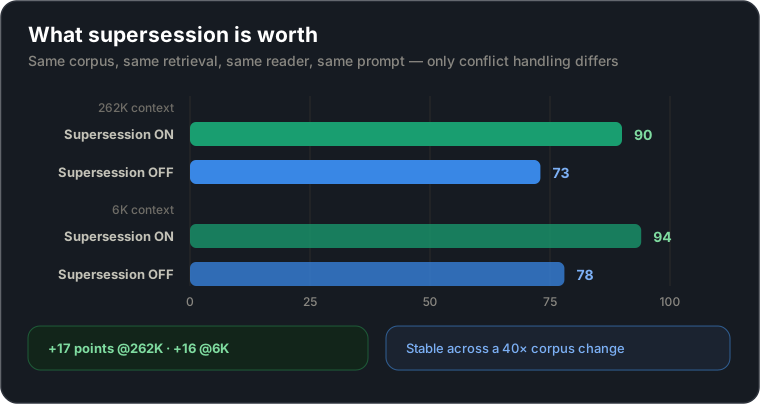
| Context | Supersession ON | OFF | Gap |
|---|---|---|---|
| 262K | 90 | 73 | +17 |
| 6K | 94 | 78 | +16 |
The two sections measure different things and are not comparable to each other: 98% is retrieval top-1 at 6K with no reader, 90 is end-to-end accuracy at 262K with one. Only the second is comparable to the published systems above. See benchmarks for the protocol, the checked-in results, and what the task does not cover — including multi-hop, where Knowl scores 7 against a 14-point retrieval ceiling.
Supersession is a correction, not a delete: the item, its assertions, and its history all survive.
Not a mock-up — the same sequence against the published CLI, recorded from
demo.tape:

Sharing memory across a team: knowl.cloud
Everything above is local and needs no account. knowl.cloud is the optional hosted layer for when one machine is not enough:
- Shared workspaces. Knowledge written in one checkout reaches teammates' agents, with each repository still owning what it publishes.
- Browser agents. claude.ai and chatgpt.com cannot run a local process, so they connect over a remote MCP endpoint with a token scoped to one workspace.
Local-only remains a first-class way to run Knowl. Nothing here is required to use anything above.
What gets stored
Every atom has exactly one of seven categories:
| Category | Use it for |
|---|---|
fact | Stable project truths, conventions, and verified behavior |
decision | A selected option with reasoning and alternatives |
goal | An intended outcome that guides future work |
constraint | A rule or boundary that must continue to hold |
architecture | How components are arranged and interact |
state | Current progress, readiness, blockers, or operational status |
skill | A reusable procedure or learned workflow description |
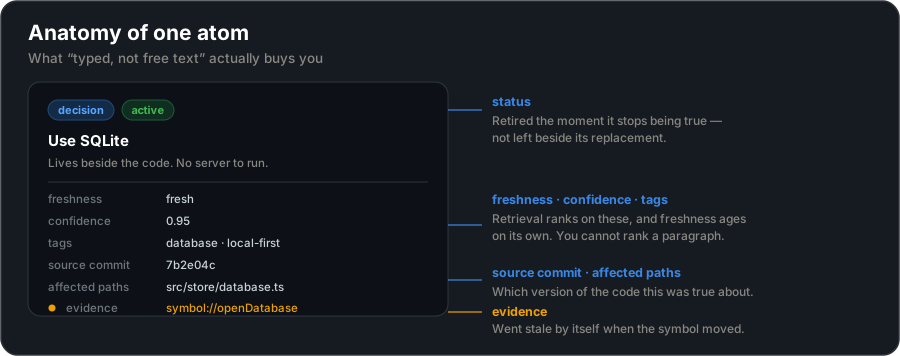
Alongside the content, each atom keeps a status (active, deprecated, rejected, archived,
superseded), a freshness flag, confidence, tags, source commit, affected paths, and optional
evidence pointing at files, commits, tests, commands, URLs, or indexed code symbols. File and
symbol evidence go stale on their own when the code moves, which is how an atom admits it may be
out of date instead of asserting a version of the repository that no longer exists.
What Knowl deliberately does not store is your conversations. Lifecycle capture records bounded events and summaries — never prompts, transcripts, stdout, or environment variables. Raw transcript search exists as an index you can switch off over files the host already wrote.
How agents use it
knowl serve exposes the store over stdio MCP; knowl init registers it for you. The workflow the
installed guidance asks agents to follow is short:
- Query memory with the words that name the subject before reading repository files.
- Use an active hit directly; inspect files only on a miss, conflict, or stale result.
- Store durable findings, stated goals, and recurring diagnoses as you go, and correct contradicted memory rather than duplicating it.
In practice that looks like this — a new session, no context, nothing pasted in:
You     why did we pick SQLite over Postgres?

Agent   → knowl_query "sqlite postgres database choice"
        ← decision · Use SQLite · active · fresh
          "Keeps storage repository-local and simple to operate."
          alternatives: PostgreSQL, MongoDB
          tags: database, local-first

        SQLite keeps the store repository-local and simple to operate.
        Postgres and MongoDB were both considered and rejected on that
        basis.
The agent answered before opening a single file, and it knew the options you rejected — which the code cannot tell it, because rejected alternatives leave no trace in a codebase.
| Host | MCP | Automatic lifecycle | Write gate | Capture nudge | Notes |
|---|---|---|---|---|---|
| Claude Code | Yes | Yes | Yes | Yes | Prompt guidance is installed as well |
| Codex CLI | Yes | Yes | Yes | Yes | Hooks need codex_hooks; not on Windows |
| GitHub Copilot | Yes | Yes | Yes | Yes | Reuses Claude Code's hook format |
| OpenHands | Yes | Yes | Yes | Yes | MCP entry is added by hand |
| Antigravity | Yes | Yes | Yes | Yes | Context rides injectSteps |
| Windsurf | Yes | Yes | Yes | Yes | Nudge rides MCP; no stop hook |
| Cursor | Yes | Yes | Yes | Yes | Finalizes per turn |
| Cline | Yes | Yes | No | Yes | Lifecycle via the shipped plugin |
| Hermes Agent | Yes | Yes | Yes | Yes | Python plugin, incl. Hermes Desktop; nudge via pre_verify on edit turns |
| Zed, JetBrains, Neovim, Kiro | Yes | Yes | No | Yes | Via knowl acp -- |
| Claude Desktop, OpenCode, Roo, … | Yes | No | No | Yes | MCP plus the manual work loop |
Full detail, and why each gap exists, in docs/hosts.md.
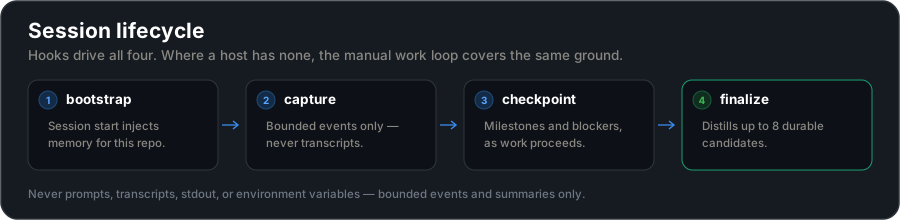
Where hooks are available, they own the session lifecycle: bootstrap context, capture, checkpoints,
and finalization happen without the agent being asked. Where they are not, knowl task run,
task start, task checkpoint, and task finish cover the same ground manually.
knowl init writes the MCP registration for every host it detects. To wire one by hand, the
entry is the same everywhere:
{
  "mcpServers": {
    "knowl": { "command": "knowl", "args": ["serve"] }
  }
}
Use knowl.cmd as the command on Windows. Codex reads the same entry under mcp_servers.
→ MCP tools and resources · Lifecycle reference
What Knowl is for
Knowl does one job: keep a project's settled knowledge accurate for the agents working on it. Not user preferences, not chat history — the decisions, constraints, and architecture a project runs on, and which of them are still true today. Most stores sit in a codebase, and the drift and evidence tooling is aimed there, but nothing in the knowledge model requires one.
Three choices follow from that:
- Typed, not free text. A decision carries reasoning and the alternatives you rejected. A
constraint is a rule that must keep holding. A
stateatom is expected to go out of date. Retrieval can rank on those differences; it cannot rank on paragraphs in a notes file. - Governed, not append-only. Status, freshness, provenance, conflict identity, and supersession let the store tell you that something stopped being true. That is the whole difference between memory and an ever-growing pile of notes.
- Repository-local, not a service. The database sits beside the project it describes. No account, no egress, no vendor between you and your own project history.
Knowl is deliberately not a personalization layer. It has no opinion about your users, and it keeps no transcripts of its own.
Features
Everything below works from the CLI and from any MCP-connected agent, against the same local database. No account, no server, no API key. Each item links into the full reference for the detail — and for the limits.
|
♻️ Knowledge that corrects itself Seven typed atom types, where a same-subject write retires its predecessor instead of sitting beside it. That one behavior is the 90-vs-73 difference. Evidence attached to a file or symbol goes stale by itself when the code moves.
|
🎯 Retrieval tuned for agents Vector-primary with a bounded BM25 fallback, reranked by freshness, status, and confidence, so the current answer wins rather than the merely similar one. The embedding model is local and optional — without it you still get keyword retrieval, and nothing leaves the machine.
|
|
⏱️ Work that survives the session On Claude Code, Codex, and Cursor, hooks own bootstrap, capture, checkpoints, and finalization without the agent being asked. A clean finish distills up to eight durable candidates. Park a workstream under a key and pick it up in any session, from any directory.
|
🔗 Workspaces Your API repo learned something the frontend repo needs. Link them and a query fans out, while each repository keeps its own database and its own ownership boundary. Open a shared peer atom in full by id, or finish that repo's work from here by naming it on the call. Knowledge a repo already holds is shared only when you promote it.
|
|
📦 Reusable procedures Package a procedure with its scripts under
|
💾 Your data, and getting it back Checksummed JSONL export and import with four explicit policies for when the same atom changed in two places. Restore verifies schema, size, SHA-256, and SQLite integrity before touching anything, and takes a pre-restore snapshot first.
|
|
🛰️ The sessions on this machine can see each other Twenty agents across four repos, and none of them knew the others existed — so two hit the same failure and both start fixing it, and a third upgrades the engine the rest are standing on. Knowl records what each session is on, what it wrote this turn, and which failure it has claimed, then says so before the second session starts the same fix. Every host with Knowl hooks is in it and they see each other, Codex beside Claude Code. Prints nothing when you are the only one running.
| |
The commands worth knowing on day one:
knowl query "auth design"              # search project memory
knowl list --unread                    # browse it — and see what nothing ever reads
knowl edit <item-id>                   # open one memory in the viewer to fix it
knowl state                            # the active memory, as a hierarchy
knowl conflicts                        # items that contradict each other
knowl timeline <item-id>               # every version an atom ever had
knowl context --token-budget 1500      # a fixed-size briefing for an agent
knowl pr --since origin/main           # knowledge your diff may invalidate
knowl fleet                            # every agent session live on this machine, and what it is on
knowl config list                      # every setting, its value, and how to change it
knowl doctor                           # setup, retrieval, and registration
Knowledge that corrects itself — seven typed atom types, and a write that retires what it replaces
- Seven atom types — listed above. Structure instead of one growing notes file.
- Automatic supersession — a same-subject write retires its predecessor. This is the
90-vs-73 difference above. It is guarded: an
automatic write (capture, ingest) never retires a verified fact, a write that leaves out an
exclusive item's key never retires that item, and a write that only drops the old fact's
values retires nothing. Those are kept side by side, and
knowl conflictslists them with every verified fact retired in the last 14 days. The rules - Conflict identity — mark an atom exclusive and Knowl refuses a second active answer to the
same question, instead of quietly holding both.
knowl conflicts - Full history — every version an atom ever had survives as an immutable assertion.
knowl timeline <item-id> - Time travel — ask what the project believed on a past date:
knowl query "auth design" --as-of 2026-01-01T00:00:00Z - Evidence — attach files, symbols, commits, tests, commands, or URLs to an atom. File and symbol evidence go stale by themselves when the code moves.
- Drift detection —
knowl pr --since origin/mainflags knowledge your diff may have invalidated, before you merge it, andknowl_driftasks the same question from inside the agent that wrote the branch. What it reports is a cited path that is gone, not one merely edited — that distinction is what keeps the signal readable. - The claims drift cannot reach — drift watches files, and about half the store cites none.
knowl statusdates those instead, by how long since anyone last restated them, and names the ones furthest past their own category's cadence. It ranks rather than flags: for prose there is no evidence a claim became false, only the absence of anyone reaffirming it. - Code intelligence — incremental Tree-sitter index over TypeScript, JavaScript, Python and Go, so
evidence can point at
symbol://locators, not just line numbers.knowl index-code - Secret-safe writes — every write is screened for detected secrets, sensitive paths, and oversized content before it lands. Long-lived memory is the last place a credential should end up.
Retrieval tuned for agents — the current answer wins, not merely the similar one
- Vector-primary ranking with a bounded BM25 fallback, reranked by freshness, status,
confidence, and recency — so the current answer wins, not merely the similar one. (This is the
agent/MCP path; a single-repo
knowl queryfrom the CLI is lexical.) - Runs offline. The embedding model is local and optional; without it you still get keyword retrieval. Retrieval never sends your query anywhere.
- Five bundled embedding presets, including a multilingual one covering 200+ languages, plus
customfor your own ONNX model.knowl config set-model <model> - Exact-identifier support — filenames, item IDs, and
symbol://locators still hit even when semantic similarity is weak. - Token-budgeted context packs — hand an agent a fixed-size briefing with constraints pinned
first, so non-negotiable rules never get truncated away:
knowl context --query "auth rollout" --token-budget 1500 - Usage feedback — agents report whether a result helped, and
knowl accessshows what is heavily used, what is stale, and what keeps causing corrections.
Work that survives the end of a session — hooks, work loops, handoff batons, and resume keys
- Automatic lifecycle on Claude Code, Codex, and Cursor — bootstrap, capture, checkpoints, and finalization happen through hooks without the agent being asked.
- Work loops for everything else —
knowl task start,checkpoint,finish, or wrap a single command withknowl task run "Run tests" -- npm test. - Promotion at session end — a clean finish distills up to eight durable candidates out of the
session, and a command that has succeeded three times becomes a
skillatom describing it. - Handoff — leave one baton for the next session in this repo. It is delivered once, then archived.
- Resume keys — park a workstream under a short key you keep, and pick it up in any session,
from any directory, any number of times later.
knowl resume <key> - Transcript search — on by default, and off means nothing exists on disk. With it on, past
session prose is searchable, so a memory miss degrades to a slower lookup instead
of amnesia. Keyword indexing keeps up on its own; semantic coverage is filled by
knowl reindex --transcripts, because an embedding model does not belong in a per-turn hook. - The recall gap — how often an agent edited a file this store already knew something about
without ever retrieving it. Invisible from inside a session, because an agent that never
retrieved an atom cannot notice the atom exists. Counted on every tool call, shown to nobody but
you, in
knowl status— and split between the main thread and subagents, because a subagent receives no prompt reminder and no server instructions, so its share is the only read you get on whether the bootstrap card alone carries the habit. - The write gate's own score — with change impact on, the gate that would refuse an edit to
code another session changed runs in shadow first, recording every refusal it withheld.
knowl statusprints the precision that produced, next to the bar it has to clear before it is allowed to block anything (≥95% over ≥40 adjudicated findings) — so the decision to arm it is made against a number instead of a hunch. Absent entirely until the gate has withheld something: a repo that never ran it has not scored 0%, it has measured nothing.
The sessions on this machine can see each other — one roster, on every host
The other half of the same problem: not one session across time, but several at once. Claude Code keeps a registry of its live sessions and lets one message another; it records nothing about what any of them is doing, and no other host records anything at all.
- A roster at session start — who else is running, grouped by repo, own repo first. Empty when you are alone, so a single-session user never sees a line about any of this.
- Every host with Knowl hooks is in it, and they see each other. A Codex session appears on a Claude session's roster and the reverse. Liveness comes from the host's own session registry where it publishes one, and from recency where it does not.
- "Another session is already on this problem" — two sessions never see byte-identical output, so failures are matched on a normalised signature rather than raw text, and a claim is keyed to the problem rather than the file. The card names the peer, its files, and the exact call to make; a bare announcement of a conflicting edit is measurably no better than saying nothing.
- A pre-flight before a shared surface moves — hooks, host settings, migrations, lock files,
and the
knowlinstall every other session's hooks are running on. Advice on a channel the agent already receives, never a refusal. - A stop-time nudge when this turn's writes invalidated a file another live session had read, joined through the read set rather than guessed. Shadow by default — it records what it would have said, because delivering it withholds a stop and that costs a turn.
- Only reachable peers are offered as something to message. A session on another host or under another config directory is listed and marked, and the card asks you instead — a card that told the agent to message a session it cannot address teaches it to skip the next one.
- Machine-level, not per-repo.
~/.knowl/fleet.db, beside the resume keys: a session in~/work/apiupgrading the engine is a fact~/work/webneeds.knowl fleetreads it from any terminal, inside a project or not. fleet.enabledships on, and so do the cards — the roster costs a directory listing and says nothing when you are alone, and a card is advice on a channel the agent already reads. What ships quiet is what would cost you something: the per-turn digest, and the stop-time nudge that withholds a stop.
Workspaces: many repos, one shared memory — you decide what each repo shares
Your API repo learned something the frontend repo needs. Link them, and a query fans out — while each repository keeps its own database and its own ownership boundary.
knowl workspace init product      # create the workspace
knowl workspace add product       # run inside each repo that joins it
                                  # ...or --default-visibility repo to keep its writes private

knowl workspace promote                               # pick what to share from a list
knowl workspace promote --category decision --apply   # or name it outright
Joining a workspace shares what the repo writes from then on, and says so when it does; pass
--default-visibility repo to decline. What the repo already knows is shared only when you
promote it. Peer results are labeled with the repo that owns them, and a shared one can be opened
in full by id — without its affectedPaths or evidence, which resolve against a checkout you are
not standing in. A peer that is missing or unreadable is skipped and disclosed, never a reason for
your local search to fail.
Writing into a sibling is deliberate rather than incidental. An agent names the repo on the call
and that one call runs as that repo — its store, its config, its ownership rules, stamped as
its own — exactly as cd-ing there has always behaved for the CLI. Name nothing and a foreign id
is refused as before. Either way a repo's private knowledge stays private until it is promoted.
Reusable procedures — file-backed skills you can inspect before they run
- File-backed skills — package a procedure with its scripts under
.knowl/skills/, then inspect it before it ever runs.knowl skill list·read·run - Global playbooks — a procedure that is the same everywhere lives once at
~/.knowl/skills/, and each repository supplies its own commands and paths through a binding in.knowl/config.json. A playbook and a binding are two keys: neither runs anything alone, an unbound playbook lists and reads but refuses to run, and a project skill of the same name shadows the global one. - What runs is shown before it runs — a manifest declares its
inputs, itscapabilitiesand fail-closedpreconditions(clean_worktree,on_branch:,command_exists:), an unrecognised precondition refuses rather than passing, and the run banner prints the fully resolved command. Approval is per set of bytes and re-checked every run; a repository cannot ship a skill and its own approval. Capabilities are declarations, not a sandbox, and say so. - Deterministic synthesis — roll several atoms into one architecture summary with no AI
provider involved:
knowl synthesize --scope storage
Your data, and getting it back — portable export, verified snapshots, and one doctor command
- Portable export/import — checksummed JSONL with four explicit divergence policies for when
the same atom changed in two places.
knowl export·knowl import --on-divergence newer - Verified snapshots —
knowl snapshot createwrites a checksum manifest; restore verifies schema version, size, SHA-256, and SQLite integrity before touching anything, and takes a pre-restore snapshot first. - Garbage collection that previews by default and protects anything recently used.
knowl gc knowl doctor— one command that checks setup, config, integrity, schema, retrieval, vector coverage, agent registration, and workspace health.- Optional AI — configure a provider for
knowl askand raw-text ingest. Every feature above works without one.
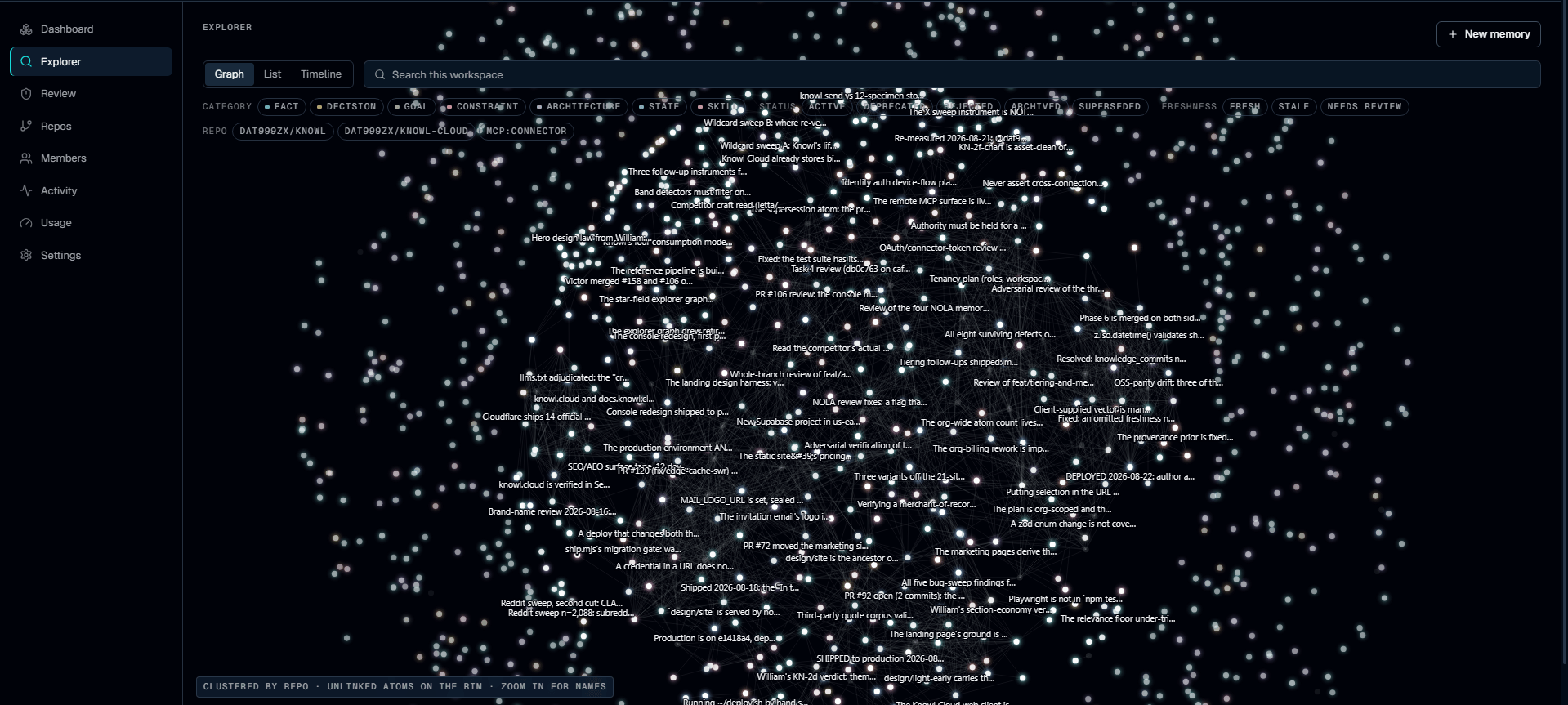
See it: the local viewer
knowl view starts an editor on 127.0.0.1 with a fresh access token per launch — knowing the
port is not enough to read anything, and writes additionally require the request to name this
viewer as its origin, so another page you happen to have open cannot write here.
knowl view
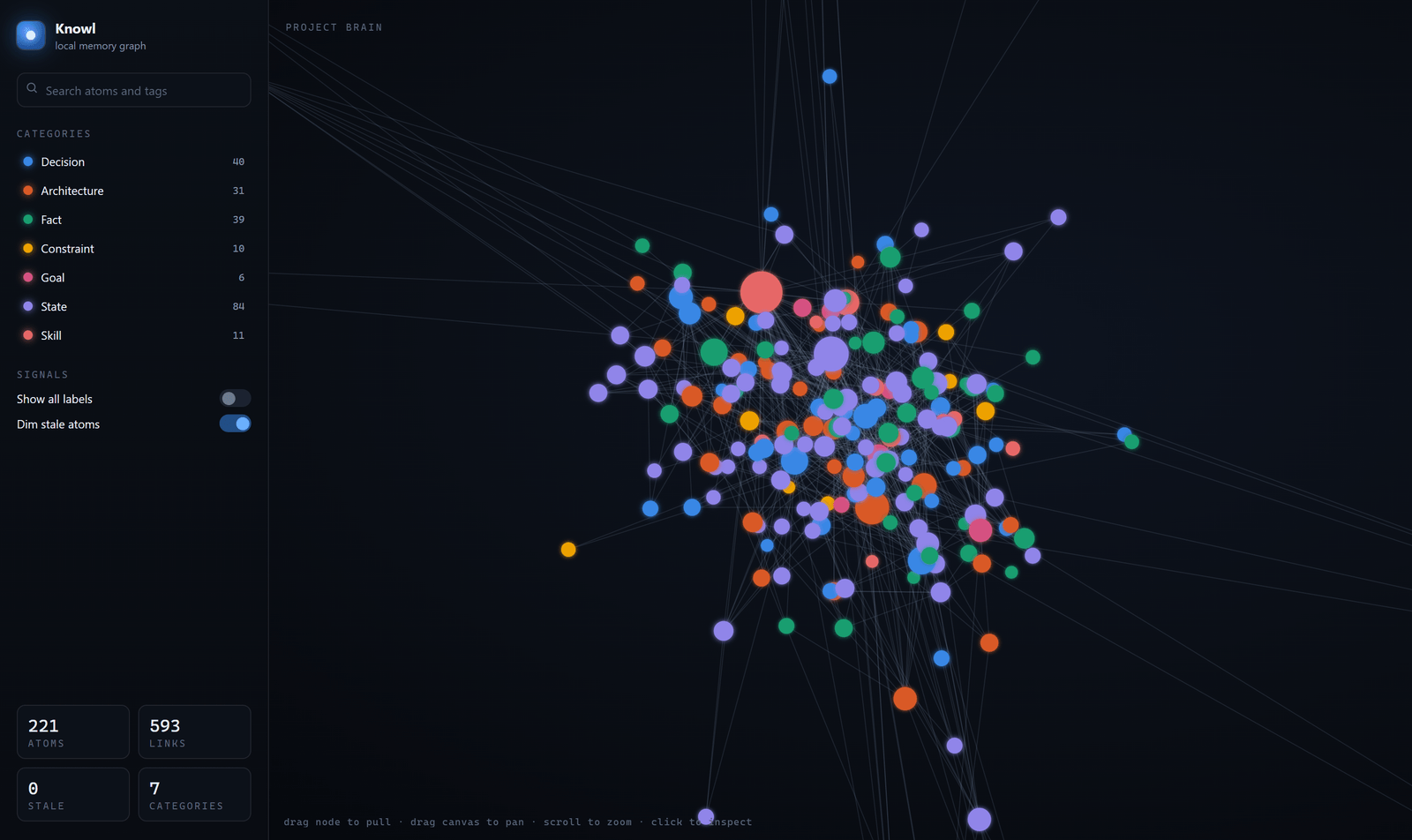
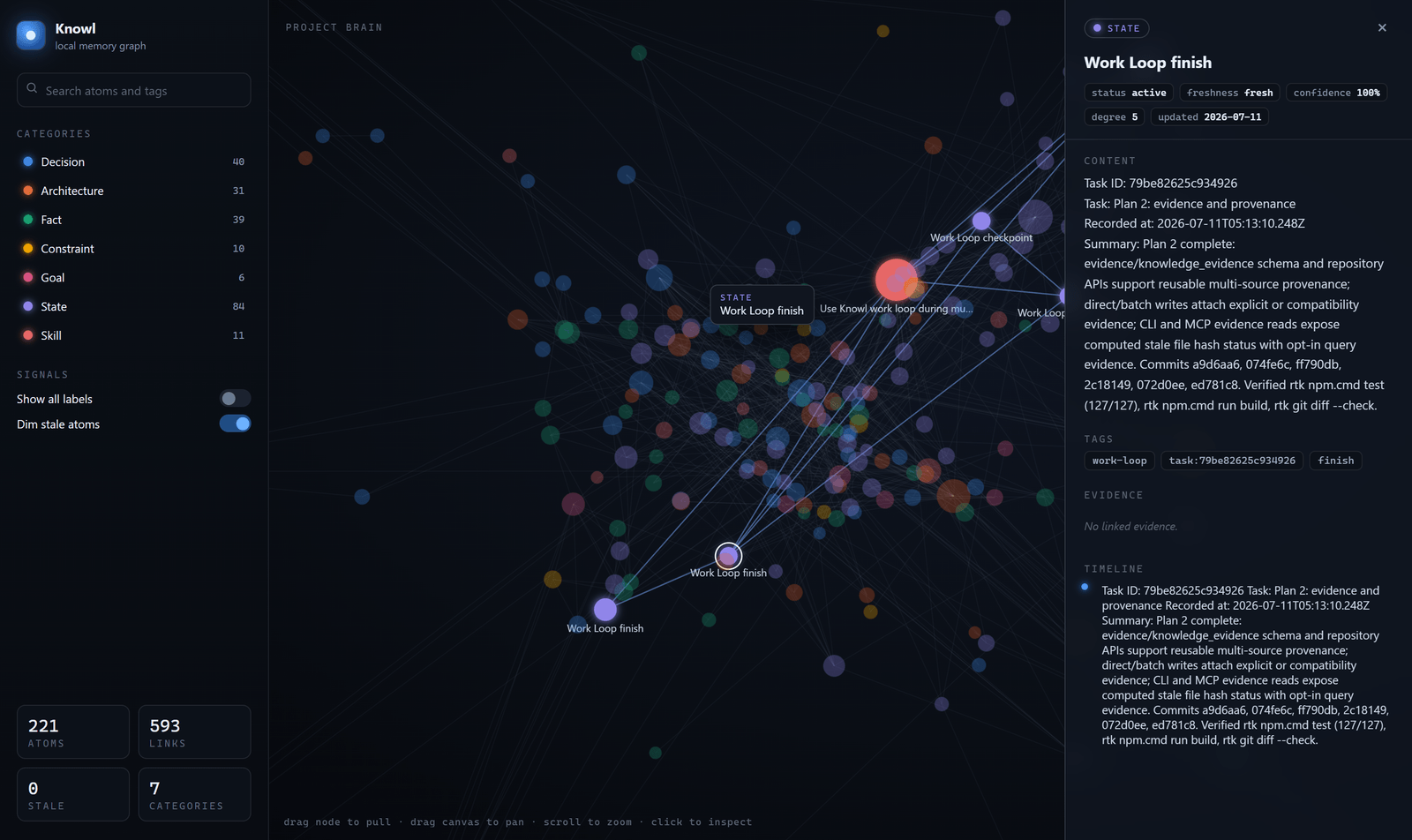
Leave it open while you work and it shows you the agent thinking. A retrieval lights the atoms
it answered with, in rank order, and drops the rest of the graph away. A write arrives on a cleared
stage. A retirement goes dark and stays dark. Each changed atom is captioned with what happened to
it — NEW, UPDATED, SUPERSEDED.
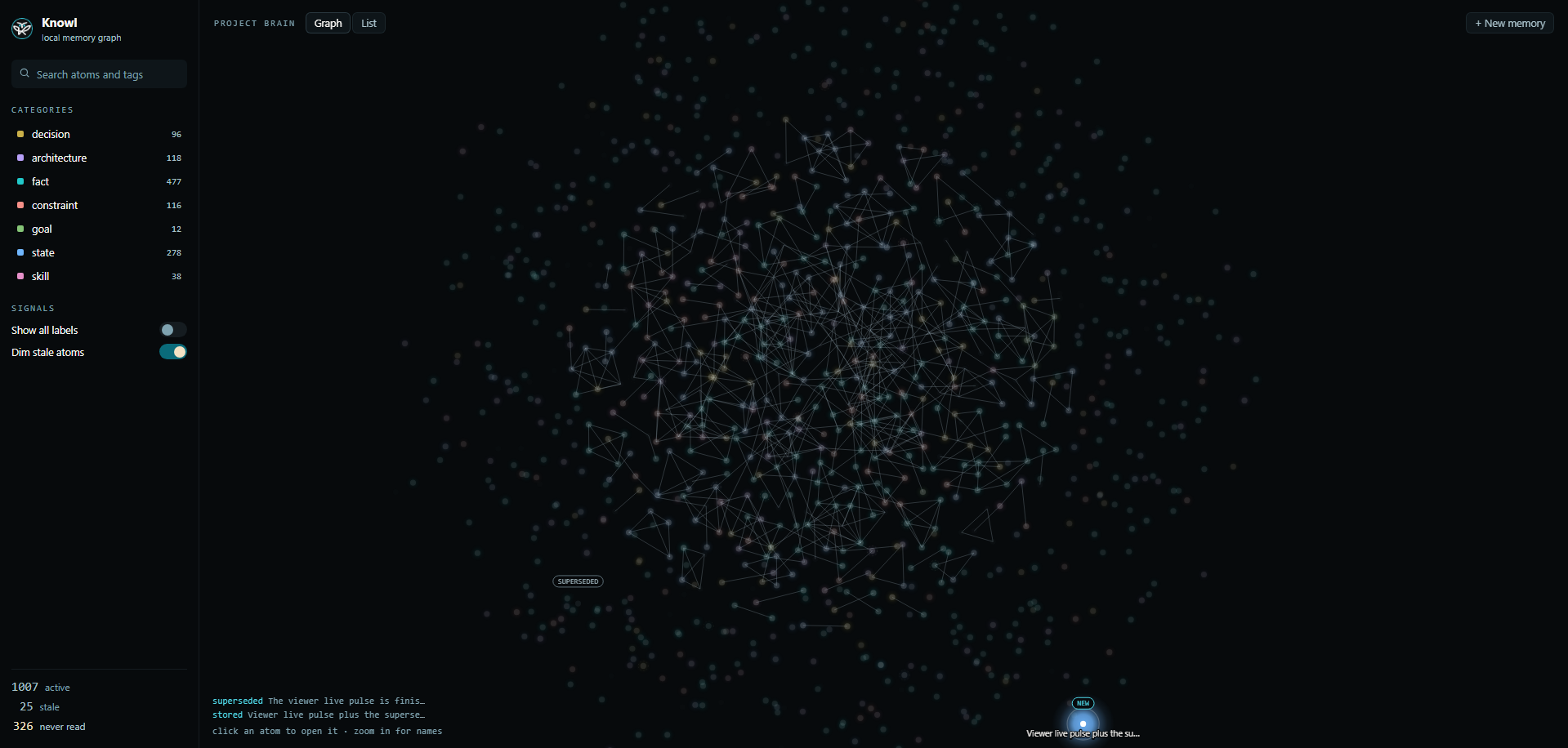
It watches the database rather than the agent, so it makes no difference which tool is working:
Claude Code, Codex, Cursor, or you running knowl query in another terminal all light the same
graph. Nothing was added to any write path to make this work, so when no viewer is open, none of
it runs.
This is also where you fix what your agents got wrong. Open any atom to read its evidence and timeline, then edit it, archive it, or write a new one by hand. Archiving is reversible — Restore is on the same panel. Retired atoms stay on the graph as dark points: they are the history, and they no longer claim to be current.
Beside the graph there is a list, with a lens for what nothing has ever read. That one earns
its place: search only reaches memory you already suspect exists, and an atom carrying no
information is precisely the one nobody thinks to look for. Sorted oldest-first, it surfaces on its
own. knowl list --unread asks the same question from the terminal.
The graph links atoms only through tags few atoms share — a tag on dozens of them is a category, and the rail already filters by those. An atom nothing else is about stays unlinked rather than being tied to an arbitrary neighbour. It is a navigation aid, not a causal or evidence graph. It shows full local content across every status, so loopback binding is the privacy boundary: do not put it behind a public proxy or tunnel.
Memory that is true of you, not of a repository
Some things belong to no repository: that you prefer pnpm, that this machine's driver breaks on
CUDA 12, that every project here uses conventional commits. Knowl keeps those in a machine-wide
store at ~/.knowl/global.db, separate from any project's memory.
knowl link global        # this project may read and write it; reversible with --off
knowl store "I prefer pnpm over npm" --title "Package manager" --category constraint --namespace global
Your project always answers first. Linking never changes what a repository says about itself — global entries sit behind the project's own, and can never crowd them out. And a session with no repository at all, such as a Hermes Desktop window with no folder open, reads the global store alone rather than having no memory. A project that exists but fails to open stays an error: global is personal defaults, never a fallback for a broken store.
It follows you to another machine. The machine store syncs to a cloud workspace the same way a project does — it is not a project, but it is addressed like one:
knowl cloud connect --global # then push and pull with --global
Run any knowl cloud command outside a repository and it uses the machine store on its own,
saying so. That inference is narrow on purpose: only when there is no project above the directory
at all. A project whose config will not parse is an error about that project, never quietly
answered from your personal defaults.
→ Memory namespaces and the global layer
Everything else
28 MCP tools (plus 3 when transcript search is on, 1 when connected to a cloud workspace, 2 when linked into a local workspace, 1 when change impact is on, 1 for fleet awareness unless it is switched off, and 1 when hooks run over MCP)
and two resource URIs · the
complete CLI, from knowl status to knowl audit · a read-only integrity audit ·
retrieval evaluation you can run yourself against the checked-in governance and 500-case
regression suites with knowl eval.
→ CLI reference · MCP tools · Benchmarks
Requirements and local data
Node.js 22 or later. Everything Knowl writes for a project lives under .knowl/, which knowl init
adds to .gitignore:
| Path | Holds |
|---|---|
.knowl/config.json | Project, search, security, AI, and workspace configuration |
.knowl/knowl.db | Atoms, assertions, knowledge commits, full-text index, feedback, embeddings |
.knowl/skills/ | File-backed skill packages |
A little lives beside your home directory instead, under ~/.knowl/, because it is true of the
machine rather than of any one repository: the machine-wide personal-defaults store
(~/.knowl/global.db), resume keys, the fleet's record of the sessions running right now, your cloud
credential, and the local mirror of a cloud workspace. Workspace manifests live outside member
repositories for the same reason — their checkout paths are machine-local. Exports and snapshots are
written only when you ask for them.
Documentation
Everything above is the summary. The full reference is one document covering every subsystem in depth — including the parts that are deliberately limited, which is usually what you actually need to know.
| If you want to know… | Go to |
|---|---|
| What an atom is, and what each field means | Knowledge model |
| How a query is ranked, and what wins ties | Retrieval and context |
| What a hook records, and when | Tasks, sessions, lifecycle |
| What the other sessions on this machine are doing | The fleet |
| How an atom notices the code moved | Evidence and drift |
| How several repos share memory safely | Workspaces |
| How a procedure becomes reusable | Skills and synthesis |
| How to export, snapshot, or restore | Portability and maintenance |
| How to read, correct and add memory by hand | Local viewer |
| How the pieces fit, and where the trust boundaries are | Architecture |
| How to wire a specific host | Agent setup |
| How the numbers on this page were measured | Benchmarks |
| Every command and every flag | CLI reference |
| Every MCP tool and resource | MCP tools |
| What needs a provider, and what never does | Optional AI |
| Exactly what lands on disk | Local data |
Contributing
See CONTRIBUTING.md for setup, the checks to run before a pull request, and the conventions this codebase follows. Contributors are asked to agree to the Contributor License Agreement once, on their first pull request.
License
Knowl is licensed under the Apache License 2.0. Apache-2.0 does not grant trademark rights.
