health-os
Conservez votre dossier de santé personnel dans votre propre Postgres local et laissez n’importe quel client MCP (y compris les modèles locaux) travailler avec : mettez en scène et approuvez les résultats de laboratoire à partir de PDF, suivez les tendances, les médicaments, les diagnostics, les appareils portables et un journal alimentaire avec un profil de 41 nutriments. Les règles de sécurité sont un code déterministe, pas un jugement LLM : alertes de valeurs critiques, données de laboratoire en attente d’approbation, refus d’interactions médicamenteuses et un protocole de crise.
Documentation
health-os

Local-first personal health record, exposed over MCP. Your labs, diagnoses, medications, wearable data and food log live in your own Postgres; any MCP client — one running a local model or a cloud assistant — can read and update them through guarded tools. Critical values, drug-safety rules and screening schedules are deterministic code, not LLM judgement.
Medical disclaimer. This is not a medical device and does not give medical advice. Critical-value alerts and screening reminders are only a signal to contact a doctor — never a diagnosis and never a reason to delay care. Use at your own risk.
What it does
- Lab results — drop a PDF or photo into your MCP client; the model extracts the values, health-os normalizes names (uk/ru/en/Latin synonyms) and units, and stages the panel as pending. Nothing counts as fact until you approve it.
- Safety net in code — critical values alert immediately (log, macOS notification, optional Telegram); critical findings in narrative reports are flagged; drug-interaction questions are refused and redirected to a doctor/pharmacist (only deterministic checks run: total daily paracetamol across products, biotin before lab tests); a crisis tool returns a fixed response with hotlines, independent of the model.
- Trends and analytics — Mann-Kendall trends, personal baselines and anomalies, age-gated risk calculators, a screening calendar, a weekly report, a doctor-visit brief.
- Food log — meals with a 41-nutrient profile, %RDA, deficiency/excess flags, meal templates.
- Devices — Apple Health export and Garmin import.
- 28 MCP tools + server instructions — the safety rules are sent to every client on connect; see mcp_server/README.md.
Try it in one command
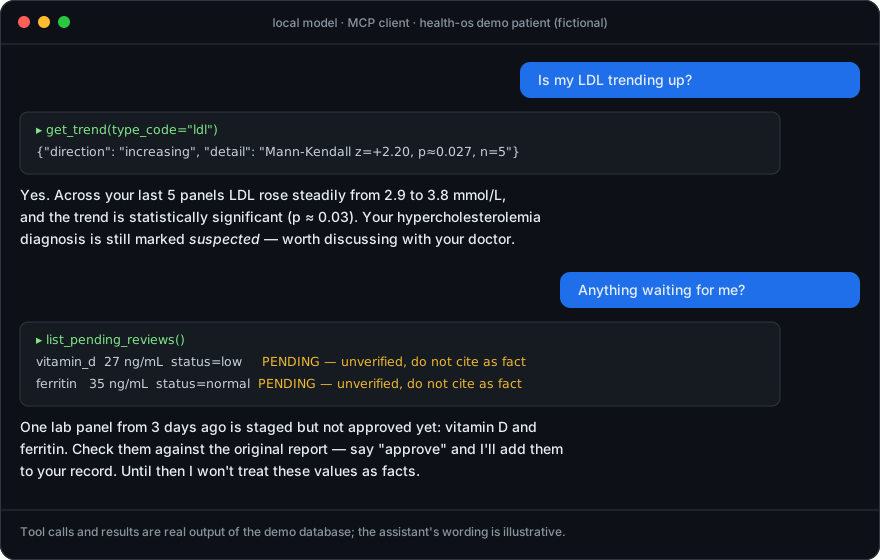
Only Docker needed. Starts a throwaway database with a fictional patient — two years of labs (LDL creeping up), blood pressure, medications, a food log and a lab panel awaiting approval:
git clone https://github.com/andronaft/health-os && cd health-os/demo
docker compose up -d --build
Point your MCP client at it:
{
  "mcpServers": {
    "health-os-demo": {
      "command": "docker",
      "args": ["run", "-i", "--rm", "--network", "health-os-demo",
               "-e", "DATABASE_URL=postgresql+psycopg://health:demo@db:5432/health_os",
               "health-os:local"]
    }
  }
}
Ask "show my health summary", "is my LDL trending up?", "what's pending review?",
"what am I short on nutritionally?". Remove it all with docker compose down -v.
Install for your own data
Requires Docker and Python 3.12+.
git clone https://github.com/andronaft/health-os && cd health-os
cp .env.example .env                  # set the passwords
docker compose up -d db               # Postgres 16 + pgvector
python3 -m venv .venv && .venv/bin/pip install -e ".[dev]"
.venv/bin/alembic upgrade head        # schema
.venv/bin/python -m seed.load         # marker catalog, synonyms, units, nutrients
.venv/bin/python -m seed.demo         # optional: a fictional demo patient to play with
Then connect an MCP client — config for LM Studio, Open WebUI, Ollama CLI and Claude is in mcp_server/README.md. Try: "show my health summary", "LDL trend", "what am I short on nutritionally this week?".
Local models: the server speaks standard MCP over stdio, so any MCP client that runs a local model can use it. Verified so far: the server itself with the official MCP Python client (CI + the Docker demo). Not yet verified end-to-end with a local model — see #9; reports welcome.
How it works
MCP client (local or cloud model)
        │ stdio
   mcp_server/  ── read tools ──▶ approved views (read-only role, 5s timeout, row limits)
        │        ── write tools ─▶ core/services: normalize → status → critical rules → pending
        │
   safety/    critical values, narrative flags, interactions, crisis, alerts
   analytics/ trends, baselines, calculators, screening, nutrition, weekly report
        │
   PostgreSQL 16 + pgvector  ◀── ingestion/ (Apple Health, Garmin, embeddings)
| Directory | What's inside |
|---|---|
core/ | config, DB, normalization, services, dedup, health summary |
mcp_server/ | MCP server, read and write tools |
safety/ | deterministic safety rules and alert delivery |
analytics/ | trends, baselines, calculators, screening, nutrition, reports |
ingestion/ | extraction schema, confidence scoring, device importers, embeddings |
migrations/ | Alembic schema |
seed/ | reference catalog + the demo patient |
evals/ | red-team scenarios (injections, hidden critical values, unit tricks) |
scripts/ | backup/restore (restic + launchd), read-only role setup, importers |
Privacy / local-first
- Your data stays in your own database. Postgres runs locally in Docker;
data/and.envare outside git. Nothing is sent anywhere by health-os itself. - What leaves the machine depends on the MCP client you connect. With a local model (LM Studio, Open WebUI + Ollama, …) nothing does. With a cloud assistant, whatever the tools return is sent to that provider — use one whose terms fit medical data (no training on your data, zero/short retention).
- The goal is fully local: local models for chat and extraction, local embeddings for search (already supported via fastembed). Cloud clients remain optional.
- Optional alert channel (Telegram) sends only a generic "check your health system" text, never values.
- Encrypt the disk (FileVault / LUKS / BitLocker) — the database files are plaintext at rest.
- Never put real medical data in issues, PRs or tests — synthetic data only.
Tests
make test              # everything (needs Postgres for the integration part)
make test-unit         # pure unit tests — no database needed
make test-integration  # only tests marked `integration`
Integration tests never touch the working database: tests/conftest.py drops and recreates
<POSTGRES_DB>_test on the same server (migrations + seed) on every run. Override with
TEST_DATABASE_URL (the name must end in _test). Without Postgres, integration tests are
skipped locally; CI sets REQUIRE_DB=1 so they fail instead.
Development history: PROGRESS.md.
License
AGPL-3.0-or-later. You may use, modify and fork health-os; if you distribute it or run a modified version as a network service, you must publish your source under the same license.
Want to use it in a closed-source or commercial product without those obligations? A separate commercial license is available from the author — reach out via GitHub (@andronaft).
Contributions are welcome — see CONTRIBUTING.md (includes a short CLA).