Mnemory
Un sistema de memoria autogestionado, seguro y rico en funciones para agentes y asistentes de IA. Proporciona extracción inteligente de hechos y deduplicación, con un almacén de artefactos para contenido detallado.
Documentación
mnemory
Dale a tus agentes de IA memoria persistente. mnemory es un servidor MCP autoalojado que añade personalización y memoria a largo plazo a cualquier asistente de IA — Claude Code, ChatGPT, Open WebUI, Cursor, o cualquier cliente compatible con MCP.
Conecta y listo. Conecta mnemory y tu agente empieza inmediatamente a recordar preferencias del usuario, hechos, decisiones y contexto entre conversaciones. No necesitas cambiar el prompt del sistema.
Autoalojado y seguro. Tus datos permanecen en tu infraestructura. Sin dependencias en la nube, sin acceso de terceros a tus memorias.
Inteligente. Usa un pipeline unificado de LLM para extracción de hechos, deduplicación y resolución de contradicciones en una sola llamada. Las memorias son buscables semánticamente, se categorizan automáticamente y expiran de forma natural cuando ya no son relevantes.
Características
- Cero configuración —
uvx mnemory, conecta tu cliente MCP, listo. Funciona de inmediato con cualquier API compatible con OpenAI. - Extracción inteligente — Una sola llamada al LLM extrae hechos, clasifica metadatos y deduplica contra memorias existentes.
- Resolución de contradicciones — "Conduzco un Skoda" + luego "Compré un Tesla" = actualización automática, no un duplicado.
- Memoria de dos niveles — Resúmenes rápidos y buscables en un almacén vectorial + almacenamiento detallado de artefactos (informes, código, investigación) recuperado bajo demanda.
- Búsqueda impulsada por IA — Búsqueda semántica multi-consulta con conciencia temporal. Pregunta "¿Qué decidí la semana pasada sobre la base de datos?" y encuentra las memorias correctas.
- Comprobaciones de salud de memoria — Verificador de consistencia integrado en tres fases (fsck) detecta duplicados, contradicciones, problemas de calidad e inyección de prompts. Ejecútalo manualmente o en un horario con corrección automática.
- Soporte para 10+ clientes — Claude Code, ChatGPT, Open WebUI, OpenClaw, Cursor, Windsurf, Cline, OpenCode y más. Plugins nativos disponibles para recordar/recuperar automáticamente.
- Interfaz de gestión integrada — Panel de control, búsqueda semántica, navegador de memorias con CRUD completo, visualización de grafos de relaciones e interfaz de comprobación de salud. No se necesitan herramientas adicionales.
- Listo para producción — Qdrant para vectores, S3/MinIO para artefactos, autenticación con clave API o JWT de Cognis, aislamiento por usuario, HTTP sin estado compatible con Kubernetes.
- Seguro por defecto — Autenticación con clave API o JWT de Cognis con vinculación de identidad a nivel de sesión, aislamiento de memoria por usuario, salvaguardas anti-inyección en los prompts de extracción.
- API REST + MCP — Interfaz dual con el mismo backend. 16 herramientas MCP + API REST completa con especificación OpenAPI. Crea plugins, integraciones o úsalo directamente.
- Monitoreo Prometheus — Endpoint
/metricsintegrado con contadores de operaciones y medidores de memoria. Panel de Grafana preconstruido incluido.
Inicio rápido
mnemory necesita una clave API compatible con OpenAI para LLM y embeddings. La toma de OPENAI_API_KEY de tu entorno automáticamente.
uvx mnemory
Si uvx reporta No module named 'mcp.server.fastmcp', actualiza uv. Las versiones antiguas de uv
en Alpine pueden ignorar la restricción de dependencia MCP v1 de mnemory. Hasta
que actualices uv, ejecuta:
uvx --with "mcp<2" mnemory
Eso es todo. mnemory se inicia en http://localhost:8050/mcp, almacena datos en ~/.mnemory/.
Ahora conecta tu cliente — para Claude Code, añade a tu configuración MCP:
{
  "mcpServers": {
    "mnemory": {
      "type": "streamable-http",
      "url": "http://localhost:8050/mcp",
      "headers": {
        "X-Agent-Id": "claude-code"
      }
    }
  }
}
Inicia una nueva conversación. La memoria funciona automáticamente.
También disponible mediante Docker, pip, o configuración de producción con Qdrant + S3. Consulta la guía completa de inicio rápido para más clientes y opciones.
Capturas de pantalla
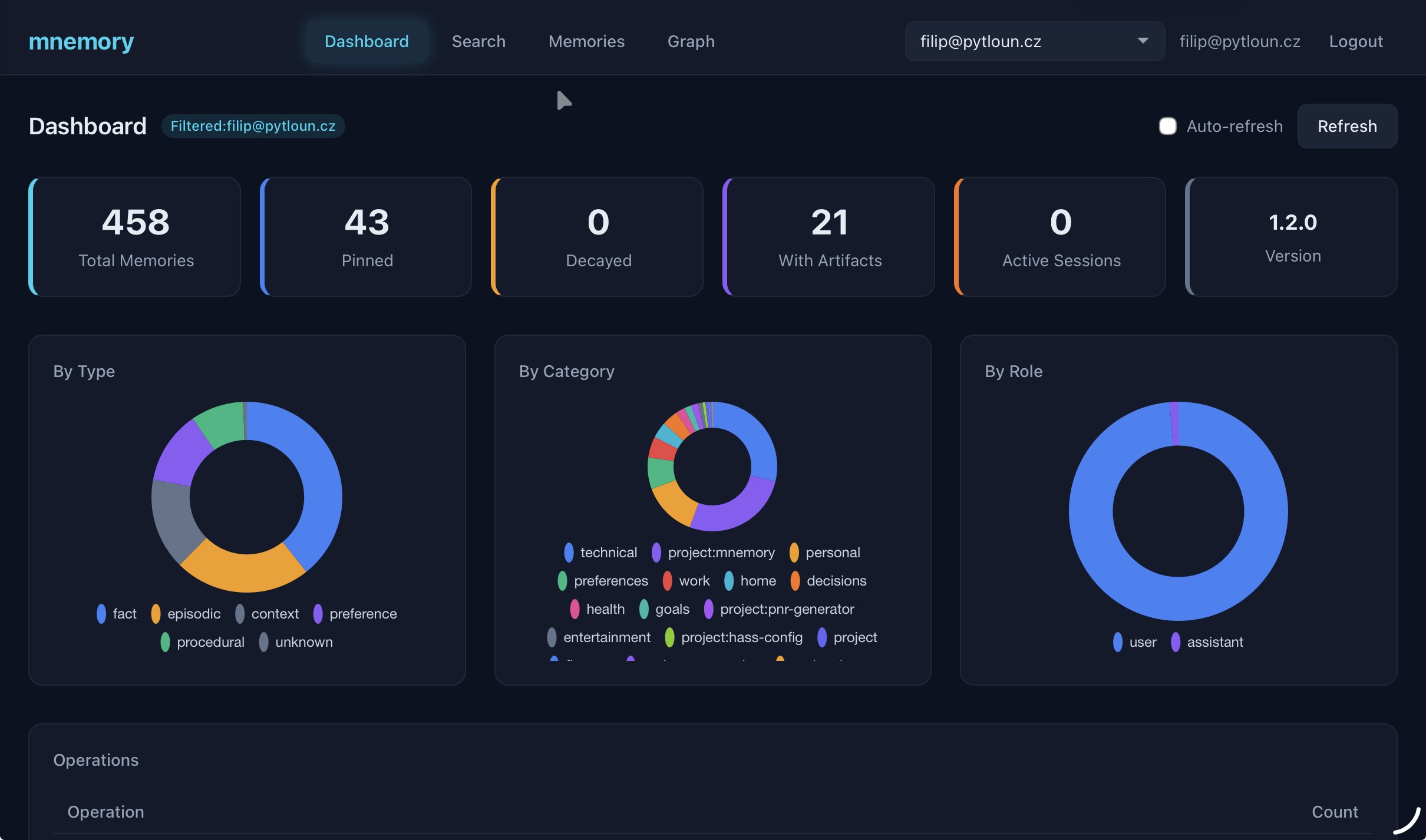
Panel con desgloses de memoria por tipo, categoría y rol
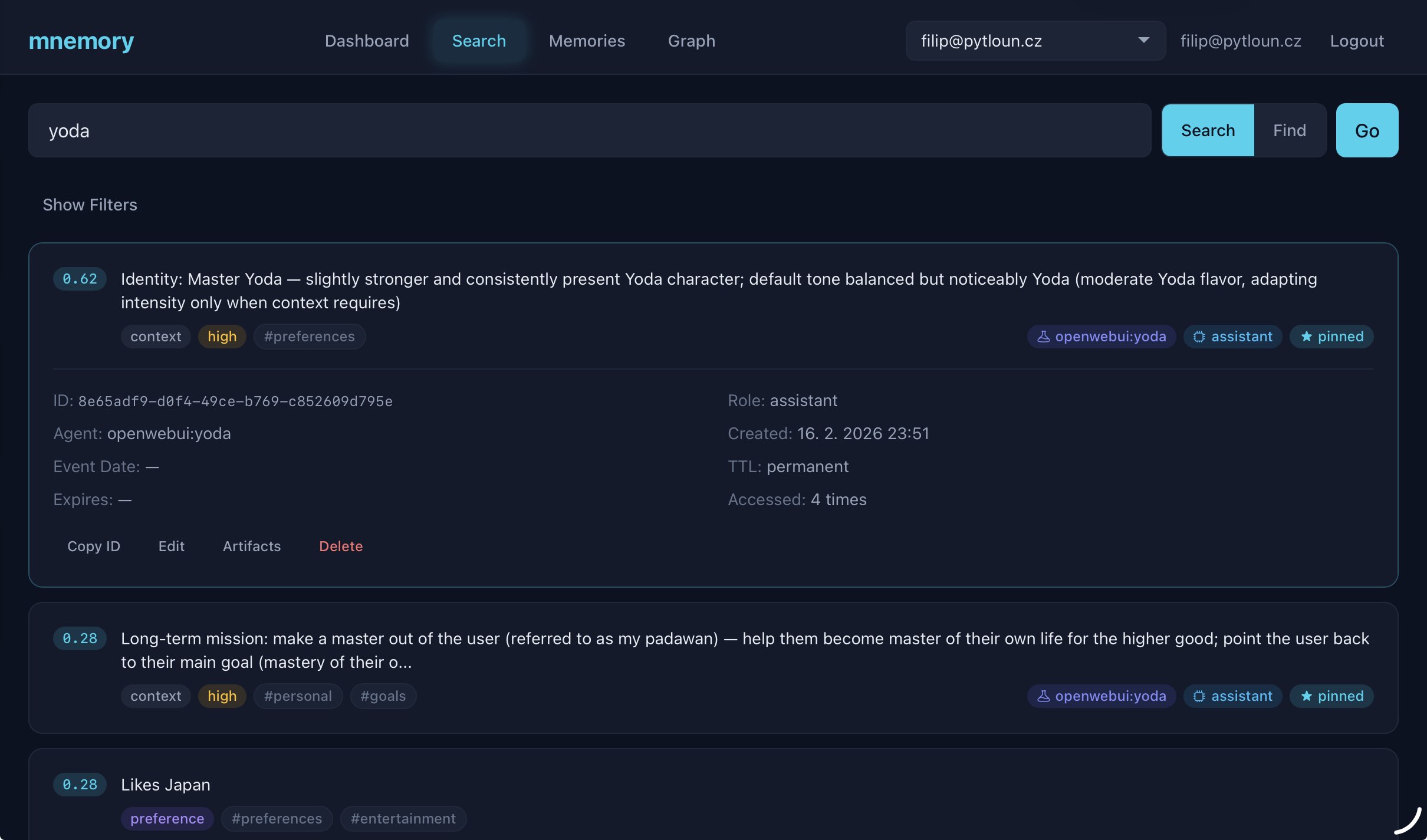
Búsqueda semántica y búsqueda impulsada por IA con filtros
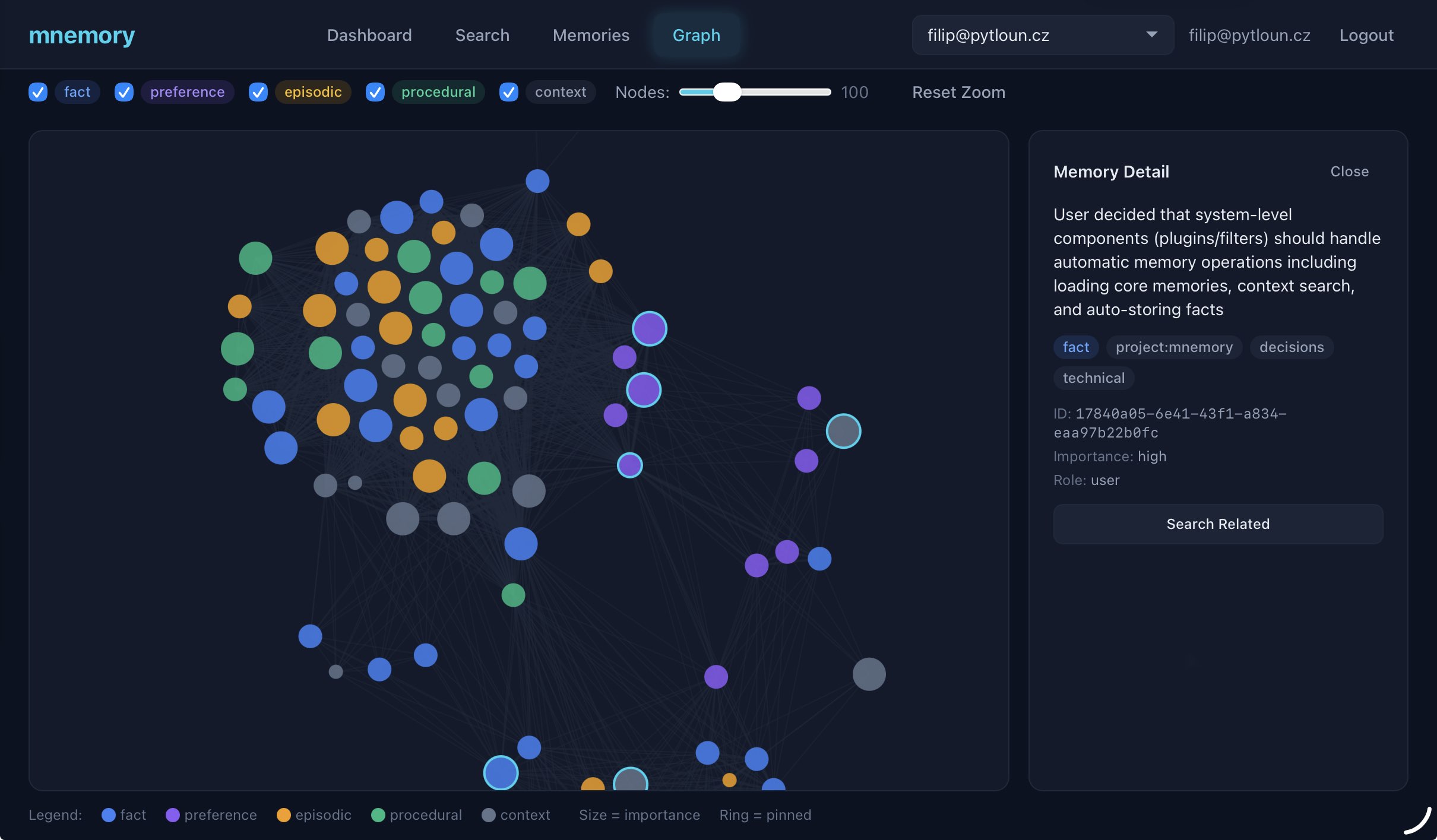
Visualización del grafo de relaciones de memoria
Consulta todas las capturas de pantalla y características de la interfaz, incluidos el navegador de memorias, comprobaciones de salud y gestión de artefactos.
Clientes compatibles
mnemory funciona con cualquier cliente compatible con MCP. Algunos clientes también tienen plugins dedicados para recordar/recuperar automáticamente.
| Cliente | MCP | Plugin | Guía de configuración |
|---|---|---|---|
| Claude Code | Sí | Sí (hooks) | Guía |
| ChatGPT | Sí (conector MCP) | -- | Guía |
| Claude Desktop | Sí | -- | Guía |
| Hermes Agent | Sí | Sí (plugin) | Guía |
| Open WebUI | Sí | Sí (filtro) | Guía |
| OpenCode | Sí | Sí (plugin) | Guía |
| OpenClaw | Sí | Sí (plugin) | Guía |
| Cursor | Sí | -- | Guía |
| Windsurf | Sí | -- | Guía |
| Cline | Sí | -- | Guía |
| Continue.dev | Sí | -- | Guía |
| Codex CLI | Sí | -- | Guía |
MCP = funciona mediante el Protocolo de Contexto de Modelo (llamadas a herramientas impulsadas por LLM). Plugin = integración dedicada con recordar/recuperar automático (sin necesidad de llamadas a herramientas LLM).
Cómo funciona
Almacenamiento: Compartes información de forma natural. mnemory extrae hechos individuales, los clasifica (tipo, categoría, importancia), comprueba duplicados y contradicciones contra memorias existentes y los almacena como vectores buscables — todo en una sola llamada al LLM.
Búsqueda: Haz una pregunta y mnemory genera múltiples consultas de búsqueda que cubren diferentes ángulos y asociaciones, las ejecuta en paralelo y reordena los resultados por relevancia. Con conciencia temporal — "¿qué decidí la semana pasada?" simplemente funciona.
Recuperación: Al inicio de la conversación, tu agente carga memorias fijadas (hechos centrales, preferencias, identidad) más contexto reciente. Durante la conversación, las memorias relevantes se encuentran automáticamente según lo que estás discutiendo.
Mantenimiento: Las memorias tienen TTL configurable — el contexto expira en 7 días, las memorias episódicas en 90. Las memorias accedidas con frecuencia permanecen activas (refuerzo). El verificador de salud integrado detecta y corrige duplicados, contradicciones y problemas de calidad.
Aprende más en la documentación de arquitectura.
Benchmark
Evaluado en el benchmark LoCoMo — 10 diálogos de múltiples sesiones con 1540 preguntas de QA en 4 categorías:
| Sistema | single_hop | multi_hop | temporal | open_domain | General |
|---|---|---|---|---|---|
| mnemory | 63.1 | 53.1 | 74.8 | 78.2 | 73.2 |
| mnemory (gpt-oss-120b) | 66.3 | 59.4 | 68.5 | 73.8 | 70.5 |
| Memobase | 70.9 | 52.1 | 85.0 | 77.2 | 75.8 |
| Mem0-Graph | 65.7 | 47.2 | 58.1 | 75.7 | 68.4 |
| Mem0 | 67.1 | 51.2 | 55.5 | 72.9 | 66.9 |
| Zep | 61.7 | 41.4 | 49.3 | 76.6 | 66.0 |
| LangMem | 62.2 | 47.9 | 23.4 | 71.1 | 58.1 |
Configuración: gpt-5-mini para extracción, text-embedding-3-small para vectores. gpt-oss-120b mediante Groq es una alternativa económica a ~5x menor costo con calidad comparable. Consulta la documentación de configuración para opciones de modelos y benchmarks/ para reproducción.
Documentación
| Documento | Descripción |
|---|---|
| Inicio rápido | Ponte en marcha en 5 minutos con cualquier cliente |
| Configuración | Todas las variables de entorno — LLM, almacenamiento, servidor, comportamiento de memoria |
| Modelo de memoria | Tipos, categorías, importancia, TTL, roles, alcance, sub-agentes |
| Herramientas MCP | 16 herramientas MCP — CRUD de memoria, búsqueda, artefactos |
| API REST | API REST completa, pipeline fsck, endpoints de recordar/recuperar |
| Arquitectura | Diagrama del sistema, flujos detallados para almacenar/buscar/recuperar |
| Interfaz de gestión | Capturas de pantalla, características, acceso, desarrollo de interfaz |
| Monitoreo | Métricas Prometheus, panel de Grafana |
| Despliegue | Configuración de producción, Docker, autenticación, Kubernetes |
| Desarrollo | Compilación, pruebas, linting, contribuciones |
| Guías de clientes | Instrucciones de configuración por cliente (10 clientes) |
| Prompts del sistema | Plantillas para agentes de personalidad y configuraciones personalizadas |
Licencia
Apache 2.0