DOS Kernel
DOS ist ein kleiner Open-Source-Kernel, der Ihren KI-Agenten nicht vertraut: Er überprüft, was tatsächlich aus Git-Nachweisen ausgeliefert wurde, schlichtet Dateikollisionen zwischen parallelen Agenten und lehnt mit strukturierten Gründen ab.
Dokumentation
DOS — the Dispatch Operating System
Catch your AI agents when they lie about what they shipped.






📊 See it run on real repos: the scoreboard scores 15 popular AI-built repos (roborev, open-interpreter, crewAI, autogen, …) — how much agents wrote, which ones, and whether each commit's claim is backed by its own diff. Score yours:
dos commit-audit --sweep --workspace . BASE..HEAD.
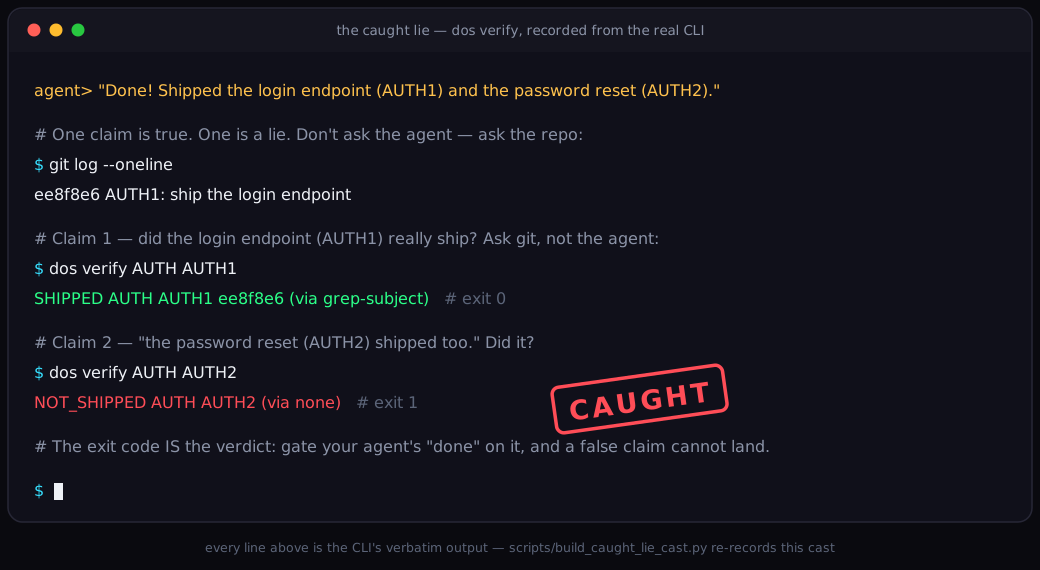
The whole pitch in one recording: the agent claims two features shipped; git backs one.
dos verify answers from the commits, the lie exits 1, and a gate on that
exit code refuses the false "done". Every line is the real CLI's verbatim output —
scripts/build_caught_lie_cast.py re-records it whenever the output changes.
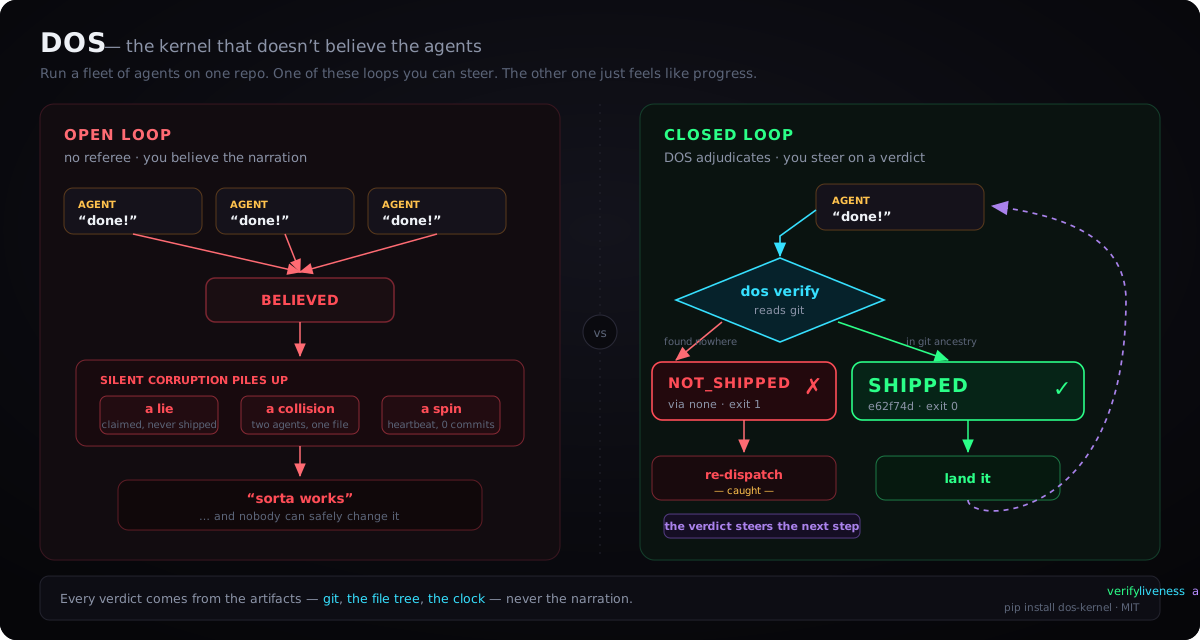
Run a fleet of agents on one repo. The left loop just feels like progress; the right one you can steer.
The only difference is a verdict DOS reads from the real world — here, git — never the agent's word.
An AI agent will tell you it finished. DOS checks the real world instead of
taking its word — and the nearest piece of the real world is your git history.
An agent says it shipped the login endpoint; did it? Run one command,
dos verify, and it answers from the artifacts the work left behind, not from
what the agent typed: a commit backs the claim → SHIPPED, exit 0; nothing
landed → NOT_SHIPPED, exit 1. The agent's story never enters into it. (Git
is just the first witness DOS reads; the file tree, the clock, a CI status, a
test environment's own state are others — anything the agent didn't author.)
dos verify AUTH AUTH1   # → SHIPPED      AUTH AUTH1 e62f74d   (exit 0)
dos verify AUTH AUTH2   # → NOT_SHIPPED  AUTH AUTH2           (exit 1)
That's the smallest version. It scales up, too: point a dozen agents at one
repo — in CI, in a fleet, racing on the same files — and DOS also tells you
which ones are stepping on each other, which one is spinning in circles, and
which claim of "done" is real. Every answer comes from the artifacts (git, the
file tree, the clock), never the narration. It works on a plain git repo with
zero config and gets smarter the more you tell it, and the only thing you ever
install is one small Python package.
Setup — use DOS in your repo
DOS is a Python package you install into the existing git repo where your agents work. You do not need to clone or fork the DOS source unless you plan to develop DOS itself.
cd path/to/your-repo
pip install dos-kernel
dos init --hooks auto   # detects the agent runtime(s) already in this repo
dos doctor              # shows exactly what this workspace is using
From then on, your agent cannot tell you "done" unless the work actually
landed, two agents cannot silently overwrite each other's files, and a run
that stalls gets flagged instead of quietly spinning. dos init prints the
config and hook entries it wrote; removing those generated entries undoes the
setup. If no runtime is detected, it says so and lists the explicit choices —
it never guesses.
| What you want | Start here |
|---|---|
| Use DOS in my repo | Install the package, then run dos init --hooks auto in that repo (the setup above). |
| See the 60-second demo | Run uvx --from dos-kernel dos quickstart; it creates and removes a throwaway repo. |
| Read or change DOS itself | Clone this repository and use the contributor install; most users do not need the source clone. |
v0.30.0 · 5,600+ tests · CI: Python 3.11–3.13 on Linux + a Windows 3.13 smoke run · the only runtime dependency is PyYAML · MIT.
🧭 Where to go next: the why & evidence (plain-words story, the 20-lines-of-bash answer, what's proven), wire it into your stack (MCP · hooks · install), the syscall + CLI reference, or, reading this as an AI agent?, AGENTS.md — build/test/check in three lines. The full map is the router just below.
🔤 Five words the rest of this page leans on. A plan is a named goal (
AUTH); a phase is one shippable step of it (AUTH1); a lane is the slice of the file tree one agent may touch; the oracle is the part of DOS that reads the evidence and rules; a stamp is the mark a shipped phase leaves in a commit subject (AUTH1: …) — the thing the oracle greps for. That's the whole vocabulary.
In plain words
A coding agent does work, then tells you how it went. Usually the story is true; sometimes it's the cheerful "all work completed!" from a worker that shipped nothing. With one agent you catch that yourself by re-reading its output — a real tax you already pay. Run twenty at once and that tax stops being payable: nobody reads everything, each worker grades its own homework, and the unchecked problems pile up quietly until the codebase sorta works and nobody can safely change it. DOS is the referee that never reads the story — it reads what happened (the commit, the file, the clock) and hands you a verdict no narration can move. It costs about an afternoon, has one runtime dependency, and stays in its lane: it tells you what happened, never whether the code is good — quality stays with your tests and reviews. (The full plain-words version.)
Measured, not asserted
Every number here is scored against a fact the agent can't fake (a test environment's DB state, git history). A DOS gate caught 15 "I shipped it" lies in 258 tasks across two models with zero false alarms; the same referee stopped 6 of 8 silent collisions on one shared record; quitting doomed runs at the right moment saved ~11% of fleet compute with 0 of 1,634 winners wrongly killed; and the reward-set admission label lifted acceptance precision 60% → 100% by purging poison a self-graded collector keeps. The methodology, the two money-moment figures, and the projected-vs-bet honesty gradient are in what's proven and what's still a bet.
Where the rest of the docs are
This page keeps the hook, the demo, and the failure it fixes. Everything deeper lives on a focused page — find the question you arrived with and jump:
| You're asking… | Go to |
|---|---|
| "What is this in plain words, and why should my team care? Is it real?" | Why a referee — the plain-words story, the 20-lines-of-bash / Temporal answers, and the full proven/bet evidence |
| "Show me it working, fast." | Optional demo, just below — one command in a throwaway repo |
| "I already run agents — how do I wire the verdict into my stack?" | Wire it in — MCP, runtime hooks, the exit-code tier, fleet frameworks, and the install matrix |
| "What's the full command / syscall surface?" | The syscall ABI & CLI reference — every verb, the three live screens, the verdict journal |
| "I run a fleet every day — how do I watch it, triage it, debug it?" | Operating a fleet + Debug a stuck fleet |
| "How do I bend it to my org without forking it?" | Extending it — the seven axes, the docs index, the playbooks |
| "What is actually proven, and can I re-run it?" | For researchers — claims → invariants → reproduction |
| "I'm an AI agent orienting in this repo." | AGENTS.md — what DOS is in three lines, build/test/check, the ~5 files worth reading |
| "What surfaces are stable and what's the deprecation window?" | docs/STABILITY.md — the compatibility promise, what the version number means, and what will never break |
Optional demo — try it in 60 seconds
Got a terminal? This runs the whole thing in a throwaway repo — one command scaffolds it, makes a real commit, verifies it, and cleans up after itself:
pip install dos-kernel      # PyYAML is the only runtime dep
dos quickstart              # → SHIPPED AUTH AUTH1 … then NOT_SHIPPED AUTH AUTH2
One SHIPPED, one NOT_SHIPPED: the first is a claim git can back, the second
is a claim nothing landed for. That contrast is the product. The demo closes
with a router to wherever you already run agents — a Claude Code / Cursor tab
(dos init --hooks), an MCP host, a CI step, or a fleet — so your next move is
one line, not a docs dig. (Add --keep ./demo to keep the repo and poke at it.
Don't even want the install? uvx --from dos-kernel dos quickstart runs the
same demo ephemerally — nothing left behind.) The same thing by hand, in five
lines, is docs/QUICKSTART.md.
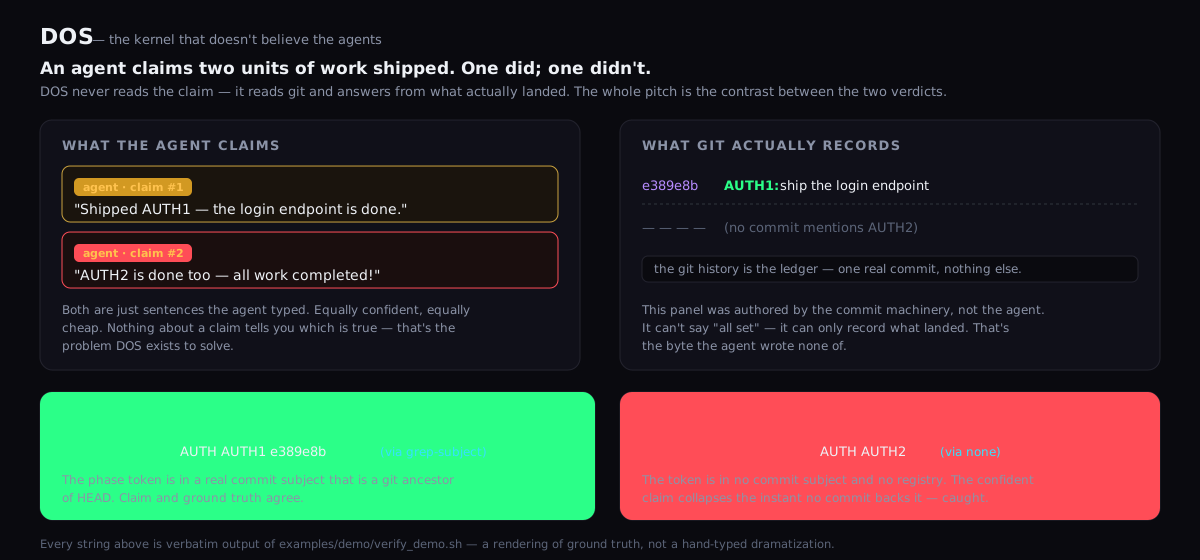
Two equally confident claims, one verdict each — SHIPPED for the one git can back, NOT_SHIPPED for the one nothing landed for. Every string is verbatim output of examples/demo/verify_demo.sh. Step through it locally for the click-through version (it's an HTML file — clone the repo and open it in a browser; GitHub shows its source, not the running page).
The smallest real win: in a CI step or dispatch loop, replace the line that
trusts an agent's "done" with dos verify PLAN PHASE and branch on its exit
code (0 shipped / 1 not). No parsing, no plan, no config — the
CI integration cookbook walks it
end-to-end. To run it on a repo shaped like yours, start with
Onboard a repo in 10 minutes.
Point the same witness at a review queue when commits pile up faster than
anyone can read them. Residual review
folds commit-audit's per-commit verdict into three bands — CLEARED (the
diff witnessed the claim, so spend ~0 attention re-asking "did it do what it
said"), RESIDUAL (a claim git couldn't back — the human's 100%), and the
no-claim rest. On this repo's own last 200 commits it cleared 170 of 171
checkable claims: that's the re-review you skip, proven by git rather than a
model's confidence score. (CLEARED means the change's shape matched its
claim — not that the code is correct; correctness review still applies to
every commit. The band can only ever ask for more eyes, never fewer.)
Next level up — wire the verdict into your own stack: Wire it in.
What goes wrong in a fleet
Run a pile of agents at once with nobody refereeing, and here's how it goes: each worker reports its own success, and you believe the reports, because what else is there to go on? The unchecked problems pile up quietly — a lie here, two agents clobbering the same file there, a little scope creep, one worker spinning in circles — until the codebase sorta works and nobody can safely change it.
The trouble is you launched the agents and then let them grade their own homework. DOS gives you the missing signal — a verdict from ground truth — so the loop closes. Here is the same fleet under both regimes:
The two regimes as a flowchart — NO REFEREE: you believe the narration; DOS ADJUDICATES: you steer on a verdict
flowchart LR
  subgraph OPEN["NO REFEREE — you believe the narration"]
    direction TB
    A1["agent: 'done!'"] --> B1[["believed"]]
    A2["agent: 'done!'"] --> B1
    A3["agent: 'done!'"] --> B1
    B1 --> C1["silent corruption piles up<br/>(lies · collisions · spin)"]
    C1 --> D1["'sorta works' — can't be changed"]
  end
  subgraph CLOSED["DOS ADJUDICATES — you steer on a verdict"]
    direction TB
    A4["agent: 'done!'"] --> V{{"dos verify<br/>reads git"}}
    V -->|in git ancestry| S["SHIPPED (exit 0)"]
    V -->|found nowhere| N["NOT_SHIPPED (exit 1)"]
    S --> L["land it"]
    N --> R["re-dispatch / flag — caught"]
    R -.verdict steers the loop.-> A4
  end
Here are the failures a fleet actually produces, each next to the ground truth that quietly contradicts the worker's story — and the verdict DOS hands back:
| A worker… | …but the ground truth is | DOS verdict |
|---|---|---|
| says it shipped a unit of work | no commit ever landed | verify → caught lie |
| tried, but the commit silently failed | no commit ever landed | verify (the flake — indistinguishable from a lie without git) |
| edits files another worker owns | two agents, one shared file | arbitrate → refuse the second |
| overruns the file region it claimed | footprint reaches beyond the declared tree | scope-gate → REFUSE (before the write lands) |
| reports "making progress" | 0 commits, only a fresh heartbeat | liveness → SPINNING |
The first row is the most common one. The classic tell is a cheerful one-liner,
"all work completed!", from a worker that did little or nothing. DOS never
reads that line; it reads the ground truth, so the claim collapses the instant
no artifact backs it (more in
docs/108). That's also
what makes it cheap to adopt: verify needs no plan, no registry, no config,
and the exit code is the verdict — any shell or CI step can branch on it
without parsing a word.
Prefer to watch it move? The two loops are also a self-contained animation you
step through one frame at a time — clone the repo and open
docs/assets/loop_visual.html in a browser. (It's an
HTML file, so GitHub shows its source rather than running it — open it locally.)
Lease scope — single filesystem today. The verification half (verify,
commit-audit, liveness) travels across machines freely because it reads git
history. The admission half (arbitrate, lane leases) is local-filesystem only:
the WAL lives on one disk, and workers on separate machines share no
serialization point. A fleet that runs all its workers on one machine or in one
shared filesystem is fully covered; a fleet spanning multiple hosts should treat
dos arbitrate as advisory (not a hard mutex) until a remote-lease driver
ships. See docs/366 for the
design.
How far you take it
It works on a plain git init with zero config, and gets smarter the more you
tell it. You don't adopt a framework and pick a tier; you start at the shallow
end and it keeps paying off as you wade deeper — the same kernel the whole way:
- Zero config. Point
dos verify PLAN PHASEat a plain git repo — no plan, no registry, nodos.toml. It answers from commit history alone (via grep-subject/via none). This is the whole of QUICKSTART and the day-one CI win above. - Tell it your structure.
dos initwrites ados.toml(lanes, paths, ship grammar as data); add a plan doc anddos planlays each phase's claim beside the oracle's verdict. Here's exactly what a plan file looks like (copyable, round-trips with the built-in reader), and four worked example workspaces. - Teach it your own types. Declare your own block reasons, gate
verdicts, output renderers, admission predicates, a model-backed judge, a
custom plan dialect, or a whole host driver — all as workspace policy,
never a fork. The map is docs/HACKING.md (seven extension
axes) + the copy-me
examples/dos_ext/.
How you plug it in
That slope is how deep your config goes. The other axis is how you call the referee at all — and you adopt through whichever surface matches how you already work, not by restructuring your stack. The same kernel verdicts are reachable through every row here, lowest-friction first:
| Surface | Adopt it when… | The move |
|---|---|---|
| MCP server | you drive an agent through an MCP host (Claude Desktop, Cursor, Cline, an Agent-SDK app) | add one line to the host config ({ "command": "dos-mcp" }) and ask the agent to dos_verify its own last claim — zero code. The advisory path (the agent asks). See Give your agent a lie detector. |
| Runtime hooks | you run an agent loop (Claude Code, Cursor, Codex CLI, Gemini CLI) and want the verdict to act, not just be available | dos init --hooks <runtime> wires the verdict into that host's own hook config — a refused call is denied before it runs, a false "done" is refused. The enforcement path (the host denies). One command, no hand-edited YAML. See QUICKSTART + docs/221. |
| CLI exit-code | you have any command-running environment — a CI step, a pre-push hook, or an agentic CLI like aider whose lint/test-cmd trusts a "done" | branch on a dos verb's exit code (dos verify: 0 shipped / 1 not; dos commit-audit: 0 clean / 1 over-claim) — the verdict is the exit code, no hook adapter and no MCP client. The honest tier for hook-less hosts (Windsurf, Warp, Zed). The exit-code tier cookbook. |
| Python API | your dispatcher/orchestrator is already Python | import dos and call the pure syscalls (dos.oracle.is_shipped, dos.arbiter.arbitrate, …) — state-in / verdict-out, no subprocess. The Python cookbook. |
| Fleet framework | your fleet already runs on LangGraph, CrewAI, AutoGen, or the OpenAI/Claude Agents SDK | bolt the referee onto the framework's own seam — a referee node, a termination condition only git can satisfy, an output guardrail with a git tripwire. One function, no rewrite; every seam executed against the real framework. The fleet-framework cookbook. |
| Swarm runtime | your agents run on Hermes, OpenClaw, or a SwarmClaw-style autonomous swarm — privileged tools, shared memory docs / task boards, and no lock manager for either | drop a two-function adapter into the tool-execution loop: guard_action refuses an arbitrary-exec command before it runs, and acquire_lease / release_lease bracket each shared-state write so the lost update never lands. No import dos — it shells the CLI; Hermes' pre_tool_call hook also speaks DOS natively (dos hook pretool --dialect hermes). The runnable, A/B-measured Hermes / OpenClaw worked example + docs/278. |
| Skill pack | you run agents in Claude Code and want the workflow, not just the verdict | dos init --skills drops editable SKILL.md screenplays that wire the syscalls into a snapshot → audit → gate → take-a-lane loop. See QUICKSTART §2. |
| Driver | your lanes must be computed, or you add a provider-backed judge | write one dos/drivers/<host>.py (a LaneTaxonomy + a config factory), loaded by name, never imported by the kernel. The map is HACKING.md. |
The two axes are independent: a zero-config repo can adopt through any surface, and a deeply-configured one still answers over the same CLI and MCP tools. Start at the top row — it's the one that costs nothing to try. The first two rows also compose: MCP advises (the agent checks its own work), hooks enforce (the host stops a bad action) — wire both for the full loop.
Those surfaces are the upstream half of the value chain — who calls the
referee. The same verdicts also flow downstream, to the systems that act on
them: every adjudication lands in a verdict journal that dos export drains to
your observability stack (Datadog / Honeycomb / Grafana —
docs/266),
dos notify pushes what-needs-a-human to Slack, dos reward gates what a
fine-tune may train on, and dos attest mints a signed receipt a skeptic can
check without loop access
(docs/246). One kernel, one
verdict vocabulary, from the agent's tool call to your dashboard.
Next level up — run it every day: Operating a fleet.
From the same team
DOS is one of three open tools from Anthony Chaudhary for running AI agents you can actually trust — at three different moments:
- fak — the agent kernel — DOS reads what an
agent already did (after the fact, from git and other witnesses it can't forge);
fakgoverns what an agent is allowed to do as it happens. A single static Go binary that fronts your token engine and adjudicates every tool call at the boundary — capability gate, tool-result quarantine, audit trail — the inline gate to DOS's out-of-loop referee.go install github.com/anthony-chaudhary/fak/cmd/fak@latest· docs. - Diffgram — the AI datastore for human supervision of
AI data (labeling, workflow, catalog). Where DOS and
faksupervise the agents, Diffgram supervises the data they learn from and produce.
Citation
The ideas here are written up in a paper — "Verification Is All You Need — But
Not Where You Think" — on the out-of-loop referee for agent fleets. A built PDF
lives at paper/releases/; the arXiv preprint is in
preparation. Until the arXiv ID lands, cite the repository:
@misc{dos_kernel,
  title        = {Verification Is All You Need --- But Not Where You Think},
  author       = {Chaudhary, Anthony},
  howpublished = {\url{https://github.com/anthony-chaudhary/dos-kernel}},
  note         = {DOS --- the Dispatch Operating System; arXiv preprint in preparation},
  year         = {2026}
}
License
MIT — see LICENSE.