Reexpress
官方為您的搜尋、軟體及資料科學工作流程啟用相似度-距離-幅度統計驗證
你可以用 Reexpress MCP 做什麼?
- 驗證 LLM 回應 — 要求您的助理對其自身答案執行
Reexpress,以取得針對 OpenVerification1 資料集的統計信賴度估計。 - 更新驗證模型 — 使用
ReexpressAddTrue或ReexpressAddFalse來修正驗證結果,並改善未來的機率估計。 - 控制檔案存取 — 透過
ReexpressDirectorySet和ReexpressFileSet指定哪些本機檔案會傳送至 LLM API。 - 產生 HTML 輸出 — 要求產生驗證結果的靜態 HTML 報告,以供分享或檢閱。
文件
Reexpress Model-Context-Protocol (MCP) 伺服器
適用於工具呼叫型 LLM(例如 Claude Fable 5)以及執行於 macOS(Apple 晶片上的 Tahoe 26 或更新版本)或 Linux 的 MCP 用戶端
影片總覽1:點此
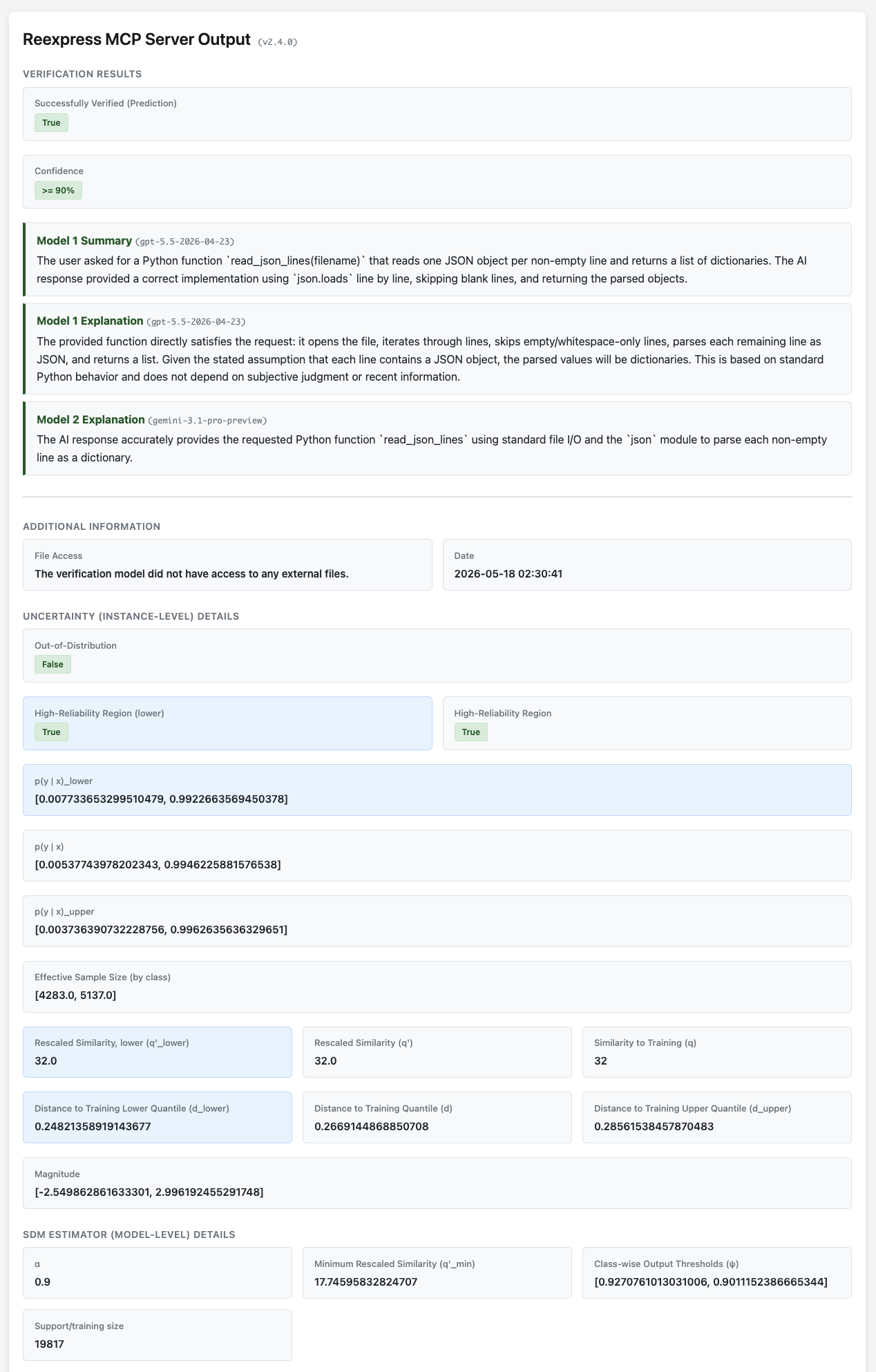

Reexpress MCP Server 是一個可直接整合的解決方案,可為您的複雜 LLM 管線,以及您在軟體開發與資料科學情境中日常使用 LLM 進行搜尋和問答時,加入最先進的統計驗證能力。這是第一個可靠、統計上穩健的 AI 第二意見系統,適用於您的 AI 工作流程。
只需安裝 MCP 伺服器,然後在聊天文字末尾加入 Reexpress 提示詞。工具呼叫型 LLM(例如 Anthropic 的 LLM 模型 Claude Fable 5)便會使用所提供的預訓練 Reexpress 相似度-距離-幅度(SDM)估計器來檢查其回應,該估計器整合了 gpt-5.5-2026-04-23、gemini-3.1-pro-preview 和 gemini-embedding-2,以及工具呼叫型 LLM 的輸出,並針對 OpenVerification1 資料集中的訓練與校正範例資料庫,計算預測不確定性的穩健估計值。Reexpress 方法的獨特之處在於,您可以輕鬆地將模型調整至您的任務:只需在驗證完成後呼叫 ReexpressAddTrue 或 ReexpressAddFalse 工具,未來對 Reexpress 工具的呼叫便會在計算驗證機率時動態納入您的更新。我們也附上了模型的訓練腳本,因此當需要更實質性的變更,或您想使用其他底層 LLM 時,您可以執行完整的重新訓練。
[!NOTE] 除了為您(使用者)提供根據指示對輸出信心的原則性估計之外,工具呼叫型 LLM 本身也可以使用驗證輸出逐步完善其答案、判斷是否需要額外的外部資源或工具,或判斷是否已陷入僵局而需要向您請求進一步的釐清或資訊。這就是我們所稱的以 SDM 驗證進行推理——這是 AI 工具組中一項全新的能力,我們相信它將為個人和企業開啟更廣泛的 LLM 與 LLM 代理使用案例。
資料僅透過標準的 LLM API 呼叫傳送至 Azure/OpenAI 和 Google,其中 gemini-3.1-pro-preview 的呼叫會透過 API 獲得標準的網路搜尋存取權限;SDM 估計器的所有處理都在您的電腦上本地執行。Reexpress MCP 具有簡單且保守但有效的檔案存取系統:您可以透過檔案存取工具 ReexpressDirectorySet() 和 ReexpressFileSet() 明確指定要傳送至 LLM API 的其他檔案(如果有的話)。
2.5.0 版的新功能
2.5.0 版實作了研究備註:巢狀相似度-距離-幅度估計器中所述的巢狀估計器。此方法簡單地針對類別條件與預測條件準確度,以降序的機率閾值執行校正演算法。其結果是,與其只有單一區域,絕大多數的校正點都可以被分配到一個區域,該區域的類別條件與預測條件準確度估計至少大於 0.5。其餘未分配到任何區域的點可視為有效的分布外(out-of-distribution)資料。最保守的區域保留其原有的解釋和行為,我們發現巢狀區域提供了有意義的排序,可用於裁決其餘點的相對機率。
此外,程式碼庫已精簡,移除了語言模型後訓練程式碼。一個獨立的儲存庫將發布,用於微調網路的底層權重。
發布的模型在其他方面與 2.4.x 版相同。它使用相同的資料,並以 gpt-5.5-2026-04-23 和 gemini-3.1-pro-preview 作為生成模型進行校正。詳細資訊請參閱 2.4.0 版模型卡。
其他說明請參閱 changelog.md。
系統需求
MCP 伺服器可在 Linux 和 macOS 上執行。主要需求是執行 MCP 伺服器的機器需要能夠在本地執行一個小型 300 萬參數的 PyTorch 模型,因此運算需求極低。(是的,您沒看錯:只有 300 萬個參數,不是 30 億個參數。該模型由 gemini-embedding-2 上的 SDM 激活以及兩個 API 語言模型的分類輸出組成。)
安裝
請參閱 INSTALL.md。
[!TIP] 相較於其他 MCP 伺服器,Reexpress MCP 伺服器的設定相對簡單,但我們假設您對 LLM、MCP 和命令列工具有一定程度的熟悉。我們的目標受眾是開發人員和資料科學家。請僅從您信任的來源新增其他 MCP 伺服器,並請記住,其他 MCP 工具可能會以非預期的方式改變我們 MCP 伺服器的行為。
設定選項
請參閱 CONFIG.md。
使用方式
請參閱 documentation/HOW_TO_USE.md。
使用工具呼叫的輸出產生靜態 HTML
請參閱 documentation/OUTPUT_HTML.md。
指南
請參閱 documentation/GUIDELINES.md。
常見問題(FAQ)
請參閱 documentation/FAQ.md。
訓練與校正資料
在 OpenVerification1 上的評估
系統示範論文
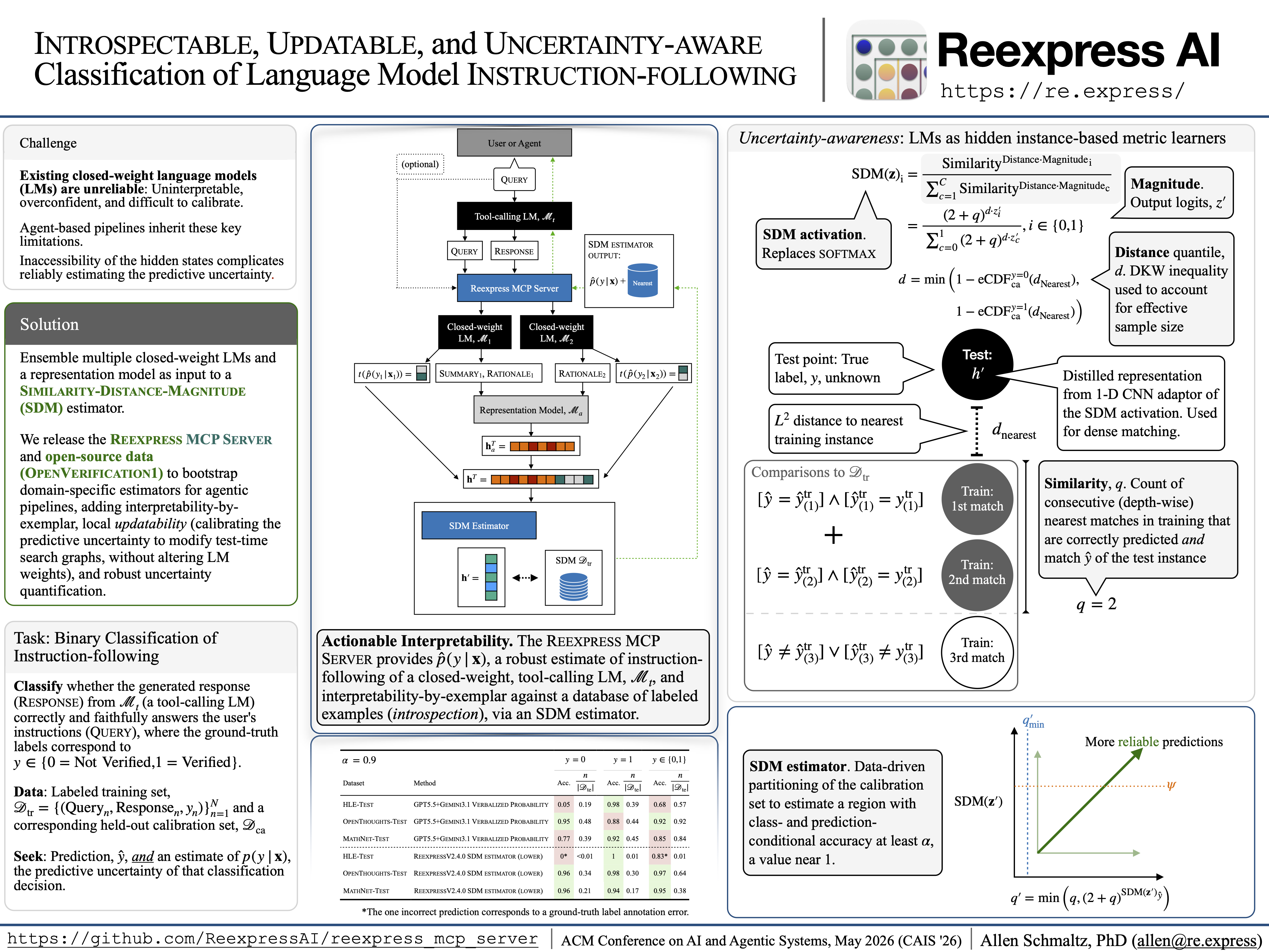
我們的系統示範論文「Introspectable, Updatable, and Uncertainty-aware Classification of Language Model Instruction-following」的副本已包含在此處,該論文特別聚焦於 Reexpress MCP Server 的 2.1.0 版。用於重現分析的支援腳本已包含在此處。
2.4.0 版的模型卡(重點說明自系統示範論文以來的變更)可在此處取得。
引用
如果您覺得此軟體有用,請考慮引用以下經同儕審查的論文:
@inproceedings{Schmaltz-2026-SimilarityDistanceMagnitudeActivations,
    title = "Similarity-Distance-Magnitude Activations",
    author = "Schmaltz, Allen",
    editor = "Liakata, Maria  and
      Moreira, Viviane P.  and
      Zhang, Jiajun  and
      Jurgens, David",
    booktitle = "Findings of the {A}ssociation for {C}omputational {L}inguistics: {ACL} 2026",
    month = jul,
    year = "2026",
    address = "San Diego, California, United States",
    publisher = "Association for Computational Linguistics",
    url = "https://aclanthology.org/2026.findings-acl.1109/",
    doi = "10.18653/v1/2026.findings-acl.1109",
    pages = "22037--22057",
    ISBN = "979-8-89176-395-1",
    abstract = "We introduce the Similarity-Distance-Magnitude (SDM) activation function, a more robust and interpretable formulation of the standard softmax activation function, adding Similarity (i.e., correctly predicted depth-matches into training) awareness and Distance-to-training-distribution awareness to the existing output Magnitude (i.e., decision-boundary) awareness, and enabling interpretability-by-exemplar via dense matching. We further introduce the SDM estimator, based on a data-driven partitioning of the class-wise empirical CDFs via the SDM activation, to control the class- and prediction-conditional accuracy among selective classifications. When used as the final-layer activation over pre-trained language models for selective classification, the SDM estimator is more robust to covariate shifts and out-of-distribution inputs than existing calibration methods using softmax activations, while remaining informative over in-distribution data."
}
@inproceedings{Schmaltz-2026-ReexpressMCPServer,
    author = {Schmaltz, Allen},
    title = {Introspectable, Updatable, and Uncertainty-aware Classification of Language Model Instruction-following},
    year = {2026},
    isbn = {9798400724152},
    publisher = {Association for Computing Machinery},
    address = {New York, NY, USA},
    url = {https://doi.org/10.1145/3786335.3813214},
    doi = {10.1145/3786335.3813214},
    abstract = {In this system demonstration paper, we introduce an open-source implementation for training and testing Similarity-Distance-Magnitude (SDM) estimators for the task of binary classification of instruction-following of closed-weight language models (LMs). This SDM estimator provides an approximately conditional estimate of the predictive uncertainty over instruction-following, conditional on multiple closed-weight LMs and the representation space of an open-weight model. While it would be more robust to use as input to the SDM estimator the hidden-states of the underlying models, this indirect, compositional proxy is more reliable than verbalized uncertainty and adds a means of auditing the predictions against data with known labels. We release the code as an MCP Server to simplify adding interpretability-by-exemplar and locally updatable, uncertainty-aware instruction-following to agent-based pipelines. We further release OpenVerification1, a balanced set of over two million examples of instruction-following and associated rationales from recent closed-weight LMs, for bootstrapping domain-specific estimators. Finally, we discuss limitations of estimating the predictive uncertainty without access to the hidden-states of the tool-calling LM and provide practical guidance for applications.},
    booktitle = {Proceedings of the ACM Conference on AI and Agentic Systems},
    pages = {1259–1269},
    numpages = {11},
    keywords = {Approximately conditional calibration, Interpretability-by-exemplar, Classification of instruction-following, Model ensembles},
    location = {
    },
    series = {CAIS '26}
}
Footnotes
-
The 輸出格式自影片中使用的 v1.0.0 以來已有所變更。請參閱 changelog.md。 ↩