systemprompt
Self-hosted MCP governance runtime in Rust — audit trail, policy enforcement, and cost controls for MCP servers.
Run your AI agent fleet on your own infrastructure, with your own choice of inference.
Install this binary, point Claude for Work, Claude Code, any Anthropic-SDK client, or any MCP host at it, and every request lands on a host you operate — on your network, in your air-gap, under your audit table. Pick the upstream per model pattern: Anthropic, OpenAI, Gemini, Moonshot (Kimi), Qwen, MiniMax, or a custom provider you register yourself. One YAML block swaps it.
Every tool call authenticated, scoped, secret-scanned, rate-limited, and audited before the tool process spawns. ~50 MB Rust binary, one PostgreSQL, four commands from git clone to serving inference. Built for SOC 2, ISO 27001, HIPAA, and the OWASP Agentic Top 10.
systemprompt.io · Documentation · Guides · Discord
Got your AI governance question answered? ⭐ Star it — helps other security teams find it.
Live capture of ./demo/governance/06-secret-breach.sh. Secret exfiltration attempt denied before spawn. One audit row written. No model touched the key.
Quick start
just build # 1. compile the workspace
just setup-local <anthropic> <openai> <gemini> # 2. profile + Postgres + publish
just start # 3. serve governance, agents, MCP, admin, API
./demo/sweep.sh # 4. run all 43 demos against the live binary
Install the Cowork credential helper — only if you're pointing Claude for Work at this binary
The systemprompt-cowork binary is the Credential helper script slot in Claude for Work. It turns a PAT into a short-lived JWT that Claude Desktop merges into every inference request routed at this binary. Download the prebuilt Windows or Linux binary from systempromptio/systemprompt-core releases; macOS builds from source on any Mac.
Current release: cowork-v0.2.0 — Linux x86_64 + Windows x86_64 (mingw ABI). macOS build is pending a Mac-hosted CI.
1. Download
Linux x86_64
curl -fsSL -o /usr/local/bin/systemprompt-cowork \
https://github.com/systempromptio/systemprompt-core/releases/download/cowork-v0.2.0/systemprompt-cowork-x86_64-unknown-linux-gnu
chmod +x /usr/local/bin/systemprompt-cowork
curl -fsSL https://github.com/systempromptio/systemprompt-core/releases/download/cowork-v0.2.0/systemprompt-cowork-x86_64-unknown-linux-gnu.sha256 \
| sha256sum -c --ignore-missing
Windows x86_64 (PowerShell as Administrator):
$dir = "C:\Program Files\systemprompt"
New-Item -ItemType Directory -Force -Path $dir | Out-Null
Invoke-WebRequest `
-Uri "https://github.com/systempromptio/systemprompt-core/releases/download/cowork-v0.2.0/systemprompt-cowork-x86_64-pc-windows-gnu.exe" `
-OutFile "$dir\systemprompt-cowork.exe"
[Environment]::SetEnvironmentVariable("PATH", "$env:PATH;$dir", "User")
Windows Smart Screen will flag the unsigned binary on first run → "More info" → "Run anyway".
macOS (source build):
git clone https://github.com/systempromptio/systemprompt-core.git
cd systemprompt-core
cargo build --manifest-path bin/cowork/Cargo.toml --release \
--target "$(rustc -vV | awk '/host:/ {print $2}')"
sudo install -m 755 \
"bin/cowork/target/$(rustc -vV | awk '/host:/ {print $2}')/release/systemprompt-cowork" \
/usr/local/bin/
2. Configure
Linux/macOS: ~/.config/systemprompt/systemprompt-cowork.toml
Windows: %APPDATA%\systemprompt\systemprompt-cowork.toml
[gateway]
url = "http://localhost:8080" # for the local-trial template; swap to your production host
[pat]
token = "sp-live-your-personal-access-token"
Issue a PAT from the running binary with systemprompt admin users pat issue <user-id> --name cowork-laptop. Absent config sections are silently skipped. Dev overrides: SP_COWORK_GATEWAY_URL, SP_COWORK_PAT.
3. Verify
systemprompt-cowork # prints exactly one JSON {token, ttl, headers}
systemprompt-cowork --check # exits 0 if a token can be issued
Diagnostics go to stderr only. The stdout JSON matches Anthropic's inferenceCredentialHelper contract byte-for-byte.
4. Point Claude Desktop at it
In Claude Desktop Enterprise → Settings → Inference:
- Credential helper script:
/usr/local/bin/systemprompt-cowork(orC:\Program Files\systemprompt\systemprompt-cowork.exe). - API base URL: the
gateway.urlfrom your TOML.
Every Claude Desktop request now lands a row in ai_requests with user_id, tenant_id, session_id, trace_id, tokens, cost, and latency — identical governance to every other tool call. Run systemprompt infra logs audit <request-id> --full after a prompt to see the trace end-to-end.
5. (Optional) Install the org-plugins/ sync agent
The same binary manages Cowork's signed plugin / managed-MCP mount:
systemprompt-cowork install # register launchd (macOS) / scheduled task (Windows) / systemd --user (Linux)
systemprompt-cowork sync # pull signed plugin manifest + allowlist now
systemprompt-cowork validate # verify the ed25519 signature
systemprompt-cowork uninstall # remove
Mount targets: /Library/Application Support/Claude/org-plugins/ (macOS), C:\ProgramData\Claude\org-plugins\ (Windows), ${XDG_DATA_HOME:-$HOME/.local/share}/Claude/org-plugins/ (Linux).
What a CISO gets
- A single query answers every AI audit. Every request, scope decision, tool call, model output, and cost lands in one 18-column Postgres table. Six correlation columns (UserId, SessionId, TaskId, TraceId, ContextId, ClientId) bind identity at construction time, so a row without a trace is a programming error.
- Credentials physically cannot enter the context window. The governance process is the parent of every MCP tool subprocess. Keys are decrypted from a ChaCha20-Poly1305 store and injected into the child's environment by
Command::spawn(). The parent, which owns the LLM context, never writes the value. 35+ regex patterns deny any tool call that tries to pass a secret through arguments. - Self-hosted, air-gap capable, single artifact. One Rust binary. One PostgreSQL. No Redis, no Kafka, no Kubernetes, no SaaS handoff. The same binary runs on a laptop, a VM, and an air-gapped appliance without modification. Zero outbound telemetry by default.
- Policy-as-code on PreToolUse hooks. Destructive operations, blocklists, department scoping, six-tier RBAC (Admin, User, Service, A2A, MCP, Anonymous). Rate limiting at 300 req/min per session with role multipliers. Every deny reason is structured and auditable.
- Certifications-ready, not certification-marketing. Tiered log retention from debug (1 day) through error (90 days). 10 identity lifecycle event variants. SIEM-ready JSON events for Splunk, ELK, Datadog, Sumo. Built for SOC 2 Type II, ISO 27001, HIPAA, and the OWASP Agentic Top 10.
This repo is the evaluation template. Fork it, clone it, compile it. 43 scripted demos execute every claim above against the live binary on your own laptop.
What you'll see in the first five minutes
- http://localhost:8080 — admin UI, live audit table, session viewer.
systemprompt analytics overview— conversations, tool calls, costs in microdollars, anomalies flagged above 2x/3x of rolling average.systemprompt infra logs audit <request-id> --full— the full trace for any request: identity, scope, rule evaluations, tool call, model output, cost. One query, one row, one answer.- Point Claude Code, Claude Desktop, or any MCP client at it. Permissions follow the user, not the client. Try to exfiltrate a key through a tool argument and watch the secret-detection layer deny it before the tool process spawns.
./demo/governance/06-secret-breach.sh— the scripted version of that denial, recorded above.
The scripted demos
./demo/00-preflight.sh # acquire token, verify services, create admin
./demo/01-seed-data.sh # populate analytics + trace data
# Governance — the audit line
./demo/governance/01-happy-path.sh # allowed tool call, full trace chain
./demo/governance/05-governance-denied.sh # scope check rejects out-of-role call
./demo/governance/06-secret-breach.sh # secret-detection blocks exfiltration
./demo/governance/07-rate-limiting.sh # 300 req/min per session enforced
./demo/governance/08-hooks.sh # PreToolUse policy-as-code
# Observability — the audit table
./demo/analytics/01-overview.sh # conversations, costs, anomalies
./demo/infrastructure/04-logs.sh # structured JSON events, SIEM-ready
# Scale — the overhead budget
./demo/performance/02-load-test.sh # 3,308 req/s burst, p99 22.7 ms
Full index: demo/README.md. 41 of 43 scripts are free; two cost ~$0.01 each (real model calls).
Prerequisites
| Requirement | Purpose | Install |
|---|---|---|
| Docker | PostgreSQL runs in a container; just setup-local starts it | docker.com |
| Rust 1.75+ | Compiles the workspace binary | rustup.rs |
just | Task runner | just.systems |
jq, yq | JSON and YAML processing in the scripts | brew install jq yq / apt install jq yq |
| AI API keys | One key per provider enabled in services/ai/config.yaml. Shipped config enables Anthropic, OpenAI, Gemini (default gemini). Disable providers you don't want or pass all three. | Provider dashboards |
| Ports 8080 + 5432 | HTTP + PostgreSQL | Free on localhost |
Running a second clone side-by-side: just setup-local <anthropic> <openai> <gemini> 8081 5433.
Claude for Work / LLM Gateway — new in v0.3.0
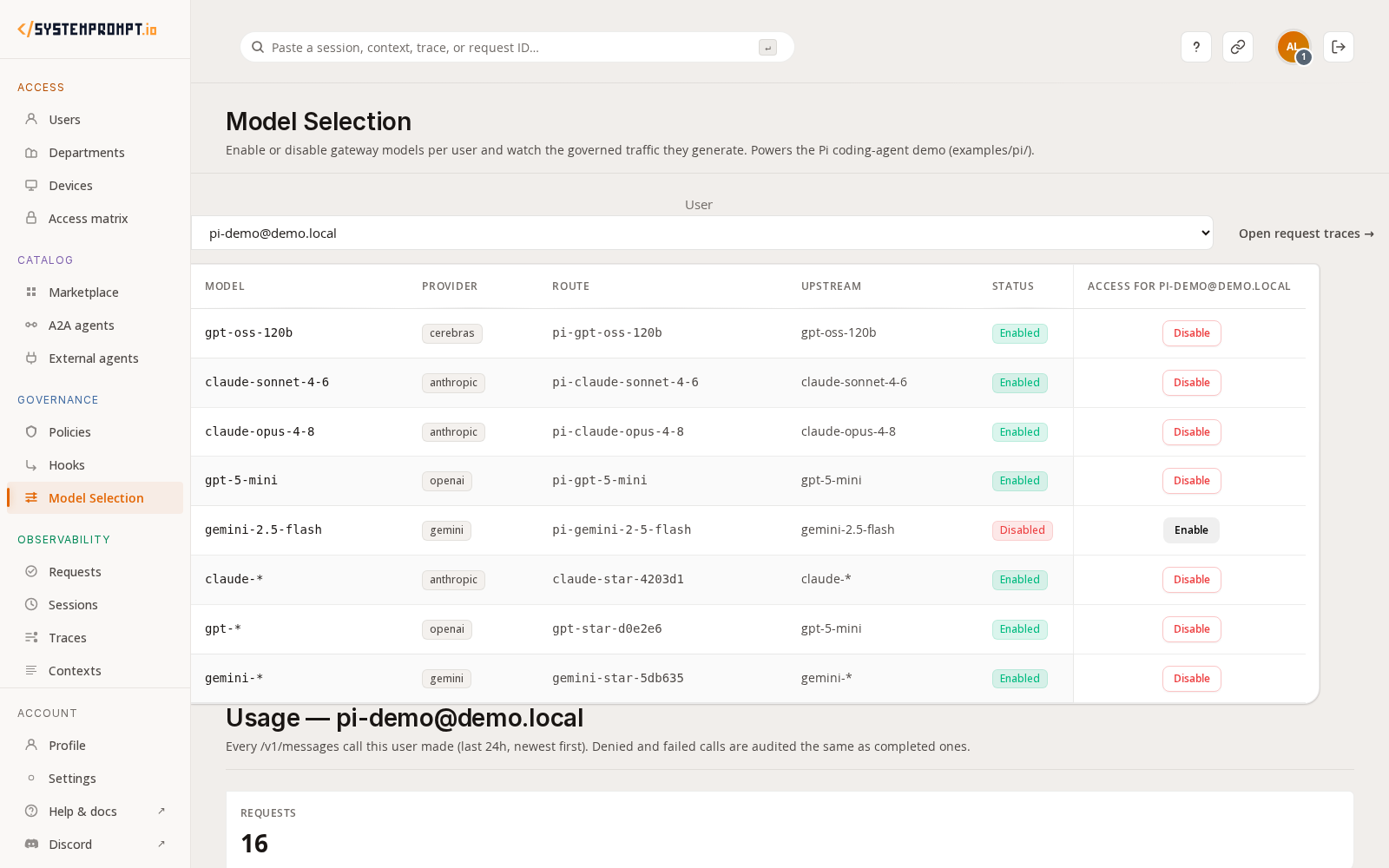
Anthropic defined the socket; systemprompt is the plug. v0.3.0 turns the binary into a /v1/messages inference gateway that a Claude-for-Work fleet (or any Anthropic-SDK client, Claude Desktop included) can point at as api_external_url. Every inference request now flows through the same governance pipeline as every tool call — on infrastructure you operate.
POST /v1/messagesat the Anthropic wire format. SDK-compatible. Claude Desktop-compatible. Authenticated with a systemprompt JWT inx-api-key(falls back toAuthorization: Bearer). No new credential type — existing user JWTs serve as the gateway credential.- Routes by
model_patternto the upstream of your choice. Built-in provider tags:anthropic,openai,moonshot(Kimi),qwen,gemini,minimax. Anthropic is a transparent byte proxy (extended thinking, cache-control headers, and SSE events preserved verbatim). OpenAI-compatible providers get full request/response/SSE conversion to and from the Anthropic format. Upstream API keys resolve from the existing secrets file by secret name. - Zero overhead when disabled. The
/v1router mounts only ifgateway.enabled: truein the active profile.
Profile YAML:
gateway:
enabled: true
routes:
- model_pattern: "claude-*"
provider: anthropic
endpoint: "https://api.anthropic.com/v1"
api_key_secret: "anthropic_api_key"
- model_pattern: "moonshot-*"
provider: moonshot
endpoint: "https://api.moonshot.cn/v1"
api_key_secret: "kimi_api_key"
upstream_model: "moonshot-v1-8k"
- model_pattern: "MiniMax-*"
provider: minimax
endpoint: "https://api.minimax.io/anthropic"
api_key_secret: "minimax"
- model_pattern: "*"
provider: anthropic
endpoint: "https://api.anthropic.com/v1"
api_key_secret: "anthropic_api_key"
Routes evaluate in order; first model_pattern match wins. upstream_model lets you alias a client-requested model to a different upstream name without the client knowing.
Cowork credential helper. Claude for Work's "credential helper script" slot is filled by systemprompt-cowork — a standalone ~2.4 MB Rust binary (no tokio, no sqlx, no axum) that exchanges a lower-privilege credential for a short-lived JWT. Progressive capability ladder: mTLS → dashboard session → PAT. Gateway endpoints mounted under /v1/gateway/auth/cowork/:
POST /pat—Authorization: Bearer <pat>→{token, ttl, headers}with a fresh JWT and the canonical identity header map (x-user-id,x-session-id,x-trace-id,x-client-id,x-tenant-id,x-policy-version,x-call-source).POST /session—501(dashboard-cookie exchange not yet wired).POST /mtls—501(device-cert exchange not yet wired).GET /capabilities—{"modes":["pat"]}; probes advertise which exchange modes this deployment accepts.
The helper writes the signed JWT + expiry to the OS cache dir with mode 0600. Stdout contract is exactly one JSON object; all diagnostics go to stderr. Released out-of-band as cowork-v* tags. See Install the Cowork credential helper above for download + configure + wire-up steps.
Extensible provider registry. GatewayRoute.provider is a free-form string resolved at dispatch time against a startup-built registry. Extension crates register new upstreams with:
inventory::submit! {
systemprompt_api::services::gateway::GatewayUpstreamRegistration {
tag: "my-provider",
factory: || std::sync::Arc::new(MyUpstream),
}
}
The GatewayUpstream trait (async fn proxy(&self, ctx: UpstreamCtx<'_>)) is the single integration seam. Built-in tags seeded automatically; extension tags may shadow built-ins (logged as a warning). Full detail: core/CHANGELOG.md.
The governance pipeline
Every tool call passes five in-process checks, synchronously, before it reaches a tool process. Every decision lands in an 18-column audit row.
LLM Agent
│
▼
Governance pipeline (in-process, synchronous, <5 ms p99)
│
├─ 1. JWT validation (HS256, verified locally, offline-capable)
├─ 2. RBAC scope check (Admin · User · Service · A2A · MCP · Anonymous)
├─ 3. Secret detection (35+ regex: API keys, PATs, PEM, AWS prefixes)
├─ 4. Blocklist (destructive operation categories)
└─ 5. Rate limiting (300 req/min per session, role multipliers)
│
▼
ALLOW or DENY → 18-column audit row, always
│
▼ (ALLOW)
spawn_server()
│
├─ decrypt secrets from ChaCha20-Poly1305 store
└─ inject into subprocess env vars only (never parent)
│
▼
MCP tool process credentials live here, never in the LLM context path
Run it: ./demo/governance/05-governance-denied.sh · Feature detail
How credential injection works
When a tool call passes the pipeline, spawn_server() decrypts credentials from the ChaCha20-Poly1305 store and injects them into the child process environment. The parent process — which owns the LLM context window — never writes the value.
Source: systemprompt-core/crates/domain/mcp/src/services/process/spawner.rs.
let secrets = SecretsBootstrap::get()?;
let mut child_command = Command::new(&binary_path);
// Child env only. The parent (LLM context path) never touches the value.
if let Some(key) = &secrets.anthropic {
child_command.env("ANTHROPIC_API_KEY", key);
}
if let Some(key) = &secrets.github {
child_command.env("GITHUB_TOKEN", key);
}
// Detach; parent forgets the child after spawn.
let child = child_command.spawn()?;
std::mem::forget(child);
Before spawn, a secret-detection pipeline scans tool arguments for 35+ credential patterns. A tool call that tries to pass a secret through the context window is blocked even if the agent has scope to run the tool. The hero recording above is the scripted proof: ./demo/governance/06-secret-breach.sh.
Performance
Sub-5 ms governance overhead, benchmarked. Each request performs JWT validation, scope resolution, three rule evaluations, and an async audit write.
| Metric | Result |
|---|---|
| Throughput | 3,308 req/s burst, sustained under 100 concurrent workers |
| p50 latency | 13.5 ms |
| p99 latency | 22.7 ms |
| Added to AI response time | <1% |
| GC pauses | Zero |
Reproduce: just benchmark. Numbers measured on the author's laptop.
Configuration & CLI
Runtime configuration is flat YAML under services/, loaded through services/config/config.yaml. Unknown keys fail loudly (#[serde(deny_unknown_fields)]). No database-stored config, no admin UI required. Every change is a diff.
services/
config/config.yaml Root aggregator
agents/<id>.yaml Agent: scope, model, tool access
mcp/<name>.yaml MCP server: OAuth2 config, scopes
skills/<id>.yaml Skill: config + markdown instruction body
plugins/<name>.yaml Plugin bindings (references agents, skills, MCP)
ai/config.yaml AI provider config (Anthropic, OpenAI, Gemini)
scheduler/config.yaml Background job schedule
web/config.yaml Web frontend, navigation, theme
content/config.yaml Content sources and indexing
Eight CLI domains cover every operational surface. No dashboard required for any task.
| Domain | Purpose |
|---|---|
core | Skills, content, files, contexts, plugins, hooks, artifacts |
infra | Services, database, jobs, logs |
admin | Users, agents, config, setup, session, rate limits |
cloud | Auth, deploy, sync, secrets, tenant, domain |
analytics | Overview, conversations, agents, tools, requests, sessions, content, traffic, costs |
web | Content types, templates, assets, sitemap, validate |
plugins | Extensions, MCP servers, capabilities |
build | Build core workspace and MCP extensions |
More recordings — infrastructure, integrations, analytics, agents, compliance, MCP governance
Each recording is a live capture of the named script running against the binary.
Infrastructure — one binary, one process, one database. Same artifact runs laptop to air-gap.
All data on your infrastructure, zero outbound telemetry · ./demo/infrastructure/01-services.sh · Feature
Profile YAML promotes environments without rebuilding · ./demo/cloud/01-cloud-auth.sh · Feature
Every operational surface has a CLI verb · ./demo/infrastructure/03-jobs.sh · Feature
MCP, OAuth 2.0, PostgreSQL, Git · zero proprietary protocols · ./demo/mcp/01-servers.sh · Feature
MCP governance, analytics, closed-loop agents, compliance.
Each MCP server is an isolated OAuth2 resource server with per-server scope validation · ./demo/mcp/02-access-tracking.sh · Feature
Nine analytics subcommands, anomaly detection, SIEM-ready JSON · ./demo/analytics/01-overview.sh · Feature
Agents query their own error rate, cost, and latency via MCP tools and adjust · ./demo/agents/03-tracing.sh · Feature
Tiered retention, 10 identity lifecycle events, SOC 2 / ISO 27001 / HIPAA / OWASP Agentic Top 10 · ./demo/users/03-session-management.sh · Feature
Integrations — any provider, Claude Desktop, web publisher, extensions.
Anthropic, OpenAI, Gemini swap at the profile level · cost attribution in integer microdollars · ./demo/agents/01-agents.sh · Feature
Skills persist across sessions via OAuth2 · ./demo/skills/01-skills.sh · Feature
Same binary serves your website, blog, and docs · systemprompt.io runs on this binary · ./demo/web/01-web-config.sh · Feature
Your code compiles into your binary via the Extension trait · no runtime reflection · ./demo/skills/05-plugins.sh · Feature
3,308 req/s burst, p99 22.7 ms · just benchmark
License
This template is MIT. Fork it, modify it, use it however you like.
systemprompt-core is BSL-1.1: free for evaluation, testing, and non-production use. Production use requires a commercial license. Each version converts to Apache 2.0 four years after publication. Licensing enquiries: [email protected].
Máy chủ liên quan
Tovee.AI
Connect the apps that make you, you
Paperless-MCP
An MCP server for interacting with a Paperless-NGX API server. This server provides tools for managing documents, tags, correspondents, and document types in your Paperless-NGX instance.
Planka
Interact with Planka, a Trello-like kanban board, to manage projects, boards, and cards. Requires Planka server URL and credentials.
PM33 MCP Server
AI-native product management MCP server with 17 tools and 11 resources. WSJF backlog optimization, portfolio scheduling, Monte Carlo forecasting, velocity analytics, competitive intelligence, strategic alignment, PRD generation, sprint management. Integrates with Jira, Linear, and Asana.
Trello
Trello integration for working with boards, lists in boards and cards in lists.
Cursor Admin
Monitor team productivity, usage, and spending for AI assistants using the Cursor Admin API.
AgentHire
AI job search & hiring MCP server with 55 tools. Search jobs, apply, interview, negotiate offers across 20 countries. No account needed to start.
Runbook
Integrates with Runbook to allow listing, reading, and searching over documents.
Audiense Insights
Marketing insights and audience analysis from Audiense reports, covering demographic, cultural, influencer, and content engagement analysis.
GitHub Project Manager MCP
A GitHub-integrated project management server for Claude Desktop, requiring a personal access token.