KinetAios
Bảng điều khiển AI agent đa công cụ ưu tiên cục bộ (Windows/macOS) với máy chủ MCP tích hợp: hiển thị các phiên agent, tìm kiếm bộ nhớ dài hạn và hơn 40 công cụ cho bất kỳ máy khách MCP nào. Chạy Claude Code, Codex và công cụ ReAct tích hợp song song. https://github.com/phinn/KinetAios
Tài liệu
KinetAios



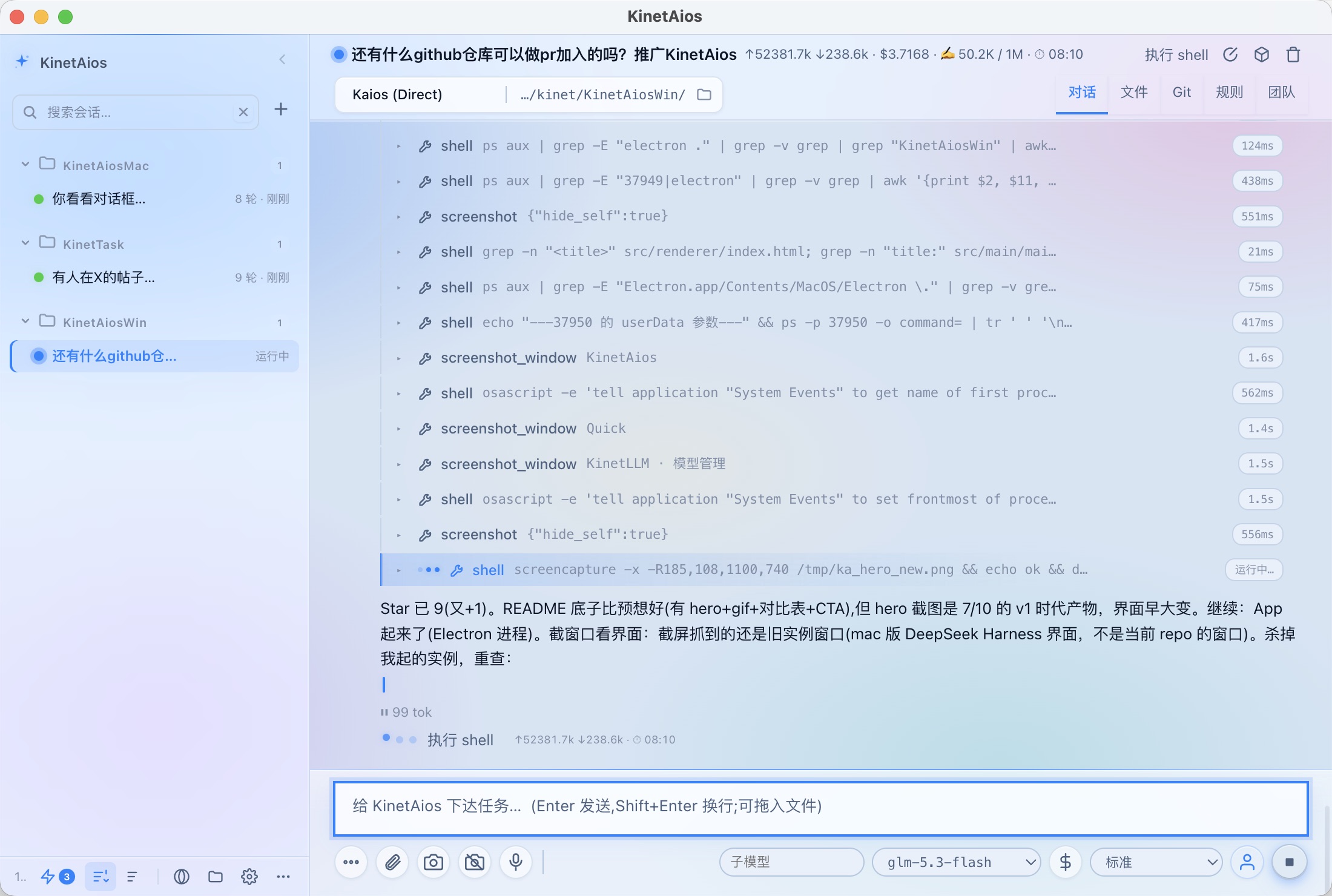
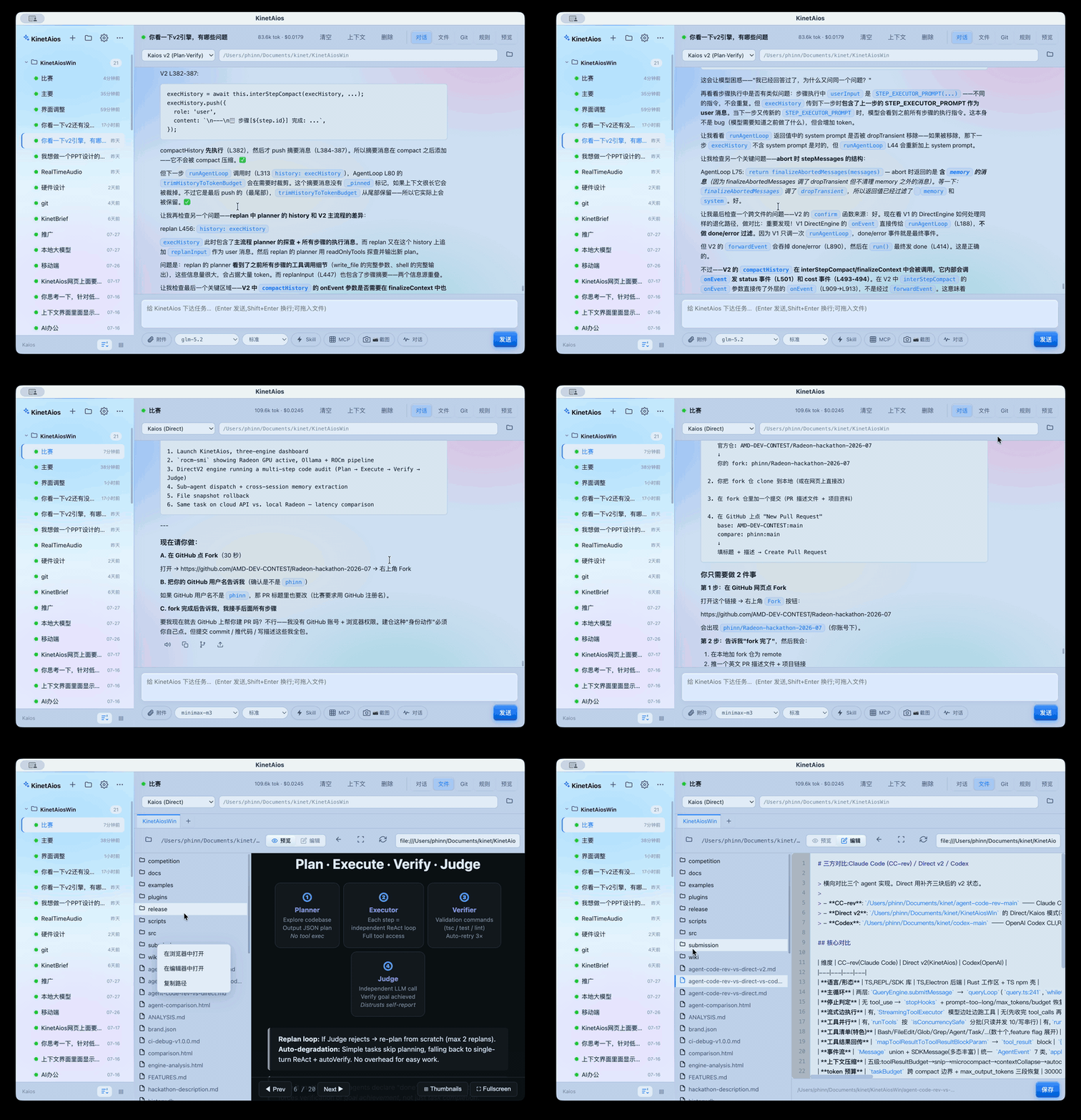
Real session: parallel conversations across projects, engine badge per session (Direct / Claude Code / Codex), file & Git & rules tabs, token-cost accounting per turn.
A local-first AI agent dashboard for Windows 11 and macOS — both first-class platforms (the "Win" folder name is historical; the repo is phinn/KinetAios). Platform differences (cmd.exe vs /bin/sh, hotkey, tray) are routed at runtime; features are aligned on both sides. Run multiple agent sessions concurrently with streaming answers, shell/file/search/MCP tools, SQLite history with long-term memory, a global hotkey, and a per-session model. No account, no relay server — your own LLM API key is the only credential.
The 30-second version:
- 🔀 Four engines, one window — Direct (in-house ReAct) + Claude Code + Codex + DeepSeek Harness; switch per session, hand off context via Pipeline
- 🧠 Long-term memory on local SQLite — auto-extracted facts shared across all engines, survives restarts
- 🔒 Local-first, no account — your API key is the only credential; nothing goes through a relay
- 🛠 30+ built-in tools + MCP client/server + plugins — shell, files, web, screenshots, computer use out of the box
- ⌨️ Global-hotkey quick panel — Spotlight for AI agents, summon from anywhere
- 📊 Benchmarked on a real 400k-row business task — in-house engine 9.2 vs Claude Code 7.0 (full report)
- 🖥 Windows 11 & macOS — both first-class
⭐ If KinetAios saves you time, a Star is the loudest thank-you for a solo open-source project.
Why KinetAios?
Most AI clients lock you into one provider, drop context when you switch engines, and route your conversations through a relay. KinetAios runs four engines in one window, keeps long-term memory across all of them, and never asks for an account.
| KinetAios | Claude Desktop | Cherry Studio | Cursor | Codex Desktop | |
|---|---|---|---|---|---|
| Four engines (Direct V1/V2/V3 + Claude Code + Codex + DeepSeek Harness) | ✅ | — | — | — | — |
| Local SQLite + automatic long-term memory | ✅ | — | — | — | — |
| Cross-engine memory (one user profile shared by all engines) | ✅ | — | — | — | — |
| Multiple parallel sessions | ✅ | — | ✅ | — | ✅ |
| Global hotkey + quick panel | ✅ | — | — | — | — |
| Auto-scan MCP / Skills / Agents | ✅ | ✅ | — | — | — |
| Project rules (AGENTS / CLAUDE / KINET) | ✅ | — | — | ✅ | ✅ |
| Built-in MCP Server (remote agent control) | ✅ | — | — | — | — |
| Plugin system (tools / panels / slash commands) | ✅ | — | — | — | — |
| Multimodal (image input + voice + screenshots) | ✅ | ✅ | — | — | — |
| Session branching + cross-engine Pipeline orchestration | ✅ | — | — | — | — |
| Local-first, no account | ✅ | ✅ | ✅ | — | — |
Install
Grab the latest release:
- Windows —
KinetAios-Setup-<version>.exe(NSIS installer, current: 3.9.3) - macOS — see releases
Unsigned builds → Windows SmartScreen / macOS Gatekeeper will warn; allow it manually.
First launch: click the ⚙ in the top right → paste your API Key (+ base URL / model, defaults to GLM/Zhipu) → hit Test Connection, then send your first task.
🐋 One key for every model? Pick the OrcaRouter preset — an OpenAI-compatible gateway with 200+ models, adaptive routing, zero markup. Sign up with this link to support the project (5% referral credit).
Built-in OrcaRouter preset:
provider: orcarouter          # Settings → Presets → OrcaRouter (multi-model routing)
protocol: openai              # OpenAI-compatible
base_url: https://api.orcarouter.ai/v1
api_key: sk-orca-...          # create in the OrcaRouter console
model: orcarouter/auto        # adaptive routing, or pin a vendor/model e.g. anthropic/claude-opus-4.8
From source
Requires Node.js 18+ and a network connection (the better-sqlite3 native module needs compiling).
git clone https://github.com/phinn/KinetAios.git
cd KinetAios
npm install      # includes postinstall: rebuild better-sqlite3 for Electron
npm run build
npm start
Highlights
Four engines, switchable per session
- Direct V1 (Kaios) — built-in ReAct loop with a dual-protocol provider (OpenAI-compatible & Anthropic, both directions of SSE streaming), tool-level concurrency, sub-agents, context compaction and retries.
- Direct V2 — next-gen ReAct on a Plan-Execute-Verify-Judge architecture, streaming tool calls, step-by-step task lists rendered live in the chat as checklist cards, plus a unified execution loop shared by plan and replan (retry / verification / checkpointing / compaction behave identically on both paths).
- Direct V3 — latest: an intent router picks
fast/standard/deepper query; thedeeppath builds tool calls into a dependency DAG and executes it in parallel — real speedups on multi-step tasks. - Claude Code — spawns
claude -p --output-format stream-json, parses NDJSON, resumes with--resume. - Codex — spawns
codex exec --json, parses JSONL, resumes. - DeepSeek Harness (3.0+) — spawns the
dshCLI over OpenAI-compatible SSE with built-in OpenAI / Pi-AI providers, retries and token billing. Switchable per session like every other engine.
30+ built-in tools
shell (confirm before running; focus guard — if a command steals the foreground it's handed back automatically), read_file, write_file, edit_file (exact replace), grep, glob, web_fetch (SSRF guard + Jina Reader fallback), web_search (Bing → DuckDuckGo fallback), recall_memory, git_diff (read-only, no confirm), remember_fact / recall_fact (session anchors), memory_replace / memory_append (core memory blocks), dispatch_agent (read-only sub-agent with its own context), spawn_team / team_broadcast / team_send / team_close (multi-agent teams), video_gen (MiniMax H3 text-to-video), todo_write (shared task list, rendered live as checklist cards), and more.
Computer Use (native, zero external dependencies)
screenshot(withhide_self— the agent's own window turns transparent during the shot, zero focus stealing),screenshot_window(capture any window by title — even occluded/background ones, no desktop switching).mouse_click/mouse_scroll/mouse_drag,keyboard_type/keyboard_key— coordinates are converted from the last screenshot's pixel space to the platform's action space (DPI / window-origin aware, with staleness expiry).- Backed by Electron desktopCapturer + PowerShell (Windows) / cliclick (macOS) / xdotool (Linux). On macOS, bare
openis mechanically rewritten toopen -gj— the agent never steals your foreground.
MCP integration (client + server)
- Client: the Direct engine auto-connects to MCP servers configured on your system (scans
~/.claude.json,~/.codex/config.toml, Claude Desktop). stdio transport, auto-reconnect after unexpected drops. The 🔌 button shows connected servers/tools. - Server: a built-in MCP Server (HTTP+SSE) exposes a
run_agenttool — remote machines can invoke your local full agent. Token auth (constant-time compare), 5-minute timeout, zombie-connection detection.
Long-term memory + memory graph
- Each turn, durable "facts about the user" are extracted in the background → SQLite → injected into the next turn. Shared across engines and sessions.
- Memory graph visualization: force-directed graph of memory provenance, conflict detection, timeline. Standalone fullscreen window.
- Import/export memories as JSON (backup or migration).
Skills / Commands / Agents / Plugins
- Scans Claude Code's skills + commands + agents and Codex's skills. Invoke via the
/menu or the ⚡ button. - Skills panel (Settings → Skills): aggregates skills from all third-party sources plus plugin contributions, with search, viewing, and direct source editing (plugin skills read-only). Edits take effect immediately.
- Plugin SDK v3: plugins contribute tools, slash commands, hooks, and fullscreen panels. Injected on demand (keyword matching saves ~60% tokens). 21 built-in plugins: office-suite, brainstorm (Excalidraw), math-practice, cpp-learning, low-altitude (drones), an embedded & IoT suite (arduino-dev / platformio-dev / serial-comm / modbus-dev / mqtt-dev / ble-dev / ota-dev / sensor-lookup / logic-analyzer / hw-diag), nestjs-dev, deepseek-harness, claude-code, codex, marketing-kit (marketing research: competitors / SEO / funnel / app-review mining + a marketing console panel), and more.
Sidebar (left to right)
- + new session.
- 📂 Workbench — project cards grouped by cwd, each showing recent activity + cost. A "Context" button edits
KINET-CONTEXT.md. - Live session status — running sessions show the engine's current step (tool executing / retrying / compacting) right under the title in the sidebar, no need to open the channel.
- 📊 Dashboard — standalone window with live token usage, cost stats, engine distribution.
- 🌐 Files — file browsing +
<webview>preview (HTML/SVG/PNG/JPG/PDF) + editor. Multi-tab. The address bar acceptsfile:///http(s):///localhost:<port>. - 🏘️ Town — game-style isometric visualization of remote nodes (other KinetAios instances) on your network.
- 🧠 Memory — memory panel: current channel / all, inline edit/delete, provenance.
- 🔌 Plugins — plugin management: enable/disable, search & filter, category cards.
- ⚙️ Settings — see below.
Main-window tabs (Chat / Files / Git / Rules)
- Chat — streaming output, collapsible tool steps, live token counts, context inspector, screenshots, voice input.
- Files — same as 🌐, following the current session's cwd.
- Git —
git status(left) +git log(right). Click a changed file → side-by-side diff; click a commit → unifiedgit show. - Rules — edit
KinetAios.mdin the cwd (project-level rules, injected into the system prompt).
Pipeline (cross-engine orchestration)
Chain multiple stages, each with its own engine + prompt. The previous stage's output is prepended to the next stage's prompt. 2-minute per-stage timeout polling, abort on failure.
Session branching & handoff
- Branch from any turn — deep-copies turns/steps into a new session.
- Export/import sessions — serializes full session state (turns + history + engine + model + cwd) for cross-machine handoff. Export auto-redacts secrets (API keys, passwords →
[REDACTED]). - Cross-session references — link related sessions, visualized as a DAG.
Context management (Direct engine)
- Context inspector — view/edit each session's
directHistoryarray (JSON editor). - Auto-compaction — when history exceeds the token budget, early turns are summarized by the LLM. Compaction events are visualized (tokens before vs after).
- Per-protocol calibration — token/char ratios are tracked separately per API protocol (OpenAI vs Anthropic) so concurrent sessions don't interfere.
Multimodal (Direct engine)
- Image input: 📎 pick/paste images → vision content parts → OpenAI
image_urlor Anthropic base64 format. - Voice transcription: 🎤 record → Whisper → fills the input box.
- Realtime voice chat: 🎤 → Volcengine Doubao WebSocket two-way voice — natural TTS, live transcription, parallel agent tool execution. See the voice chat wiki.
- Screenshots: 📸 overlay → drag a region → cropped image injected into the prompt.
Global search
Ctrl/Cmd+K overlays a search across all sessions — matching prompt text, answer text, and tool output.
Settings (⚙️)
- Two-column layout: vertical tab nav on the left (Models / Appearance / Engines / Advanced / Security / Messages / Plugins / Skills / Goal / Multi-machine), independent scrolling on the right; narrow windows fall back to horizontal tabs; a search box filters across all panels.
- Providers: OpenAI / Anthropic protocols, base URL, model, key. GLM / DeepSeek / OrcaRouter / OpenAI / Anthropic presets. Zhipu balance check button. Encrypted storage via safeStorage.
- Security: privacy gate (detects sensitive data leaving the machine).
- Behavior: shell approval mode, sandbox level, plan mode, CLI engine toggles, window-close behavior (quit / minimize / tray).
- Pricing: per-model input/output prices for cost calculation.
- Interface: language (English / 简体中文 / 繁體中文 / 日本語), theme (dark / light, live preview).
- Long-term memory: export/import JSON.
Misc
- Per-session model (editable dropdown, OpenAI-compatible + Anthropic dual protocol).
- File attachments: 📎 pick/drop multiple text files (large files read header-only),
@pathreferences to cwd files. KinetAios.md/AGENTS.md/CLAUDE.md— rule files in the cwd are auto-injected into the system prompt.- Tray + global hotkey
Ctrl/Cmd+Alt+Space→ quick panel. - Compact mode: per-turn meta (duration / tokens / cost) hidden by default, shown on message hover; real file paths in tool output are clickable to open.
- Update check against GitHub Releases, shown on the About page.
- Configurable branding (
brand.json), encrypted API key storage (safeStorage: macOS Keychain / Windows DPAPI).
Benchmarks: four engines, one real business task
The same 400k-row medical-device CRM cross-analysis (multi-sheet × hospital tier × time window, producing an interactive ECharts report) — four engines, identical prompt, zero human intervention:
| Engine | Score /10 | Tokens | Key difference |
|---|---|---|---|
| Direct (in-house) | 9.2 | 1.31M | Native SAX-streaming xlsx — the file never enters the context |
| Claude Code | 7.0 | ~2M | Great context management, but no plugin tools — every step detours through Bash+python |
| Codex | 5.5 | ~2.4M | Sandbox-first design, wrong fit for interactive data tasks |
| PEVJ V2 (in-house) | 3.5 | 3.8M+ | Four-layer architecture with no guardrails on verify = token amplifier |
The most valuable finding: 7.5% of API calls burned 63% of the budget. The root cause wasn't the model — it was tool design. The agent read the same large file 16 times sequentially, resending full history each pass. Switching to a streaming reader zeroed that cost.
Full report: methodology + per-dimension scores + step-by-step traces — includes all the gory details of our own engine's 3.5.
Tech stack
- Electron + TypeScript — the main process runs the agent runtime; the renderer is a native web UI.
- better-sqlite3 — SQLite + FTS5 (history /
recall_memoryfull-text search + embedding semantic recall). - No frontend framework — the renderer is vanilla TS + HTML/CSS, bundled with esbuild.
Project layout
KinetAios/               # repo root (the "Win" dir name is historical — it's the cross-platform repo now)
  brand.json               # branding config (product name etc., read at startup)
  package.json
  src/
    shared/types.ts         # types + applyEvent (shared by main/renderer, single source of truth)
    shared/i18n.ts          # four-language string table + t()
    main/
      main.ts               # windows / tray / hotkey / IPC / shell-confirm bridge
      TaskManager.ts        # session management + engine dispatch + memory extraction
      engines.ts            # Engine interface + Direct/ClaudeCode/Codex + cross-platform CLI spawn
      AgentLoop.ts          # ReAct loop (Direct) + history compaction + auto-shrink
      V3/                   # Direct V3: intent router + fast/deep paths (deep = DAG parallel)
      glm.ts                # providers + OpenAI/Anthropic SSE streaming + retries
      updater.ts            # GitHub Releases update check
      tools.ts              # 30+ built-in tools + computer-use glue + focus guard
      computer-use.ts       # screenshot / mouse / keyboard (native APIs)
      mcp.ts                # MCP client (scan + stdio + reconnect)
      mcp-server.ts         # MCP server (HTTP+SSE, run_agent, token auth)
      skills.ts             # skills/commands/agents/plugin scanning
      plugins.ts            # plugin loader (SDK v3: tools/slash commands/hooks/panels)
      store.ts              # better-sqlite3 + FTS5
      settings.ts           # config (encrypted API key, lang, embedding)
    preload/preload.ts      # narrow contextBridge API
    renderer/
      index.html quick.html styles.css
      app.ts                # dashboard logic (chat, sidebar, tabs, context inspector)
      quick.ts              # quick panel logic
      dashboard.ts          # cost/token dashboard window
      arena.ts              # deep-analysis dashboard
      memory-graph.ts       # memory graph SVG visualization
      town.ts               # Town view (remote-node visualization)
      files-pane.ts         # file browsing + webview preview + editor
      code-editor.ts        # code editor (syntax highlighting)
      file-drawer.ts        # file drawer UI
      nexus.ts              # Nexus view
      focus-manager.ts      # focus / focus-trap management
      highlight.ts          # chat code-block syntax highlighting
      markdown.ts           # mini markdown renderer
  plugins/                  # 20 built-in plugins (SDK v3)
Build / develop
npm run build       # tsc (main/preload/shared) + esbuild (renderer) + copy brand.json
npm run typecheck   # typecheck both halves, no emit
npm start           # launch (requires a prior build)
npm run dev         # build + start
Packaging
npm run dist # default target for the current platform
- Windows:
release\KinetAios Setup <ver>.exe(NSIS). Must be built on Windows (cross-building Windows + native modules from macOS is unreliable). - macOS: build a dmg with
npx electron-builder --mac(requires a Mac toolchain). - electron-builder rebuilds
better-sqlite3against Electron's ABI automatically;asar: falseavoids native-module-in-asar loading errors. - Unsigned builds → Windows SmartScreen / macOS Gatekeeper will warn; allow manually. Removing the warning needs a signing cert (+ Apple notarization).
- The icon defaults to Electron's; replace with your own:
build/icon.ico(256×256) on Windows,build/icon.icnson macOS.
Known constraints
- Window-close behavior is configurable (quit / minimize / tray), default minimize. The global hotkey only works while the app is running.
- No cross-building — build Windows installers on a Windows machine or a GitHub Actions
windows-latestrunner, and dmgs on a Mac (native-module rebuild needs the target toolchain). - Platform-specific code paths (shell / PATH / hotkey / tray) should be verified on their target OS.
The Kinet family
KinetAios is part of the Kinet family:
- KinetFit — smart health companion
- KinetAgent — AI automation assistant
- KinetBrief — AI briefing / notes app
- KinetTask — local-first task manager with on-device AI (Mac App Store)