CHAI pentest tool
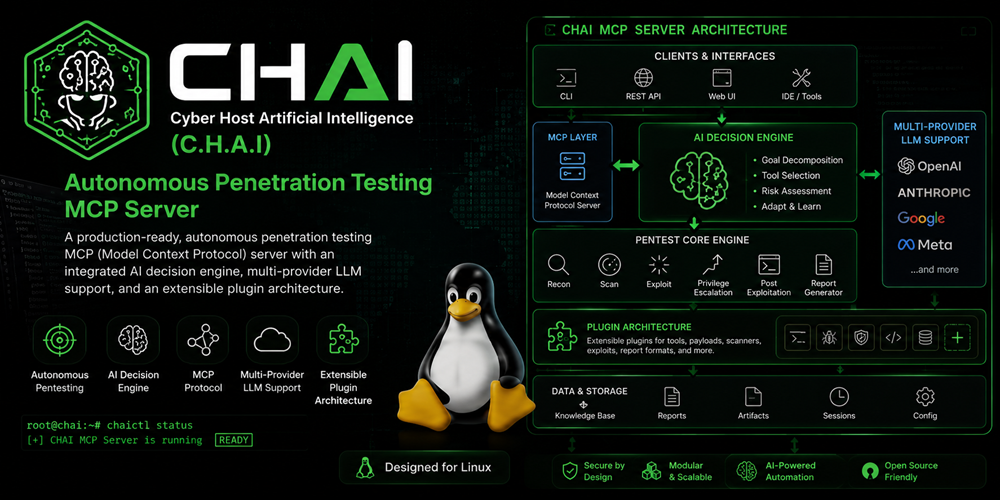
Cyber Host Artificial Intelligence (C.H.A.I) là máy chủ MCP (Model Context Protocol) kiểm thử thâm nhập tự động với công cụ quyết định AI tích hợp, hỗ trợ LLM đa nhà cung cấp và kiến trúc plugin có thể mở rộng.
Tài liệu
CHAI
Cyber Host Artificial Intelligence (C.H.A.I)
A production-ready, autonomous penetration testing MCP (Model Context Protocol) server with an integrated AI decision engine, multi-provider LLM support, and an extensible plugin architecture. Designed for Raspberry Pi 4/5 running Kali Linux ARM64.
External Client (CHAI / any MCP tool)
         │  MCP stdio/SSE
         ▼
┌─────────────────────────────────────────┐
│         MCP Security Server             │
│                                         │
│  run_autonomous_scan()                  │
│         │                               │
│    ┌────▼────────────────────┐          │
│    │   execution_loop.py     │          │
│    │  (local, no LLM here)   │          │
│    │  tool1 → tool2 → tool3  │          │
│    └────┬────────────────────┘          │
│         │ at phase boundaries only      │
│    ┌────▼────────────────────┐          │
│    │   ai_planner.py         │          │
│    │  plan / evaluate /      │◄─────────┼── llm/provider_factory.py
│    │  summarize              │          │   (Azure / OpenAI / Claude /
│    └─────────────────────────┘          │    Bedrock / OpenRouter / HF)
│                                         │
│  All tools, safety, sandbox unchanged   │
└─────────────────────────────────────────┘
Design Philosophy: THIN BRAIN, THICK LOOP
- The internal LLM fires only at decision boundaries, not per-step
- A local
execution_loophandles tool chaining deterministically between LLM calls - Keeps token usage low (~6-10 calls per full pentest) and latency acceptable on a Pi 4
Features
Multi-Provider LLM Support
- Azure OpenAI (GPT-4.1, GPT-4o, GPT-5+, Kimi, DeepSeek via Azure AI Foundry)
- Direct OpenAI (GPT-4.1, GPT-4o, etc.)
- Anthropic Claude (Sonnet, Opus)
- Amazon Bedrock (Claude, Titan, Llama via AWS)
- OpenRouter (100+ models with one key)
- HuggingFace (DeepSeek, Qwen, Llama via Inference API)
AI Decision Engine
- plan(): Decides what to test next based on findings
- evaluate(): Decides whether to continue or stop
- summarize_for_report(): Generates executive summary and remediation priorities
Security & Sandboxing
- firejail profiles with rlimit restrictions
- Linux cgroups for resource limiting
- Restricted user (
pentester) execution - Tiered safety policy (Tier 1/2/3)
- Immutable audit logging of all commands and AI decisions
Plugin System
- Auto-discovers plugins from
plugins/bundled/andplugins/external/ - Drop-in plugin architecture — no core changes needed
- Bundled plugins: Feroxbuster, Metasploit, Burp Suite API
Database
- SQLite ONLY — no Neo4j, Redis, or Postgres required
- WAL mode for better concurrency
- Knowledge graph with 50+ attack techniques and recursive CTE chain queries
Project Structure
CHAI/
├── main.py                          # FastMCP server entry point
├── config.py                        # Configuration loader
├── config.yaml                      # Main configuration (no secrets)
├── .security.yml                    # API keys (git-ignored)
├── requirements.txt                 # Python dependencies
├── app_context.py                   # Application context singleton
│
├── llm/                             # Multi-provider LLM adapter layer
│   ├── base_provider.py             # Abstract base class
│   ├── provider_factory.py          # Provider selection with fallback
│   ├── prompt_templates.py          # All LLM prompts (versioned)
│   └── providers/
│       ├── azure_openai.py          # Azure OpenAI
│       ├── openai_direct.py         # Direct OpenAI
│       ├── anthropic_claude.py      # Claude
│       ├── amazon_bedrock.py        # AWS Bedrock
│       ├── openrouter.py            # OpenRouter
│       └── huggingface.py           # HuggingFace
│
├── core/                            # Core engine
│   ├── session_manager.py           # SQLite session CRUD + state machine
│   ├── safety_policy.py             # Command validation, tier system
│   ├── process_controller.py        # firejail/cgroups/chroot wrapper
│   ├── audit_logger.py              # Immutable audit logging
│   ├── ai_planner.py                # LLM decision engine (3 call types)
│   └── execution_loop.py            # Local chain runner
│
├── kb/                              # Knowledge Base
│   ├── graph_db.py                  # Attack graph with recursive CTE
│   ├── playbook_loader.py           # Playbook section extraction
│   └── vector_search.py             # Vector/BM25 search
│
├── tools/                           # Security testing tools
│   ├── base.py                      # Base tool class
│   ├── recon.py                     # Reconnaissance
│   ├── scan.py                      # Vulnerability scanning
│   ├── injection.py                 # Injection testing
│   ├── auth.py                      # Authentication testing
│   ├── network.py                   # Network testing
│   ├── poc.py                       # PoC generation
│   ├── exec.py                      # Custom command execution
│   ├── analyze.py                   # Findings analysis
│   ├── report.py                    # Report generation
│   └── autonomous.py                # Autonomous scan orchestrator
│
├── plugins/                         # Plugin system
│   ├── plugin_base.py               # Base class
│   ├── plugin_loader.py             # Auto-discovery loader
│   └── bundled/
│       ├── feroxbuster_plugin.py    # Directory bruteforcer
│       ├── metasploit_plugin.py     # Metasploit Framework
│       └── burp_api_plugin.py      # Burp Suite Pro API
│
├── models/                          # Data models
│   ├── session.py                   # Session and Finding models
│   └── schemas.py                   # Pydantic schemas
│
├── utils/                           # Utilities
│   ├── command_parser.py            # Command parsing
│   ├── output_parser.py             # Tool output parsing
│   └── cvss_calculator.py           # CVSS v3.1 calculator
│
└── data/                            # Database schemas & profiles
    ├── init_sessions.sql            # Session DB schema + AI decisions table
    ├── init_graph.sql               # Knowledge graph (50+ nodes)
    └── firejail/
        └── pentest.profile          # Firejail sandbox profile
Installation
Prerequisites
- Any linux machine / Raspberry Pi 4/5 with Kali Linux ARM64 (bare metal, NO Docker)
- Python 3.11+
- firejail installed
- Kali Linux pentest tools (nmap, sqlmap, nuclei, ffuf, etc.)
Setup
# Clone the repository
git clone https://github.com/NIHAR-SARKAR/CHAI.git
cd CHAI

# Create virtual environment
python -m venv .venv
source .venv/bin/activate -- linux
.venv\Scripts\activate    -- windows

# Install dependencies
pip install -r requirements.txt

# Configure secrets
cp .security.yml.example .security.yml
chmod 600 .security.yml
# Edit .security.yml with your API keys

# Create required directories
### linux
sudo mkdir -p /opt/sessions /opt/logs /opt/kb /opt/mcp-security-server/plugins/external
sudo chown -R $(whoami) /opt/sessions /opt/logs /opt/kb

### windows PowerSheel
New-Item -ItemType Directory -Force -Path "C:\opt\sessions"
New-Item -ItemType Directory -Force -Path "C:\opt\logs"
New-Item -ItemType Directory -Force -Path "C:\opt\kb"
New-Item -ItemType Directory -Force -Path "C:\opt\mcp-security-server\plugins\external"

icacls "C:\opt" /grant "$env:USERNAME:(OI)(CI)F" /Ts -- Grant current user full permissions

# Install firejail profile
sudo cp data/firejail/pentest.profile /etc/firejail/


# run server
python main.py --transport streamable-http
Configuration
config.yaml (Main Config)
Edit config.yaml to configure:
- Server transport (stdio or SSE)
- Sandbox limits (RAM, CPU, timeout)
- LLM provider selection
- Plugin enable/disable
Key sections:
llm:
  active_provider: "azure_openai" # Change to your preferred provider
  fallback_provider: "openrouter" # Optional fallback

ai_planner:
  max_phases: 4 # Max autonomous phases
  stop_on_critical: true # Stop on critical findings

plugins:
  bundled:
    feroxbuster: true
    metasploit: false # Disabled by default (Tier 3)
    burp_api: false # Needs Burp Pro API key
.security.yml (Secrets)
# NEVER commit this file
azure_openai:
  api_key: "your-azure-key"

openai:
  api_key: "your-openai-key"

anthropic:
  api_key: "your-anthropic-key"

# ... etc for each provider
CHAI Integration
Add to your CHAI config.json:
stdio transport:
{
  "tools": {
    "mcp": {
      "servers": {
        "chai-security": {
          "transport": "stdio",
          "command": "python",
          "args": ["-m", "main.py"],
          "cwd": "/opt/mcp-security-server",
          "env": {
            "PYTHONPATH": "/opt/mcp-security-server"
          },
          "discovery": "deferred"
        }
      }
    }
  }
}
SSE transport (for remote Pi access):
{
  "tools": {
    "mcp": {
      "servers": {
        "chai-security": {
          "transport": "sse",
          "url": "http://raspberrypi.local:9010/sse"
        }
      }
    }
  }
}
Usage
Initialize a Session
initialize_session(
    target="https://target.example.com",
    test_type="web_app",
    scope=["target.example.com"]
)
# Returns: {"session_id": "sess-abc-123", ...}
Run Autonomous Scan (One Call, Complete Test)
run_autonomous_scan(
    session_id="sess-abc-123",
    max_phases=4,
    stop_on_critical=True,
    generate_report=True,
    provider_override=None  # Uses config.yaml active_provider
)
# Internally: plan → [recon → scan → inject] → evaluate → plan → [...] → report
# Returns after ~15-30 min:
# {
#   "phases_completed": 3,
#   "total_findings": 12,
#   "critical_count": 1,
#   "high_count": 4,
#   "report_path": "/opt/sessions/reports/sess-abc-123.md",
#   "status": "complete"
# }
Manual Tool Calls
# Reconnaissance
run_recon(session_id="sess-abc-123", target="target.example.com", recon_type="passive")

# Vulnerability scanning
scan_vulnerabilities(session_id="sess-abc-123", target="target.example.com", scanner="nuclei")

# Injection testing
test_injection(session_id="sess-abc-123", target="target.example.com", injection_type="sqli")

# Authentication testing
test_authentication(session_id="sess-abc-123", target="target.example.com", test_type="bypass")

# Network testing
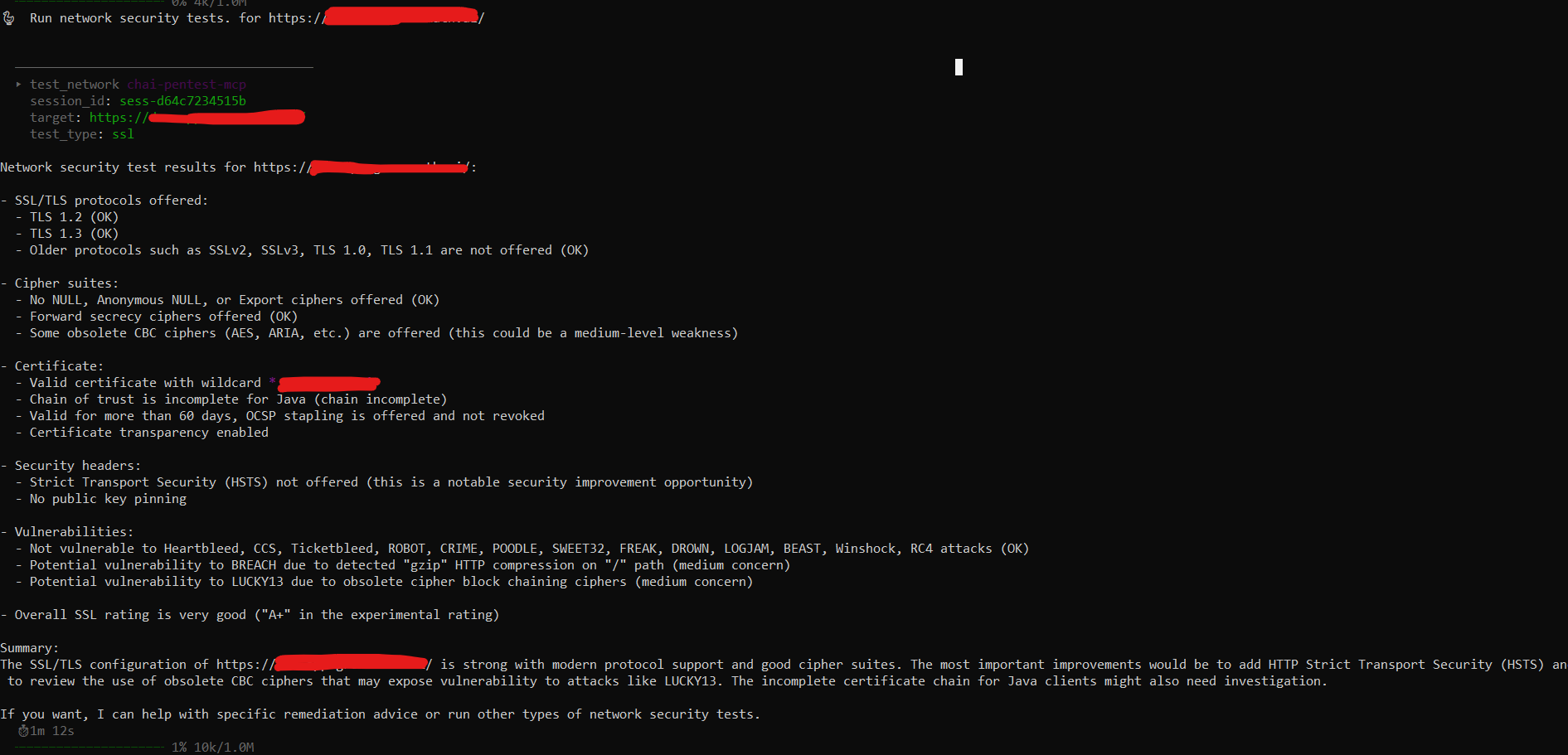
test_network(session_id="sess-abc-123", target="target.example.com", test_type="ssl")

# Custom command
execute_command(session_id="sess-abc-123", command="nmap -sV target.example.com")

# Run plugin
run_plugin(session_id="sess-abc-123", plugin_name="feroxbuster", target="https://target.example.com")

# Generate report
generate_report(session_id="sess-abc-123", format="markdown")

# Check status
get_session_status(session_id="sess-abc-123")

# Emergency stop
emergency_stop(session_id="sess-abc-123")
Adding a New LLM Provider
Step 1 — Create llm/providers/gemini.py:
from llm.base_provider import BaseLLMProvider, LLMResponse

class GeminiProvider(BaseLLMProvider):
    def __init__(self, config): ...
    @property
    def provider_name(self): return "gemini"
    async def complete(self, ...): ...
    async def health_check(self): ...
Step 2 — Add one case to llm/provider_factory.py:
case "gemini":
    from llm.providers.gemini import GeminiProvider
    return GeminiProvider(config)
Step 3 — Add config block to config.yaml:
llm:
  gemini:
    enabled: true
    model: "gemini-2.5-pro"
    api_base: "https://generativelanguage.googleapis.com/v1beta/openai"
Step 4 — Add key to .security.yml:
gemini:
  api_key: ""
Step 5 — Change active_provider: "gemini" in config.yaml.
That's it. No other files change.
Adding a New Pentest Plugin
Step 1 — Create plugins/external/gospider_plugin.py:
from plugins.plugin_base import PentestPlugin, PluginMetadata, PluginResult

class GospiderPlugin(PentestPlugin):
    @property
    def metadata(self):
        return PluginMetadata(
            name="gospider", display_name="GoSpider Web Crawler",
            version="1.1.6", description="Fast web spider",
            tier="tier1", requires_binary="gospider",
            tags=["web", "recon", "crawler"],
        )
    async def run(self, session_id, target, args, process_controller, safety_policy, session_manager):
        # Build command, validate through safety_policy, execute via process_controller
        ...
Step 2 — Restart the server. The plugin auto-loads.
That's it. No changes to core application.
LLM Call Budget
For a 4-phase autonomous scan:
- Phase 1: plan() + evaluate() = 2 calls
- Phase 2: plan() + evaluate() = 2 calls
- Phase 3: plan() + evaluate() = 2 calls
- Phase 4: plan() + evaluate() = 2 calls
- Report: summarize_for_report() = 1 call
- Total: ~9 LLM calls per full pentest
This keeps token usage low and latency acceptable on a Raspberry Pi 4.
Safety & Compliance
- Command denylist: Dangerous commands (rm -rf /, fork bombs, etc.) are blocked
- Tier system: Tools classified by risk (Tier 1/2/3)
- Scope checking: Commands validated against defined scope
- Rate limiting: Per-tier concurrent execution limits
- Sandboxing: All commands run through firejail with resource limits
- Audit trail: Every command and AI decision is logged immutably
License
MIT License — See LICENSE file for details.

Contributing
- Fork the repository
- Create a feature branch
- Make your changes
- Add tests (pytest)
- Submit a pull request
Support
For issues and questions:
- GitHub Issues: https://github.com/NIHAR-SARKAR/CHAI/issues
- Documentation: https://github.com/NIHAR-SARKAR/CHAI/blob/main/README.md
- Site Url: https://aithread.in