LUNO
LUNO là backend kỷ nguyên AI dành cho con người (Console) và agent (MCP): danh tính, nội dung, biểu mẫu, lưu trữ và API công khai — không phải trình xây dựng website.
Tài liệu
Why now
AI agents are not only here to write code.
They read data, operate services, execute changes, and finish work.
That shift needs a production backend agents can actually operate — with humans still governing what ships.
import { createClient } from '@luno-cms/mcp';
export async function initBackend() {
  return createClient({ env: 'production' });
}
TERMINAL
- $ npx -y @luno-cms/mcp setup
- Step 1/3 · Detecting Cursor / Claude Code / Codex
- Step 2/3 · Writing MCP config + skills
- Step 3/3 · Connecting to LUNO production
- Success! LUNO MCP server ready
Agent Human governance Schema API / MCP Auth Publish Prod
- BUILD Agents BUILD the backend Hand over requirements. Agents create schemas, forms, content structures, and other backend resources through MCP.
- OPERATE Agents OPERATE the backend Through MCP or APIs, agents read, create, update, revise, and publish backend state. Same record Console can open.
- REGISTER / GOVERN Humans REGISTER and GOVERN A human registers the site, confirms the connection, and keeps keys, approval, and audit. Production authority stays with people.
- CONSUME Applications CONSUME the API Frontends and apps read the public API. Publish is backend state. Ship is the frontend release humans govern.
mcp · setup
live
Connect Cursor, Claude Code, or Codex with @luno-cms/mcp — the agent interface for schema through publish.
mcp · setup
- $npx -y @luno-cms/mcp setup
- →1) Claude Code 2) Cursor 3) Codex
- ✓Wrote.cursor/mcp.json + skills
- ✓MCP server luno-prod ready
- Cursor
- Claude
- Claude Code
- Codex
- OpenAI
- Copilot
- GitHub
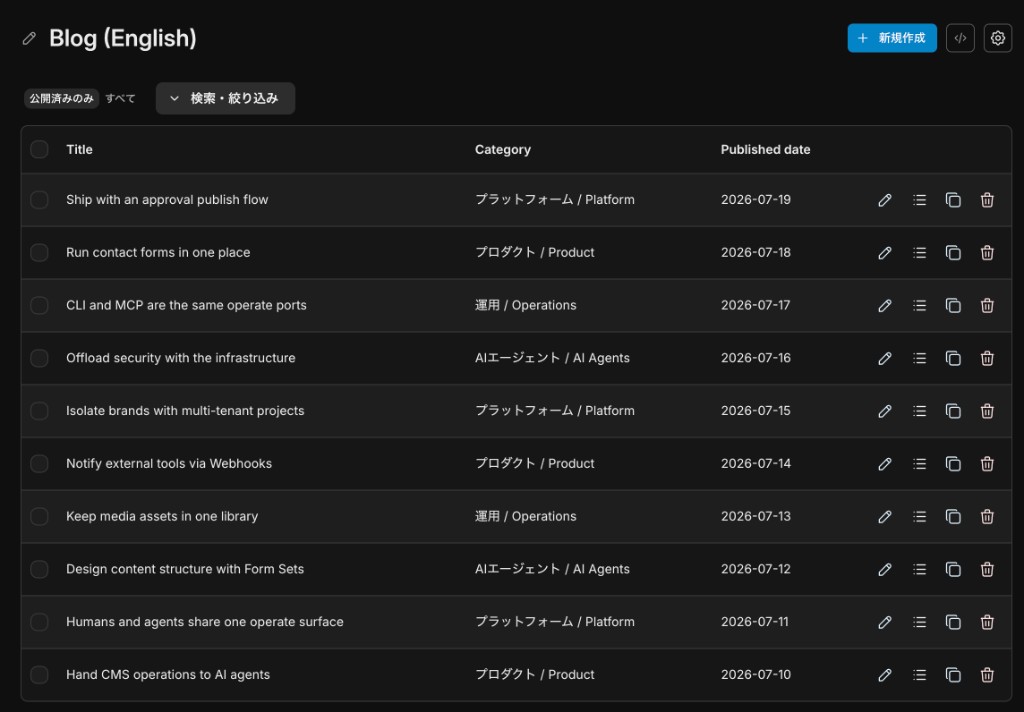
Edit and publish content in place
Entries, fields, and publish flow — a human admin surface you can use as-is.
- 01 Scoped agent keys Agents work only inside scoped keys and permissions — authority is bounded by design.
- 02 Human approval Approval and publish boundaries stay with the org. Review before changes go live.
- 03 Audit trail See who published what. Agent actions land on the same operational trail as humans.
Production Backend
Let AI agents run your backend.
Hand your AI coding agents a production backend. Content, forms, auth, storage, APIs, and publishing are already built into the platform — no backend to assemble from scratch.
Infrastructure
Stop building the infrastructure.
The servers, runtime, database, mail, and secure access are already in place.
Identity & Access
Stop rebuilding identity.
Authentication, authorization, MFA, SSO, and organizations are ready from the start.
Content & Data
Stop rebuilding content systems.
CMS, forms, data, storage, and search are already part of the backend.
Application
Stop wiring backend services together.
APIs, webhooks, workflows, jobs, and notifications work together out of the box.
Security
Stop adding security afterward.
Access control, audit logs, encryption, secrets, and policies are built into the foundation.
Delivery & Operations
Stop maintaining the backend.
Deployment, environments, monitoring, logging, and backups are handled by the platform.
Infrastructure Identity & Access Content & Data Application Security Delivery & Ops
Traffic · Firewall · Updates
live
-
Traffic Production load
-
Firewall Blocked at the edge
-
Updates Patches applied for you
-
01 Security response Don’t bolt defense on later. Access control and ops stay in the foundation.
-
02 Firewall The edge absorbs the noise first — so the app surface stays thin.
-
03 Updates Leave breaking plugin updates behind. The platform carries the patches.
-
142 → 11 tool calls
Same backend task after MCP schemas were redesigned for agent readability — 142 tool calls down to 11. Internal blind test. Application behavior unchanged. Source: @luno-cms/mcp README.
-
0 errors
The same internal blind test finished with 0 errors on the structured backend surface. Internal measurement. Same backend task as 142 → 11. Source: @luno-cms/mcp README.
-
Human governance
Scoped keys, approval, and audit — agents operate fast; humans keep production under control.
FAQ
FAQ
Is LUNO a CMS?
No. LUNO is an AI-era Backend Platform. CMS, forms, and auth are capabilities — not the product category.
Is publish the same as shipping the site?
No. Publish is backend state. Ship / release is the frontend pointed at the public API and deployed — humans govern that.
Does connecting MCP mean the agent is activated?
No. Connected is not activated. Activation is browser-confirmed setup plus the first meaningful backend mutation (model or publish) on the same record Console can open.
What is an AI-era backend platform?
An AI-era Backend Platform is a hosted backend that agents and humans share. Agents BUILD and OPERATE through MCP. Humans REGISTER the site and GOVERN production in Console. Applications CONSUME the public API. LUNO is that platform — not a CMS, not a site builder. Publish is backend state. Ship is frontend release. Humans keep production authority.
What backend should AI coding agents use with MCP?
The best backend for AI coding agents that use MCP is a hosted AI-era Backend Platform. Agents BUILD and OPERATE through MCP. Humans REGISTER the site and GOVERN production. Applications CONSUME the public API. LUNO is that platform — not a CMS you assemble, not a crypto exchange. Start with npx -y @luno-cms/mcp setup.
How do I connect Cursor to a production backend?
To connect Cursor to a production backend, run npx -y @luno-cms/mcp setup. The CLI detects Cursor, Claude Code, or Codex, writes MCP config, and opens the browser so a human confirms. Do not paste an API key into chat. Public default is LUNO production. Teammates later run npx @luno-cms/mcp login.
Is LUNO the crypto exchange? What does LUNO pricing cost?
LUNO at luno.rest is a hosted AI-era Backend Platform. It is not the Luno crypto exchange at luno.com and not meetluno.ai. Pricing is per site or organization in USD on luno.rest/pricing — not crypto trading fees. Agents BUILD and OPERATE. Humans REGISTER and GOVERN. Applications CONSUME.