OpenInvestOp
Công cụ quyết định đầu tư cấp nghiên cứu cho các tác nhân AI: ủy ban đa tác nhân độc lập, phán quyết có thể kiểm toán, kiểm tra ngược với bảo vệ nhìn trước, công bố kết quả tiêu cực
Tài liệu
openInvest
A self-hosted investment decision engine built for modern AI agents. Multi-agent information isolation and cross-challenge protocol, providing an auditable decision trail (Audit Trail).




What is OpenInvest?
OpenInvest is a self-hosted investment decision engine built for modern AI agents.
It provides a verifiable investment committee, evidence-based reasoning, long-horizon backtesting, and auditable decision records. Instead of replacing Claude Code, Codex, Hermes, or OpenClaw, OpenInvest is designed to power them.
Live Performance & PnL
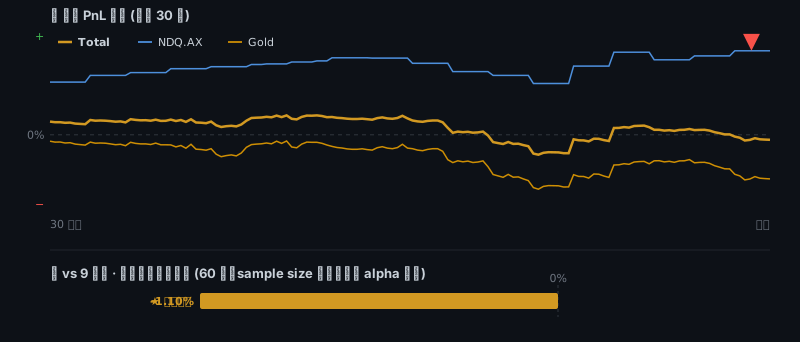 Data feed is automatically updated every 2 hours using `jobs/pnl_snapshot` and pushed to the pnl-data branch
Upper half: 30-day net asset value trend · Lower half: Net asset value comparison against 8 benchmark assets (transparent disclosure, not an alpha claim—the committee's proven value is discipline and transparency, not excess return, see ADR-023)
📌 Note: The current chart shows the author's live production portfolio. After self-hosting, the system will automatically render your own equity curve based on the holdings defined in your `memory/` directory.
- Benchmark Portfolio: The system introduces 8 standard control benchmarks across 4 quadrants (AI advisors / Mutual funds / Wealth management / Broad market index). For details on the comparison methodology and data cleaning logic, see docs/wiki/README.md.
Research & Falsification
System Self-Disclosure: This system is an auditing tool to eliminate human investment cognitive biases and enforce reasoning transparency, not a return-amplifying black box. Latest automated audit (docs/verdict_accuracy.md): Directional verdicts (excluding HOLD) have a true hit rate of 42.2% (n=56, below random); HOLD accounts for 56% of all decisions. The system's value lies in transparency and discipline (mostly staying inactive, low turnover), not directional prediction. Detailed log stream can be found in docs/verdict_accuracy.md.
This project systematically attempts to falsify its own edge and publishes negative results as-is. The deterministic features the committee reads, and the timing signals around them, were tested against pre-registered statistical gates — none survived as tradable alpha.
| Test | Result | Verdict |
|---|---|---|
| Q1 cross-sectional stock picking | 6 features, mean-IC 0.025–0.067, Holm-corrected p=0.397 | No significant stock-picking signal |
| M1 multivariate GBM (out-of-sample) | mean OOS IC +0.003, p=0.925 | Feature combination doesn't help either — no signal |
| Q2 gold MA200 trend | p_holm=0.016, significant — but trend_dca shows it is beta, not tradable alpha: timing terminal value 3.07 vs 15.10 buy-and-hold, Sharpe +0.36 vs +0.68, max drawdown deeper (−57% vs −44%) | Statistically significant, economically untradable |
| Per-asset multi-signal families | 3 assets × 4 signal families × parameter grid = 24 variants per asset; after costs + DSR deflation, none passes DSR > 0.95 | No tradable signal in any family |
| Positive control | A cheating perfect-foresight timing signal scores DSR = 1.00 | The harness can detect a real signal |
Methodology: Newey-West HAC t-statistics, Deflated Sharpe Ratio (Bailey & López de Prado 2014, re-derived equation by equation), Holm correction, zero lookahead, and LLM training-cutoff probes.
Details: experiments/signal-eval/README.md · docs/verdict_accuracy.md · ADR-022 · ADR-023
Product Philosophy
Most AI investment assistants try to become better chatbots. OpenInvest instead builds a transparent, verifiable, and auditable decision engine that plugs into personal agents such as Claude Code, Codex, Hermes, and OpenClaw — every improvement in those agents automatically makes OpenInvest more capable.
The division of labor is deliberate: your agent handles long-term memory, natural conversation, and user understanding; OpenInvest handles the verifiable investment committee, evidence-based reasoning, long-horizon backtesting, and auditable decision records.
                   User
                     │
         ┌───────────┴───────────┐
         ▼                       ▼
    Your Agent             OpenInvest
(User Understanding)   (Market Understanding)
         │                       │
         └───────────┬───────────┘
                     ▼
            Better Investment Decisions
Your agent knows you. OpenInvest knows investing.
Avoiding User Ownership
OpenInvest intentionally avoids "owning" the user. Most AI products try to own everything—memory, persona, chat history, and workspaces. OpenInvest takes a back seat. It exposes clean APIs, CLI commands, and agent skills (Claude Code / Codex / Hermes / OpenClaw), letting your primary agent manage the conversation and context while OpenInvest powers the underlying investment intelligence.
Features
- Multi-Agent Investment Committee: Isolated analysis and round-rebuttal debate.
- Coordinator-Worker Architecture: Prevents context contamination and role hallucination.
- Information Isolation: Rigidly blocks quant and risk analysts from out-of-boundary contexts.
- Auditable Decision Trail: Clean logs showing exactly "why" each decision was made.
- Markdown-as-a-Database: Frontmatter (YAML) + Markdown (Body) as the single source of truth.
- Long-Horizon Backtesting: Built-in test harness with lookahead bias protections.
- Dreaming-Based Memory Consolidation: Nightly memory distillation to prevent context drift.
- Self-Hosted / Zero-Cost: Powered directly by your local agent's reasoning resources.
- Agent Skill: Lightweight plugin for Claude Code / Codex / Hermes / OpenClaw, with interactive bootstrap wizard.
- Automated Deployment: GitHub Actions workflow to run the committee and email reports daily.
Quick Start
1. Integrate with your agent (Recommended)
Add the lightweight skill from your agent's plugin registry. The host agent will automatically pull the core code and align dependencies on first run:
# Claude Code
/plugin marketplace add longsizhuo/openInvest
/plugin install invest@openinvest

# Codex
codex plugin marketplace add longsizhuo/openInvest

# Hermes Agent
hermes plugins install longsizhuo/openInvest --enable

# OpenClaw
openclaw plugins install clawhub:openinvest
Any other MCP client: register the MCP server from step 2 below (full walkthrough in the agent tutorial).
2. Standalone — MCP server or CLI (no clone needed)
The backend ships on PyPI; ~/openInvest holds only your data:
# MCP (18 tools, any MCP client; add --http for a remote streamable-HTTP server — BETA)
claude mcp add openinvest -e INVEST_HOME=~/openInvest -- uvx openinvest-mcp

# or plain CLI
INVEST_HOME=~/openInvest uvx openinvest status
Send set up invest (or 帮我初始化 invest) to any skill-enabled AI terminal. The system will trigger an interactive bootstrap wizard to guide you through:
- Detecting the
memory/state storage path and.envconfiguration. - 5-dimensional profiling (Legal name, Risk capacity, Debt structure, Initial holdings, and optional keys).
- Running static data migration to immediately generate your first asset exposure memo.
💡 Zero-Cost Execution: In skill interactive mode, the committee's underlying reasoning relies entirely on the host agent's (e.g. Claude Code) reasoning pipeline. No third-party API Key is consumed. You only need to configure an API key when setting up automated crons or calling independent Web APIs.
For self-hosting details, see docs/QUICK_START.md. (The bundled Web GUI was retired on 2026-07-05 — all capabilities are exposed via CLI/MCP; a standalone frontend may return later.)
3. Serverless Self-Hosting (GitHub Actions)
Run the committee automatically via GitHub Actions and receive daily digest emails.
⚠️ Fork must be set to Private: State files (holdings, verdicts) will be committed back to your fork. Public forks will leak your private financial information.
- Fork this repository and change its visibility to Private (Settings -> Visibility).
- Run
set up investlocally to generate the initialmemory/folder, then commit and push it to your private fork:git add -f memory/ && git commit -m "chore: init memory state" && git push - In your fork's Settings -> Secrets and variables -> Actions, add the following Secrets:
LLM_API_KEY(orDEEPSEEK_API_KEY): API key to run the committee.EMAIL_SENDER/EMAIL_PASSWORD: Gmail address + App Password.DIGEST_EMAIL_TO: Recipient email address.
- Enable Workflows under the Actions tab. The workflow runs automatically at 10:00 AM (Beijing time) daily; you can also manually trigger
daily-reportvia Run workflow.
Architecture & Multi-Agent Orchestration
openInvest does not run a mock debate in a single LLM session. The system enforces an Information Isolation Contract at the core/committee/ layer, orchestrating 4 independent LLM processes in a directed acyclic graph (DAG):
                [ Macro Data Injection ]
                           │
                 ▼ 1. Macro Alignment Context
             ┌──────────────────────────┐
             │    Macro Strategist      │ (VIX / Interest rate spread / Currency momentum)
             └─────────────┬────────────┘
                           │
                 ▼ 2. Async Multi-Dimensional Scrutiny (Async DAG)
             ┌─────────────┴────────────┐
             ▼                          ▼
   ┌──────────────────┐        ┌──────────────────┐
   │  Quant Analyst   │        │   Risk Officer   │
   │ (RSI / Momentum) │        │ (Concentration)  │
   │                  │        │                  │
   │ 🛑 No Holdings   │        │ 🛑 No Indicators │
   └─────────┬────────┘        └─────────┬────────┘
             │                           │
             └─────────────┬─────────────┘
                           │
             ▼ 3. Round 2 Rebuttal & Cross-Challenge
             │ Mutual feedback loop for signal correction
             ▼
   ┌──────────────────────────────────────────────┐
   │         Chief Investment Officer (CIO)       │
   └───────────────────────┬──────────────────────┘
                           │
             ▼ 4. Deterministic State Persistence
          [ BUY / ACCUMULATE / HOLD / TRIM / SELL ]
- Macro Strategist: Assesses the global macro landscape (VIX, yield curve spread, core currency matrix) to establish the portfolio's risk threshold.
- Quant Analyst: A pure mathematical momentum and technical indicator filter. Strictly blocked from knowing portfolio holdings to eliminate human attachment and loss-aversion biases.
- Risk Officer: Focuses entirely on tail risks (drawdown buffers, concentration limits, solvency multipliers). Strictly blocked from technical indicators to make objective asset exposure rulings.
- Round 2 Rebuttal: Quant and Risk analysts are fed each other's Round 1 reports in Round 2, challenging boundaries until signals converge or safety valves trigger.
- CIO (Chief Investment Officer): Synthesizes the audited reports and outputs a structured
Verdict(BUY / ACCUMULATE / HOLD / TRIM / SELL) with a confidence level. No auto-order execution occurs; final action remains strictly up to the human auditor.
Key trade-offs behind this design are recorded as ADRs in docs/wiki/adr/ (24 to date), including rulings that overturned our own earlier designs — ADR-007 retired the few-shot CIO route, and ADR-009 rejected TA-style analyst agents after a pre-registered experiment.
Core Design
- Coordinator-Worker Pattern: Workers operate in isolated namespaces. Boundary constraints are hardcoded at the framework layer in Python to prevent attention contamination in large multi-role prompts.
- Markdown-as-a-Database: The system uses Frontmatter (YAML) + Markdown (Body) as the single source of truth. Leveraging
fcntl.flockprocess file locks and temporary atomic file replacement, it provides a tamper-proof investment audit trail natively tracked by Git. - Three-Phase Dreaming Consolidation: Distills daily decisions against actual market outcomes nightly (Light Sleep $\rightarrow$ REM $\rightarrow$ Deep Sleep) to consolidate long-term insights, preventing Large Language Model (LLM) context drift over long execution spans.
Configuration
The system defaults to DeepSeek endpoints and supports any standard OpenAI-compatible API. LLM provider setup and all tunable runtime overrides (ADR-017) are documented in docs/wiki/22-configuration.md.
Disclaimers & Backtest Limitations
- No Financial Advice: This system is a decision-support tool powered by LLMs. Output memos represent simulated reasoning based on deterministic data and do not constitute asset allocation advice.
- Backtest Time-Lock & Lookahead Guard: The backtest engine (
scripts/backtest_runner.py) has a hardcoded safety valve: it rejects backtests fordecision_date > 2024-06-30by default (override with--allow-lookahead). Since mainstream foundation models have training cutoff dates around mid-2024, backtesting on later intervals introduces severe Lookahead Bias (model pre-training leakage). Parameter tuning, Optuna sweeps, and prompt optimization must run strictly on historical windows prior to June 30, 2024.
Acknowledgments
- MiMo — Special thanks to MiMo Quantitative Lab for sponsoring production-grade high-performance LLM inference (powering
mimo-v2.5-prolong-horizon sweeps). - OpenClaw Dreaming Guide — Theoretical foundation for the three-phase sleep-cycle memory distillation framework.
License
This project is licensed under the MIT License - see the LICENSE file for details.