Loreto Skills Generator
Đưa bất kỳ video YouTube, bài viết, PDF hoặc hình ảnh nào vào API Loreto và nhận các gói kỹ năng sẵn sàng sản xuất, hoàn chỉnh với SKILL.md, tập lệnh kiểm thử và mã tham chiếu.
Tài liệu
loreto-mcp
Stop re-explaining your codebase. Every codebase keeps rules no one wrote down: where code goes, how big a change is, what has to change together, what was reverted and why. Loreto reads them from your git history and installs them as a harness your coding agent loads, so every pull request it opens reads like your team wrote it.
Then, before your agent writes a line, Gitology tells it whether to build it that way in this repository, with the commits to prove it.
Works with Claude Code, Codex, Muse Code, OpenCode, Hermes and Cursor.
What the harness holds
Written from the repository's own history, with the figure behind every rule:
| File | Claude Code path | What it does |
|---|---|---|
| Root file | CLAUDE.md (or AGENTS.md) | Read on every session: what the repo is and the rules that matter most. Merged between loreto markers; your own file is kept. |
| Conventions skill | .claude/skills/<repo>-conventions/SKILL.md | How a change is made here: where code goes, sizing, naming, testing. |
| Reviewer | .claude/agents/<repo>-conventions-reviewer.md | Checks a change against the repo's own thresholds before a human has to. |
| References | …/references/conventions.md, hotspots.md, coupling.md, lessons-from-reverts.md | The evidence: conventions, the files the work lands in, what moves together, what had to be undone. |
Each agent gets its own layout (AGENTS.md + .agents/skills/ for Codex and Muse Code, .cursor/rules/ for Cursor, ~/.hermes/skills/ for Hermes). list_agents shows them.
Pricing
Reading a repository and seeing what its harness would hold is free. The harness is $5, or $2 a file (three files cost the same as all of them). No subscription. Each purchase includes 25 questions to the repository.
Install
claude mcp add loreto -- uvx loreto-mcp
Or in any MCP client config:
{
  "mcpServers": {
    "loreto": { "command": "uvx", "args": ["loreto-mcp"] }
  }
}
No API key is needed for public repositories. To keep purchases on your Loreto account, and to read private repositories you have connected to Loreto through GitHub (read-only), add your key from loreto.io/dashboard:
"env": { "LORETO_API_KEY": "lor_..." }
Tools
| Tool | Cost | What it does |
|---|---|---|
list_agents | free | The supported agents and where each reads its files. |
read_repo(repo, agent) | free | Reads the history; returns what it says, the files, the prices and a read_id. |
buy_harness(read_id, agent, files?) | $5 / $2 a file | Returns a Stripe checkout link for the person to pay. The agent cannot pay. |
get_harness(path) | — | After payment: waits for the files and installs them into the repository at path. |
ask_repo(question) | included | Why was this reverted? Who knows this code? Answered from the history. |
check_approach(approach, path?) | free, local | Should I build it this way here? Good to go, risky or don't merge, with the evidence and a better route. Runs Gitology. |
plan_change(request, path?) | free, local | A change kit: SPEC.md, and STEPS.md small enough for a small model to build. Runs Gitology. |
A typical session:
You: arm Claude Code with this repo
Agent: (read_repo) Half of the last 400 commits touch 2 files or fewer…
src/api/routes.pyandsrc/api/schema.pychanged together 17 times… The harness is $5. (buy_harness) Here is the checkout link.You: paid
Agent: (get_harness) Armed Claude Code:
~ CLAUDE.md (kept yours, added the Loreto section),+ .claude/skills/…
Gitology: ask before you build
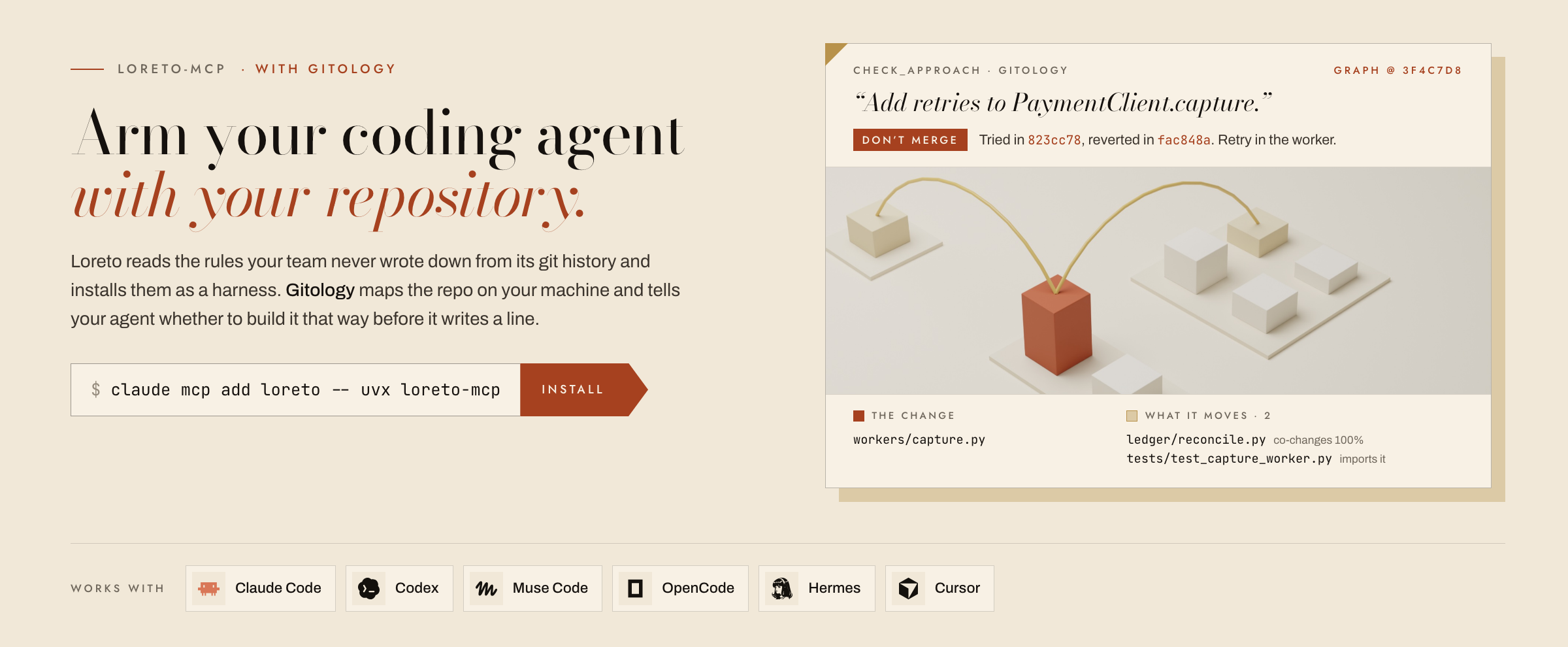
Gitology maps a repository on your machine into a graph of what exists (modules, files, symbols, endpoints, tests, decision records, owners) and how it holds together (imports, changes-with, reverted-by, tested-by), and keeps it current through git hooks. check_approach and plan_change call it:
You: add retries to PaymentClient.capture
Agent: (check_approach) DON'T MERGE. This exact change was made in
823cc78, captured cards twice, and was reverted infac848a; ADR-014 says retries belong in workers. Better route: wrap the call inCaptureWorkerwithwith_backoff. (plan_change) Kit written: 4 steps.
Install it once (Python 3.9+), and the tools find it:
curl -fsSL https://loreto.io/gitology/install.sh | sh
The graph is built locally. Only the verdict and the change kit call a model, they send it the excerpts and history that bear on the question, and the model can be local: set GITOLOGY_MODEL=ollama:<model>, or ANTHROPIC_API_KEY / OPENAI_API_KEY in the MCP server's env. Gitology also runs on its own as a CLI and MCP server: see loreto.io/gitology.
For agents with a wallet: x402
An agent holding USDC on Base can buy without a person or a browser, over x402. The harness is written before anyone pays, and the paid call answers with the files, so a payment settles only on a delivery:
POST https://api.loreto.io/api/v1/harness/prepare        {"repo": "...", "agent": "claude-code"}   free
GET  https://api.loreto.io/api/v1/harness/prepare/{id}   poll until "ready"                         free
POST https://api.loreto.io/api/v1/harness/x402           {"prepare_id": "..."}                      $5
POST https://api.loreto.io/api/v1/harness/x402/file      {"prepare_id": "...", "file": "skill"}     $2
Public repositories only. A harness that is not ready yet answers 409 and nothing is charged. Full walkthrough with a Python x402 client: loreto.io/docs#x402. This MCP server does not sign payments.
Changes in 1.1.1
check_approach speaks plain words: good to go, risky, don't merge, not sure (from Gitology's new labels).
Changes in 1.1
check_approach and plan_change, through Gitology. Nothing else changed.
Changes in 1.0
loreto-mcp used to wrap Loreto's skill generator and marketplace. Loreto is now about one thing, the harness, and the generator is no longer public. The generate_skills, catalog, marketplace_* and agent_* tools are gone; pin loreto-mcp<1 if you depended on them.