OpenHire
Tìm kiếm tin tuyển dụng trực tiếp từ API ATS của 139 nhà tuyển dụng (Greenhouse, Lever, Ashby, Beisen, Moka) trên khắp Mỹ, EU và Trung Quốc — tập trung mạnh vào hạ tầng AI, lái xe tự hành và AI nhúng. Mỗi tin đăng đều có ngày đăng thực tế, days_open và ghost_score, giúp agent phân biệt yêu cầu mới với yêu cầu đã mở suốt 300 ngày. Không cần tài khoản, không đăng ký, và không có hồ sơ nào đến máy chủ: việc khớp ứng viên chạy trên máy khách và chỉ gửi một dấu vân tay ẩn danh. Được cấp phép MIT.
Tài liệu
OpenHire · 开聘
A job-search radar for your AI assistant — first-party listings, ghost jobs scored, and your résumé never touches our servers. 让 AI 助手替你盯岗的求职雷达 —— 一手职位、幽灵岗位打分,简历不经过我们的服务器。




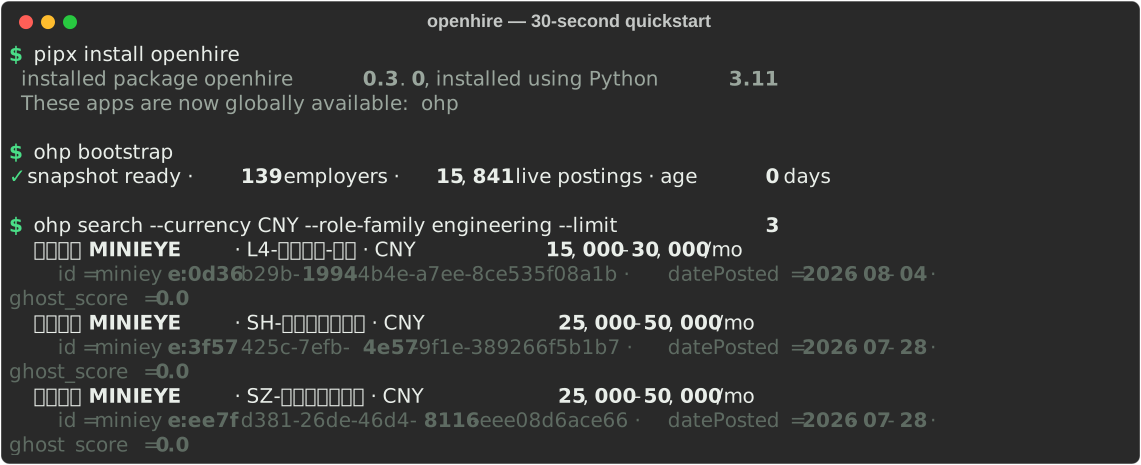
Real terminal output — install from PyPI, download the public index, search. No account, no signup.
What your agent actually sees
You ask your assistant a question in plain language. It calls search_jobs, and every row comes
back carrying the employer's real posting date — so the agent can reason about staleness
instead of guessing.
You: Any senior Python roles that are actually still open? Skip the stale ones.
// one row from search_jobs — trimmed to the fields that matter here
{
  "title":        "Senior Python Engineer",
  "company":      "MongoDB",
  "datePosted":   "2026-03-31",   // from the employer's ATS, not a board's refreshed label
  "days_open":    166,
  "ghost_score":  0.61,           // pure f(relist_count, first_seen_at) — frozen by a test
  "apply_channel":"https://boards.greenhouse.io/…",   // straight to the employer
  "verified_at":  "2026-09-02T09:47:10Z"
}
Assistant: This one has been open 166 days with a ghost_score of 0.61 — I'd deprioritise it. Here are four posted in the last three weeks instead…
ghost_score measures how long a posting has been open, not whether the employer still intends
to hire. A long-open role can equally mean "hard to fill". Treat it as a reason to ask, not a verdict.
An MCP server that turns your AI assistant (Claude, Cursor, Windsurf) into a private radar for AI / Infra, autonomous-driving and embodied-AI jobs — pulled straight from 139 employers' own career sites and public ATS APIs (Greenhouse / Lever / Ashby / 北森 Beisen / Moka), across the US, Europe and China (Waymo, Figure, Zoox — and Unitree, XPeng, UBTECH, Mech-Mind…). No account. No signup. No résumé upload. Ever.
Three things a job board won't do for you:
- Kills ghost-job noise. Every listing carries a
ghost_scoreaged off the employer's real posting date — the "2 days ago" a board shows you can be 300 days old in the ATS. - Structural privacy, not a pinky-promise. There is no résumé field in the protocol; a CI test fails the build if anyone adds one. Matching runs on your machine — only an anonymous fingerprint reaches the server.
- Ranking you can't buy. Order is a locked pure function of (match, freshness). No sponsored slots, no bidding — the signature is frozen by a test.
This is the 「哨兵 / Sentinel」 reference implementation — see
design_handoff_openhire_v01/README.md for the full protocol spec.
Quickstart — under a minute
# 1. Install (pipx keeps it isolated and puts `ohp` on your PATH)
pipx install openhire

# 2. Get a job index. Downloads the public snapshot (~25 MB), then runs one incremental
#    crawl to refresh verified_at / delisting. The crawl is the slow part: it can run for
#    20+ minutes on a cold index and prints nothing while it works.
#    Only needed for the CLI — `ohp serve` fetches the snapshot by itself on first start.
ohp bootstrap                    # 139 employers · ~16k live postings · no account

# 3. Use it directly…
ohp search --required-skills rust,k8s --remote --role-family engineering
ohp search --currency CNY --role-family engineering   # e.g. CN autonomous-driving / robotics roles

# …or connect it to an MCP client:
ohp serve
Then point your MCP client at it — see Works with below.
Works with
All clients use the same MCP entry. The canonical, zero-install config (needs uv) works in every MCP client:
{ "mcpServers": { "openhire": { "command": "uvx", "args": ["openhire@latest", "serve"] } } }
The server auto-downloads the public job snapshot on first run if the index is empty, so
ohp bootstrap is optional. If you ran pipx install openhire, "command": "ohp" works too.
Claude Desktop — %APPDATA%\Claude\claude_desktop_config.json (macOS: ~/Library/Application Support/Claude/); quit & reopen after editing:
{ "mcpServers": { "openhire": { "command": "ohp", "args": ["serve"] } } }
Cursor — ~/.cursor/mcp.json (or a project .cursor/mcp.json):
{ "mcpServers": { "openhire": { "command": "uvx", "args": ["openhire", "serve"] } } }
Windsurf — ~/.codeium/windsurf/mcp_config.json:
{ "mcpServers": { "openhire": { "command": "uvx", "args": ["openhire", "serve"] } } }
First start downloads the ~25 MB public snapshot (jobs/companies only) — give it a moment. To refresh later run
ohp bootstrap --forceorohp ingest. On Windows Claude Desktop from the Microsoft Store, the config is under…\Packages\<Claude package>\LocalCache\Roaming\Claude\.Hosted / remote:
ohp serve --transport streamable-http --host 0.0.0.0 --port 8000exposeshttp://host:8000/mcp(also--transport sse). ADockerfileis included.
What it does
| Tool | What it gives you |
|---|---|
search_jobs | Hard-filter the live index; every result carries verified_at, datePosted, days_open, ghost_score, remote_scope, eligible_regions, apply_channel. Filter by required_skills (AND), role_family, remote_scope, min_salary + currency. |
watch_intent | Register a standing intent once — new matching jobs are waiting next time you check, even after you close the terminal. Accepts required_skills / role_family so sales / solutions roles stay out. |
check_watches | Pull the matches that are new since your last check (client-pull; stdio has no push). |
authorize_application | One explicit confirmation per job. It records your authorization and returns the employer's own application URL — you apply as yourself. It cannot accept a résumé. |
get_company_info | Aggregate, anonymous trust signals for one employer (ghost_score_avg, active_jobs, index_built_at). Never any candidate data. |
Optional, entirely local: ohp init --scan <dir> derives a skill fingerprint from your
own repos. You never write a résumé; the code never leaves your machine — only an anonymous
vector does.
The five protocol fields
Every listing is valid schema.org/JobPosting, plus:
verified_at— last moment confirmed live on the employer's own sitesource—employer_site | ats_public_api(never a job board)ghost_score— 0–1 listing-activity signal, aged off the real posting date (lower = fresher). A noise filter, not an accusation: long-open listings are often evergreen talent pools or slow pipelines — the score simply lets agents down-rank low-activity noiseresponse_sla_days— employer's committed response window (v0.1: always null)apply_channel— always the employer's own application URL, deep-linked to the specific job
Privacy Policy
Short version: there is no résumé field in the protocol, matching runs on your machine, and the only user-originated value the server ever stores is an anonymous client-generated fingerprint. No analytics, no telemetry, no third-party sharing. Full policy: docs/PRIVACY.md.
Privacy model
| Résumé / PII upload | never — matching runs locally; a résumé never transits the server, and we never store one |
| What the server sees | one anonymous, client-generated fingerprint + hard filters |
| Repo scan | local-only · personal projects · explicit consent · opt-out anytime |
| Job sources | first-party only: employer career pages + public ATS APIs (Greenhouse / Lever / Ashby) |
First-run data — the snapshot vs. fresh
ohp bootstrap (default) downloads a small public index snapshot (a GitHub Release
asset — companies + jobs only, zero user data) and then runs one incremental crawl to
refresh verified_at / delisting. --fresh skips the snapshot and crawls the public ATS from
scratch with the free offline heuristic extractor. Either way: no account, no PII.
Two things that surprise people:
- The incremental crawl is slow and quiet. On a cold index it can run for 20+ minutes
with no output. It is working, not hung. If you only want the data,
ohp serveskips it entirely — the server downloads the snapshot on first start and is answering in seconds. - The snapshot URL is pinned to the
v0.1.0tag on purpose. It looks stale; it is not. That asset is overwritten in place every Monday by a scheduled workflow, so the URL is a stable address for always-current data. Pinning it to the newest tag would break every client the moment a release is cut.
Three rules this project will never break
- Your résumé stays on your machine — it never transits the server, and we never store it.
- Ranking is not for sale — it is only
f(match_quality, freshness), a locked pure function. - Employers pay only for authorized, delivered outcomes — never for exposure. (v0.1 has no billing at all.)
These are enforced by CI (tests/test_privacy.py, tests/test_ranking.py,
tests/test_snapshot.py).
Development
python -m venv .venv && . .venv/Scripts/activate   # Windows
pip install -e ".[dev]"
pytest        # privacy red lines + ranking + snapshot must be green
Set OPENHIRE_DATABASE_URL=postgresql+psycopg://… to run against Postgres instead of the
default local SQLite file (~/.openhire/openhire.db).
Roadmap
- v0.2 – v0.3 (shipped) — CN ATS adapters (北森 Beisen + Moka) · weekly auto-refreshed
public snapshot ·
ghost_scorepublic beta · 139 employers across US / EU / China - next — Employer claim + verified badges — employers can reserve their claim today via a corporate-identity GitHub issue (zero-cost now; badges + listing-status control ship next) · response-SLA enforcement (7-day auto-delist) · redacted proof-of-fit — an anonymous, candidate-authorized match summary that travels with an application (skills overlap only; identity never included, résumés still never transit the server)
- v1.0 — Open, vendor-neutral schema extension for AI-readable job postings
FAQ
Where does the job data come from?
Directly from 139 employers' own public ATS APIs (Greenhouse, Lever, Ashby, 北森 Beisen, Moka) — the
same endpoints that power their careers pages. No scraping, no third-party job boards. source is
always ats_public_api, and verified_at records the last time we confirmed each posting live.
The public index is auto-refreshed weekly, so a fresh ohp bootstrap starts from recent data.
Why should I trust ghost_score?
It's a pure, open, unpurchasable function — min(1, 0.15·relist_count + staleness) aged off the
real ATS posting date, not our crawl date. The formula lives in pipeline/ghost_score.py,
is unit-tested, and takes no money as input (red line #2). Long-open, repeatedly-relisted
postings score higher; you can always re-rank client-side. Read it as signal-to-noise, not
bad faith: plenty of high-scoring listings are legitimate evergreen talent pools. Employers
who want their listing activity represented accurately can claim their tenant (see Roadmap).
Does my résumé actually go through the server — really?
No. There is no résumé anywhere in the protocol. authorize_application has no résumé/file
parameter (it structurally cannot accept one), matching runs on your machine, and the only thing
that ever transits the server is a short anonymous fingerprint like #a3f9. This is enforced by
tests/test_privacy.py, and the published snapshot carries zero user data (tests/test_snapshot.py).
Does it support China (中国区)?
Yes — this is what sets OpenHire apart. Employers on 北森 Beisen (<tenant>.zhiye.com) and
Moka (app.mokahr.com) are indexed: 20+ autonomous-driving / robotics / embodied-AI
companies including 宇树 Unitree, 小鹏 XPeng, 优必选 UBTECH, 梅卡曼德 Mech-Mind, 速腾聚创 RoboSense,
元戎启行 DeepRoute, 星海图 Galaxea, 傅利叶 Fourier, 普渡 Pudu. Pay published as 月薪 keeps its real
period (salary_period), so a salary floor no longer silently drops Chinese roles.
飞书招聘 (Feishu Hire) is not supported and won't be: it signs its job-list requests with a
ByteDance _signature and gates them behind a captcha SDK, so its listings are not publicly
readable. We don't break anti-bot measures.
How do I get a company added?
Open a Company inclusion request issue (title it with the company + its ATS URL) — this is
the best way to contribute. If you code, add it to src/openhire/seed/candidates.py (company
slug + ATS vendor/tenant) and open a PR; the seeder validates tenants against the live API.
License
MIT © OpenHire Protocol · PRs welcome.
Built by a non-coder PM-ing Claude Code — full acceptance reports in reports/.