Agentic SWMM
Eleven MCP servers for reproducible EPA SWMM stormwater modelling — building, simulation, calibration, GIS, climate scenarios, uncertainty, plotting, and modelling memory.
Documentation
Agentic SWMM Workflow






Pre-1.0 · stable v0.9.4 ·
pip install aiswmm==0.9.4· CHANGELOG
[!TIP] Headaches from tedious model setup? Try our another project SWMMCanada, our automated model-building project: draw an area anywhere in Canada and get a ready-to-run SWMM model. Up and running now.
Highlights
- Agentic SWMM for reproducible stormwater modeling: the aiswmm runtime + Skills + MCP + SWMM, verification-first, with a full audit trail.
- Live replay demo, no install: a recorded end-to-end session, replayed in the browser at aiswmm.com.
- One sentence to a client deliverable: one English sentence fetched the real downtown Victoria storm network, ran SWMM, audited it, and exported a Word report, then did the same on a fifth city, Kelowna, with the model committed so the run reproduces offline: cases/downtown-victoria · cases/kelowna.
- A model that said not to trust it: when the requested week turned out dry, the run named its own errors as disqualifying instead of handing over bad numbers: cases/downtown-victoria-on-arm.md.
- Published method: AI for Engineering (MDPI, 2026): read the paper.
Project Overview
Agentic SWMM is an open-source, verification-first framework for reproducible and extensible stormwater modelling, starting with EPA SWMM. It connects QGIS-based preprocessing, upstream model generation from SWMMCanada inside Canada (real storm networks for 35 cities, synthesis anywhere else in the country) and SWMManywhere-based synthesis outside Canada, deterministic SWMM execution, QA checks, provenance tracking, calibration and climate-scenario support, documentation, and modelling memory, while keeping human modellers in control.
The goal is not to replace SWMM or the modeller, but to build an agentic modelling layer that makes stormwater-modelling workflows easier to reproduce, audit, extend, remember, and trust. Agentic SWMM comes with aiswmm as its built-in runtime. Users can describe a modelling goal in natural language, while model execution remains deterministic, inspectable, and artifact-based. The repository's MCP servers and Skills can also be used with other agent runtimes, including Codex, Claude, OpenClaw, and Hermes.
This is not a simple chat-to-SWMM wrapper. The aiswmm runtime can help coordinate the workflow, but model files, SWMM runs, QA checks, plots, provenance records, audit notes, and modelling memory remain visible as reusable artifacts. Modelling memory can summarize repeated problems and propose Skill refinements, but accepted changes still require human review and benchmark verification.
Authors: Zhonghao Zhang & Caterina Valeo
License: MIT





Why this project exists
Stormwater modelling is rarely one command. A typical SWMM project can involve GIS preprocessing, rainfall formatting, parameter assignment, network assembly, INP construction, model execution, QA checks, plots, calibration, uncertainty analysis, and reporting.
Agentic SWMM provides a middle path: natural-language orchestration with deterministic SWMM execution, explicit provenance, project memory, and verification-first modelling.
What makes it different
- Quick onboarding: start from one-line macOS/Linux or Windows installers, with Docker and Python package paths documented separately.
- Bring the LLM you already pay for: ten provider routes behind one
aiswmm setupwizard, with a local fallback chain. - Agent-guided, SWMM-grounded: agents can coordinate tasks, while model execution stays deterministic, inspectable, and CLI-runnable.
- Modular skill layer: GIS, climate, building, running, plotting, calibration, uncertainty, audit, and orchestration are separated into reusable modules with MCP interfaces where available.
- Verification-first provenance: build, run, audit, and comparison stages emit traceable artifacts before outputs are treated as evidence.
- Supervised skill evolution: audited runs can surface recurring workflow patterns and propose updates to existing skills or new skills, while staying coupled to the current skill-driven framework.
Meet your agent in about five minutes
macOS and Linux:
curl -fsSL https://aiswmm.com/install.sh | bash
Windows PowerShell:
irm https://aiswmm.com/install.ps1 | iex
Reproducible run (pinned Docker image, v0.9.4), no local install:
docker run --rm -v "$PWD/runs:/app/runs" ghcr.io/zhonghao1995/agentic-swmm-workflow:v0.9.4 acceptance
After installation, launch the runtime with aiswmm.
One-line installers run a remote script; review it first if you want to see what executes. When it finishes it hands over to aiswmm setup, which lists every route and detects what is already running; three of them need no API key at all, including a local gateway that fronts a ChatGPT plan. For storing a key directly, see API key configuration. Never paste API keys into the aiswmm conversation.
Three ways in (one-line installer, Docker, or pip), compared side by side (what you get, prerequisites, reproducibility, when to pick each): choosing an install path. If something goes wrong, or you want a provider that needs no API key: install and troubleshooting.
Workflow
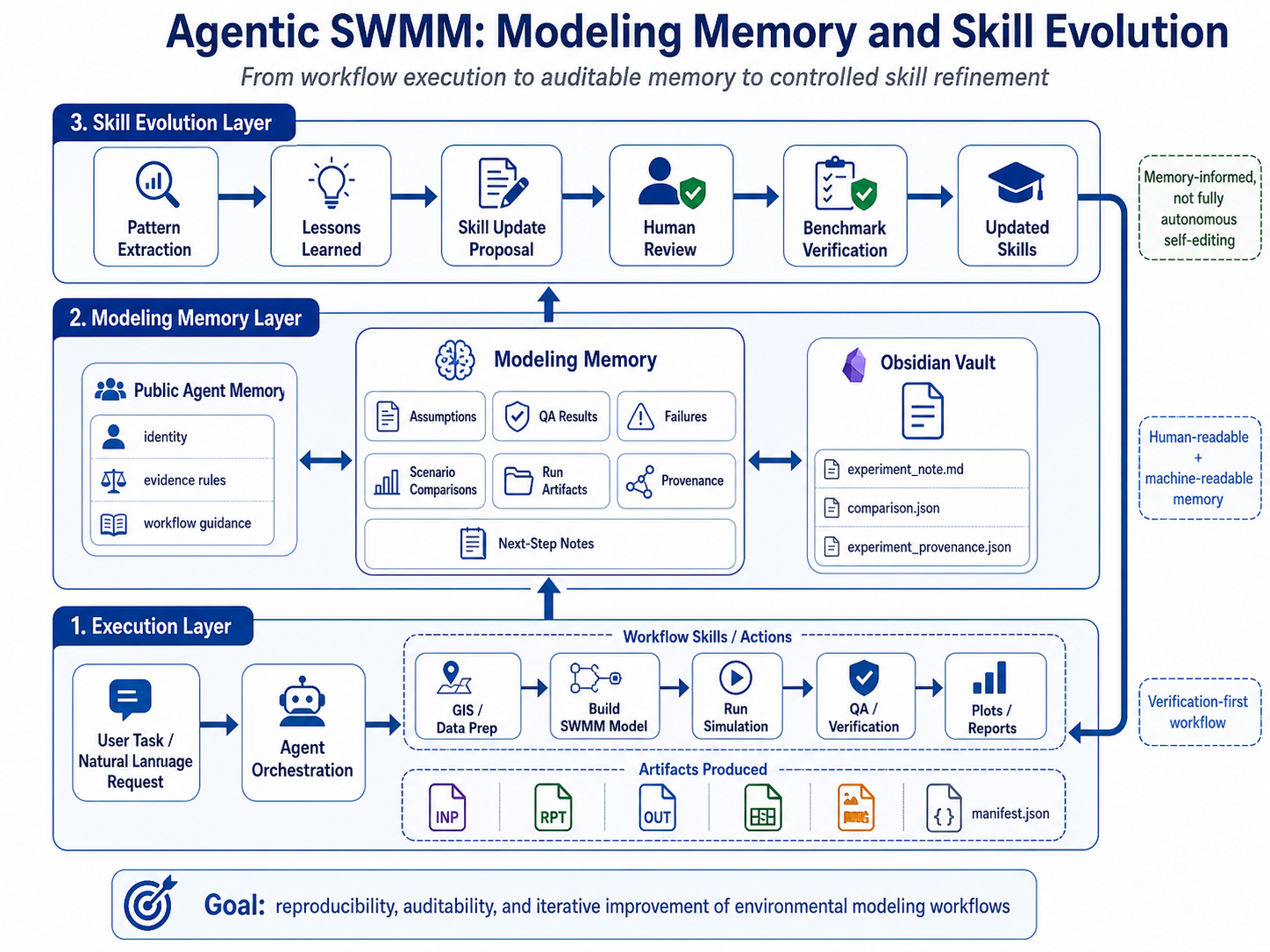
The workflow has three connected layers: execution, modeling memory, and controlled skill evolution. Natural-language requests can trigger reproducible SWMM actions; audited artifacts update human-readable and machine-readable memory; repeated patterns can produce skill-refinement proposals that still require human review and benchmark verification.
What a run can produce
- generated or supplied SWMM input files such as
model.inp - SWMM report and binary outputs such as
.rptand.out - manifests, command traces, QA summaries, and parsed peak-flow metrics
- rainfall-runoff figures, calibration summaries, and fuzzy uncertainty summaries
- audit records:
experiment_provenance.json,comparison.json, andexperiment_note.md - Obsidian-ready modelling notes and modelling-memory summaries
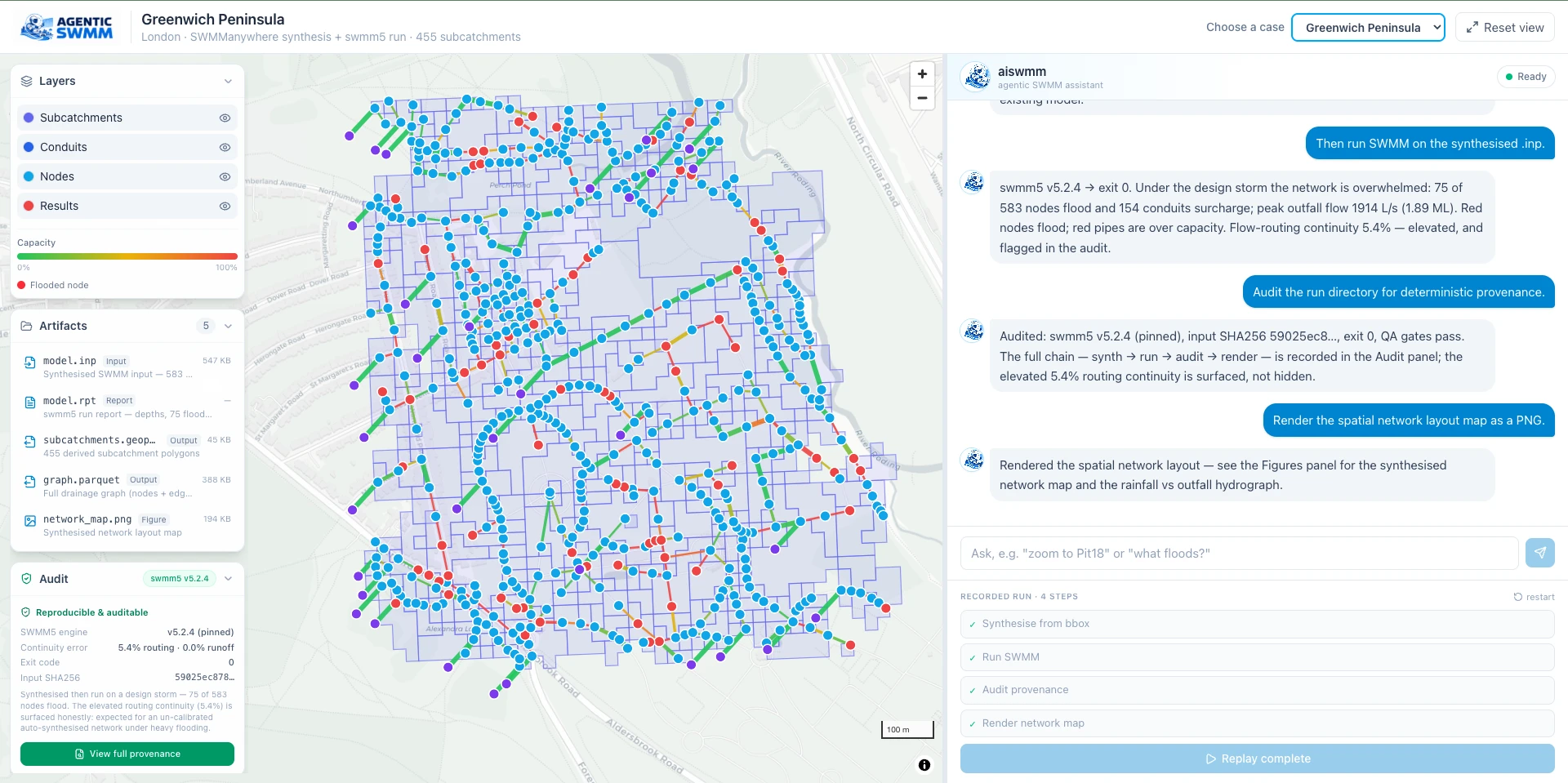
▶ Watch the replay demo: Greenwich Peninsula, SWMManywhere synthesis → swmm5 run → audit → render, end to end in the browser.
Validation snapshot
The repository includes runnable benchmarks and research previews with different evidence boundaries. The README keeps only the index; figures, commands, and boundary notes live in Validation evidence.
| Path | What it shows | Evidence boundary |
|---|---|---|
| Information-loss-guided subcatchment partition | QGIS-to-Agentic SWMM preprocessing driven by the information-loss rule from Zhang & Valeo's Environmental Modelling & Software paper, with the entropy and fuzzy-similarity concepts from their Journal of Hydrology paper | GIS preprocessing concept, not a calibrated SWMM performance claim |
| Raw GeoPackage-to-INP benchmark | Public TUFLOW GeoPackage layers converted into SWMM-ready artifacts, QA, and audit | Structured raw GIS path, not arbitrary CAD/GIS recognition |
| Prepared-input SWMM benchmark | External 40-subcatchment Tecnopolo model execution, plotting, and direct swmm5 comparison | Prepared INP validation path |
| Prior Monte Carlo uncertainty smoke | Tecnopolo HORTON parameter perturbation and hydrograph envelope preview | Prior uncertainty smoke, not calibration |
| Optional INP-derived raw adapter benchmark | Raw-like inputs extracted from a public SWMM fixture and rebuilt through the modular path | Adapter handoff check, not greenfield watershed generation |
| Cross-environment byte-identical reproducibility | A natural-language prompt (Run the Tecnopolo (Rome 1994) demo) drives the aiswmm chain (LLM agent → MCP → swmm-runner skill) to the same byte-identical model.out as bare swmm5, across macOS and Docker. v0.7.1 re-verification: the minimum natural-language prompt length for this chain is now 11 words, and the model.out SHA256 remains identical across the v0.7.0 → v0.7.1 minor revision. | SWMM execution-layer reproducibility, not agentic workflow reproducibility |
| LLM-driven dispatch + data-scarce urban modeling (SWMManywhere) | A single natural-language sentence referring only to a WGS84 bounding box drives the end-to-end SWMManywhere → SWMM → audit → network-map workflow on two independent regions (Greenwich Peninsula and NYC Midtown, ~1 km² each), with no shapefile, no DEM file, and no step-by-step tool instructions. Synthesis is the work of SWMManywhere (Imperial College London, BSD-3-Clause). | Agent-side plumbing for data-scarce baseline modeling; not a calibrated or validated network. Calibration is next-milestone scope. |
| Cross-session memory autonomous activation | An 11-word user prompt drove a complete Tecnopolo run on 2026-05-28 during which the LLM autonomously queried recall_session_history and recovered two prior Tecnopolo sessions from 12 days earlier: the first user-observable activation of the memory layer on a real production run. | Memory layer fires correctly and shapes planner decisions; staleness weighting and negative-precedent handling are next-milestone scope. |
Examples: TUFLOW and Tecnopolo.
Audit and research memory
The audit layer consolidates artifacts, QA checks, and metric provenance into an Obsidian-compatible experiment note. This example catches a recorded peak-flow value that does not match the value re-parsed from the SWMM report source section.
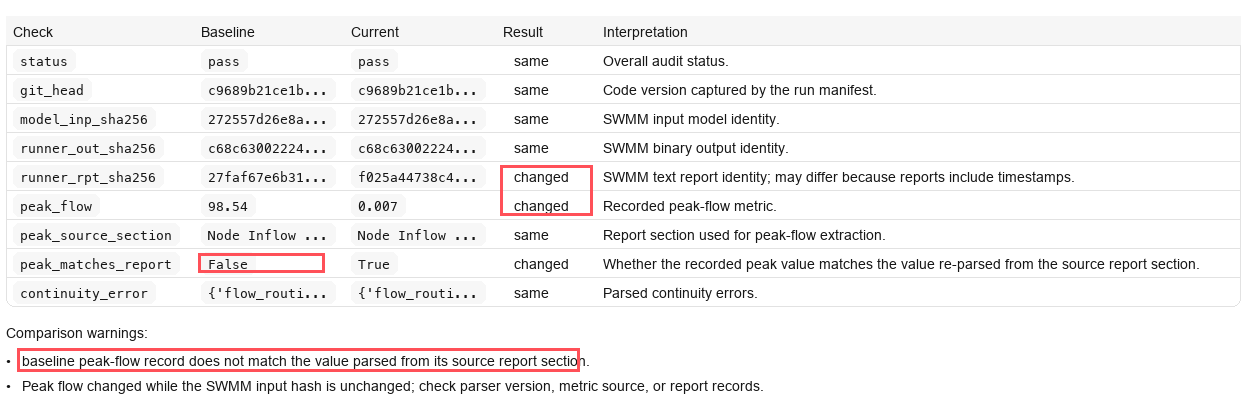
The downstream modelling-memory layer can summarize audited run histories into recurring failure patterns, assumptions, missing evidence, QA issues, lessons learned, and controlled proposals for updating existing skills or creating new skills. Because skills drive the workflow, these proposals stay coupled to the current Agentic SWMM framework and still require human review and benchmark verification before acceptance.
More details: Experiment audit framework and Modeling memory and skill evolution.
Learn more about the ecosystem
Agentic SWMM is the SWMM engine within a larger effort toward a trustworthy, auditable, fully automated urban-hydrology modelling platform: a top-level agentic runtime orchestrating engine-specific automation on top of a shared data-to-model front end.
| Project | Role in the ecosystem | Status |
|---|---|---|
| agentic-hydrology-platform | Orchestration layer: top-level agentic runtime that governs data, model selection, runs, and audit across the engine branches | LSTM catchment-modelling pipeline live; cross-engine (SWMM / MIKE+) orchestration in progress |
| SWMMCanada | Data & model-building layer: ingests and cleans GIS / open data and synthesises reliable model files; the shared front end for the engines. Agentic SWMM consumes it as an upstream INP source via fetch_swmm_from_canada (real municipal storm pipes for 35 cities, sanitary where the city publishes it) | Exports SWMM, MIKE+, InfoWorks ICM and HEC-RAS 2D packages |
| Agentic SWMM (this repository) | SWMM engine: verification-first EPA SWMM automation (Skills + MCP + deterministic runs + audit) | Stable v0.9.4 |
| Agentic-MIKE-Plus | MIKE+ engine: headless DHI MIKE+ automation (Skills + MCP), built on the Agentic SWMM design and the same method paper | Active development |
Codex / Claude / OpenClaw / Hermes ready
Beyond its own aiswmm runtime, the Agentic SWMM workflow can be driven by external agent runtimes: Codex, Claude Code, OpenClaw, or Hermes. For an agent-orchestrated run, preload the agent/memory/ package and point the runtime at the top-level entry skill skills/swmm-end-to-end/SKILL.md, which decides which workflow path to take, which QA gates must pass, and when to stop rather than invent missing inputs.
Install the skills into any skills-aware runtime (Claude Code, Codex, OpenCode, …) with one command:
npx skills add Zhonghao1995/agentic-swmm-workflow
The skills carry the workflow and evidence contracts; pair them with the project install for the executable toolchain (aiswmm CLI, SWMM solver, MCP servers).
More details: Codex runtime path · OpenClaw execution path · Skill installation · MCP runtime integration.
Documentation map
- Validation evidence - benchmark scope, commands, audit example, and evidence boundaries
- Installation and CLI guide - Docker, local install, Windows options, and CLI examples
- Install and troubleshooting - the one-liner per platform, what goes wrong on a real machine and why, and which platforms are covered by an install job in CI
- Two interfaces, one engine - how natural-language goals and CLI verbs map onto the same deterministic tools and artifacts, and when to use which
- LLM provider routes - ten routes out of the box (OpenAI, Anthropic, OpenRouter, DeepSeek, Groq, Gemini, local Ollama/LM Studio, gateways, custom endpoints), the
aiswmm setupwizard, per-route auth, and the local fallback chain - Climate scenario batches -
aiswmm climate: calibrate first, then compare the model's response under precipitation-scaled climate scenarios, one canonical03_climate/summary per run - Experiment audit framework - provenance, comparison, and Obsidian note contracts
- Modeling memory and skill evolution - controlled memory-to-skill refinement loop
- Memory runtime - on-disk substrate, four confidence quadrants, and runtime opt-out flags
- Memory runtime CLI examples - one worked example per memory verb
- Codex runtime path - local development, audit, Obsidian, and evidence-review workflow
- OpenClaw execution path - MCP tool-call sequence for agent runtimes
- Repository map - folder-level walkthrough
- Calibration example - compact calibration support example
Where collaborators can help
Contributions are welcome in additional SWMM case studies, stronger calibration and validation workflows, DEM / land-use / soil / drainage-asset workflows, new MCP tools, QA testing, tutorials, and interoperability with GIS, ML, and hydrologic toolchains.
Contact:
Citation
GitHub citation metadata is provided in CITATION.cff. Please cite the published article.
APA article (preferred)
Zhang, Z., & Valeo, C. (2026). Agentic SWMM: Auditable and reproducible stormwater modelling workflow with Agent Skills and Model Context Protocol. AI for Engineering, 1(1), 5. https://doi.org/10.3390/aieng1010005
APA repository
Zhang, Z., & Valeo, C. (2026). agentic-swmm-workflow [Computer software]. GitHub. https://github.com/Zhonghao1995/agentic-swmm-workflow