Code Relay
Branch-scoped runbooks, remote checkpoints, and auditable verification receipts.
Documentation
 Code Relay
Build. Prove. Relay.
Code Relay lets your coding agent develop on one machine and prove the result on another.
Relay is an MCP-based coding-agent integration for cross-machine development and verification. AI on the Dev Host implements the request; the Target Host runs the real validation; a structured receipt comes back to guide the next repair iteration. It works with Codex, Claude Code, Cursor, VS Code, and other MCP-capable coding agents.
When Relay is useful
- Different environments — develop on Windows or macOS, verify on Linux, a private network, or a production-like host.
- Special hardware — send model code to a CUDA/GPU machine, or verify a camera, serial device, or sensor where it is connected.
- Real integrations — exercise payment callbacks, queues, databases, browsers, or internal services that cannot be reproduced locally.
- AI-driven iteration — return concrete expected/actual results so the coding agent can repair, republish, and retry.
What Relay provides
- Branch-scoped project binding and short-lived join links.
- Exact source-commit verification in an isolated worktree.
- Checkpoint execution through a
code-relay-checkpointGitHub Actions self-hosted runner. - Safe, allowlisted validation commands with bounded output and timeouts.
- Structured
receipt.jsonand human-readable receipts for passed, failed, and blocked runs.
Quick start
AI client installation
Let your coding agent read and follow the instructions:
https://raw.githubusercontent.com/zarcherlot/code-relay/main/install.md
npm fallback
npx -y code-relay-mcp@latest install --client codex
Replace codex with claude-code, cursor, vscode, or generic as needed.
MCP server details
Code Relay is a local MCP server that communicates over stdio. The npm package starts the server with:
npx -y code-relay-mcp@3.1.0
The server implements the MCP JSON-RPC surface directly in Go (without a
third-party MCP SDK). It supports initialize, ping, tools/list, and
tools/call, and exposes these tools:
| Tool | Purpose |
|---|---|
bind_project | Bind a repository and branch to a relay role. |
create_checkpoint_invite | Create a short-lived checkpoint join link. |
join_checkpoint | Join a branch-scoped checkpoint subscription. |
watcher_status | Read local watcher state. |
stop_watcher | Stop the local watcher. |
doctor | Run non-mutating local health checks. |
publish_runbook | Validate and publish a runbook. |
status | Read runbook and receipt status. |
fetch_receipt | Load and validate a runbook receipt. |
analyze | Analyze a receipt and determine the next state. |
The implementation and transport loop are in internal/relay/mcp.go.
How it works
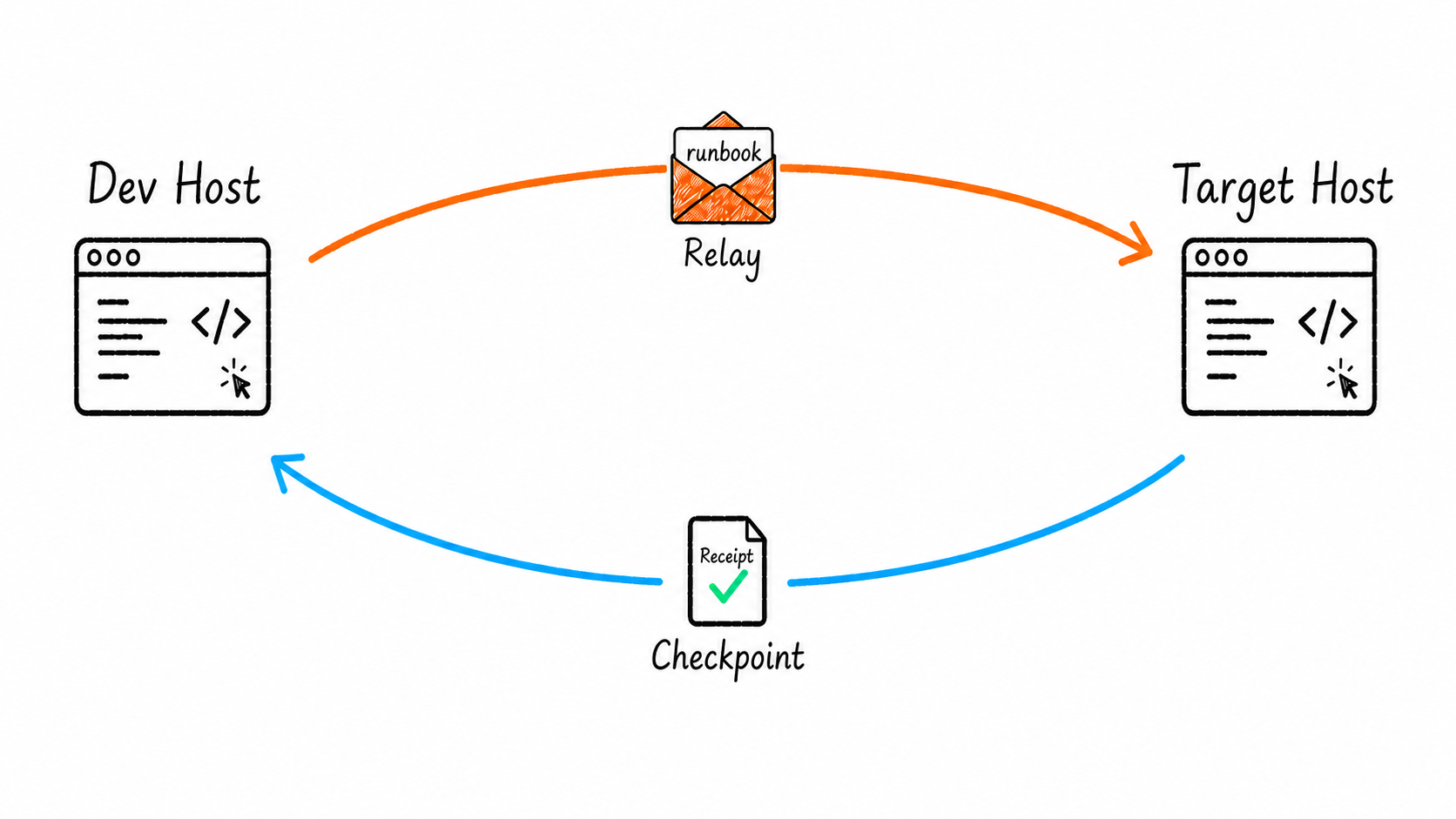
the Dev Host sends a repository- and branch-bound runbook through Relay; the Target Host checks the exact source commit in its real environment and returns a Receipt recording the Checkpoint result.
Every runbook is bound to a repository, branch, and source commit. The Target Host acts as the Checkpoint, and the resulting receipt records passed, failed, or blocked verification for the next iteration.
Documentation
- Chinese README
- User guide
- AI-client installation guide
- Local desktop install runbook
- Deployment and runbook
- Security
- Contributing
License
Code Relay is released under the MIT License.