GhostApi
The local internet for AI agents
Documentation

GhostAPI
Local API simulation and test evidence for AI-assisted development.
GhostAPI gives applications and coding agents a local target for selected Stripe, Resend, OpenAI, Twilio, GitHub, Discord, and generic REST workflows. It records heuristically sanitized traffic, injects deterministic failures, exposes MCP controls, and turns captured behavior into repeatable tests.
On supported Linux hosts, ghostapi run can execute a test command inside a loopback-only network namespace. It is not a hostile-code or filesystem sandbox.


Quickstart · Security model · Provider coverage · Release evidence
npx @yiaany/ghostapi start --open
Why GhostAPI
Coding agents can write a Stripe checkout, an OpenAI workflow, a GitHub automation, or an email integration in minutes. The dangerous part is what happens when they run that code.
When a client is configured against a live provider, a test can:
- charge a real card;
- send a real email or SMS;
- create or modify real GitHub resources;
- spend API credits;
- leak credentials into logs, prompts, screenshots, or test fixtures.
GhostAPI provides a local endpoint at 127.0.0.1:8080. Requests sent to that endpoint are classified, heuristically sanitized, recorded in bounded local stores, and answered by implemented provider packs or generic fallback behavior. You can inspect the result in the dashboard, control local behavior through MCP, and turn captured failures into repeatable tests.
Verified Locally, Not Customer-Validated Yet
The public repository contains reproducible tests for local provider simulation, Linux namespace enforcement, package installation, and hosted-pilot authorization. GhostAPI does not yet claim production customers, paid pilots, or a deployed team service.
Quickstart
Start the local server and dashboard:
npx @yiaany/ghostapi start --open
Send a Stripe-shaped request:
curl -X POST http://127.0.0.1:8080/v1/customers \
  -H "content-type: application/json" \
  -H "authorization: Bearer stripe_test_ghostapi" \
  -d '{"email":"ada@example.com","name":"Ada Lovelace"}'
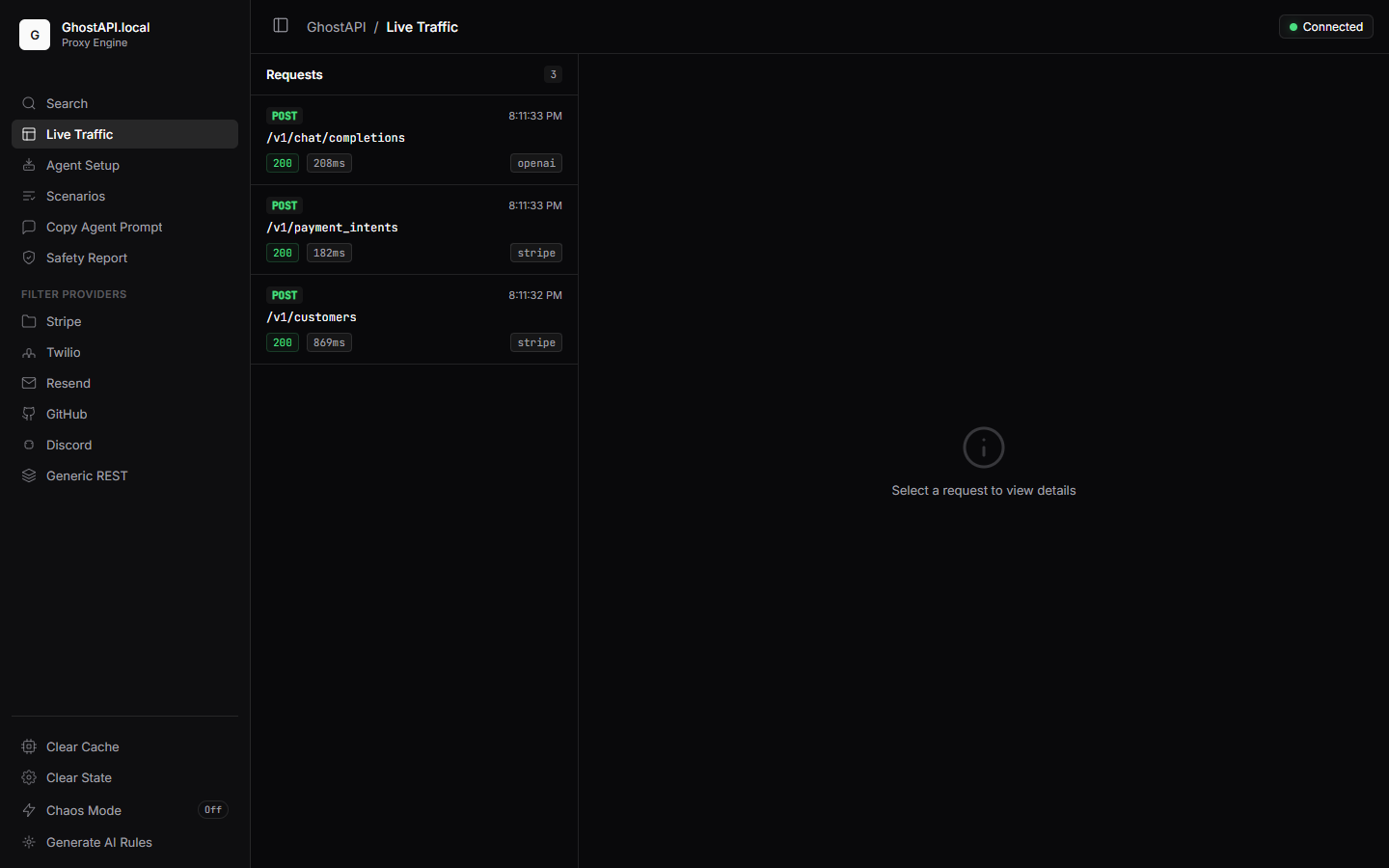
Open the dashboard at http://127.0.0.1:8080/dashboard. The request appears in live traffic with its provider, request body, generated response, source, status, and timing.
Initialize GhostAPI inside an existing repository:
npx @yiaany/ghostapi init
npx @yiaany/ghostapi doctor
init creates local configuration, a versioned safety policy, MCP snippets, and agent instructions without overwriting existing files.
On a supported Linux host, run a command inside the loopback-only network namespace:
npx @yiaany/ghostapi run -- npm test
On Windows and macOS, ghostapi run fails closed because an equivalent process-isolation backend is not implemented. The local API server and dashboard still work normally.
What You Get
| Feature | What it does |
|---|---|
| Local API simulation | Gives explicitly configured SDKs and applications a local target instead of a live provider. |
| Provider-shaped behavior | Returns deterministic objects and errors shaped like the implemented subset of each provider API; it does not claim live-provider parity. |
| Live dashboard | Shows requests and responses, filters traffic by provider, generates tests, and arms scenarios. |
| MCP control plane | Lets compatible coding agents inspect state, read traffic, configure responses, and toggle Chaos Mode. |
| Stateful synthetic worlds | Maintains deterministic local identities and state across Stripe, GitHub, email, and REST projections. |
| Scenarios and record/replay | Saves sanitized sandbox traffic and replays it offline as deterministic fixtures. |
| Contract drift checks | Imports bounded OpenAPI/HAR contracts and classifies breaking, non-breaking, and uncertain changes. |
| Agent evals and evidence | Produces bounded reports with a local self-consistency hash, verifiable while the runtime and local storage remain trusted. |
| Secret-risk reduction | Heuristically masks recognized secret-shaped headers, query parameters, bodies, paths, events, prompts, and cache inputs. |
| Fault testing | Forces latency, provider errors, card declines, rate limits, and other unhappy paths. |
| Safety controls | Includes local approvals, scoped budgets, kill switches, circuit breakers, ledgers, and reconciliation for synthetic actions. |
| Reliability tooling | Tracks local SLO samples, cost attribution, runtime health, backups, inventory, and attack-path metadata. |
Dashboard
The dashboard is the fastest way to understand what an agent or application actually did.
- Watch traffic arrive in real time over SSE.
- Inspect sanitized request and response JSON.
- Filter by Stripe, Twilio, Resend, GitHub, Discord, OpenAI, or generic REST.
- Generate a Vitest test from a captured request.
- Generate and copy setup files for supported coding agents.
- Arm deterministic scenario presets.
- Toggle Chaos Mode and inspect the local safety report.
Dashboard and API routes are token-protected on every non-loopback bind. Use HTTPS or a secure tunnel when exposing GhostAPI beyond localhost.
Provider Support
GhostAPI has two levels of provider support.
Stateful provider packs
| Provider | Included behavior |
|---|---|
| Stripe | Customers, products, prices, subscriptions, invoices, payment intents, payment methods, checkout sessions, refunds, pagination, lifecycle scenarios, and signed local webhooks. |
| Resend | Deterministic email-shaped requests, responses, validation, and failure behavior. |
Provider-shaped adapters and generic inference
OpenAI, Twilio, GitHub, Discord, and generic REST routes are detected and receive provider-shaped synthetic responses and errors. These adapters are useful for local development, but they do not claim complete parity with live-provider endpoints.
Unsupported Stripe and Resend pack operations fail diagnostically. Legacy adapters and generic REST inference may return a synthetic fallback response for unrecognized routes; such responses do not indicate provider support or parity.
SDK Setup
Stripe:
import Stripe from "stripe";

export const stripe = new Stripe(
  process.env.STRIPE_SECRET_KEY ?? "stripe_test_ghostapi",
  {
    host: process.env.GHOSTAPI_HOST ?? "127.0.0.1",
    port: Number(process.env.GHOSTAPI_PORT ?? "8080"),
    protocol: process.env.GHOSTAPI_PROTOCOL ?? "http",
  },
);
OpenAI:
import OpenAI from "openai";

export const openai = new OpenAI({
  apiKey: process.env.OPENAI_API_KEY ?? "sk-ghostapi",
  baseURL: process.env.GHOSTAPI_OPENAI_BASE_URL ?? "http://127.0.0.1:8080/v1",
});
Generic REST:
curl -X POST http://127.0.0.1:8080/tasks \
  -H "content-type: application/json" \
  -d '{"title":"Add integration tests","status":"open"}'
MCP For Agents
Start the MCP server:
npx @yiaany/ghostapi mcp
Generic MCP configuration:
{
  "mcpServers": {
    "ghostapi": {
      "command": "npx",
      "args": ["-y", "@yiaany/ghostapi@0.2.1", "mcp"]
    }
  }
}
Available tools:
| Tool | Purpose |
|---|---|
inspect_state | Read current local API objects. |
get_traffic_logs | Inspect sanitized recent traffic. |
set_api_behavior | Force a deterministic response for a method and path. |
toggle_chaos_mode | Enable or disable local latency and failure injection. |
Generate setup snippets for Cursor, Claude, Cline, Aider, Codex, OpenCode, Gemini CLI, Goose, OpenClaw, Hermes, and generic MCP clients:
npx @yiaany/ghostapi setup --write
Connect only trusted local MCP clients. MCP tools can read retained traffic and state and can modify local simulation behavior; MCP is not an authentication or egress boundary. Pin the package version in persistent MCP configuration or use a reviewed local installation.
Scenarios, Contracts, And Evals
Record approved sandbox traffic into a sanitized offline bundle:
ghostapi record \
  --input capture.har \
  --allow-sandbox-host api.sandbox.example \
  --approve
Replay it without network access:
ghostapi replay bundle.json --requests requests.json
Import and compare API contracts:
ghostapi contract import-openapi --input openapi.json
ghostapi contract diff \
  --baseline base.contract.json \
  --candidate head.contract.json \
  --policy ghostapi.policy.yaml \
  --ci
Generate sanitized CI evidence:
ghostapi evidence generate --policy ghostapi.policy.yaml --ci
Run a deterministic agent eval:
ghostapi eval \
  --template retry-after \
  --evidence .ghostapi/reports/latest.json \
  --ci
Security Boundaries
GhostAPI uses local-first defaults, explicit external-LLM opt-in, and heuristic secret masking. Its boundaries are explicit:
- Real provider calls are disabled by default.
- Ambient
OPENAI_API_KEYdoes not enable external generation. - External LLM generation requires an explicit flag plus a separate
GHOSTAPI_LLM_API_KEY. - On non-loopback binds, every route except
/and/healthrequires a strongGHOSTAPI_AUTH_TOKEN. The token provides access control, not encryption. - External response redirects, unsafe response headers, traversal, remote schema references, symlinks, archives, and oversized inputs are rejected where applicable.
- Persistent stores have size, entry, retention, or rotation limits.
- The Linux
runbackend provides loopback-only process network isolation when namespace preflight succeeds. runis not a hostile-code filesystem sandbox.- Secret masking is heuristic and incomplete. Use synthetic credentials and data even in local fixtures.
- Local approval, action, credential, ledger, trust, and safety components execute synthetic operations only. They are not a production-provider executor.
- Evidence hashes are local self-consistency checks, not signatures, immutable provenance, or proof against a same-user editor.
- Current run evidence records namespace lifecycle and GhostAPI-local traffic; it does not enumerate kernel-denied socket attempts.
Read the detailed threat models in docs/security and the reporting policy in SECURITY.md.
Explicit Non-Goals
- No live-provider parity guarantee.
- No complete secret-redaction guarantee.
- No hostile-code filesystem sandbox.
- No equivalent process-egress enforcement on Windows or macOS.
- No deployed hosted service, SLA, compliance certification, or production credential executor.
Platform Support
| Platform | Local API and dashboard | ghostapi run enforcement |
|---|---|---|
| Linux | Supported on Node.js 20+ | Supported when unshare, iproute2, and namespace preflight pass. |
| Windows | Supported on Node.js 20+ | Not implemented; fails closed. |
| macOS | Supported on Node.js 20+ | Not implemented; fails closed. |
Check the current machine:
ghostapi doctor --json
ghostapi doctor --egress
Health Endpoints
GET /health             process liveness, HTTP 200 while state can be evaluated
GET /health/readiness   structural readiness, HTTP 503 when a required store is unsafe
Hosted Experiment
No hosted or enterprise service is currently available. The hosted/ directory is an undeployed experimental implementation, excluded from the npm package and unsupported for production use. Its live OAuth, dependency, migration, load, failover, backup, and disaster-recovery behavior has not been proven in staging.
Development
npm ci
npm run lint
npm run typecheck
npm test
npm run test:coverage
npm run build
npm run smoke:package
Hosted pilot checks:
cd hosted
npm ci
npm run check
See CONTRIBUTING.md, PROVENANCE.md, and docs/releases/ for the contribution and release boundaries.
Documentation
- Usage guide
- MCP setup
- Policy reference
- GitHub Actions integration
- Generic CI integration
- Stripe provider pack
- Security policy
- Threat models
- Project provenance
- Release evidence
- Release readiness
- Migration and rollback
License
MIT. See LICENSE.