Hyper MCP
A fast, secure, and extensible MCP server using WebAssembly plugins.
Documentation




hyper-mcp
⚠️ NOTICE: PROJECT TRANSFERRED
This project has been transferred to https://github.com/joseph-wortmann/hyper-mcp
Please refer to the new repository for the latest updates and contributions.
A fast, secure MCP server that extends its capabilities through WebAssembly plugins.
What is it?
hyper-mcp makes it easy to add AI capabilities to your applications. It works with Claude Desktop, Cursor IDE, and other MCP-compatible apps. Write plugins in your favorite language, distribute them through container registries, and run them anywhere - from cloud to edge.
Features
- Write plugins in any language that compiles to WebAssembly
- Distribute plugins via standard OCI registries (like Docker Hub)
- Built on Extism for rock-solid plugin support
- Sanboxing with WASM: ability to limit network, filesystem, memory access
- Lightweight enough for resource-constrained environments
- Support all 3 protocols in the spec:
stdio,sseandstreamble-http. - Deploy anywhere: serverless, edge, mobile, IoT devices
- Cross-platform compatibility out of the box
- Support tool name prefix to prevent tool names collision
Security
Built with security-first mindset:
- Sandboxed plugins that can't access your system without permission
- Memory-safe execution with resource limits
- Secure plugin distribution through container registries
- Fine-grained access control for host functions
- OCI plugin images are signed at publish time and verified at load time with sigstore.
Getting Started
- Create your config file:
- Linux:
$HOME/.config/hyper-mcp/config.json - Windows:
{FOLDERID_RoamingAppData}. Eg:C:\Users\Alice\AppData\Roaming - macOS:
$HOME/Library/Application Support/hyper-mcp/config.json
- Linux:
{
  "plugins": {
    "time": {
      "url": "oci://ghcr.io/tuananh/time-plugin:latest"
    },
    "qr_code": {
      "url": "oci://ghcr.io/tuananh/qrcode-plugin:latest"
    },
    "hash": {
      "url": "oci://ghcr.io/tuananh/hash-plugin:latest"
    },
    "myip": {
      "url": "oci://ghcr.io/tuananh/myip-plugin:latest",
      "runtime_config": {
        "allowed_hosts": ["1.1.1.1"]
      }
    },
    "fetch": {
      "url": "oci://ghcr.io/tuananh/fetch-plugin:latest",
      "runtime_config": {
        "allowed_hosts": ["*"],
        "memory_limit": "100 MB",
      }
    }
  }
}
📖 For detailed configuration options including authentication setup, runtime configuration, and advanced features, see RUNTIME_CONFIG.md
Supported URL schemes:
oci://- for OCI-compliant registries (like Docker Hub, GitHub Container Registry, etc.)file://- for local fileshttp://orhttps://- for remote filess3://- for Amazon S3 objects (requires that you have your AWS credentials set up in the environment)
- Start the server:
$ hyper-mcp
- By default, it will use
stdiotransport. If you want to use SSE, use flag--transport sseor streamable HTTP with--transport streamable-http. - If you want to debug, use
RUST_LOG=info. - If you're loading unsigned OCI plugin, you need to set
insecure_skip_signatureflag or env varHYPER_MCP_INSECURE_SKIP_SIGNATUREtotrue
Using with Cursor IDE
You can configure hyper-mcp either globally for all projects or specifically for individual projects.
- For project-scope configuration, create
.cursor/mcp.jsonin your project root:
{
  "mcpServers": {
    "hyper-mcp": {
      "command": "/path/to/hyper-mcp"
    }
  }
}
-
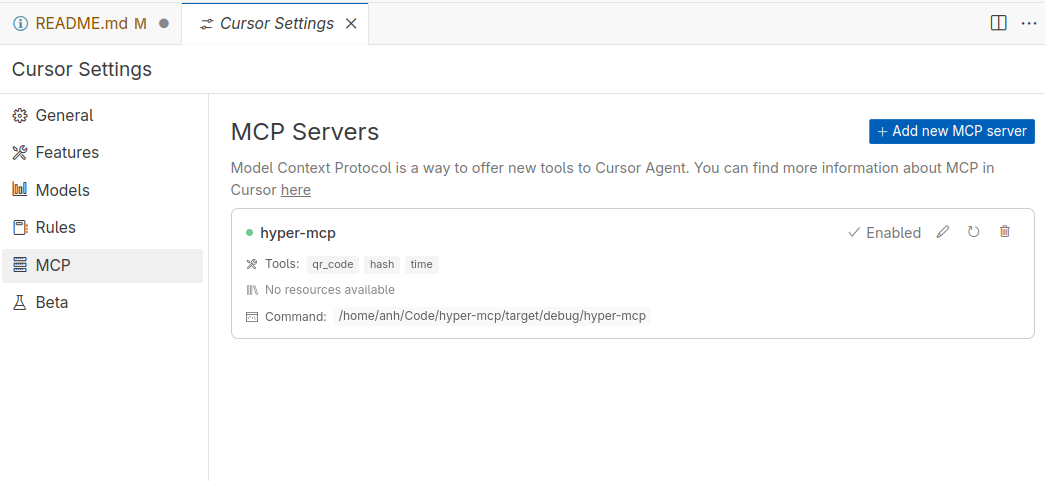
Set up hyper-mcp in Cursor's settings:
-
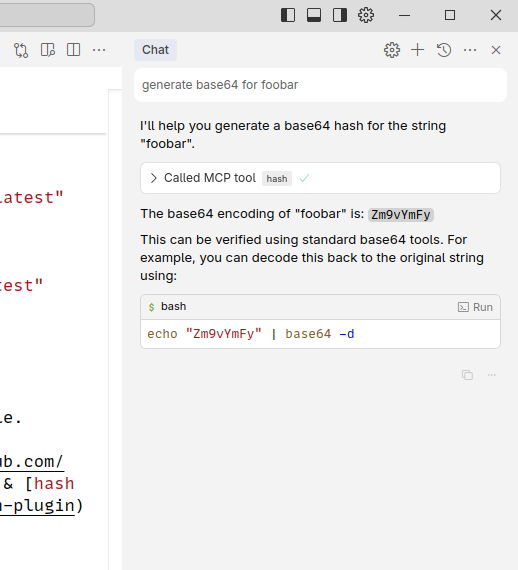
Start using tools through chat:
Available Plugins
We maintain several example plugins to get you started:
V1 Plugins
These plugins use the v1 plugin interface. While still supported, new plugins should use the v2 interface.
- time: Get current time and do time calculations (Rust)
- qr_code: Generate QR codes (Rust)
- hash: Generate various types of hashes (Rust)
- myip: Get your current IP (Rust)
- fetch: Basic webpage fetching (Rust)
- crypto_price: Get cryptocurrency prices (Go)
- fs: File system operations (Rust)
- github: GitHub plugin (Go)
- eval_py: Evaluate Python code with RustPython (Rust)
- arxiv: Search & download arXiv papers (Rust)
- memory: Let you store & retrieve memory, powered by SQLite (Rust)
- sqlite: Interact with SQLite (Rust)
- crates-io: Get crate general information, check crate latest version (Rust)
- gomodule: Get Go modules info, version (Rust)
- qdrant: keeping & retrieving memories to Qdrant vector search engine (Rust)
- gitlab: GitLab plugin (Rust)
- meme_generator: Meme generator (Rust)
- context7: Lookup library documentation (Rust)
- think: Think tool(Rust)
- maven: Maven plugin (Rust)
- serper: Serper web search plugin (Rust)
V2 Plugins
These plugins use the v2 plugin interface. New plugins should use this interface.
- rstime: Get current time and do time calculations (Rust)
Community-built plugins
- hackernews: This plugin connects to the Hacker News API to fetch the current top stories and display them with their titles, scores, authors, and URLs.
- release-monitor-id: This plugin retrieves project ID from release-monitoring.org, which helps track versions of released software.
- yahoo-finance: This plugin connects to the Yahoo Finance API to provide stock prices (OHLCV) based on a company name or ticker symbol.
- rand16: This plugen generates random 16 bytes buffer and provides it in base64uri format - very usable for symmetric cryptography online.
Documentation
- Runtime Configuration Guide - Comprehensive guide to configuration options including:
- Authentication setup (Basic, Token, and Keyring)
- Plugin runtime configuration
- Security considerations and best practices
- Platform-specific keyring setup for macOS, Linux, and Windows
- Troubleshooting authentication issues
- Skip Tools Pattern Guide - Comprehensive guide to filtering tools using regex patterns:
- Pattern syntax and examples
- Common use cases and best practices
- Environment-specific filtering strategies
- Advanced regex techniques
- Migration and troubleshooting
Creating Plugins
For comprehensive instructions on creating plugins, see CREATING_PLUGINS.md.