api-test-mcp
Call your real API and check the response against what your OpenAPI spec promises
Documentation
api-test-mcp
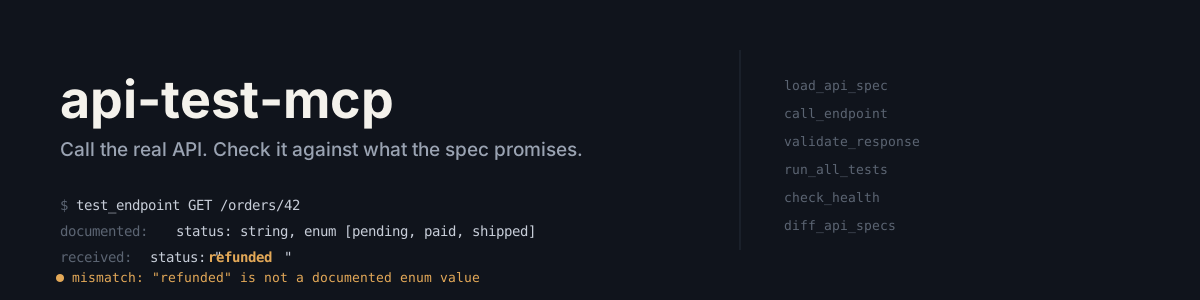




An MCP server that gives Claude Code, Cursor, Windsurf, or any MCP-compatible AI agent the ability to actually call your API and check the response against what your OpenAPI spec promises — not just read the docs and guess.
No API keys, no config, no cost. Works with any OpenAPI/Swagger 3.x spec (URL or local file).
Why this exists
AI agents are great at reading an OpenAPI spec and writing code against it — but they're guessing about whether the real API actually behaves the way the spec says. This gives an agent (or you, in a normal chat) a way to find out for real: call the live endpoint, and check whether the response actually matches the documented schema.
Install
git clone <this repo>
cd api-test-mcp
npm install
Add it to your MCP client config, e.g. for Claude Code:
claude mcp add api-test -- node /absolute/path/to/api-test-mcp/src/index.js
Or in claude_desktop_config.json / Cursor's MCP settings:
{
  "mcpServers": {
    "api-test": {
      "command": "node",
      "args": ["/absolute/path/to/api-test-mcp/src/index.js"]
    }
  }
}
Tools
| Tool | What it does |
|---|---|
load_api_spec | Load and dereference an OpenAPI/Swagger spec from a URL or local path. Returns the API title, servers, and every documented endpoint. Call this first. |
list_endpoints | List every endpoint currently loaded. |
call_endpoint | Make a real HTTP call to a documented endpoint. Returns the real status, headers, and body. |
validate_response | Check a response body against the JSON schema documented for a given method + path + status. |
test_endpoint | call_endpoint + validate_response in one step. The main tool — "does this endpoint actually work as documented?" |
run_all_tests | Best-effort contract-test pass across every GET endpoint that needs no required parameters. Pass includeMutating: true to also auto-generate example params/bodies from the schema and attempt POST/PUT/PATCH (off by default — it can write real data). Endpoints still needing manual input are listed as skipped, with the reason. |
check_health | One-shot ping across a set of endpoints (or every parameter-free GET in the loaded spec): reports reachability and latency. Handy before a demo or as a CI step. |
diff_api_specs | Compare two versions of a spec (e.g. an old tag vs. main) and flag likely-breaking changes — removed endpoints, newly-required fields, type changes, removed enum values — versus safe additive changes. |
All of the above accept an optional auth preset (bearer, apiKey in a header or query param, or basic) so authenticated APIs aren't limited to hand-building raw headers, and an optional timeoutMs.
Example (what an agent conversation looks like)
You: Load my API spec at
https://api.example.com/openapi.jsonand check whether/users/{id}actually returns what it documents.Agent: (calls
load_api_spec, thentest_endpointwith a real user id) → "Called it — got a 200, but the response is missing thecreated_atfield your spec marks as required, androleis documented as an enum of 3 values but the API returned"superadmin", which isn't one of them."
For an authenticated API:
You: Run a full contract-test pass against my staging API using this bearer token, and include the write endpoints.
Agent: (calls
run_all_testswith{ auth: { type: "bearer", token: "..." }, includeMutating: true }) → "12 passed, 2 failed, 3 skipped.POST /ordersfailed schema validation —total_centscame back as a string, not the integer your spec documents."
Tested against real live traffic
npm test runs three real, unmocked checks, no canned fixtures pretending to be a server:
test/smoke-test.js— loads a spec, makes real HTTPS calls to a live public API, validates the real response, and deliberately feeds in a broken response to confirm validation actually catches mismatches (not just a happy-path check).test/new-features-test.js— auth presets applied to a real outgoing request URL, a real network timeout/abort, a real health-check call, and deterministic offline tests for the spec-diff logic.test/mcp-protocol-test.js— spawns the actual MCP server as a subprocess and talks to it over the real MCP protocol, the same way Claude Code or Cursor would.
CI runs the full suite on every push/PR against Node 18, 20, and 22.
Roadmap
v1.0 shipped contract testing, auth presets, auto-generated example data for mutating endpoints, spec diffing, and health checks. Ideas for what's next:
- YAML output mode / a small CLI wrapper for non-MCP use
- Configurable retry/backoff for flaky endpoints in
run_all_testsandcheck_health - Pattern-aware example generation (respect JSON Schema
patterninstead of a placeholder string) - Persisted health-check history (currently one-shot only)
Contributions welcome — see CONTRIBUTING.md. See an endpoint type or spec quirk this doesn't handle well? Open an issue.
License
MIT