StickerByVIN
Remote MCP server: give it a VIN and it says whether the car's original window sticker (Monroney label) is on file, decodes the vehicle, counts recalls and shows where the paint code is printed. No auth.
Hosted MCP Server
npx add-mcp 'https://stickerbyvin.com/mcp'Installs into Claude Code, Codex, Cursor and more
Documentation
Your VIN tells you who built it
1FT is the world manufacturer code: 1 means built in the USA, FT means a Ford truck.
1FTFW3L5XSKD97239
Check free.Pay once.
You see if the sticker exists before you pay.
Free VIN check
$0
Full Report
$9.99
One payment. No subscription.
No sticker delivered, no charge. Refunds
Where each stickercomes from
- FordStraight from Ford
- ChevroletNewer cars, when on file
- JeepFrom Stellantis, 2013 on
- RamFrom Stellantis, 2013 on
- ToyotaNewer cars, when on file
- HondaNo stickers, free decode only
More brands: Lincoln, Dodge, Chrysler, GMC, Cadillac, Buick, Lexus, Hyundai, Kia, Nissan, Subaru, Volkswagen, BMW, Tesla. Any other car still gets the free check.
The label law of 1958
Every new car comes with this label. It gets thrown away when the car is sold. We find it again from the VIN.
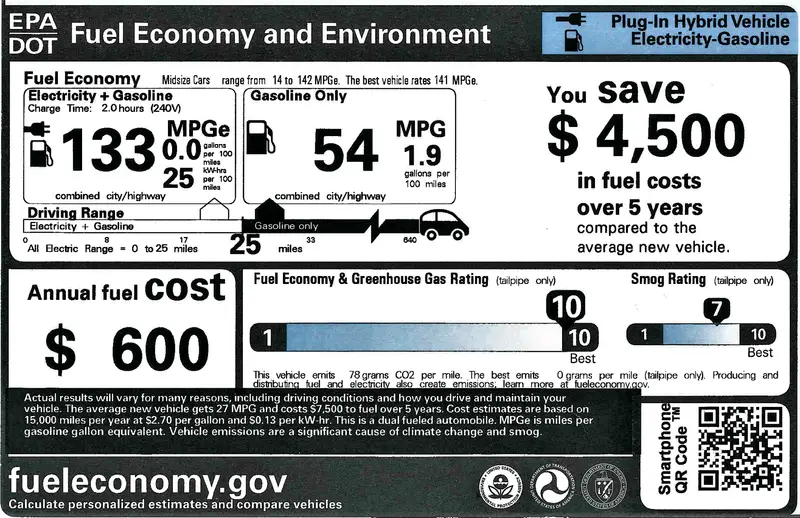
The EPA fuel economy and environment section of a Toyota Prius Prime window sticker
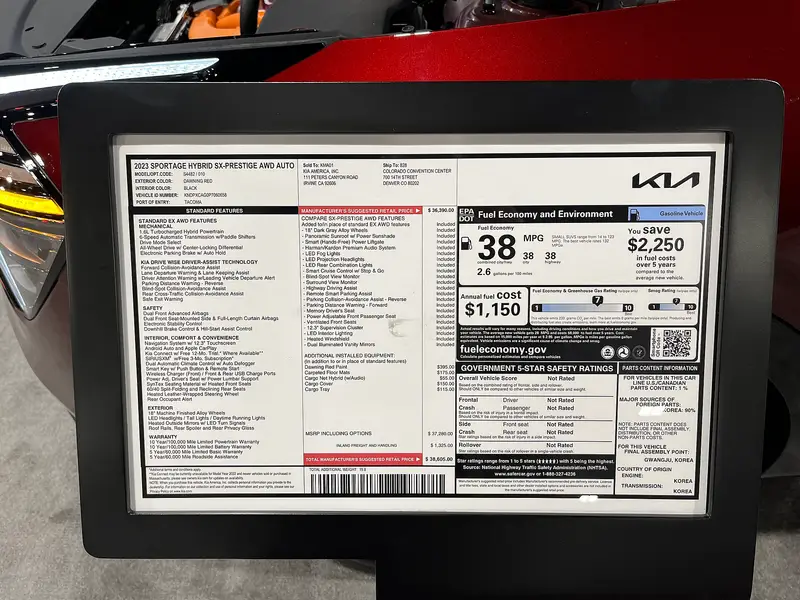
A window sticker displayed next to a new Kia Sportage Hybrid
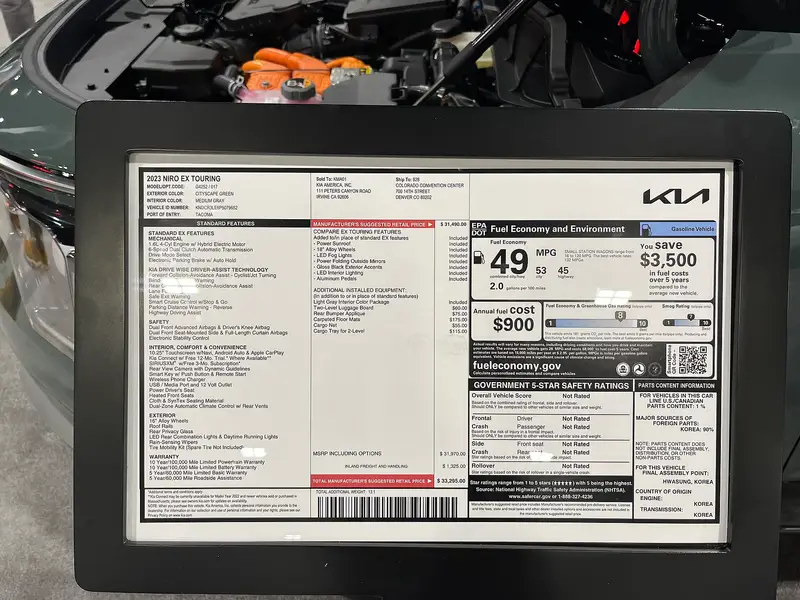
A window sticker in a holder on a new Kia Niro at the 2023 Denver Auto Show
The full guide
What the label shows, how the lookup works for each brand, and where to find the VIN.
What a Monroney label is
To get a car’s original window sticker by VIN, enter the VIN in the tool above and the free check tells you whether the sticker is on file. On a new car, that sticker has an official name: the Monroney label. It comes from the Automobile Information Disclosure Act of 1958, sponsored by Senator Mike Monroney of Oklahoma. The law requires manufacturers to attach a label to the window of every new passenger car sold in the US, and only the buyer may remove it.
The law set out what the label must show:
- Make, model and serial number (today, the VIN)
- The final assembly point
- The dealer the car was shipped to
- The manufacturer’s suggested retail price (MSRP) of the base vehicle
- Each factory-installed option and its price
- The destination and delivery charge
- The total suggested price
Later rules added more. EPA fuel economy figures, estimated fuel cost and emissions ratings now sit on the label, along with NHTSA crash-test star ratings where a vehicle has been rated. A separate 1992 law, the American Automobile Labeling Act, added the share of US and Canadian parts content and the country of origin for the engine and transmission.
Why used-car buyers want the original sticker
Once a car is sold, the sticker usually ends up in a glove box or a bin. For a used-car buyer, though, it’s still the best single record of how that car was built.
- Verify options and packages. A listing might say “fully loaded”. The sticker shows exactly which packages were ordered and what each one cost.
- See the original MSRP. Knowing what the car cost new helps you judge whether an asking price makes sense, and whether a higher-priced trim was really bought.
- Spot a misrepresented trim. Badges are cheap. A base model wearing a top-trim badge, or a truck sold as an off-road package it never had, is easy to catch when the sticker lists the real trim and packages.
- Check the factory color and equipment. The exterior and interior color names, wheels, engine and transmission are all printed, which helps if a part has been swapped or the car has been repainted.
How our window sticker lookup works
Enter the 17-character VIN in the tool above. We decode it through NHTSA’s free vPIC database, then check whether an original sticker is available for that exact vehicle.
What happens next depends on the brand:
| Brand | Original sticker | Cost |
|---|---|---|
| Ford, Lincoln | Straight from Ford’s own window-sticker system, when Ford has released it for that VIN | Full Report, $9.99 |
| Jeep, Ram, Dodge, Chrysler, Fiat, Alfa Romeo | From Stellantis’s own window-sticker system for most 2013-and-later VINs, and through our licensed partner when Stellantis has none | Full Report, $9.99 |
| Chevrolet, GMC, Buick, Cadillac, Hyundai, Genesis, Kia, Toyota, Lexus, Nissan, Mitsubishi | Through a licensed window-sticker data partner, when one is on file for that VIN | Full Report, $9.99, when a partner has it on file |
| Subaru | From Subaru’s own window-sticker system, when it has the VIN on file (2021 and later in our tests) | Full Report, $9.99, when Subaru has it on file |
| Honda, Acura, Volkswagen, Audi, BMW, Mercedes-Benz, Tesla, Porsche, Mazda, Volvo and others | No original-sticker source | Free decode; $4.99 Spec Sheet, labelled as not the original |
Ford coverage is best for recent model years. In our testing, 2025 vehicles returned the real sticker, while several 2021 and 2022 VINs returned Ford’s “not yet released” notice. Older Fords are often unavailable. Partner coverage also varies by model year and market, so we never promise a sticker exists for every VIN.
For brands with no sticker source, we tell you plainly. Your best options are the selling dealer, the brand’s customer-service line, the original purchase paperwork, or the owner’s online account (Tesla owners, for example, can find purchase documents in their account). If you just need the specs, the $4.99 Spec Sheet pulls equipment, fuel economy and crash ratings from NHTSA and EPA data, and says on its face that it isn’t the original sticker.
What is always free
For every brand, at no cost:
- The VIN check and NHTSA decode: year, make, model, trim where the VIN shows it, series, body style, engine, drivetrain, fuel type, and the assembly plant where NHTSA reports it
- Whether an original window sticker is on file for that VIN
- The number of NHTSA recall campaigns for that make, model and year, with a link to NHTSA’s free open-recall check for your exact VIN
The Full Report
The Full Report is a one-time $9.99 purchase, with no subscription and no account needed. It has the original window sticker PDF where one is on file, the MSRP breakdown (base price, options total, destination), every factory option and package with its original price, the paint code, and full recall details: what’s wrong, the risk and the fix. It’s all saved as one PDF with a permanent link. If we showed a sticker as available and can’t deliver it, you’re refunded automatically. A vehicle history report covering title brands, odometer and salvage records is coming soon where available. Dealers and auction buyers who check a lot of cars can use the Dealer Pass, a monthly plan with a set number of Full Reports.
Original, recreated or decoded?
Search “window sticker by VIN” and you’ll find three different things sold under the same name. Before you trust one, or pay for one, know which you’re getting:
| Original sticker | Recreated sticker | VIN decode | |
|---|---|---|---|
| Where it comes from | The carmaker’s own system or a licensed copy of it | Rebuilt by a website from government or catalog data | NHTSA’s vPIC database |
| Real option prices | Yes, as printed | Rarely; often estimates or blank | No |
| Packages and port accessories | Yes | Sometimes guessed from the trim | No |
| Exact paint name | Yes | Sometimes | No |
| Shows the VIN it was printed for | Yes | Only because you typed it in | Yes |
Recreated stickers aren’t useless, but they aren’t evidence. When a seller claims a package, only the original proves it. Every result on StickerByVIN says which kind it is, and we never sell a recreated sticker as the original.
Can you get the sticker free from the carmaker?
For a few brands, yes, and we’d rather you know. As of our last test, Ford answers a public link for recent VINs, Stellantis (Jeep, Ram, Dodge, Chrysler, Fiat, Alfa Romeo) answers one in a normal web browser, and Subaru answers one for 2021-and-later cars. GM’s old link returned an empty error, and Kia’s and Mitsubishi’s are gone. We test every one monthly and publish the links and results on our free window sticker by brand page.
What we add is the free check across every brand, the sticker read line by line, the paint code, full recall details and one permanent link, for $9.99 when a sticker is on file.
Two real stickers we’ve pulled
- 2025 Ford F-150 XLT, from Ford’s system: base price $51,915, Equipment Group 302A at $7,440, the 5.0L V8 at $2,060, destination $1,995, an “XLT Mid Discount” of $2,000, and a total MSRP of $61,410. You can open the full result free.
- 2021 Jeep Wrangler Unlimited Sport, from Stellantis’s system: base price $32,870, Customer Preferred Package 23S at $3,200, a Cold Weather Group, a Trailer-Tow Group and Mopar leather seats, $1,595 destination and a $44,780 total. The Jeep window sticker page goes through it line by line.
Neither total is something you could guess from the VIN. The decode for the F-150 gets the trim and engine right, but not the package, the discount or the price.
Check the sticker against the car
A sticker only helps if it belongs to the car in front of you.
- The VIN on the sticker must match the dash plate and the door-jamb label, character for character.
- The trim line should match the badge. If the sticker says Sport and the tailgate says Rubicon, the badge was added later.
- Check the equipment against the packages. A sticker listing a cold weather group means heated seats should be there. Missing items can mean swapped parts.
- Compare the color name with the paint. A different color usually means a repaint, which is worth asking about.
- The sums should work. Base price plus options plus destination, minus any printed discount, should equal the total.
Window sticker vs build sheet
People use the two terms loosely, but they are different documents.
- Window sticker (Monroney label): the federally required label for the customer. It lists equipment in plain English with prices, MPG and safety ratings.
- Build sheet: the factory’s internal record of how the car was assembled, often a list of option codes rather than prices. Old build sheets were paper sheets that sometimes turned up under seats or behind door panels.
On StickerByVIN, the build sheet is the parsed version of the sticker, included in the Full Report: standard equipment, optional packages with original prices, base MSRP, destination charge, total MSRP, EPA MPG and assembly plant. Without a sticker, we show the NHTSA-decoded build data, clearly labeled as decoded data rather than the original sticker. See build sheet by VIN for more.
Where to find the VIN
The VIN is 17 characters, using letters and numbers but never I, O or Q. It’s printed in three places:
- Dashboard: on a plate at the base of the windshield on the driver’s side, readable from outside the car
- Driver door jamb: on the certification label on the door edge or the pillar it closes against
- Paperwork: the registration, title and insurance card all show it
Check that the VIN on the dashboard matches the door jamb and the paperwork. If they don’t match, ask why before you go any further.
If the lookup comes back empty
- “Not a valid VIN.” VINs never use I, O or Q, so a 0 read as an O is the usual mistake. Copy it from the registration rather than the dash if you can.
- “Not yet released” or no sticker on file. The carmaker or our partner has nothing for that VIN. It’s common for older cars and for some 2021 and 2022 Fords. You aren’t charged, and the free decode still runs.
- A brand with no source. Honda, BMW, Tesla and others don’t publish stickers. Try the selling dealer or the owner’s account, or use the $4.99 Spec Sheet for the specs.
Related lookups
- Monroney sticker by VIN: the law behind the label and a real one read panel by panel
- Free window sticker by brand: which carmaker links still work, tested monthly
- Paint code by VIN: what the VIN can and can’t tell you about color, and where each brand puts its paint label
- What trim is my car: how to confirm the real trim level
- Brand guides: Ford, Chevrolet, Jeep, Toyota
Questions
Is the window sticker lookup really free?
Checking is free for every car: we decode the VIN, count recalls and tell you if the original sticker is on file. The sticker itself, with every option and its price, is the $9.99 Full Report. One payment, no subscription.
Can I get the original window sticker for any car?
No. It depends on the brand and year. For brands like Honda, BMW and Tesla there is no sticker source, and we tell you that instead of selling you one. Subaru has its own sticker system, but in our tests it only covered 2021 and later.
Will I pay for a report and find out there is no sticker?
No. The free check tells you first whether a sticker is on file for that exact VIN. And if we say one is found but can't deliver it, you get your money back automatically.
Is a window sticker the same as a Monroney label?
Yes. Monroney label is the official name for the window sticker US law requires on every new car. It's named after Senator Mike Monroney, who wrote the 1958 law.
Are free window sticker sites giving me the original?
Often not. Many free tools rebuild a sticker-style page from government VIN data. That can help, but it isn't the label the factory printed and it can't show real option prices. We mark every result as original or decoded.
Can I get a window sticker for an older car?
Sometimes. Carmaker systems mostly hold recent model years, and Stellantis's starts around 2013. The free check tells you for your exact VIN. For older cars without one, the $4.99 Spec Sheet covers specs and ratings from NHTSA and EPA data, labelled as not the original.
Does a window sticker show accident or title history?
No. The sticker shows the car as it left the factory: equipment, options and prices. Accidents and title history are in a separate vehicle history report.