Davinci Resolve Lua MCP
Control the free edition of DaVinci Resolve using your AI Agent
Documentation
DaVinci Resolve Lua MCP
Control the free edition of DaVinci Resolve 21.1 from Claude through a Lua script that runs inside Resolve. macOS and Windows (experimental), no Studio licence, no network.




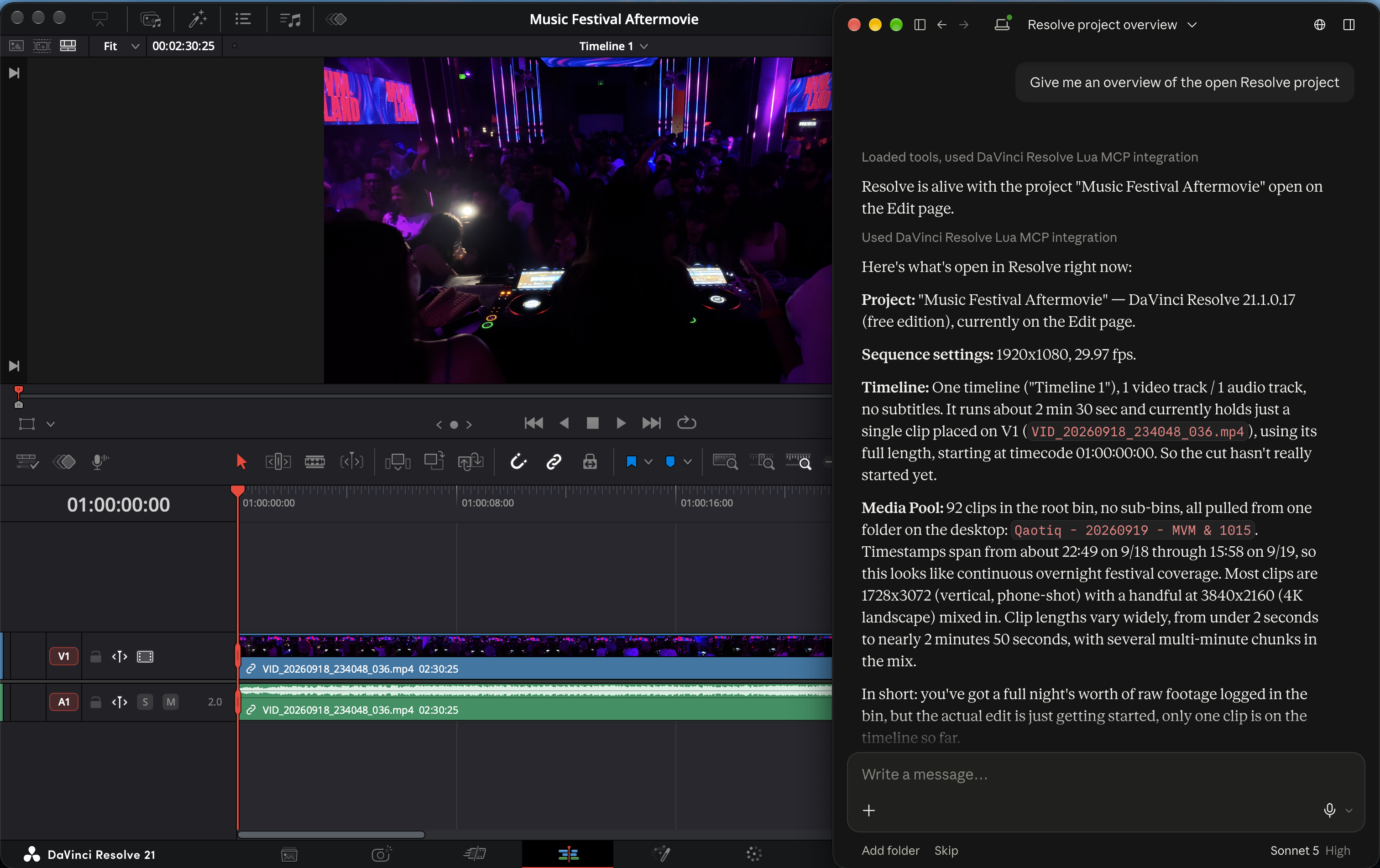
DaVinci Resolve 21.1 moved Python scripting and the external scripting API to the Studio edition, and Blackmagic's own MCP server ships with Studio only. One door is still open on the free edition: Workspace > Scripts lists and runs Lua files. This project puts a small Lua script there. Launched once per Resolve session, it holds the live resolve object and executes Lua on behalf of an MCP server that Claude Desktop runs as an extension.
[!NOTE] Nothing here unlocks Studio features: the bridge uses the free edition's own Lua scripting API. Studio 21.1 users already have Blackmagic's native MCP server.
Features
- 15 purpose-built tools: project overview, project and timeline lists, Media Pool clips, timeline items, markers, timeline and project switching, rendering with status polling, and a search over Blackmagic's shipped scripting reference.
run_luafor everything else: any Lua 5.1 chunk runs inside Resolve with the liveresolveobject and returns JSON, capturedprintoutput and errors.- One
.mcpbbundle: install it in Claude Desktop, and the server copies its two Lua scripts into Resolve's user scripts folder on first launch. - No network: the server and the script talk through a request file and Fusion's preferences. There are no sockets, no listeners and no telemetry.
- Fast enough to feel interactive: about 60 ms per call, measured end to end on a Mac.
Requirements
- macOS (Apple Silicon is the only hardware measured).
- Windows 10 or 11, experimental. The default paths come from Blackmagic's documentation and forum reports; nothing has been measured on Windows yet. docs/windows.md lists what to check.
- DaVinci Resolve 21.1 free edition (build 21.1.0.17 is the one measured). Studio is not needed and not targeted. Blackmagic documents neither this Lua host nor its sandbox, so a point release can change what works.
- Claude Desktop. It ships the Node runtime the server needs (Node 20 or newer); nothing else is installed.
- A project open in Resolve while you use the tools.
Install
- Download
davinci-resolve-lua-mcp.mcpb(the latest release; the release notes and the SHA-256 are on the Releases page). - Double-click the file, or drag it onto the Claude Desktop window. Claude Desktop shows the extension's details and five settings; keep the defaults and click Install.
- In Resolve, open a project and click
Workspace > Scripts > resolve_mcp_bridge. That script is the bridge; the extension put it there when it first started.- The bridge stops when Resolve quits. Click it again after every Resolve launch, before using the tools.
- Ask Claude "Are you connected to DaVinci Resolve?".
From a terminal, either command downloads the file and opens the same dialog.
macOS:
curl -fsSLo ~/Downloads/davinci-resolve-lua-mcp.mcpb https://github.com/saadk408/davinci-resolve-lua-mcp/releases/latest/download/davinci-resolve-lua-mcp.mcpb && open ~/Downloads/davinci-resolve-lua-mcp.mcpb
Windows (PowerShell):
Invoke-WebRequest -Uri https://github.com/saadk408/davinci-resolve-lua-mcp/releases/latest/download/davinci-resolve-lua-mcp.mcpb -OutFile "$env:USERPROFILE\Downloads\davinci-resolve-lua-mcp.mcpb"; Start-Process "$env:USERPROFILE\Downloads\davinci-resolve-lua-mcp.mcpb"
If nothing opens, install the file from Claude Desktop: Settings > Extensions > Advanced settings > Install Extension.
To update, download the new file and open it; extensions installed from a file do not update on their own. The server refreshes its two Lua scripts on its next start, so click Workspace > Scripts > resolve_mcp_bridge again afterwards. To build the bundle yourself, see Development.
Start and stop the bridge
Open a project in Resolve and click Workspace > Scripts > resolve_mcp_bridge. Nothing appears in the Console (the free edition mutes print in menu scripts); the bridge loops in the background and Resolve stays responsive. In Claude Desktop, resolve_status then reports alive: true with the product, version, edition, page and open project.
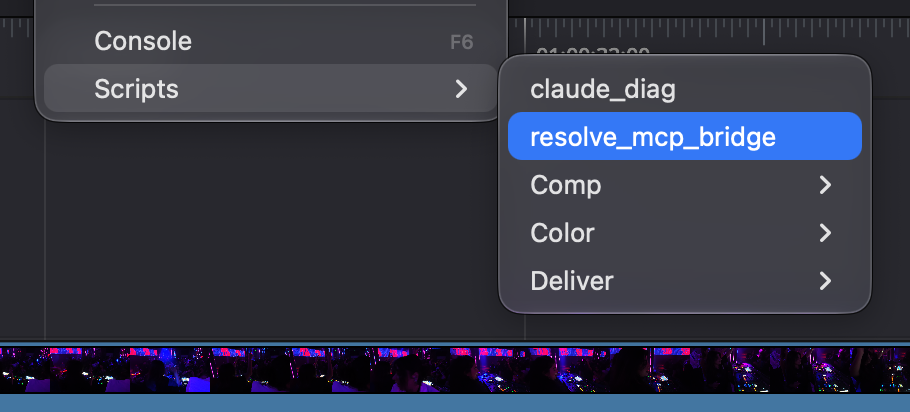
[!IMPORTANT] The bridge lives and dies with Resolve. After every Resolve launch, click
Workspace > Scripts > resolve_mcp_bridgeagain before using the tools. It is never started automatically, by design: a loop started throughfusion:Executeholds Fusion's shared script executor for the whole session, so the Scripts menu is the only supported launch.
To stop it, ask Claude to stop the bridge (stop_bridge), or quit Resolve. Clicking the script a second time while the bridge is running is harmless: the new one takes over and the old one exits on the first request addressed to the newer session.
Example prompts
Give me an overview of the open Resolve project.
List the clips in the root bin with their durations and frame rates.
What is on video track 1 of the current timeline?
Add a blue marker at frame 240 named "fix colour".
Delete all the red markers on this timeline.
Render the current timeline to ~/Movies/out as fix-v2 and tell me when it finishes.
Look up AppendToTimeline in the Resolve scripting docs.
Use run_lua to return the current timeline's start timecode and its item count on V1.
https://github.com/user-attachments/assets/febdf2b9-8e0d-4fbf-8462-0d6ecd98c829
Tools
| Tool | What it does | Parameters | Access |
|---|---|---|---|
resolve_status | Whether the bridge is running and why not, its session, the platform, the self-install outcome and, when alive, product, version, edition, page and project | none | read-only |
run_lua | Runs a Lua 5.1 chunk inside Resolve with the live resolve object; returns its first return value as JSON plus captured prints and errors | code; timeout_s 1..300 (default from the settings) | destructive |
get_project_info | Name, page, database, frame rate, resolution, timeline count, root-bin counts and the current timeline of the open project | none | read-only |
list_projects | Projects in the current project-manager folder with dates and notes; marks the open one | none | read-only |
list_timelines | Every timeline with unique id, frame range and track counts; marks the current one | none | read-only |
list_media_pool_clips | Clips in one bin with path, duration, fps, resolution, type, frames and colour | bin_path (default /); offset; limit 1..200 (default 50) | read-only |
get_timeline_items | Items on one track of the current timeline with type, frames, source frames, enabled state and file path | track_type video, audio or subtitle; track_index from 1; offset; limit 1..500 (default 100) | read-only |
add_marker | Adds a marker to the current timeline and returns the stored marker | frame (relative to the timeline start); color (one of the 16 Resolve colours); name; note; duration in frames (default 1) | writes |
delete_markers | Deletes every marker of one colour, or all markers, from the current timeline | color (omit for all); confirm must be true | destructive |
set_current_timeline | Makes the named timeline current; an unknown name lists the known ones | name | writes |
open_project | Loads the named project, saving the open one first by default; an unknown name lists the known projects | name; save_current (default true) | writes |
render_current_timeline | Queues and starts a render of the current timeline and returns the job id | preset (optional, validated against the preset list); output_dir (absolute, must exist); filename | writes |
get_render_status | Status, completion percentage and error of one render job, plus whether Resolve is rendering | job_id | read-only |
stop_bridge | Asks the bridge to exit cleanly; relaunch it from Workspace > Scripts afterwards | none | writes |
scripting_api_docs | Searches Blackmagic's shipped scripting reference (.pyi signatures, README sections, CHANGELOG) with file and line; flags deprecated and unsupported calls | query; limit 1..10 (default 5) | read-only |
Every tool declares its access hints to the client. delete_markers refuses without confirm: true, and Claude is told to ask you first; run_lua takes no confirmation and is flagged destructive so the client can warn. Results are JSON with a matching structuredContent; the paginated tools (list_media_pool_clips, get_timeline_items) report total, offset, limit and truncated, and every failure names the next step instead of throwing.
Marker colours: Blue, Cyan, Green, Yellow, Red, Pink, Purple, Fuchsia, Rose, Lavender, Sky, Mint, Lemon, Sand, Cocoa, Cream.
Writing Lua for run_lua
The chunk runs inside Resolve's Scripts-menu Lua state (LuaJIT, Lua 5.1) with the globals resolve and fusion. Conventions, as the server also tells Claude:
- Call methods with a colon (
project:GetName()) and read constants with a dot (resolve.EXPORT_AAF). - API lists are 1-based tables: use
#listandfor i = 1, #list, neverpairs. Dicts are keyed tables;GetMarkers()is keyed by frame number. - Page names for
OpenPageare lowercase ("edit","color","deliver"). returna value to get it back as JSON. Only the first return value is sent.printoutput is invisible in Resolve but comes back inprints(capped at 200 lines / 16 KB).- Look the method up with
scripting_api_docsfirst, and avoid the deprecated forms Blackmagic's shipped examples still use:GetSetting/SetSetting(useGetSettings()/SetSettings({})),GetItemsInTrack(useGetItemListInTrack), index-based render-job calls (ids are strings) and single-argumentGetClipProperty. io,os.execute,os.remove,require,package,ffianddebugdo not exist in this state; errors carry the message only, without a traceback.
local project = resolve:GetProjectManager():GetCurrentProject()
local timeline = project:GetCurrentTimeline()
local items = timeline:GetItemListInTrack("video", 1)
local out = {}
for i = 1, #items do
  out[i] = { name = items[i]:GetName(), first = items[i]:GetStart(), last = items[i]:GetEnd() }
end
return { timeline = timeline:GetName(), start_timecode = timeline:GetStartTimecode(), items = out }
[!WARNING] The bridge handles one request at a time and cannot answer Resolve's modal dialogs. Long synchronous API calls (
RenderWithQuickExport,TranscribeAudio,Export,ArchiveProject,LoadProjecton an unsaved project when live save is off) block it until they finish. Start renders withrender_current_timelineand pollget_render_statusinstead of waiting insiderun_lua.
Settings
Claude Desktop shows these five settings when you install the extension. Keep the defaults for a standard Resolve installation. An empty folder field means the platform default from the Paths table.
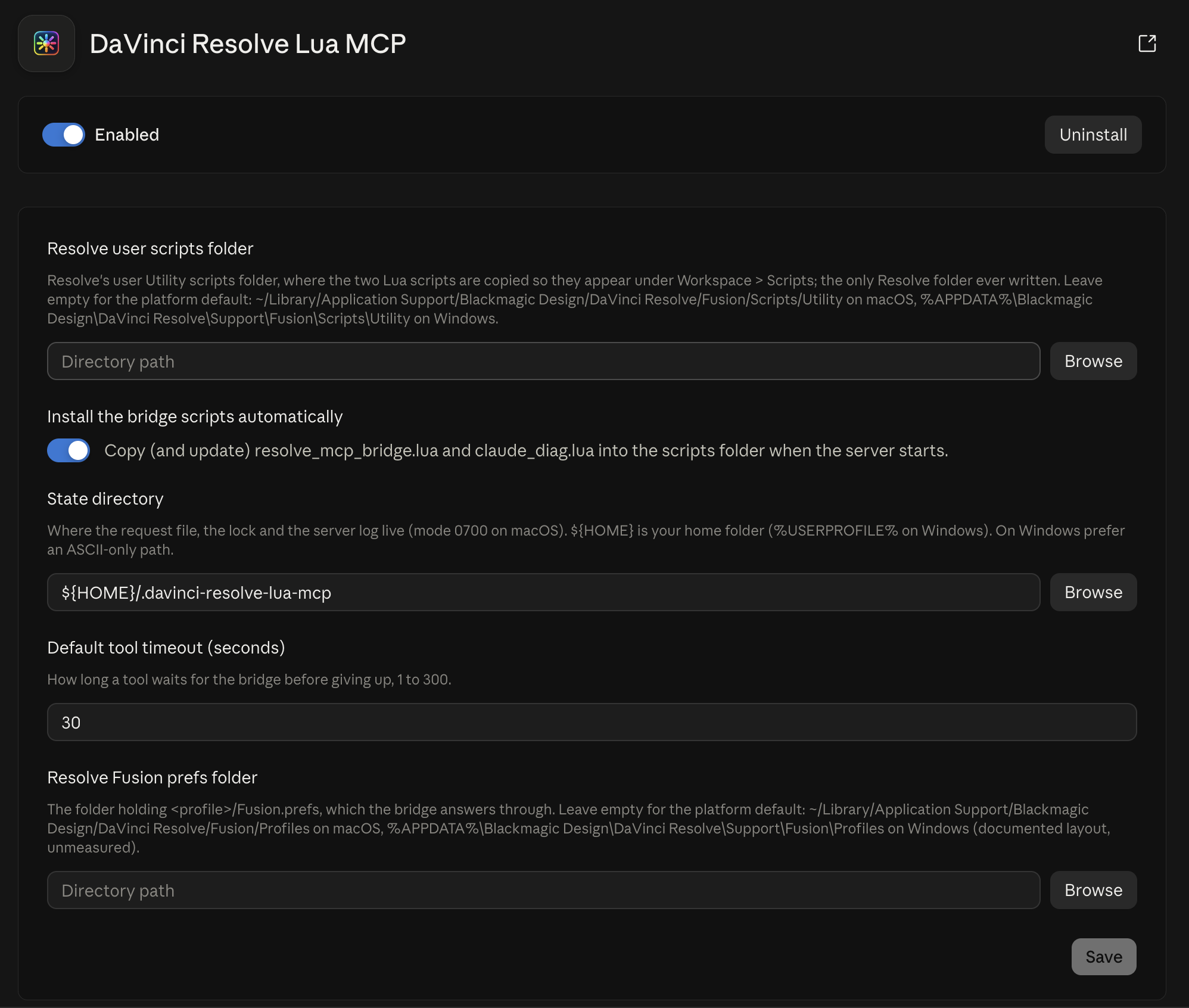
| Setting | Default | What it does |
|---|---|---|
| Resolve user scripts folder | platform default | Where the two Lua scripts are copied so they appear under Workspace > Scripts. The only Resolve folder ever written, and never created: launch Resolve once so it exists. |
| Install the bridge scripts automatically | on | Copy (and update) resolve_mcp_bridge.lua and claude_diag.lua into the scripts folder when the server starts. Off means you copy them by hand. |
| State directory | platform default | Where the request file, the lock and the server log live. On Windows prefer an ASCII-only path. |
| Default tool timeout (seconds) | 30 | How long a tool waits for the bridge before giving up, 1 to 300. run_lua can override it per call. |
| Resolve Fusion prefs folder | platform default | The folder holding <profile>/Fusion.prefs, which the bridge answers through; the newest profile file is read. Set it only if resolve_status says prefs_missing. |
Paths
| macOS | Windows | |
|---|---|---|
| Scripts folder (written) | ~/Library/Application Support/Blackmagic Design/DaVinci Resolve/Fusion/Scripts/Utility | %APPDATA%\Blackmagic Design\DaVinci Resolve\Support\Fusion\Scripts\Utility |
| State directory (written) | ~/.davinci-resolve-lua-mcp | %USERPROFILE%\.davinci-resolve-lua-mcp |
| Fusion prefs folder (read) | ~/Library/Application Support/Blackmagic Design/DaVinci Resolve/Fusion/Profiles | %APPDATA%\Blackmagic Design\DaVinci Resolve\Support\Fusion\Profiles |
| Scripting docs (read) | /Library/Application Support/Blackmagic Design/DaVinci Resolve/Developer/Scripting | %PROGRAMDATA%\Blackmagic Design\DaVinci Resolve\Support\Developer\Scripting |
| Claude Desktop logs and extensions | ~/Library/Logs/Claude/, ~/Library/Application Support/Claude/Claude Extensions/ | %APPDATA%\Claude\logs\, %APPDATA%\Claude\Claude Extensions\ |
The Windows paths are documented, not measured; the Fusion prefs folder is the least certain of them. A Microsoft Store install of Claude Desktop keeps its folders under %LOCALAPPDATA%\Packages\Claude_<id>\LocalCache\Roaming\Claude\ instead.
Environment variables (for the developer loop and tests)
The settings map onto RLB_SCRIPTS_DIR, RLB_AUTO_INSTALL, RLB_STATE_DIR, RLB_DEFAULT_TIMEOUT_S and RLB_PREFS_DIR; the rest have no setting. A bad value falls back to its default and shows up in resolve_status under config_problems; the server never refuses to start over configuration.
| Variable | Default | Meaning |
|---|---|---|
RLB_SCRIPTS_DIR | the scripts folder | Where the two Lua files go. |
RLB_AUTO_INSTALL | true | Self-install the two Lua files on start. |
RLB_STATE_DIR | the state directory | Holds next.lua, next.lua.tmp, lock and server.log. ~ and ${HOME} are expanded; on Windows the server spells the path with forward slashes. |
RLB_DEFAULT_TIMEOUT_S | 30 | 1..300 seconds. |
RLB_MAX_RESPONSE_KB | 64 | Cap on a response's JSON, 1..192 KB. |
RLB_LOG_LEVEL | info | debug, info, warn or error. |
RLB_PREFS_DIR | the Fusion prefs folder | Folder of <profile>/Fusion.prefs files; the newest one is read. |
RLB_DOCS_DIR | the scripting docs | Blackmagic's shipped reference, read by scripting_api_docs. Never written. |
Troubleshooting
- The bridge is missing from
Workspace > Scripts. Ask Claude forresolve_statusand readbridge_script.outcome:installed,updatedorup_to_date: the file is in the scripts folder. Reopen the menu; Resolve lists a new file without a restart.skipped_auto_install_off: the setting is off. Copybridge/resolve_mcp_bridge.luaandscripts/claude_diag.luathere yourself.scripts_dir_missing: the folder does not exist. Launch Resolve once so it creates it, or fix the scripts-folder setting; the server never creates Resolve folders.permission_deniedorerror: the operating-system message says why.
config_problemsnames the state directory. The path cannot be embedded in the bridge: it contains]==], a double quote or a newline, starts with@@, or contains a backslash on macOS (Windows rewrites backslashes as forward slashes). Auto-install stays off until you change the State directory setting.- I copied the script into
Scripts/Deliver. Resolve also offers that folder's scripts as selectable render start/end scripts in the Deliver page, which is not where the bridge belongs. Delete the copy and keep the script inScripts/Utilityonly. Fusion.prefsis not updating. The bridge writes preferences only when it answers a request, so first check that it is running (resolve_status). The newestFusion.prefsunder the prefs folder is the one read, whatever the profile is called; set the prefs-folder setting only if that folder is somewhere else. A save that fails while Resolve is writing the file is attempted up to five times, and a failed start save is retried once a second until it lands.resolve_statussaysprefs_missing. NoFusion.prefsexists under the Fusion prefs folder. Launch Resolve at least once, or point the prefs-folder setting at the right folder. On Windows the default is documented but unmeasured; if yourFusion.prefslives elsewhere, please report the path as docs/windows.md describes.- A request is stuck, or a tool times out. The bridge is busy on a long synchronous call or a modal dialog it cannot answer: wait for Resolve to finish, then retry. Requests older than 120 s are refused by the bridge and the server removes
next.luaafter a timeout, so nothing needs clearing by hand. For slow calls, raise the default timeout (up to 300 s) or passtimeout_storun_lua. resolve_statussayslock_held. Another server kept the request slot for longer than the timeout: a second Claude Desktop entry,make smoke, or a dev-register loop. Stop it, or change the State directory setting. Remove thelockfile in the state directory by hand only if the pid it names is not a server.- On Windows, a tool answers with
EBUSYorEPERMonnext.lua. Windows refuses to delete or replace a file another process holds open, and the bridge re-reads the request file every 50 ms, so the server retries for about a second. A persistent error means something else keeps the file open, usually an antivirus scanner: exclude the state directory from real-time scanning. - On Windows,
resolve_statussaysstate_dir_ascii: false. Resolve's Lua may not open a path with non-ASCII characters, and every request would then time out. Set the state directory to an ASCII-only path such asC:\rlb. - Resolve was restarted mid-session.
resolve_statussaysresolve_gone(the recorded pid is dead) orno_reply. The session record survives the restart on purpose, and there is no heartbeat, so nothing restarts the bridge for you: clickWorkspace > Scripts > resolve_mcp_bridgeagain. - The response says
truncated: true. The JSON exceeded the cap (64 KB by default). Forrun_lua,result_previewholds the start of it; a purpose-built tool over the cap answers with an error that names the cap and asks for a smallerlimitor a differentoffset. Useoffsetandlimiton the list tools, or return less from your Lua. - Reinstalling shows no dialog. Remove the extension under Settings > Extensions, then open the
.mcpbagain; Claude Desktop relaunches the server at once. - A tool answers
bad_response. The installed script and the server disagree on the protocol, usually after an upgrade of one but not the other. Restart Claude Desktop so the server reinstalls the script, then relaunch it from the Scripts menu. - Where the logs are. The server's own log is
server.login the state directory (truncated at 5 MB; the path is also inresolve_status). Claude Desktop keeps the server's stderr asmcp-server-DaVinci Resolve Lua MCP.login its logs folder, which records the connection, not the chat's tool calls; the installed extension islocal.mcpb.saad-khan.davinci-resolve-lua-mcpin its extensions folder (both in Paths).
Prove that a call ran
The last answer is in Fusion.prefs, hex-encoded. On macOS:
PREFS=~/Library/Application\ Support/Blackmagic\ Design/DaVinci\ Resolve/Fusion/Profiles/Default/Fusion.prefs
grep -o 'RLBResp = "[^"]*"' "$PREFS" | cut -d: -f2 | tr -d '"' | xxd -r -p
On Windows (PowerShell):
$prefs = Join-Path $env:APPDATA 'Blackmagic Design\DaVinci Resolve\Support\Fusion\Profiles\Default\Fusion.prefs'
$hex = ([regex]::Match((Get-Content -Raw -LiteralPath $prefs), 'RLBResp = "([^"]*)"').Groups[1].Value -split ':')[1]
$bytes = [byte[]]::new($hex.Length / 2); for ($i = 0; $i -lt $bytes.Length; $i++) { $bytes[$i] = [Convert]::ToByte($hex.Substring(2 * $i, 2), 16) }
[Text.Encoding]::UTF8.GetString($bytes)
Security
[!WARNING] Anything that can write one file on this machine can run Lua inside Resolve with your privileges. Read a
run_luachunk before you approve it.
- The state directory is that boundary. macOS creates it with mode 0700; Windows gives it your profile folder's permissions (the server sets none of its own).
- The last response persists hex-encoded in
Fusion.prefsuntil the next one overwrites it. On the measured Mac that file has mode 0666, so any local account can read the previous answer; on Windows it sits under%APPDATA%, private to your account by default (unmeasured). A clean stop marks the session recordstoppedand replaces the last answer with the stop acknowledgement. - The extension runs with your user's privileges, inside Claude Desktop's process model, with no sandbox of its own. It writes only its state directory and the two Lua files in Resolve's user scripts folder.
- No network: the server opens no sockets and makes no requests. Files in, preferences out.
Privacy Policy
The extension runs entirely on your machine and sends nothing anywhere. The full policy is PRIVACY.md; in short:
- Collection. It processes what Claude sends it (Lua code, marker text, names, paths) and what Resolve answers (project, timeline, clip and marker metadata, media paths). No accounts, no credentials, no telemetry, analytics or crash reporting.
- Use and storage. That data lives only in the request file (one call, then deleted), the last answer in
Fusion.prefs, the server log (ids, timings, paths and error messages; never Lua code, arguments or results) and Claude Desktop's copy of that log. - Third-party sharing. None by the extension. Claude Desktop sends tool inputs and results to Anthropic as part of your conversation, under Anthropic's privacy policy; GitHub serves the download.
- Retention. Until the next call or bridge launch overwrites the answer, until the log passes 5 MB, and otherwise until you delete the files as described under Uninstall.
- Contact. Questions: open an issue. Security problems: the repository's Security tab, as SECURITY.md describes.
Uninstall
- Remove "DaVinci Resolve Lua MCP" under Settings > Extensions in Claude Desktop.
- Delete
resolve_mcp_bridge.luaandclaude_diag.luafrom the scripts folder (see Paths); from a checkout on a Mac,make uninstall-bridgeremoves exactly those two files. - Delete the state directory.
The Global.ResolveLuaBridge.* keys stay in Fusion.prefs (under 2 KB after a clean stop: the session record, the stop answer and eight blanked keys). Remove them from Fusion's preferences if you want the file pristine.
Development
Prerequisites:
- Node 20 or newer and npm (the Makefile sources
~/.nvm/nvm.sh). - A DaVinci Resolve installation: the Lua tests run under its bundled
fuscriptat/Applications/DaVinci Resolve/DaVinci Resolve.app/Contents/Libraries/Fusion/fuscript. - Optionally
lua-language-server, formake lint-lua. - The Makefile is macOS-only. On Windows, run the same gates from Git Bash as docs/windows.md lists; the
fuscripttests andmake smokehave no Windows equivalent.
git clone https://github.com/saadk408/davinci-resolve-lua-mcp.git
cd davinci-resolve-lua-mcp
npm install
make test      # Lua checks under fuscript + the Node suite
make bundle    # dist/davinci-resolve-lua-mcp.mcpb, validated and probed
make install   # make bundle, then open the .mcpb so Claude Desktop shows its dialog
| Target | What it does |
|---|---|
make test | Grep gates, then the Lua checks under fuscript and the Node tests (node --test through tsx). Every fixture is a temp dir; nothing under ~/Library is touched. |
make build | tsc --noEmit, then esbuild src/index.ts into server/index.js (CommonJS, Node 20 target). |
make bundle | Build, then npm run bundle: mcpb validate, mcpb pack into dist/, mcpb info, then the bundle gate tests/check_bundle.mjs (exact file list, size under 2 MB, unpack, and a stdio tools/list + resolve_status probe of the unpacked copy under temp dirs with the self-install off). |
make install | Bundle, then open the .mcpb. The install click is yours. |
make sign | Optional self-signed mcpb sign plus mcpb verify; cert.pem and key.pem stay out of git and the bundle. |
make dev-register / make dev-unregister | Add or remove a davinci-resolve-lua-mcp-dev entry in ~/Library/Application Support/Claude/claude_desktop_config.json that runs server/index.js from this checkout with the current Node. The file is backed up first, other keys are kept, mode 0600 is preserved. scripts/dev-register.mjs takes --config, --name, --server (another checkout's server/index.js, for example a git worktree's), --env (a KEY=VALUE file whose RLB_* lines become the entry's environment; default .env), --dry-run and --remove. |
make smoke SMOKE_PROJECT="<name>" | Build, then drive the real tools against the live bridge exactly as Claude Desktop does: status, latency, prints and errors, project and timeline listings, a scratch timeline with markers, pagination, truncation, a render and its cleanup. SMOKE_FLAGS=--no-render skips the render. Output goes to .out/smoke.log. |
make stop | Ask the running bridge to exit (stop_bridge); relaunch it from the Scripts menu afterwards. |
make uninstall-bridge | Remove exactly resolve_mcp_bridge.lua and claude_diag.lua from the scripts folder (RLB_SCRIPTS_DIR overrides the default). |
make lint-lua | Check that the generated API types match the installed .pyi, then run lua-language-server --check over the workspace, failing on any diagnostic under bridge/ or tests/. |
make inspect | Build, then tools/list through the MCP Inspector CLI. The Inspector runs the server with the production paths, so this performs the real self-install. |
make gen-types, make clean | Regenerate types/resolve_host.d.lua from the shipped .pyi; remove server/, dist/ and .out/. |
The developer loop: make dev-register once, then make build and restart Claude Desktop after each change, with no repack. The dev entry and the installed extension can run side by side: the request-slot lock is taken per request and released at once, so an idle server never blocks the other. They answer to the same tool names, though, so disable one in Claude Desktop while testing the other. CONTRIBUTING.md has the branch and release flow.
Releases: pushing a vX.Y.Z tag runs .github/workflows/release.yml, which runs the Node gates and make bundle on the tagged commit, attests the bundle's build provenance, then publishes an immutable GitHub Release with the bundle attached and its SHA-256 in the notes; an annotated tag's message becomes the notes' introduction. A second job publishes the release to the MCP Registry as io.github.saadk408/davinci-resolve-lua-mcp, with the hash of the file the release serves. Verify a downloaded bundle with gh attestation verify davinci-resolve-lua-mcp.mcpb -R saadk408/davinci-resolve-lua-mcp. The tests workflow also runs the Node gates and the bundle gate on a Windows runner.
[!NOTE]
make smokecreates and deletes a timeline namedbridge-smoke, adds and deletes markers on it, and sets the project's render target directory and file name.SMOKE_PROJECTmust be the name of the project that is open in Resolve, and it should be a scratch project, never a real edit. The run refuses to proceed when the names differ.
Layout:
bridge/resolve_mcp_bridge.lua: the in-Resolve loop, one dependency-free file under 600 lines.src/: the TypeScript server.server.tsholds the 15 tools,lua.tsevery Lua snippet and the one string-escaping helper,protocol.tsthe request slot and lock,prefs.tstheFusion.prefsreader,bridgeInstall.tsthe self-install.scripts/claude_diag.lua: the sandbox diagnostic, also shipped in the bundle.tests/: the Node suite;tests/lua/: thefuscriptchecks.docs/: the Windows measurement checklist (windows.md) and the README's screenshots (images/).
Acknowledgments
This project builds on the work of:
- AutoSubs - Lua bridge over Fusion preferences on free 21.1, the channel this project adopted
- samuelgursky/davinci-resolve-mcp - MCP server for DaVinci Resolve Studio through the Python scripting API
DaVinci Resolve is a trademark of Blackmagic Design Pty Ltd. This project is not affiliated with or endorsed by Blackmagic Design.