Kubectl MCP Server
Enables AI assistants to interact with Kubernetes clusters using natural language.
Documentation

kubectl-mcp-server
Control your entire Kubernetes infrastructure through natural language conversations with AI.
Talk to your clusters like you talk to a DevOps expert. Debug crashed pods, optimize costs, deploy applications, audit security, manage Helm charts, and visualize dashboards, all through natural language.
Part of CNCF Landscape, Next to Terraform









Installation
Quick Start with npx (Recommended - Zero Install)
# Run directly without installation - works instantly!
npx -y kubectl-mcp-server

# Or install globally for faster startup
npm install -g kubectl-mcp-server
Or install with pip (Python)
# Standard installation
pip install kubectl-mcp-server

# With interactive UI dashboards (recommended)
pip install kubectl-mcp-server[ui]
📑 Table of Contents
- What Can You Do?
- Why kubectl-mcp-server?
- Live Demos
- Installation
- Getting Started
- Quick Setup with Your AI Assistant
- All Supported AI Assistants
- Complete Feature Set
- Using the CLI
- Advanced Configuration
- Optional Features
- Enterprise
- Integrations & Ecosystem
- In-Cluster Deployment
- Multi-Cluster Support
- Architecture
- Agent Skills
- Development & Testing
- Contributing
- Support & Community
What Can You Do?
Simply ask your AI assistant in natural language:
💬 "Why is my pod crashing?"
- Instant crash diagnosis with logs, events, and resource analysis
- Root cause identification with actionable recommendations
💬 "Deploy a Redis cluster with 3 replicas"
- Creates deployment with best practices
- Configures services, persistent storage, and health checks
💬 "Show me which pods are wasting resources"
- AI-powered cost optimization analysis
- Resource recommendations with potential savings
💬 "Which services can't reach the database?"
- Network connectivity diagnostics with DNS resolution
- Service chain tracing from ingress to pods
💬 "Audit security across all namespaces"
- RBAC permission analysis
- Secret security scanning and pod security policies
💬 "Show me the cluster dashboard"
- Interactive HTML dashboards with live metrics
- Visual timeline of events and resource usage
253 powerful tools | 8 workflow prompts | 8 data resources | Works with all major AI assistants
Why kubectl-mcp-server?
- 🚀 Stop context-switching - Manage Kubernetes directly from your AI assistant conversations
- 🧠 AI-powered diagnostics - Get intelligent troubleshooting, not just raw data
- 💰 Built-in cost optimization - Identify waste and get actionable savings recommendations
- 🔒 Enterprise-ready - OAuth 2.1 auth, RBAC validation, non-destructive mode, secret masking
- ⚡ Zero learning curve - Natural language instead of memorizing kubectl commands
- 🌐 Universal compatibility - Works with Claude, Cursor, Windsurf, Copilot, and 15+ other AI tools
- 📊 Visual insights - Interactive dashboards and browser automation for web-based tools
- ☸️ Production-grade - Deploy in-cluster with kMCP, 216 passing tests, active maintenance
From debugging crashed pods to optimizing cluster costs, kubectl-mcp-server is your AI-powered DevOps companion.
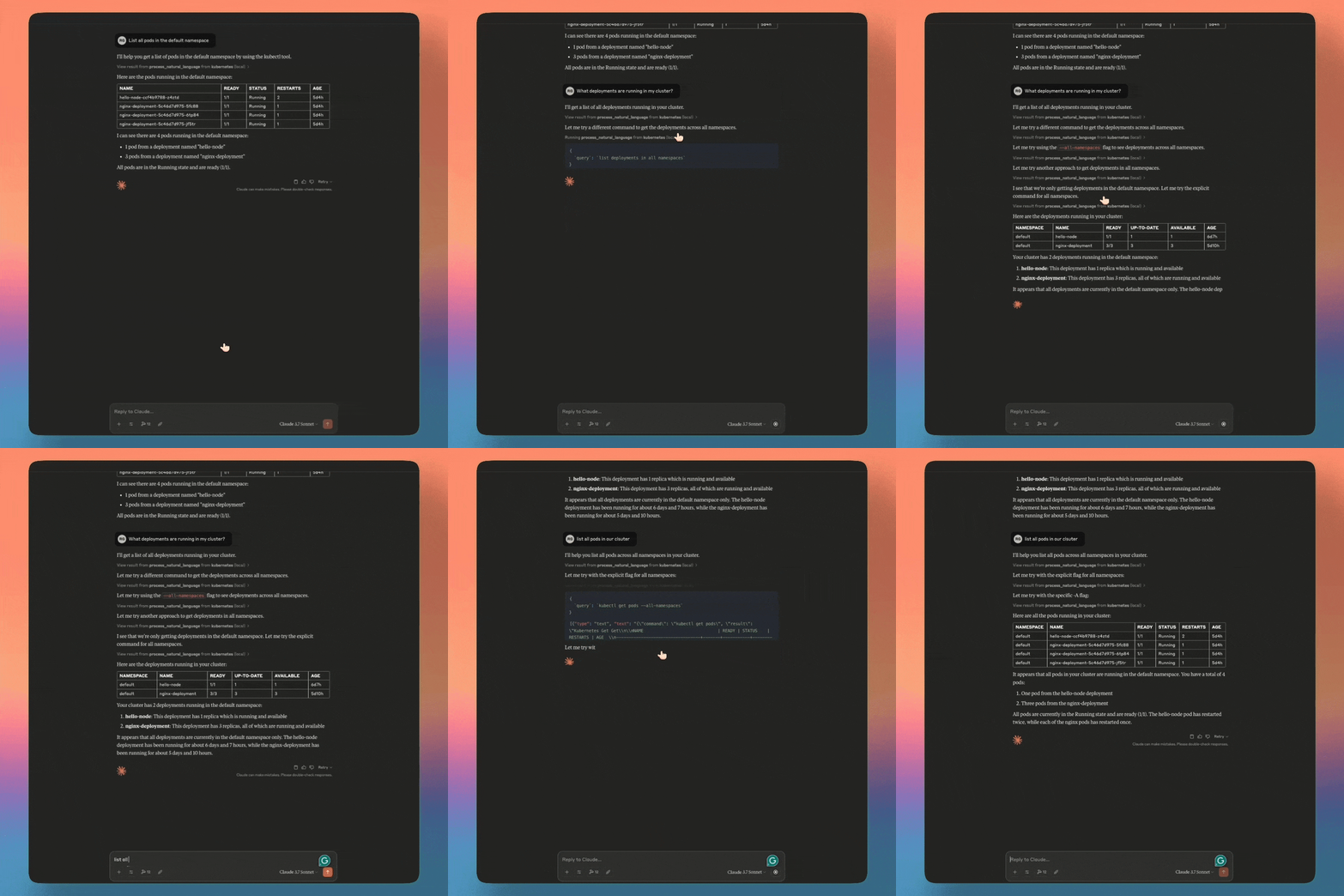
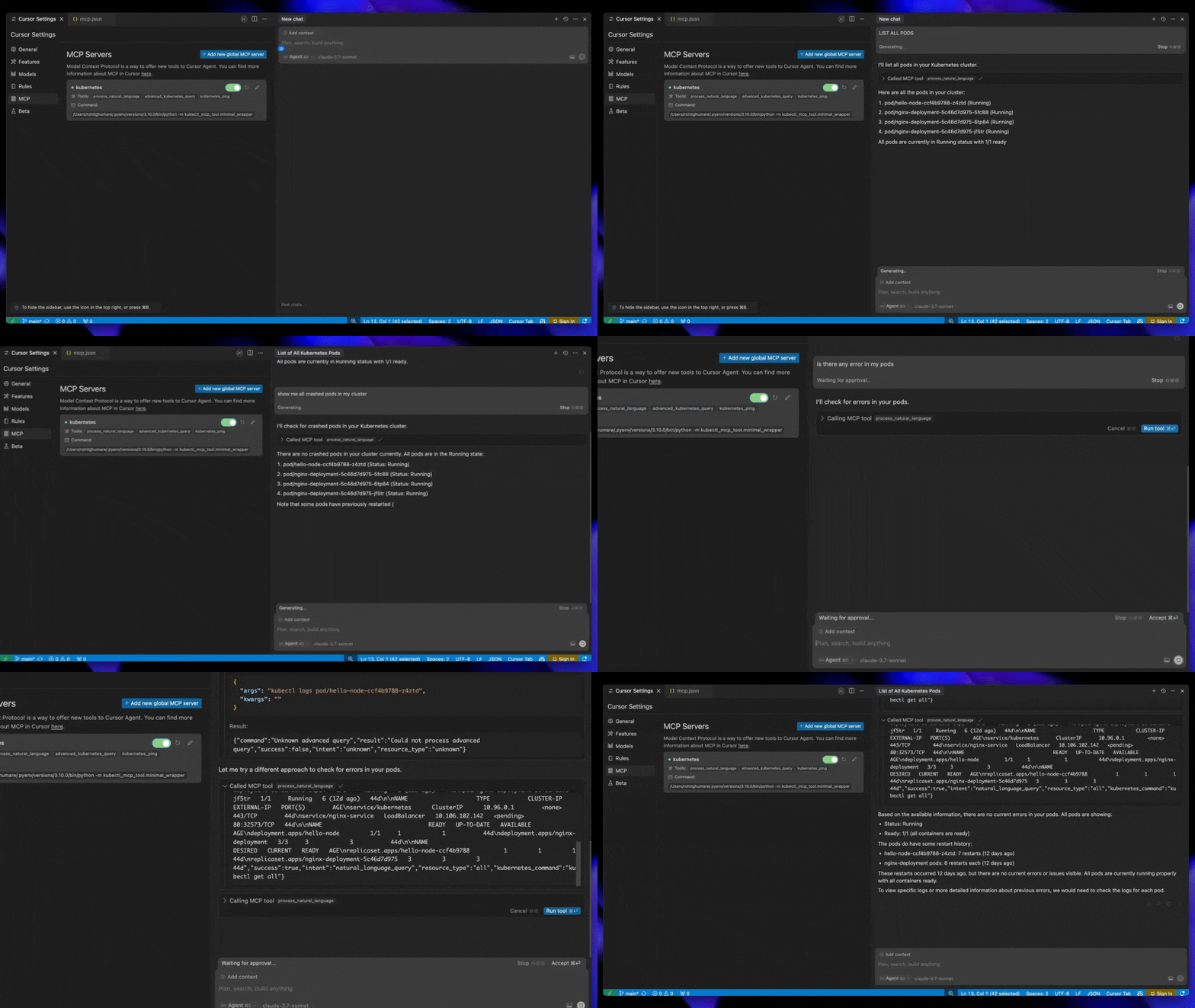
Live Demos
Claude Desktop
Cursor AI
Windsurf
Installation
Quick Start with npx (Recommended - Zero Install)
# Run directly without installation - works instantly!
npx -y kubectl-mcp-server

# Or install globally for faster startup
npm install -g kubectl-mcp-server
Or install with pip (Python)
# Standard installation
pip install kubectl-mcp-server

# With interactive UI dashboards (recommended)
pip install kubectl-mcp-server[ui]
Install from GitHub Release
# Install specific version directly from GitHub release (replace {VERSION} with desired version)
pip install https://github.com/rohitg00/kubectl-mcp-server/releases/download/v{VERSION}/kubectl_mcp_server-{VERSION}-py3-none-any.whl

# Example: Install v1.19.0
pip install https://github.com/rohitg00/kubectl-mcp-server/releases/download/v1.19.0/kubectl_mcp_server-1.19.0-py3-none-any.whl

# Or install latest from git
pip install git+https://github.com/rohitg00/kubectl-mcp-server.git
Prerequisites
- Python 3.9+ (for pip installation)
- Node.js 14+ (for npx installation)
- kubectl installed and configured
- Access to a Kubernetes cluster
Docker
# Pull from Docker Hub
docker pull rohitghumare64/kubectl-mcp-server:latest

# Or pull from GitHub Container Registry
docker pull ghcr.io/rohitg00/kubectl-mcp-server:latest

# Run with stdio transport
docker run -i -v $HOME/.kube:/root/.kube:ro rohitghumare64/kubectl-mcp-server:latest

# Run with HTTP transport
docker run -p 8000:8000 -v $HOME/.kube:/root/.kube:ro rohitghumare64/kubectl-mcp-server:latest --transport sse
Getting Started
1. Test the Server (Optional)
Before integrating with your AI assistant, verify the installation:
# Check if kubectl is configured
kubectl cluster-info

# Test the MCP server directly
kubectl-mcp-server info

# List all available tools
kubectl-mcp-server tools

# Try calling a tool
kubectl-mcp-server call get_pods '{"namespace": "kube-system"}'
2. Connect to Your AI Assistant
Choose your favorite AI assistant and add the configuration:
Quick Setup with Your AI Assistant
Claude Desktop
Add to ~/Library/Application Support/Claude/claude_desktop_config.json:
{
  "mcpServers": {
    "kubernetes": {
      "command": "npx",
      "args": ["-y", "kubectl-mcp-server"]
    }
  }
}
Cursor AI
Add to ~/.cursor/mcp.json:
{
  "mcpServers": {
    "kubernetes": {
      "command": "npx",
      "args": ["-y", "kubectl-mcp-server"]
    }
  }
}
Windsurf
Add to ~/.config/windsurf/mcp.json:
{
  "mcpServers": {
    "kubernetes": {
      "command": "npx",
      "args": ["-y", "kubectl-mcp-server"]
    }
  }
}
Using Python Instead of npx
{
  "mcpServers": {
    "kubernetes": {
      "command": "python",
      "args": ["-m", "kubectl_mcp_tool.mcp_server"],
      "env": {
        "KUBECONFIG": "/path/to/.kube/config"
      }
    }
  }
}
More integrations: GitHub Copilot, Goose, Gemini CLI, Roo Code, and 15+ other clients —> see full configuration guide below.
3. Restart Your AI Assistant
After adding the configuration, restart your AI assistant (GitHub Copilot, Claude Code,Claude Desktop, Cursor, etc.) to load the MCP server.
4. Try These Commands
Start a conversation with your AI assistant and try these:
Troubleshooting:
"Show me all pods in the kube-system namespace"
"Why is the nginx-deployment pod crashing?"
"Diagnose network connectivity issues in the default namespace"
Deployments:
"Create a deployment for nginx with 3 replicas"
"Scale my frontend deployment to 5 replicas"
"Roll back the api-server deployment to the previous version"
Cost & Optimization:
"Which pods are using the most resources?"
"Show me idle resources that are wasting money"
"Analyze cost optimization opportunities in the production namespace"
Security:
"Audit RBAC permissions in all namespaces"
"Check for insecure secrets and configurations"
"Show me pods running with privileged access"
Helm:
"List all Helm releases in the cluster"
"Install Redis from the Bitnami chart repository"
"Show me the values for my nginx-ingress Helm release"
Multi-Cluster:
"List all available Kubernetes contexts"
"Switch to the production cluster context"
"Show me cluster information and version"
MCP Client Compatibility
Works seamlessly with all MCP-compatible AI assistants:
| Client | Status | Client | Status |
|---|---|---|---|
| Claude Desktop | ✅ Native | Claude Code | ✅ Native |
| Cursor | ✅ Native | Windsurf | ✅ Native |
| GitHub Copilot | ✅ Native | OpenAI Codex | ✅ Native |
| Gemini CLI | ✅ Native | Goose | ✅ Native |
| Roo Code | ✅ Native | Kilo Code | ✅ Native |
| Amp | ✅ Native | Trae | ✅ Native |
| OpenCode | ✅ Native | Kiro CLI | ✅ Native |
| Antigravity | ✅ Native | Clawdbot | ✅ Native |
| Droid (Factory) | ✅ Native | Any MCP Client | ✅ Compatible |
All Supported AI Assistants
Claude Code
Add to ~/.config/claude-code/mcp.json:
{
  "mcpServers": {
    "kubernetes": {
      "command": "npx",
      "args": ["-y", "kubectl-mcp-server"]
    }
  }
}
GitHub Copilot (VS Code)
Add to VS Code settings.json:
{
  "mcp": {
    "servers": {
      "kubernetes": {
        "command": "npx",
        "args": ["-y", "kubectl-mcp-server"]
      }
    }
  }
}
Goose
Add to ~/.config/goose/config.yaml:
extensions:
  kubernetes:
    command: npx
    args:
      - -y
      - kubectl-mcp-server
Gemini CLI
Add to ~/.gemini/settings.json:
{
  "mcpServers": {
    "kubernetes": {
      "command": "npx",
      "args": ["-y", "kubectl-mcp-server"]
    }
  }
}
Roo Code / Kilo Code
Add to ~/.config/roo-code/mcp.json or ~/.config/kilo-code/mcp.json:
{
  "mcpServers": {
    "kubernetes": {
      "command": "npx",
      "args": ["-y", "kubectl-mcp-server"]
    }
  }
}
Complete Feature Set
253 MCP Tools for Complete Kubernetes Management
| Category | Tools |
|---|---|
| Pods | get_pods, get_logs, get_pod_events, check_pod_health, exec_in_pod, cleanup_pods, get_pod_conditions, get_previous_logs |
| Deployments | get_deployments, create_deployment, scale_deployment, kubectl_rollout, restart_deployment |
| Workloads | get_statefulsets, get_daemonsets, get_jobs, get_replicasets |
| Services & Networking | get_services, get_ingress, get_endpoints, diagnose_network_connectivity, check_dns_resolution, trace_service_chain |
| Storage | get_persistent_volumes, get_pvcs, get_storage_classes |
| Config | get_configmaps, get_secrets, get_resource_quotas, get_limit_ranges |
| Cluster | get_nodes, get_namespaces, get_cluster_info, get_cluster_version, health_check, get_node_metrics, get_pod_metrics |
| RBAC & Security | get_rbac_roles, get_cluster_roles, get_service_accounts, audit_rbac_permissions, check_secrets_security, get_pod_security_info, get_admission_webhooks |
| CRDs | get_crds, get_priority_classes |
| Helm Releases | helm_list, helm_status, helm_history, helm_get_values, helm_get_manifest, helm_get_notes, helm_get_hooks, helm_get_all |
| Helm Charts | helm_show_chart, helm_show_values, helm_show_readme, helm_show_crds, helm_show_all, helm_search_repo, helm_search_hub |
| Helm Repos | helm_repo_list, helm_repo_add, helm_repo_remove, helm_repo_update |
| Helm Operations | install_helm_chart, upgrade_helm_chart, uninstall_helm_chart, helm_rollback, helm_test, helm_template, helm_template_apply |
| Helm Development | helm_create, helm_lint, helm_package, helm_pull, helm_dependency_list, helm_dependency_update, helm_dependency_build, helm_version, helm_env |
| Context | get_current_context, switch_context, list_contexts, list_kubeconfig_contexts |
| Diagnostics | diagnose_pod_crash, detect_pending_pods, get_evicted_pods, compare_namespaces |
| Operations | kubectl_apply, kubectl_create, kubectl_describe, kubectl_patch, delete_resource, kubectl_cp, backup_resource, label_resource, annotate_resource, taint_node, wait_for_condition |
| Autoscaling | get_hpa, get_pdb |
| Cost Optimization | get_resource_recommendations, get_idle_resources, get_resource_quotas_usage, get_cost_analysis, get_overprovisioned_resources, get_resource_trends, get_namespace_cost_allocation, optimize_resource_requests |
| Advanced | kubectl_generic, kubectl_explain, get_api_resources, port_forward, get_resource_usage, node_management |
| UI Dashboards | show_pod_logs_ui, show_pods_dashboard_ui, show_resource_yaml_ui, show_cluster_overview_ui, show_events_timeline_ui, render_k8s_dashboard_screenshot |
| GitOps (Flux/Argo) | gitops_apps_list, gitops_app_get, gitops_app_sync, gitops_app_status, gitops_sources_list, gitops_source_get, gitops_detect_engine |
| Cert-Manager | certs_list, certs_get, certs_issuers_list, certs_issuer_get, certs_renew, certs_status_explain, certs_challenges_list, certs_requests_list, certs_detect |
| Policy (Kyverno/Gatekeeper) | policy_list, policy_get, policy_violations_list, policy_explain_denial, policy_audit, policy_detect |
| Backup (Velero) | backup_list, backup_get, backup_create, backup_delete, restore_list, restore_create, restore_get, backup_locations_list, backup_schedules_list, backup_schedule_create, backup_detect |
| KEDA Autoscaling | keda_scaledobjects_list, keda_scaledobject_get, keda_scaledjobs_list, keda_triggerauths_list, keda_triggerauth_get, keda_hpa_list, keda_detect |
| Cilium/Hubble | cilium_policies_list, cilium_policy_get, cilium_endpoints_list, cilium_identities_list, cilium_nodes_list, cilium_status, hubble_flows_query, cilium_detect |
| Argo Rollouts/Flagger | rollouts_list, rollout_get, rollout_status, rollout_promote, rollout_abort, rollout_retry, rollout_restart, analysis_runs_list, flagger_canaries_list, flagger_canary_get, rollouts_detect |
| Cluster API | capi_clusters_list, capi_cluster_get, capi_machines_list, capi_machine_get, capi_machinedeployments_list, capi_machinedeployment_scale, capi_machinesets_list, capi_machinehealthchecks_list, capi_clusterclasses_list, capi_cluster_kubeconfig, capi_detect |
| KubeVirt VMs | kubevirt_vms_list, kubevirt_vm_get, kubevirt_vmis_list, kubevirt_vm_start, kubevirt_vm_stop, kubevirt_vm_restart, kubevirt_vm_pause, kubevirt_vm_unpause, kubevirt_vm_migrate, kubevirt_datasources_list, kubevirt_instancetypes_list, kubevirt_datavolumes_list, kubevirt_detect |
| Istio/Kiali | istio_virtualservices_list, istio_virtualservice_get, istio_destinationrules_list, istio_gateways_list, istio_peerauthentications_list, istio_authorizationpolicies_list, istio_proxy_status, istio_analyze, istio_sidecar_status, istio_detect |
| vCluster (vind) | vind_detect_tool, vind_list_clusters_tool, vind_status_tool, vind_get_kubeconfig_tool, vind_logs_tool, vind_create_cluster_tool, vind_delete_cluster_tool, vind_pause_tool, vind_resume_tool, vind_connect_tool, vind_disconnect_tool, vind_upgrade_tool, vind_describe_tool, vind_platform_start_tool |
| kind (K8s in Docker) | kind_detect_tool, kind_version_tool, kind_list_clusters_tool, kind_get_nodes_tool, kind_get_kubeconfig_tool, kind_export_logs_tool, kind_cluster_info_tool, kind_node_labels_tool, kind_create_cluster_tool, kind_delete_cluster_tool, kind_delete_all_clusters_tool, kind_load_image_tool, kind_load_image_archive_tool, kind_build_node_image_tool, kind_set_kubeconfig_tool |
MCP Resources
Access Kubernetes data as browsable resources:
| Resource URI | Description |
|---|---|
kubeconfig://contexts | List all available kubectl contexts |
kubeconfig://current-context | Get current active context |
namespace://current | Get current namespace |
namespace://list | List all namespaces |
cluster://info | Get cluster information |
cluster://nodes | Get detailed node information |
cluster://version | Get Kubernetes version |
cluster://api-resources | List available API resources |
manifest://deployments/{ns}/{name} | Get deployment YAML |
manifest://services/{ns}/{name} | Get service YAML |
manifest://pods/{ns}/{name} | Get pod YAML |
manifest://configmaps/{ns}/{name} | Get ConfigMap YAML |
manifest://secrets/{ns}/{name} | Get secret YAML (data masked) |
manifest://ingresses/{ns}/{name} | Get ingress YAML |
MCP Prompts
Pre-built workflow prompts for common Kubernetes operations:
| Prompt | Description |
|---|---|
troubleshoot_workload | Comprehensive troubleshooting guide for pods/deployments |
deploy_application | Step-by-step deployment workflow |
security_audit | Security scanning and RBAC analysis workflow |
cost_optimization | Resource optimization and cost analysis workflow |
disaster_recovery | Backup and recovery planning workflow |
debug_networking | Network debugging for services and connectivity |
scale_application | Scaling guide with HPA/VPA best practices |
upgrade_cluster | Kubernetes cluster upgrade planning |
Key Capabilities
- 🤖 253 Powerful Tools - Complete Kubernetes management from pods to security
- 🎯 8 AI Workflow Prompts - Pre-built workflows for common operations
- 📊 8 MCP Resources - Browsable Kubernetes data exposure
- 🎨 6 Interactive Dashboards - HTML UI tools for visual cluster management
- 🌐 26 Browser Tools - Web automation with cloud provider support
- 🔄 107 Ecosystem Tools - GitOps, Cert-Manager, Policy, Backup, KEDA, Cilium, Rollouts, CAPI, KubeVirt, Istio, vCluster
- ⚡ Multi-Transport - stdio, SSE, HTTP, streamable-http
- 🔐 Security First - Non-destructive mode, secret masking, RBAC validation
- 🏥 Advanced Diagnostics - AI-powered troubleshooting and cost optimization
- ☸️ Multi-Cluster - Target any cluster via context parameter in every tool
- 🎡 Full Helm v3 - Complete chart lifecycle management
- 🔧 Powerful CLI - Shell-friendly tool discovery and direct calling
- 🐳 Cloud Native - Deploy in-cluster with kMCP or kagent
Using the CLI
The built-in CLI lets you explore and test tools without an AI assistant:
# List all tools with descriptions
kubectl-mcp-server tools -d

# Search for pod-related tools
kubectl-mcp-server grep "*pod*"

# Show specific tool schema
kubectl-mcp-server tools get_pods

# Call a tool directly
kubectl-mcp-server call get_pods '{"namespace": "kube-system"}'

# Pipe JSON from stdin
echo '{"namespace": "default"}' | kubectl-mcp-server call get_pods

# Check dependencies
kubectl-mcp-server doctor

# Show/switch Kubernetes context
kubectl-mcp-server context
kubectl-mcp-server context minikube

# List resources and prompts
kubectl-mcp-server resources
kubectl-mcp-server prompts

# Show server info
kubectl-mcp-server info
CLI Features
- Structured errors: Actionable error messages with suggestions
- Colorized output: Human-readable with JSON mode for scripting (
--json) - NO_COLOR support: Respects
NO_COLORenvironment variable - Stdin support: Pipe JSON arguments to commands
Advanced Configuration
Transport Modes
The server supports multiple transport protocols:
# stdio (default) - Best for Claude Desktop, Cursor, Windsurf
kubectl-mcp-server
# or: python -m kubectl_mcp_tool.mcp_server

# SSE - Server-Sent Events for web clients
kubectl-mcp-server --transport sse --port 8000

# HTTP - Standard HTTP for REST clients
kubectl-mcp-server --transport http --port 8000

# streamable-http - For agentgateway integration
kubectl-mcp-server --transport streamable-http --port 8000
Transport Options:
--transport: Choose fromstdio,sse,http,streamable-http(default:stdio)--host: Bind address (default:0.0.0.0)--port: Port for network transports (default:8000)--disable-destructive(or--non-destructive): Block destructive operations (allow create/update, block delete)--read-only: Block all write operations
Environment Variables
Core Settings:
| Variable | Description | Default |
|---|---|---|
KUBECONFIG | Path to kubeconfig file | ~/.kube/config |
MCP_DEBUG | Enable verbose logging | false |
MCP_LOG_FILE | Log file path | None (stdout) |
Authentication (Enterprise):
| Variable | Description | Default |
|---|---|---|
MCP_AUTH_ENABLED | Enable OAuth 2.1 authentication | false |
MCP_AUTH_ISSUER | OAuth 2.0 Authorization Server URL | - |
MCP_AUTH_JWKS_URI | JWKS endpoint URL | Auto-derived |
MCP_AUTH_AUDIENCE | Expected token audience | kubectl-mcp-server |
MCP_AUTH_REQUIRED_SCOPES | Required OAuth scopes | mcp:tools |
Browser Automation (Optional):
| Variable | Description | Default |
|---|---|---|
MCP_BROWSER_ENABLED | Enable browser automation tools | false |
MCP_BROWSER_PROVIDER | Cloud provider (browserbase/browseruse) | None |
MCP_BROWSER_PROFILE | Persistent profile path | None |
MCP_BROWSER_CDP_URL | Remote CDP WebSocket URL | None |
MCP_BROWSER_PROXY | Proxy server URL | None |
Optional: Interactive Dashboards (6 UI Tools)
Get beautiful HTML dashboards for visual cluster management.
Installation:
# Install with UI support
pip install kubectl-mcp-server[ui]
6 Dashboard Tools:
- 📊
show_pods_dashboard_ui- Real-time pod status table - 📝
show_pod_logs_ui- Interactive log viewer with search - 🎯
show_cluster_overview_ui- Complete cluster dashboard - ⚡
show_events_timeline_ui- Events timeline with filtering - 📄
show_resource_yaml_ui- YAML viewer with syntax highlighting - 📸
render_k8s_dashboard_screenshot- Export dashboards as PNG
Features:
- 🎨 Dark theme optimized for terminals (Catppuccin)
- 🔄 Graceful fallback to JSON for incompatible clients
- 🖼️ Screenshot rendering for universal compatibility
- 🚀 Zero external dependencies
Works With: Goose, LibreChat, Nanobot (full HTML UI) | Claude Desktop, Cursor, others (JSON + screenshots)
Optional: Browser Automation (26 Tools)
Automate web-based Kubernetes operations with agent-browser integration.
Quick Setup:
# Install agent-browser
npm install -g agent-browser
agent-browser install

# Enable browser tools
export MCP_BROWSER_ENABLED=true
kubectl-mcp-server
What You Can Do:
- 🌐 Test deployed apps via Ingress URLs
- 📸 Screenshot Grafana, ArgoCD, or any K8s dashboard
- ☁️ Automate cloud console operations (EKS, GKE, AKS)
- 🏥 Health check web applications
- 📄 Export monitoring dashboards as PDF
- 🔐 Test authentication flows with persistent sessions
26 Available Tools: browser_open, browser_screenshot, browser_click, browser_fill, browser_test_ingress, browser_screenshot_grafana, browser_health_check, and 19 more
Advanced Features:
- Cloud providers: Browserbase, Browser Use
- Persistent browser profiles
- Remote CDP connections
- Session management
Optional: kubectl-mcp-app (8 Interactive UI Dashboards)
A standalone npm package that provides beautiful, interactive UI dashboards for Kubernetes management using the MCP ext-apps SDK.
Installation:
# Via npm
npm install -g kubectl-mcp-app

# Or via npx (no install)
npx kubectl-mcp-app
Claude Desktop Configuration:
{
  "mcpServers": {
    "kubectl-app": {
      "command": "npx",
      "args": ["kubectl-mcp-app"]
    }
  }
}
8 Interactive UI Tools:
| Tool | Description |
|---|---|
k8s-pods | Interactive pod viewer with filtering, sorting, status indicators |
k8s-logs | Real-time log viewer with syntax highlighting and search |
k8s-deploy | Deployment dashboard with rollout status, scaling, rollback |
k8s-helm | Helm release manager with upgrade/rollback actions |
k8s-cluster | Cluster overview with node health and resource metrics |
k8s-cost | Cost analyzer with waste detection and recommendations |
k8s-events | Events timeline with type filtering and grouping |
k8s-network | Network topology graph showing Services/Pods/Ingress |
Features:
- 🎨 Dark/light theme support
- 📊 Real-time data visualization
- 🖱️ Interactive actions (scale, restart, delete)
- 🔗 Seamless integration with kubectl-mcp-server
More Info: See kubectl-mcp-app/README.md for full documentation.
Enterprise: OAuth 2.1 Authentication
Secure your MCP server with OAuth 2.1 authentication (RFC 9728).
export MCP_AUTH_ENABLED=true
export MCP_AUTH_ISSUER=https://your-idp.example.com
export MCP_AUTH_AUDIENCE=kubectl-mcp-server
kubectl-mcp-server --transport http --port 8000
Supported Identity Providers: Okta, Auth0, Keycloak, Microsoft Entra ID, Google OAuth, and any OIDC-compliant provider.
Use Case: Multi-tenant environments, compliance requirements, audit logging.
Integrations & Ecosystem
Docker MCP Toolkit
Works with Docker MCP Toolkit:
docker mcp server add kubectl-mcp-server mcp/kubectl-mcp-server:latest
docker mcp server configure kubectl-mcp-server --volume "$HOME/.kube:/root/.kube:ro"
docker mcp server enable kubectl-mcp-server
docker mcp client connect claude
agentregistry
Install from the centralized agentregistry:
# Install arctl CLI
curl -fsSL https://raw.githubusercontent.com/agentregistry-dev/agentregistry/main/scripts/install.sh | bash

# Install kubectl-mcp-server
arctl mcp install io.github.rohitg00/kubectl-mcp-server
Available via: PyPI (uvx), npm (npx), OCI (docker.io/rohitghumare64/kubectl-mcp-server)
agentgateway
Route to multiple MCP servers through agentgateway:
# Start with streamable-http
kubectl-mcp-server --transport streamable-http --port 8000

# Configure gateway
cat > gateway.yaml <<EOF
binds:
- port: 3000
  listeners:
  - routes:
    - backends:
      - mcp:
          targets:
          - name: kubectl-mcp-server
            mcp:
              host: http://localhost:8000/mcp
EOF

# Start gateway
agentgateway --config gateway.yaml
Connect clients to http://localhost:3000/mcp for unified access to all 253 tools.
In-Cluster Deployment
Option 1: kMCP (Recommended)
Deploy with kMCP - a control plane for MCP servers:
# Install kMCP
curl -fsSL https://raw.githubusercontent.com/kagent-dev/kmcp/refs/heads/main/scripts/get-kmcp.sh | bash
kmcp install

# Deploy kubectl-mcp-server (easiest)
kmcp deploy package --deployment-name kubectl-mcp-server \
   --manager npx --args kubectl-mcp-server

# Or with Docker image
kmcp deploy --file deploy/kmcp/kmcp.yaml --image rohitghumare64/kubectl-mcp-server:latest
See kMCP quickstart for details.
Option 2: Standard Kubernetes
Deploy with kubectl/kustomize:
# Using kustomize (recommended)
kubectl apply -k deploy/kubernetes/

# Or individual manifests
kubectl apply -f deploy/kubernetes/namespace.yaml
kubectl apply -f deploy/kubernetes/rbac.yaml
kubectl apply -f deploy/kubernetes/deployment.yaml
kubectl apply -f deploy/kubernetes/service.yaml

# Access via port-forward
kubectl port-forward -n kubectl-mcp svc/kubectl-mcp-server 8000:8000
See deploy/ directory for all manifests and configuration options.
Option 3: kagent (AI Agent Framework)
Integrate with kagent - a CNCF Kubernetes-native AI agent framework:
# Install kagent
brew install kagent
kagent install --profile demo

# Register as ToolServer
kubectl apply -f deploy/kagent/toolserver-stdio.yaml

# Open dashboard
kagent dashboard
Your AI agents now have access to all 253 Kubernetes tools. See kagent quickstart.
Architecture
┌─────────────────┐     ┌──────────────────┐     ┌─────────────────┐
│   AI Assistant  │────▶│   MCP Server     │────▶│  Kubernetes API │
│ (Claude/Cursor) │◀────│ (kubectl-mcp)    │◀────│    (kubectl)    │
└─────────────────┘     └──────────────────┘     └─────────────────┘
The MCP server implements the Model Context Protocol, translating natural language requests into kubectl operations.
Modular Structure
kubectl_mcp_tool/
├── mcp_server.py          # Main server (FastMCP, transports)
├── tools/                  # 253 MCP tools organized by category
│   ├── pods.py            # Pod management & diagnostics
│   ├── deployments.py     # Deployments, StatefulSets, DaemonSets
│   ├── core.py            # Namespaces, ConfigMaps, Secrets
│   ├── cluster.py         # Context/cluster management
│   ├── networking.py      # Services, Ingress, NetworkPolicies
│   ├── storage.py         # PVCs, StorageClasses, PVs
│   ├── security.py        # RBAC, ServiceAccounts, PodSecurity
│   ├── helm.py            # Complete Helm v3 operations
│   ├── operations.py      # kubectl apply/patch/describe/etc
│   ├── diagnostics.py     # Metrics, namespace comparison
│   ├── cost.py            # Resource optimization & cost analysis
│   ├── ui.py              # MCP-UI interactive dashboards
│   ├── gitops.py          # GitOps (Flux/ArgoCD)
│   ├── certs.py           # Cert-Manager
│   ├── policy.py          # Policy (Kyverno/Gatekeeper)
│   ├── backup.py          # Backup (Velero)
│   ├── keda.py            # KEDA autoscaling
│   ├── cilium.py          # Cilium/Hubble network observability
│   ├── rollouts.py        # Argo Rollouts/Flagger
│   ├── capi.py            # Cluster API
│   ├── kubevirt.py        # KubeVirt VMs
│   ├── kiali.py           # Istio/Kiali service mesh
│   └── vind.py            # vCluster (virtual clusters)
├── resources/              # 8 MCP Resources for data exposure
├── prompts/                # 8 MCP Prompts for workflows
└── cli/                    # CLI interface
Agent Skills (25 Skills for AI Coding Agents)
Extend your AI coding agent with Kubernetes expertise using our Agent Skills library. Skills provide specialized knowledge and workflows that agents can load on demand.
Quick Install
# Copy all skills to Claude
cp -r kubernetes-skills/claude/* ~/.claude/skills/

# Or install specific skills
cp -r kubernetes-skills/claude/k8s-helm ~/.claude/skills/
Available Skills (25)
| Category | Skills |
|---|---|
| Core Resources | k8s-core, k8s-networking, k8s-storage |
| Workloads | k8s-deploy, k8s-operations, k8s-helm |
| Observability | k8s-diagnostics, k8s-troubleshoot, k8s-incident |
| Security | k8s-security, k8s-policy, k8s-certs |
| GitOps | k8s-gitops, k8s-rollouts |
| Scaling | k8s-autoscaling, k8s-cost, k8s-backup |
| Multi-Cluster | k8s-multicluster, k8s-capi, k8s-kubevirt, k8s-vind |
| Networking | k8s-service-mesh, k8s-cilium |
| Tools | k8s-browser, k8s-cli |
Convert to Other Agents
Use SkillKit to convert skills to your preferred AI agent format:
npm install -g skillkit

# Convert to Cursor format
skillkit translate kubernetes-skills/claude --to cursor --output .cursor/rules/

# Convert to Codex format
skillkit translate kubernetes-skills/claude --to codex --output ./
Supported agents: Claude, Cursor, Codex, Gemini CLI, GitHub Copilot, Goose, Windsurf, Roo, Amp, and more.
See kubernetes-skills/README.md for full documentation.
Multi-Cluster Support
Seamlessly manage multiple Kubernetes clusters through natural language. Every tool supports an optional context parameter to target any cluster without switching contexts.
Context Parameter (v1.15.0)
Most kubectl-backed tools accept an optional context parameter to target specific clusters.
Note: vCluster (vind) and kind tools run via their local CLIs and do not accept the context parameter.
Talk to your AI assistant:
"List pods in the production cluster"
"Get deployments from staging context"
"Show logs from the api-pod in the dev cluster"
"Compare namespaces between production and staging clusters"
Direct tool calls with context:
# Target a specific cluster context
kubectl-mcp-server call get_pods '{"namespace": "default", "context": "production"}'

# Get deployments from staging
kubectl-mcp-server call get_deployments '{"namespace": "app", "context": "staging"}'

# Install Helm chart to production cluster
kubectl-mcp-server call install_helm_chart '{"name": "redis", "chart": "bitnami/redis", "namespace": "cache", "context": "production"}'

# Compare resources across clusters
kubectl-mcp-server call compare_namespaces '{"namespace1": "prod-ns", "namespace2": "staging-ns", "context": "production"}'
Context Management
Talk to your AI assistant:
"List all available Kubernetes contexts"
"Switch to the production cluster"
"Show me details about the staging context"
"What's the current cluster I'm connected to?"
Or use the CLI directly:
kubectl-mcp-server context                    # Show current context
kubectl-mcp-server context production         # Switch context
kubectl-mcp-server call list_contexts_tool    # List all contexts via MCP
How It Works
- If
contextis omitted, the tool uses your current kubectl context - If
contextis specified, the tool targets that cluster directly - Response includes
"context": "production"or"context": "current"for clarity - Works with all kubeconfig setups and respects
KUBECONFIGenvironment variable - No need to switch contexts for cross-cluster operations
Development & Testing
Setup Development Environment
# Clone the repository
git clone https://github.com/rohitg00/kubectl-mcp-server.git
cd kubectl-mcp-server

# Create virtual environment
python -m venv venv
source venv/bin/activate  # On Windows: venv\Scripts\activate

# Install development dependencies
pip install -r requirements-dev.txt
Running Tests
# Run all tests
pytest tests/ -v

# Run specific test file
pytest tests/test_tools.py -v

# Run with coverage
pytest tests/ --cov=kubectl_mcp_tool --cov-report=html

# Run only unit tests
pytest tests/ -v -m unit
Test Structure
tests/
├── __init__.py          # Test package
├── conftest.py          # Shared fixtures and mocks
├── test_tools.py        # Unit tests for 253 MCP tools
├── test_resources.py    # Tests for 8 MCP Resources
├── test_prompts.py      # Tests for 8 MCP Prompts
└── test_server.py       # Server initialization tests
234 tests covering: tool registration, resource exposure, prompt generation, server initialization, non-destructive mode, secret masking, error handling, transport methods, CLI commands, browser automation, and ecosystem tools.
Code Quality
# Format code
black kubectl_mcp_tool tests

# Sort imports
isort kubectl_mcp_tool tests

# Lint
flake8 kubectl_mcp_tool tests

# Type checking
mypy kubectl_mcp_tool
Contributing
We ❤️ contributions! Whether it's bug reports, feature requests, documentation improvements, or code contributions.
Ways to contribute:
- 🐛 Report bugs via GitHub Issues
- 💡 Suggest features or improvements
- 📝 Improve documentation
- 🔧 Submit pull requests
- ⭐ Star the project if you find it useful!
Development setup: See Development & Testing section above.
Before submitting a PR:
- Run tests:
pytest tests/ -v - Format code:
black kubectl_mcp_tool tests - Check linting:
flake8 kubectl_mcp_tool tests
Support & Community
License
MIT License - see LICENSE for details.
Links & Resources
Package Repositories:
Project:
Ecosystem:
Made with ❤️ for the Kubernetes and AI community
If kubectl-mcp-server makes your DevOps life easier, give it a ⭐ on GitHub!