Screen Recorder MCP
Records a real browser page over CDP and composes it into a publishable vertical video with device frame, callouts, punch-ins, captions and music. Runs locally on Windows x64.
Documentation
Screen Recorder MCP
Let your AI agent record a real browser page and cut it into a publishable vertical video.
By xukunAI · an MCP server for Claude Code, Cursor, Codex and Hermes. Your agent records a page over CDP (no browser extension, no permission dialog), then composes the clip: device frame, held-frame callouts, punch-ins, captions, music with real ducking, end card.
Everything runs locally. No upload, no API key, no cloud render.
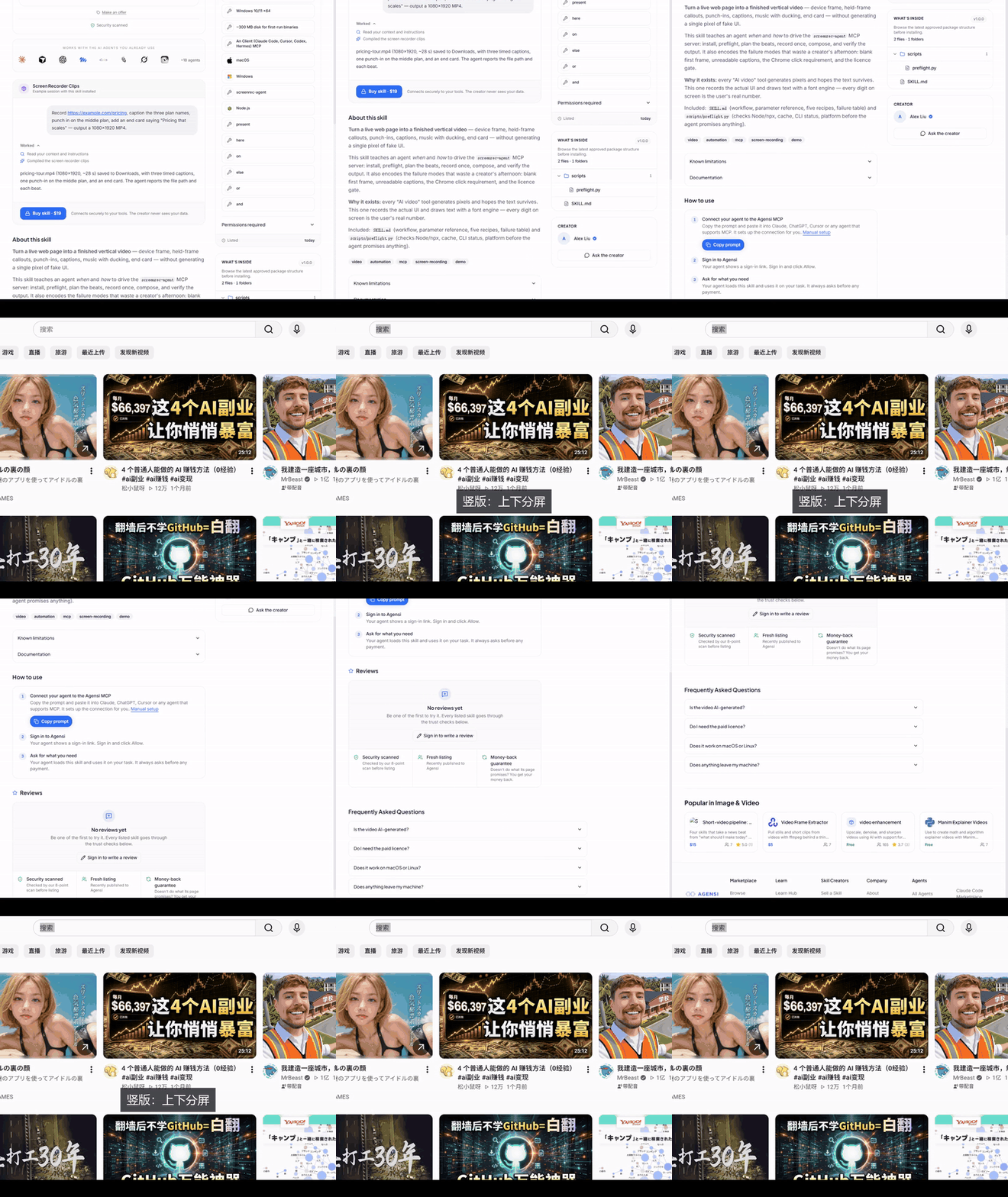
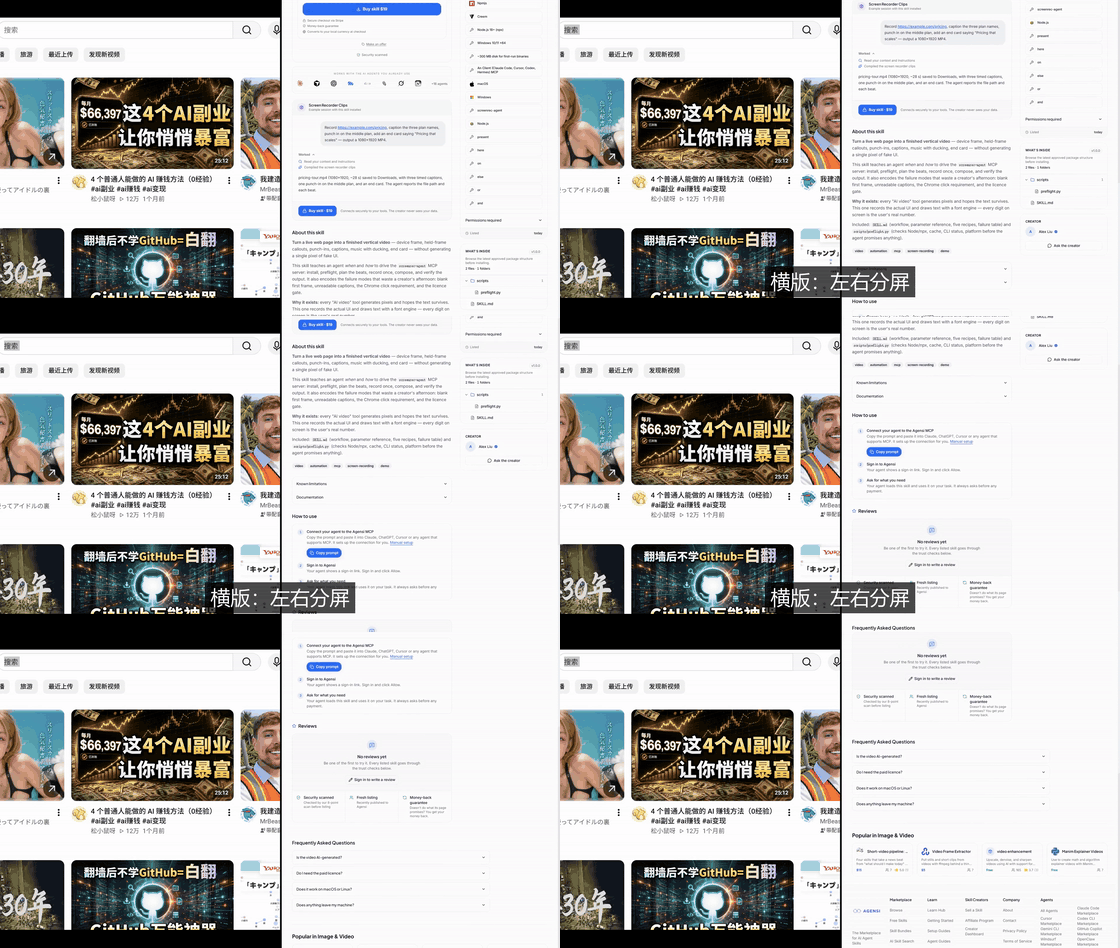
▶ 46-second demo — recording, the two split frames, and what compose adds, with the narration on.
Windows 10/11 x64 only. Start here:
npx -y screenrec-agent --selftest
Recording is free forever. compose_clip runs on a 24h / 5-clip trial, then $39 once unlocks it for good — buy here. No subscription, no account, nothing uploaded.
Two recordings, one canvas
split puts a second recording next to the first — stacked in 9:16, side by side in 16:9,
with ratio and gap to tune it. The direction follows the canvas, so the agent never has to
choose. Captions, callouts, end card and music still apply in the same call.
{ "target": "vertical",
  "split": { "source": "C:/rec/second.webm", "ratio": 0.5, "gap": 6 },
  "captions": [{ "start": 0.8, "end": 5.0, "text": "before / after" }] }
录制 → 设备框 → 冻结圈注 → 局部放大 → 字幕 → 结尾卡 → 成片
Why this exists
Every "AI video" tool generates pixels and hopes the text survives. This one doesn't generate anything: it records your actual UI and draws text with a font engine. Every digit is your real number.
The agent-facing part is the point: an agent can produce a finished clip as a tool call, not a chat suggestion.
Tools
| Tool | What it does |
|---|---|
recorder_status | recording state, bytes, bridge status |
recorder_start | start recording a tab (Chrome requires one human click — see below) |
recorder_stop | stop and save to Downloads |
recorder_files | list recent recordings |
compose_clip | the actual product: record → finished video |
compose_clip takes captions, annotations (held-frame callouts), focus (punch-ins), end_title,
music, frame (phone/browser), pip (picture-in-picture), split (second recording on the same canvas).
Install
npx (recommended) — works in Claude Code, Cursor, Codex, Hermes and any MCP client:
{
  "mcpServers": {
    "screen-recorder": {
      "command": "npx",
      "args": ["-y", "screenrec-agent"]
    }
  }
}
Then verify the install:
npx -y screenrec-agent --selftest
First run downloads the agent (~33 MB) and a pinned ffmpeg build (~201 MB) into
%LOCALAPPDATA%\screenrec-agent\bin. The cache is reused afterwards, and upgrading the launcher
re-downloads only the agent — ffmpeg is not fetched again. Downloads resume and retry on a dropped
connection instead of failing silently.
Or use the exe directly. Download screenrec-agent.exe from the
latest release, put ffmpeg.exe
beside it (only compose_clip needs ffmpeg), and point command at the exe.
Published in the official MCP Registry as io.github.Robert0303-C/screenrec-agent.
Pricing
| Free | Full — $39 once | |
|---|---|---|
recorder_* — record with your agent | unlimited, forever | unlimited |
compose_clip — turn a recording into a finished clip | 24 hours / 5 clips | unlimited |
| Runs locally, nothing uploaded | yes | yes |
The trial starts on your first successful compose, not on install. When it ends, compose_clip
returns license_required with a purchase link — recording keeps working, nothing is deleted, nothing
crashes. Check what is left with screenrec-agent --status, unlock with
screenrec-agent --activate <KEY>.
The only network call is activation itself. Trial state lives on your machine, not on a server, because the alternative is a server that watches you use it. An offline trial can always be reset by someone determined enough; we would rather say that plainly than ship surveillance.
Buy: https://whop.com/checkout/plan_Vu0jw3rmLagmv · xukun.online
If you tried to buy before 25 November 2026 and could not: the checkout link on this page pointed at a disabled product for weeks. That was our bug, not a pricing decision. Write to alex@saas.pet and I will sort it out — including for anyone who gave up and never came back.
Want the clip instead of the tool? I record the page, cut it and caption it myself, and send back one finished vertical video. No install, no trial, no license — alex@saas.pet
The one gesture Chrome insists on
chrome.tabCapture needs activeTab, and activeTab only comes from invoking the extension on that tab.
No script can fake it (verified: even a trusted CDP click inside an extension page fails). So:
- Page recording (CDP) — fully autonomous, no click, no extension
- Desktop + microphone recording (extension) — the human clicks the toolbar icon once, the agent handles everything after
Requirements
- Windows 10/11 x64
- ~300 MB disk
- An MCP client
Roadmap
- CDP recording, freeze-frame callouts, punch-ins
- Device frame, captions, end card, music ducking, picture-in-picture
- Voice-over (piper, EN + ZH) — Full edition
- macOS
License
Two different things ship in this repository, so two different licenses:
- The npm shell (
npm/bin/cli.js, the ~14 KB downloader that fetches the binary and forwards stdio) is MIT. See LICENSE. Use it, fork it, ship it inside your own tool. screenrec-agent.exe, which the shell downloads and runs, is commercial and closed source. The trial, the activation andcompose_clipall live inside that binary, none of it is in this repository, and none of it is covered by the MIT grant.
That split is deliberate: the part that makes the package installable in one command is free for anyone to copy; the part that does the work is the product.