roampal-core
Persistent memory for Claude Code with outcome-based learning. Tracks what helped vs failed, auto-injects context via hooks.
Documentation
roampal-core
Outcome-Based Persistent Memory MCP Server





Two commands. Your AI coding assistant gets outcome-based memory.
Works with Claude Code and OpenCode.
Benchmarks
85.8% on the corrected LoCoMo benchmark (non-adversarial, end-to-end answer accuracy) — validated on 1,986 questions across 10 conversations with dual grading. All figures in this section are sourced from the paper and roampal-labs (see citations at the bottom of this section).
| Result | Score |
|---|---|
| Conversational learning vs raw ingestion | +23 points (76.6% vs 53.0%, p<0.0001) |
| Architecture vs model effect | Architecture ~10x larger contributor |
| Poison resilience (1,135 adversarial memories) | -2.6 to -4.2 points only |
| TagCascade retrieval (tags-first + CE rerank) | +1.9 Hit@1 vs pure CE (p<0.0001) |
Benchmark pipeline runs on a single GPU with no cloud dependencies. Roampal itself runs on CPU — no GPU required. Full methodology, data, and evaluation scripts: roampal-labs
Paper: "Beyond Ingestion: What Conversational Memory Learning Reveals on a Corrected LoCoMo Benchmark" (Logan Teague, April 2026)
Quick Start
pip install roampal
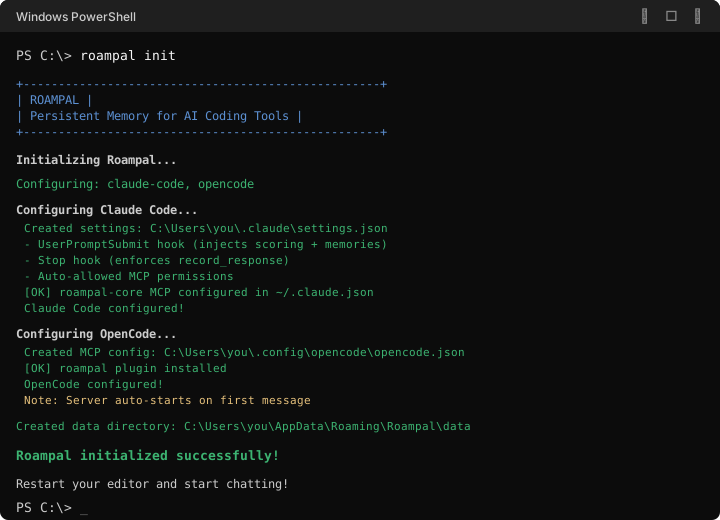
roampal init
Auto-detects installed tools. Restart your editor and start chatting.
Target a specific tool:
roampal init --claude-codeorroampal init --opencode
Platform Differences
The core loop is identical — both platforms inject context, capture exchanges, and score outcomes. The delivery mechanism differs:
| Claude Code | OpenCode | |
|---|---|---|
| Context injection | Hooks (stdout) | Plugin (system prompt) |
| Exchange capture | Stop hook | Plugin session.idle event |
| Scoring | Main LLM via score_memories tool | Independent sidecar (your chosen model, disabled by default until configured) |
| Self-healing | Hooks auto-restart server on failure | Plugin auto-restarts server on failure |
Claude Code prompts the main LLM to score each exchange via the score_memories tool. OpenCode never self-scores — an independent sidecar (a separate API call) reviews each exchange as a third party, removing self-assessment bias. The score_memories tool is not registered on OpenCode. Scoring is disabled by default until you explicitly configure it via roampal sidecar setup. During setup, Roampal detects local models (Ollama, LM Studio, etc.) and lets you choose a scoring model. Zen free models are available as an explicit opt-in choice for users without a local model or API key — they route through OpenCode's proxy which may log data. A cheap or local model works great — scoring doesn't need a powerful model.
v0.6.0: Server lifecycle + per-directory profile binding + a dedup safety net. The 4,700-line
roampal/cli.pymonolith is now aroampal/cli/package split into per-domain modules, guarded by golden-output snapshots, dispatch-table invariants, and a byte-identical equivalence suite. User-visible changes on top: per-request profile routing (hooks/MCP/plugin always name their profile; an unregistered name now fails explicitly with a "Create it first" 404 instead of silently writing to the default store);roampal profile switchno longer kills the running server (every session picks the new profile up on its next exchange); spawned servers run with-E [-P]isolation and a neutral cwd (a project containing a localroampal/directory can no longer shadow the install — and user-site installs, e.g. Microsoft Store Python, work again — an earlier draft of this spawn hardening used the isolated-Iflag, which also hides the user site-packages directory);statusreports a hanging port as stopped, not error; shared servers retire themselves after 30 idle minutes (a foregroundroampal startis exempt); androampal start --profile Xsurvives idle respawn via a persisted launch pin. Newroampal profile bind <name>/unbindpin a directory (and its subdirectories) to a profile — "this project always uses profile X" is one command instead of hand-editing env JSON. A dedup regression guard test (3 distinct facts through the realstore_memory_bankpath, plus recorded real-model vectors and a negative control that re-creates the v0.5.9 broken regime both ways) makes any future embedder swap or distance-constant change fail the suite at the first touch instead of silently collapsing writes. Privacy fix (OpenCode): since v0.3.7 the OpenCode plugin sent exchange text to Zen (opencode.ai) whenever no scoring model was chosen — including after "Skip" androampal sidecar disable— breaking v0.5.3's "nothing leaves your machine without an explicit choice" rule, which had only been applied server-side. v0.6.0 enforces it in the plugin: Zen only after an explicit opt-in, and no scoring calls at all until a model is chosen. If you use OpenCode and never picked a scoring model, scoring is now off until you runroampal sidecar setup(or--listto choose without the menu). No RAM change — the v0.5.9 footprint and model state carry over unchanged.v0.5.9: Memory footprint fix + embedder/reranker upgrade + crash observability — triggered by a
MemoryErrorcrash traced to ONNX Runtime's CPU memory arena never releasing per-shape scratch buffers, compounded by FP16 model files up-converting to FP32 at load. Disables the arena and mem-pattern cache on both models, switches the embedder to its own measured INT8 export (same mpnet model — the planned e5-base upgrade was held back to v0.6.0 after an accuracy gate caught a near-duplicate-guard regression) and the cross-encoder to its own INT8 export, and shares one cross-encoder session across all profiles instead of one per profile. Measured process footprint drops from ~2,355MB to ~484MB in isolation (~5x), and search gets faster on both the embed and rerank paths rather than trading memory for latency. A background, per-collection re-embed migrates existing vectors to the new embedder automatically on first start — never blocking the MCP client, never mixing model families within a collection. Also adds file-based logging, MemoryError/ExceptionGroup handling, an RSS heartbeat, and a/api/statusendpoint so the next incident like this one leaves a trace, and degraded states (embedder down, reranker down, migration in progress) are surfaced to the user instead of silently returning an empty result.v0.5.8: Crash-resilience release — enables SQLite WAL + FULL durability on the ChromaDB catalog so hard terminations (Windows port conflicts, external process kills, power loss) no longer corrupt or empty the database. Rewrites
SessionManager.mark_scored()to perform an atomic temp-file replace, guaranteeing the JSONL transcript survives a crash mid-write. Also ships 16 new automated tests covering both fixes, fixes pre-existing test debt that left the full suite red on Windows, and adds dev tooling (pytest-timeout,pytest-forked,build,twine). No data migration required; WAL is applied on the next server start.v0.5.7: Startup garbage collection for the MCP hook's
_completion_state.json. The file accumulated one entry perconversation_idever seen with no cleanup, driving I/O amplification on every write and leaving stuckscored_this_turn=Trueflags that could poison the cross-session scoring fallback. New_cleanup_completion_statepass drops entries older than 30 days or with no matching transcript, enforces a 500-entry hard ceiling, and writes atomically. JSONL transcript TTL bumped 7 → 30 days to stay in lockstep with the state-file TTL. Ships paired with Roampal Desktop v0.3.3.v0.5.6: Hardening release — closes remaining coverage gaps from the v0.5.5.x verification audit. Phantom sweep after archived cleanup, auto-cleanup under capacity pressure, dedup observability, hardened delete permissions, archive-then-add cycle tests, sidecar prompt alignment with benchmark, async scoring queue (per-session deferred retry), MCP tool definition quality rewrite (TDQS), OpenCode Go auto-detect in sidecar setup wizard, and user name extraction fix.
v0.5.5.2: Hotfix — Windows plugin install now verifies copy succeeded (post-copy size check + manual read/write fallback for OneDrive/antivirus interference). Also installs to
%APPDATA%\opencode\pluginsas fallback since some Electron apps resolve config paths differently on Windows. Fixes remaining cases of issue #11 whereroampal init --forcereported success but the plugin was empty or in the wrong directory.v0.5.5.1: Hotfix — OpenCode Desktop now correctly switches profiles when you switch projects in the UI (issue #10). Plugin reads the active session's
directoryviaclient.session.get()instead of caching the profile at module load, so a singleton plugin across a multi-project workspace still hits the right profile per message. Also:roampal init --forceactually overwrites the OpenCode plugin file now (issue #11), with clearer errors when Desktop holds a file lock.v0.5.5: Soft-delete for memory_bank — ChromaDB hard delete doesn't actually remove vectors from HNSW, causing phantom dedup matches that block new memories after GUI deletion. Replaced with
status=archivedmetadata update plus status filter on all query/dedup paths. Also: scoring mutex → async queue (eliminates dropped requests), sidecar summary contamination fix (delimiter fencing).v0.5.4: Profile binding is now per-request, not per-process. Every client (MCP server, OpenCode plugin, Python hooks for Claude Code / Cursor) sends an
X-Roampal-Profileheader so a single FastAPI server can cleanly serve multiple profiles simultaneously. Fixes issue #7 where OpenCode Desktop's per-projectROAMPAL_PROFILEinopencode.jsonwas ignored because the singleton FastAPI bound the profile once at startup.v0.5.3: Sidecar scoring now requires explicit configuration (no automatic fallback to Zen or localhost). Small local models (qwen2.5:3b, etc.) that return bare JSON arrays instead of OpenAI-shaped responses are handled transparently via server-side shape tolerance.
How It Works
When you type a message, Roampal automatically injects relevant context before your AI sees it:
You type:
fix the auth bug
Your AI sees:
═══ KNOWN CONTEXT ═══
• JWT refresh pattern fixed auth loop [id:patterns_a1b2] (3d, 90% proven, patterns)
• User prefers: never stage git changes [id:mb_c3d4] (memory_bank)
═══ END CONTEXT ═══

fix the auth bug
No manual calls. No workflow changes. It just works.
The Loop
- You type a message
- Roampal injects relevant context automatically (hooks in Claude Code, plugin in OpenCode)
- AI responds with full awareness of your history, preferences, and what worked before
- Outcome scored — good advice gets promoted, bad advice gets demoted
- Repeat — the system gets smarter every exchange
Five Memory Collections
| Collection | Purpose | Lifetime |
|---|---|---|
working | Current session context | 24h — promotes if useful, deleted otherwise |
history | Past conversations | 30 days, outcome-scored |
patterns | Proven solutions | Persistent while useful, promoted from history |
memory_bank | Identity, preferences, goals | Permanent |
books | Uploaded reference docs | Permanent |
Commands
roampal init                # Auto-detect and configure installed tools
roampal init --claude-code  # Configure Claude Code explicitly
roampal init --opencode     # Configure OpenCode explicitly
roampal init --no-input     # Non-interactive setup (CI/scripts)
roampal start               # Start the HTTP server manually
roampal stop                # Stop the HTTP server
roampal status              # Check if server is running
roampal status --json       # Machine-readable status (for scripting)
roampal stats               # View memory statistics
roampal stats --json        # Machine-readable statistics (for scripting)
roampal doctor              # Diagnose installation issues
roampal summarize           # Summarize long memories (retroactive cleanup)
roampal context             # Output recent exchange context
roampal ingest <file>       # Add documents to books collection
roampal books               # List all ingested books
roampal remove <title>      # Remove a book by title
roampal sidecar status      # Check scoring model configuration (OpenCode)
roampal sidecar setup       # Configure scoring model (OpenCode)
roampal sidecar test        # Test scoring model response format (OpenCode)
roampal retag               # Re-extract tags on memories using sidecar LLM
roampal sidecar disable     # Disable scoring (removes config, retrieval still works)

# Choose a scoring model without the menu (v0.6.0) — for scripts and AI-driven installs.
# Ask the user first: the choice decides where exchange text is sent.
roampal sidecar setup --list [--json]                  # Every choice, where its data goes, the command that selects it
roampal sidecar setup --model qwen3:1.7b               # A detected local/API model (name from --list)
roampal sidecar setup --auto                           # The recommended detected LOCAL model (never cloud or paid)
roampal sidecar setup --url <base_url> --model <name> --key-env <ENV_VAR>   # Custom endpoint; key read from an env var
roampal sidecar setup --go <model>                     # OpenCode Go
roampal sidecar setup --zen                            # Opt in to free Zen cloud models (data sent to opencode.ai)

# Sidecar scope flags (v0.5.3+) — OpenCode merges project-local over user-global config:
roampal sidecar setup --scope user       # Write only to user-global config (~/.config/opencode/)
roampal sidecar setup --scope project    # Write only to project-local opencode.json in cwd ancestry
roampal sidecar setup                    # Auto-detects: uses project-local if shadow exists, otherwise user-global

# Sidecar scope flags for disable (v0.5.3+):
roampal sidecar disable --scope user       # Clear only from user-global config
roampal sidecar disable --scope project    # Clear only from project-local opencode.json
roampal sidecar disable                    # Auto-detects scope same as setup

# Named memory profiles (v0.5.1) — isolate memory per project, per client, etc.
roampal profile list                         # List registered profiles
roampal profile show                         # Show active profile and its path
roampal profile create <name>                # Create auto-located profile
roampal profile register <name> --path <dir> # Register an existing directory
roampal profile use <name>                   # Persist as user-global default
roampal profile unuse                        # Clear persistence
roampal profile switch <name>                # Persist as active (no server kill — sessions pick it up on the next exchange)
roampal profile delete <name>                # Remove from registry (cascades directory bindings)
roampal profile bind <name>                  # Bind cwd directory to profile (v0.6.0)
roampal profile bind <name> --path <dir>     # Bind a specific directory
roampal profile unbind --path <dir>          # Remove a binding
roampal reembed                              # Re-embed vectors after an embedder model change (v0.5.9+)
roampal help                                 # Show the command help
roampal start --profile <name>               # Launch with a default profile: sessions with nothing configured (hook/MCP resolve the launch pin explicitly) route there; survives idle respawn; cleared by bare start/stop
Named Memory Profiles (v0.5.1)
Run separate memory stores for different contexts — per project, per client (Claude Code vs OpenCode), work vs home. Profiles are managed entirely through the CLI; no config files to hand-edit.
roampal profile create work          # auto-located at <appdata>/Roampal/data/work/
roampal profile switch work          # persist as active
# sessions without their own explicit profile config pick 'work' up on the next exchange
Register an existing directory as a profile (no data migration):
roampal profile register project-a --path /existing/custom/path
Precedence (highest wins; env/config tiers are per-shell and config-file scoped, the binding is a directory property):
--profile <name>flagROAMPAL_PROFILE=<name>env var (set per-project inopencode.jsonor.claude.jsonenv: {})- Directory binding (v0.6.0) —
roampal profile bind workpins the current directory (and all subdirectories) to profilework; the walk goes up from your cwd and the closest bound directory wins. One command per project, but not the whole setup: anyROAMPAL_PROFILEenv var set for that project's config still wins over the binding roampal profile use <name>persisted default"default"fallback
Sessions always name the profile they resolve to — an explicit header, a project's cwd directory, or a persisted default — and the shared server never guesses a profile from its own working directory or environment.
MCP Tools
Your AI gets these memory tools:
| Tool | Description | Platforms |
|---|---|---|
search_memory | Deep search across all collections | Both |
add_to_memory_bank | Store permanent facts (identity, preferences, goals) | Both |
update_memory | Correct or update existing memories | Both |
delete_memory | Remove outdated info | Both |
score_memories | Score previous exchange outcomes | Claude Code |
record_response | Store key takeaways from significant exchanges | Both |
How scoring works: Claude Code's hooks prompt the main LLM to call
score_memoriesevery turn. OpenCode uses an independent sidecar that scores silently in the background — the model never sees a scoring prompt andscore_memoriesis not registered as a tool. If the sidecar is unavailable, a warning prompts the user to runroampal sidecar setup. Choose your scoring model duringroampal initor viaroampal sidecar setup.
How Roampal Compares
| Feature | Roampal Core | Claude Code built-in (CLAUDE.md / auto memory) | OpenCode built-in |
|---|---|---|---|
| Learns from outcomes | Yes — bad advice demoted, good advice promoted | No | No |
| Semantic retrieval | Yes — TagCascade + cross-encoder reranking | No — files loaded in full, no search | No memory system |
| Context injection | Automatic — relevant memories per query | Full CLAUDE.md every session, auto memory on demand | None |
| Atomic fact extraction | Yes — summaries + facts, two-lane retrieval | No — saves what Claude decides is useful | No |
| Works across projects | Yes — shared memory across all projects | Per-project only (per git repo) | No memory |
| Scales with history | Yes — 5 collections, promotion/demotion/decay | CLAUDE.md unbounded, auto memory first 200 lines | No memory |
| Fully local / private | Yes — ChromaDB on your machine | Yes | Yes |
Architecture
┌─────────────────────────────────────────────────────────┐
│  pip install roampal && roampal init                    │
│    Claude Code: hooks + MCP → ~/.claude/                │
│    OpenCode:    plugin + MCP → ~/.config/opencode/      │
└─────────────────────────────────────────────────────────┘
                         │
                         ▼
┌─────────────────────────────────────────────────────────┐
│  HTTP Hook Server (port 27182)                          │
│    Auto-started on first use, self-heals on failure     │
│    Manual control: roampal start / roampal stop         │
└─────────────────────────────────────────────────────────┘
                         │
                         ▼
┌─────────────────────────────────────────────────────────┐
│  User types message                                     │
│    → Hook/plugin calls HTTP server for context          │
│    → AI sees relevant memories, responds                │
│    → Exchange stored, scored (hooks or sidecar)         │
└─────────────────────────────────────────────────────────┘
                         │
                         ▼
┌─────────────────────────────────────────────────────────┐
│  Single-Writer Backend                                  │
│    FastAPI → UnifiedMemorySystem → ChromaDB             │
│    All clients share one server, isolated by session    │
└─────────────────────────────────────────────────────────┘
See dev/docs/ for full technical details.
Requirements
- Python 3.10+ (3.13 supported; 3.11+ gets the full
-Plaunch protection — on 3.10 the neutral launch folder alone guards against a projectroampal/shadowing the install. Note: Python 3.10 reaches end-of-life in October 2026) - One of: Claude Code or OpenCode
- Platforms: Windows, macOS, Linux (macOS and Python 3.13 are CI-tested as of v0.6.0; primarily developed on Windows)
- RAM: ~500MB available (cross-encoder reranker + embeddings + ChromaDB); first-run migration after an upgrade adds no meaningful spike
- Disk: ~500MB for models (multilingual embedding + reranker, downloaded automatically on first use)
- CPU: Any modern x86-64 processor with AVX2 (Intel Haswell 2013+ / AMD Excavator 2015+)
- GPU: Not required — all inference runs on CPU via ONNX Runtime
Troubleshooting
Hooks not working? (Claude Code)
- Restart Claude Code (hooks load on startup)
- Check HTTP server:
curl http://127.0.0.1:27182/api/health
MCP not connecting? (Claude Code)
- Verify
~/.claude.jsonhas theroampal-coreMCP entry with correct Python path - Check Claude Code output panel for MCP errors
Context not appearing? (OpenCode)
- Make sure you ran
roampal init --opencode - Check that the server auto-started:
curl http://127.0.0.1:27182/api/health - If not, start it manually:
roampal start
Server crashes and recovers?
This is expected. Roampal has self-healing -- if the HTTP server stops responding, it is automatically restarted and retried.
Still stuck? Ask your AI for help — it can read logs and debug Roampal issues directly.
Support
Roampal Core is completely free and open source.
- Support development: roampal.gumroad.com
- Feature ideas & feedback: Discord
- Bug reports: GitHub Issues
- Need help with AI memory? Reach out: roampal@protonmail.com | LinkedIn
