HTML Docs
Create, edit, inspect, and publish collaborative HTML documents from AI agents.
Documentation
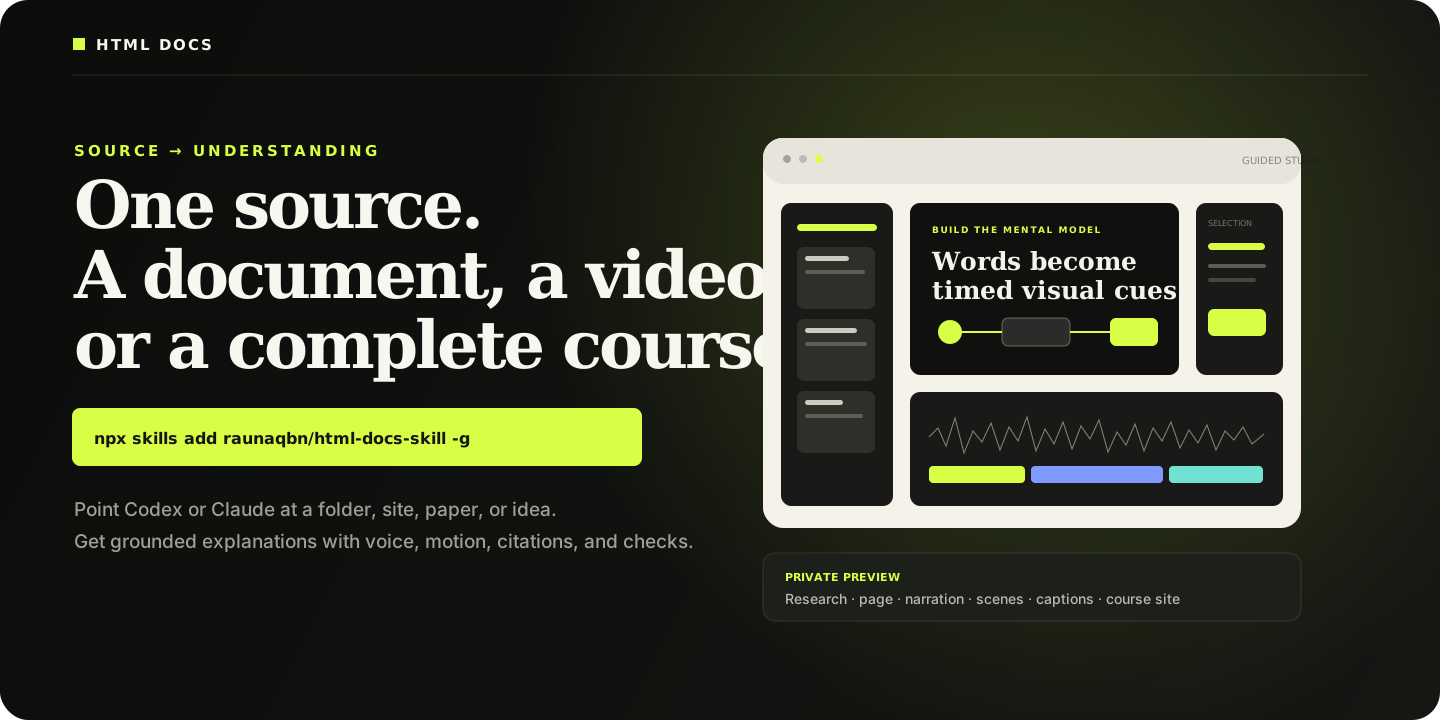




Point Codex or Claude at a folder, codebase, website, paper, PDF, document, or research topic.
Get a source-grounded HTML document, narrated explainer video, or complete learning course—with citations, captions, editable scenes, and a shareable site.
Should you use this?
Use HTML Docs when the answer needs to teach, not merely exist:
| Your situation | Ask for | Why |
|---|---|---|
| One difficult idea needs to click | Document + video | The page keeps the detail; the video builds the mental model. This is the best default. |
| A folder or codebase contains several lessons | Complete course | The agent reorganizes the source into prerequisites, lessons, practice, checks, transcripts, and a learning site. |
| Someone needs the short visual version | Video | You get a shareable Player with narration, synchronized captions, transcript, and MP4 fallback. |
| You need a durable visual reference | Document | You get responsive HTML with diagrams, examples, source evidence, and collaboration. |
For a quick factual answer or a throwaway note, ask your agent normally. Use this skill when source grounding, visual explanation, narration, presentation, or a reusable learning experience matters.
This is not a separate chatbot. It is a production workflow installed into the Codex or Claude Code session you already use:
your source → your agent + $html-docs → private page, Player, and Studio
Start in sixty seconds
npx skills add raunaqbn/html-docs-skill --skill html-docs -g
Then:
- Start a fresh Codex task or Claude Code session.
- Open it in the source folder, or give it a URL, PDF, document, or topic.
- Mention
$html-docs, the audience, and what they should understand.
For example:
Use $html-docs to turn this codebase into a private course for new engineers.
No hosted authoring model is hidden behind the command. Your current agent researches, writes, designs, and authors the project. The open local tools normalize sources, compile scenes, synchronize narration, audit frames, render media, and publish a private preview.
Ask for the outcome you need
| Output | Prompt |
|---|---|
| Document | Use $html-docs to research this topic and make a beautiful, cited visual document. |
| Video | Use $html-docs to turn this URL into a five-minute captioned explainer video. |
| Document + video | Use $html-docs to explain this paper with a rich page and embedded narrated video. |
| Complete course | Use $html-docs to turn this folder into a private adaptive course with a learner mission, lessons, videos, practice, feedback, and mastery evidence. |
| Auto | Use $html-docs to choose the clearest format for explaining this source. |
Automatic runs stay private. Public or unlisted publication is a separate, explicit action.
Built with HTML, voice, and evidence
These lightweight loops are frames from real HTML Docs renderer output—not product mockups.
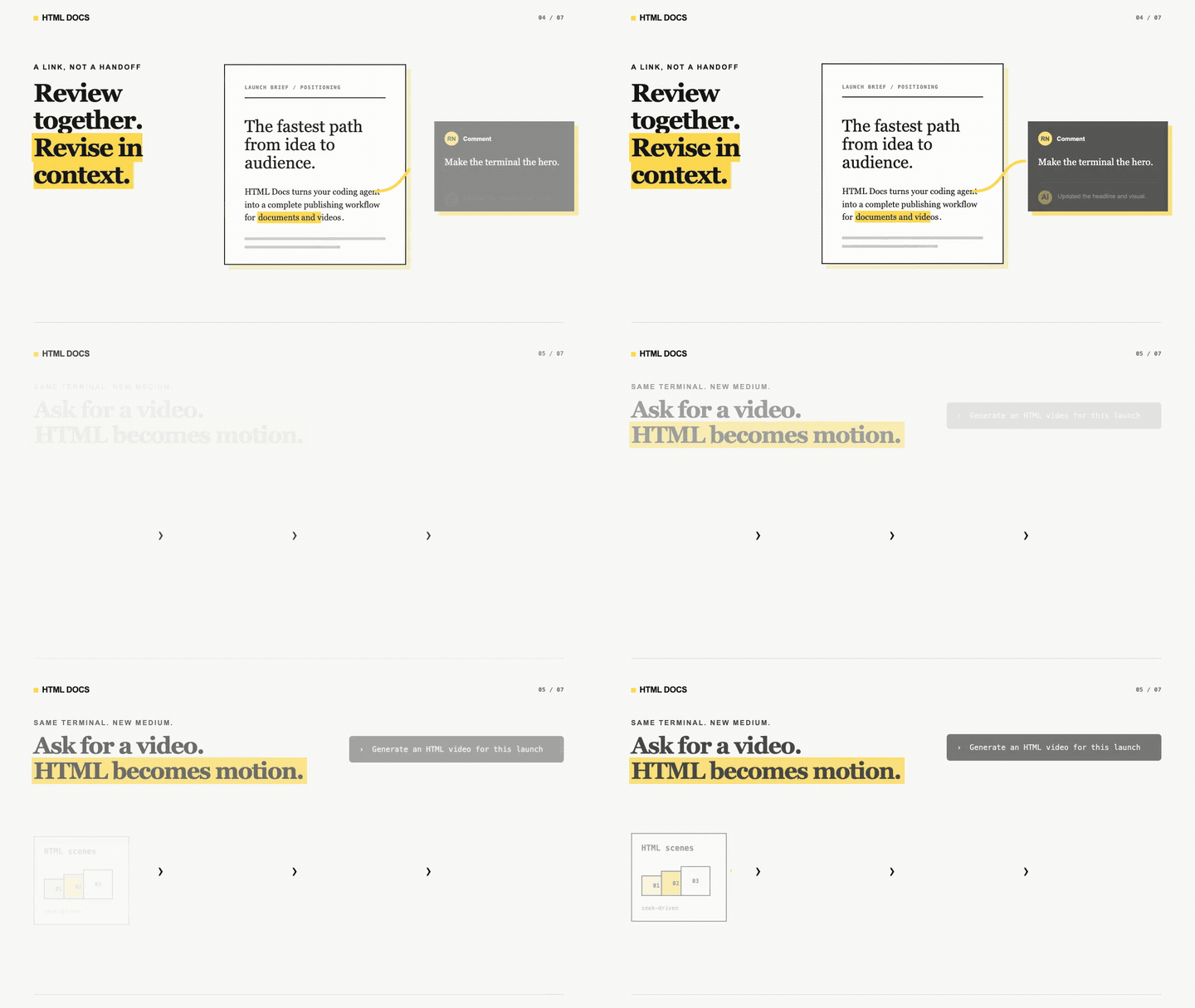
From terminal to publishedThe document preserves the launch brief and review context. The companion video teaches the workflow visually. |
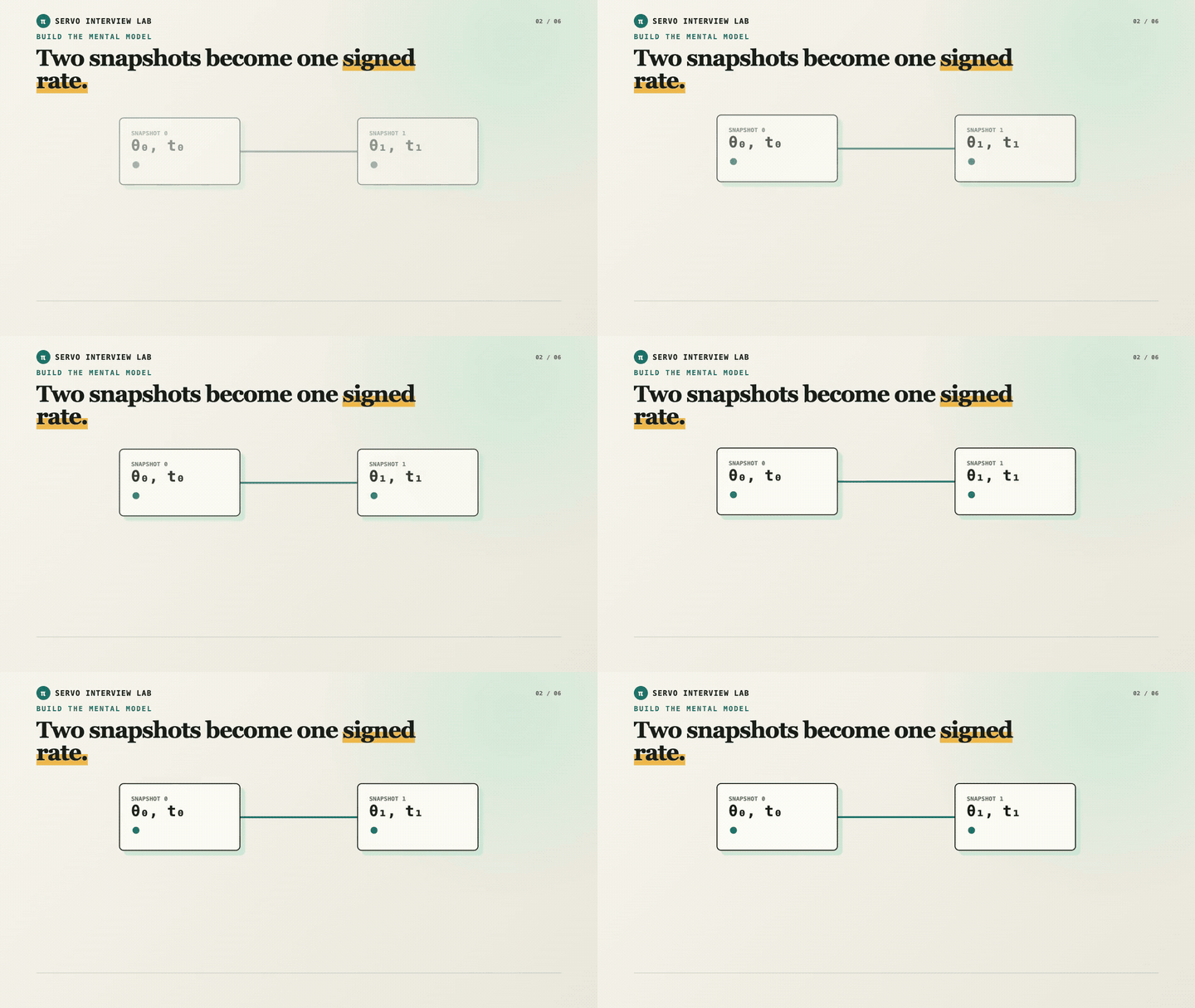
How two samples become velocityA formula becomes a concrete mental model with timed motion, captions, and a settled visual read. |
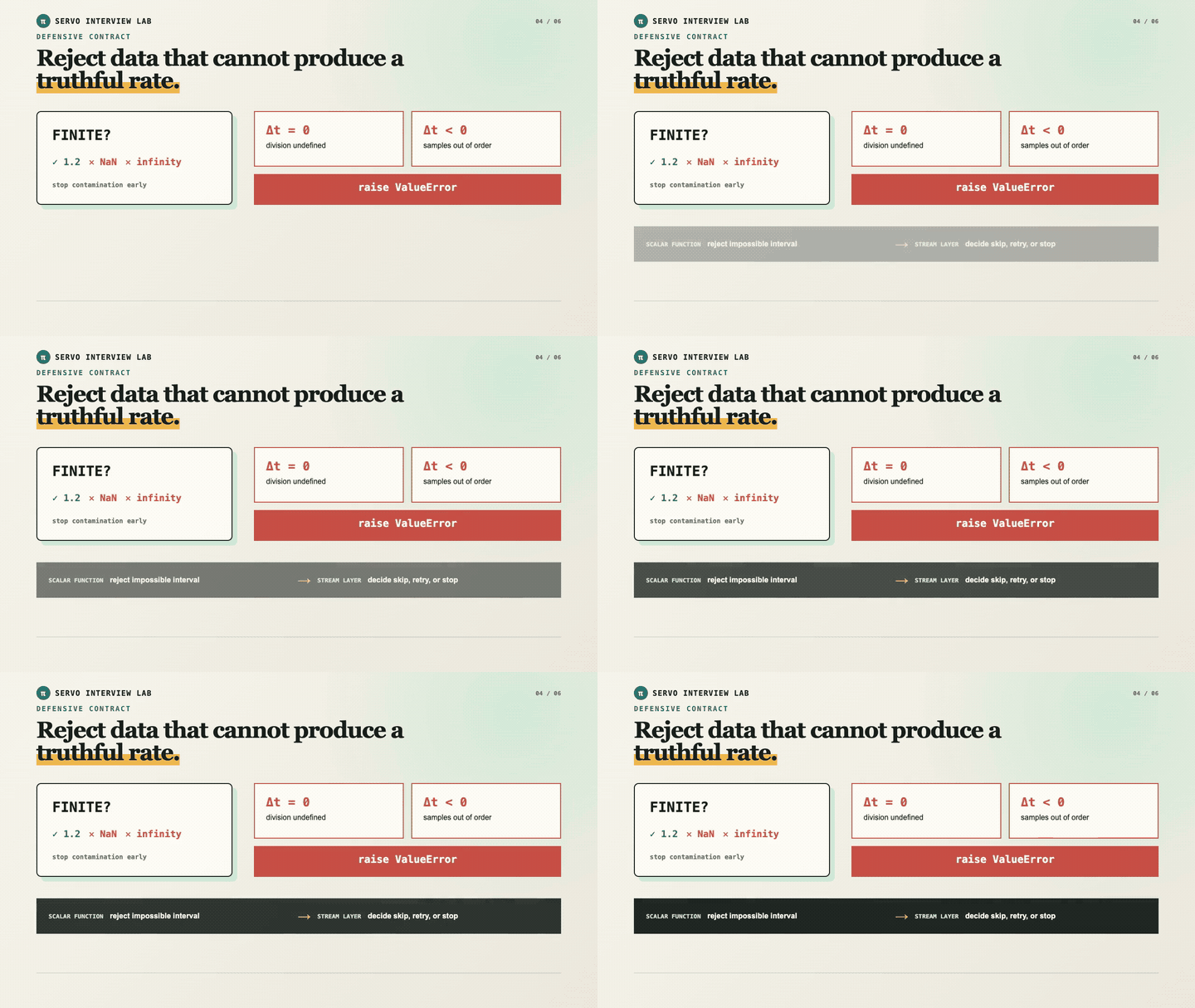
Guarding a velocity estimatorA defensive-programming lesson turns invalid timestamps and non-finite inputs into a visual contract learners can remember. | |
Explore the live Player, course pages, source projects, and Studio artifacts in the HTML Docs showcase.
Complete course examples
| Course | What you will build and understand |
|---|---|
| Robot Learning, Gently · 12 lessons | Move from the observation–policy–action loop through imitation and reinforcement learning, action representations, world models, and VLAs—then apply the theory in a measured ANIMA-Kiwi capstone. |
| Build an LLM from First Principles · 11 lessons | Build the stack rather than treating it as a black box: scalar autodiff, embeddings, training diagnostics, causal attention, byte-pair tokenization, a decoder-only Transformer, and honest evaluation. |
| The Inference Company Founder’s Field Course · 7 lessons | Choose a defensible wedge, build and benchmark a production-shaped serving MVP, model the economics, operate it under load, and apply evidence gates before pursuing custom silicon. |
Reproduction briefs and portable source ledgers live in
examples/: codebase → course, website → document + video, and
research topic → course.
The production loop
folder · repo · URL · PDF · document · topic
                      │
                      ▼
          source snapshot + evidence graph
                      │
                      ▼
        learner contract · course specification
                      │
                      ▼
        vertical lesson slices · mastery evidence
                      │
           ┌──────────┴──────────┐
           ▼                     ▼
    rich HTML page        locked narration
                                 │
                                 ▼
                     timed words + visual cues
                                 │
                                 ▼
                  deterministic HTML scene modules
                                 │
                                 ▼
                  audit · Player · Studio · MP4
The page and video share one evidence model but serve different jobs: the page is the detailed reference; the video teaches the core mechanism visually. Courses also preserve the learner’s purpose, canonical terminology, demonstrated capabilities, misconceptions, retrieval schedule, source ledger, and the decision trail behind the curriculum. Completion is navigation state; mastery requires evidence.
Why the synchronization holds
- Generate or record final audio before final scene timing.
- Prefer provider-native word timestamps.
- Forced-align the locked transcript when timestamps are unavailable.
- Assign every spoken word to exactly one cue and scene.
- Give every cue one or more same-scene
data-html-video-idtargets. - Derive captions, chapters, scenes, and visual timing from the same word track.
- Seek Chromium to explicit timestamps; never depend on wall clocks or self-running animation.
- Compare repeated same-time captures and inspect cue/scene contact sheets.
Voice profiles are provider-neutral: warm-teacher, gentle-guide,
precise-engineer, and energetic-coach. ElevenLabs is supported through
bring-your-own-key; Kokoro is the offline fallback. Provider keys stay local.
The open product
| Package | Responsibility |
|---|---|
html-docs/ | Installable agent skill, source/research workflow, document design system, video direction, and course production |
@html-docs/cli | Publishing, authentication, MCP server, project orchestration, and agent installation |
@html-docs/html-video | Portable project schemas, source snapshots, audio/caption timing, deterministic runtime, audits, Chromium capture, FFmpeg rendering, and sync |
@html-docs/player | Dependency-free <html-docs-video> web component with live-player and MP4 fallback |
@html-docs/studio | Evidence-aware educational Studio with live preview, waveform, cue/caption lanes, semantic selection, overrides, requests, and versions |
Authored source, rendering, voice generation, and provider credentials stay on your machine. HTML Docs hosts private project versions, collaborative pages, the live Player, Guided Studio, course sites, and explicitly published media.
Local project commands
The skill invokes these for you, but every stage is inspectable:
# Any source, with an explicit or automatic output mode
html-docs project init ./source --mode auto --output ./explanation
html-docs project build ./explanation
html-docs project audit ./explanation
html-docs project preview ./explanation

# A video
html-docs/scripts/video.sh build ./video-project
html-docs/scripts/video.sh check ./video-project
html-docs/scripts/video.sh audit ./video-project
html-docs/scripts/video.sh render ./video-project --output ./final.mp4

# A course
html-docs/scripts/video.sh course init ./source \
  --output ./course-project --title "Course title"
html-docs/scripts/video.sh course build ./course-project
html-docs/scripts/video.sh course audit ./course-project
html-docs/scripts/video.sh course preview ./course-project
html-docs/scripts/video.sh course publish ./course-project
Renderer frame caches are content-addressed. If Chromium or FFmpeg is interrupted, rerunning the render reuses every completed deterministic frame.
The scaffold is only a normalized starting point. The active agent replaces it with the evidence graph, learner contract, course specification, dependency map, vertical lesson slices, lesson pages, narration, storyboards, semantic scenes, diagnostic practice, captions, and checks.
Publish any HTML
The document-only path stays one command:
npx @html-docs/cli publish page.html
# → https://www.html-docs.com/site/<slug>
Authenticate owned work:
npx @html-docs/cli auth
Install the MCP server in detected clients:
npx @html-docs/cli install
Available tools include document publishing, reading, updating, commenting, video synchronization, and project operations. See the agent guide and API reference.
Portable artifacts
Courses and videos are ordinary folders with JSON manifests, a learner contract, course specification, mastery records, production slices, Markdown briefs, HTML/CSS/JavaScript scene modules, audio files, timed words, captions, evidence records, quality reports, and rendered fallbacks. They can be inspected, versioned, moved, rendered locally, or hosted independently.
License and provenance
The HTML Docs skill, Producer, Player, and Studio are MIT licensed. Third-party
dependencies and adapted design references are recorded in
NOTICE. See PROVENANCE.md
and THIRD_PARTY_NOTICES.md for release provenance.