PinkRoosterMcp
Self-hosted project management system built for AI coding agents. 24 MCP tools with automatic state cascades, dependency tracking, autonomous implementation loop, and a React dashboard. One-command Docker setup.
Documentation

PinkRoosterMcp
Project management that thinks in code, not tickets.
The first project management system built from scratch for AI coding agents — not a wrapper around Jira or Linear.





Quick Start · Why PinkRooster? · Dashboard · MCP Tools · PM Skills · Getting Started
Quick Start
git clone https://github.com/pinkroosterai/PinkRoosterMcp.git
cd PinkRoosterMcp
make install
That's it. make install pulls the pre-built image from Docker Hub, registers the MCP server in Claude Code, installs PM skills, and starts all containers. No accounts, no configuration, no build step.
Dashboard at localhost:3000 · API at localhost:5100 · MCP at localhost:5200
Why PinkRooster?
Every other PM-related MCP server is a wrapper around an existing SaaS product. PinkRoosterMcp is purpose-built for AI agents — the data model, response format, and workflow skills are designed for AI consumption first, with a dashboard for human visibility.
The Problem
Traditional workflow:
  1. Open browser → find Jira ticket → read requirements
  2. Switch to IDE → write code → run tests
  3. Switch to browser → update ticket status → add comment
  4. Repeat 50x per day
The PinkRooster Workflow
  You: /pm-next --auto
  Agent: picks highest priority work → scaffolds plan → implements code →
         runs tests → commits → updates all project state → picks next item →
         repeats until done
  You: ☕
How It Compares
| PinkRoosterMcp | Jira + MCP Wrapper | Linear + MCP Wrapper | |
|---|---|---|---|
| Built for AI agents | From scratch | Bolt-on API wrapper | Bolt-on API wrapper |
| Self-hosted | Single Docker image | SaaS only | SaaS only |
| Setup time | 1 command | Account + OAuth + config | Account + API key + config |
| State cascades | Automatic (5 levels deep) | Manual updates | Manual updates |
| Work breakdown | Agent scaffolds from description | You write every ticket | You write every ticket |
| Multi-user RBAC | Built-in (4 roles, per-project) | Org-level permissions | Workspace roles |
| Project memories | Built-in cross-session context | None | None |
| Autonomous mode | /pm-next --auto | None | None |
| Token-optimized responses | Purpose-built for agents | Verbose human-facing payloads | Verbose human-facing payloads |
| Cost | Free (MIT) | $8-16/user/month | $8-16/user/month |
Features at a Glance
Automatic State Cascades
Complete a task and everything upstream updates automatically — no manual ticket grooming:
Task completed
  └→ Phase auto-completes (all tasks done)
       └→ Work Package auto-completes (all phases done)
            ├→ Linked Issue auto-resolved
            └→ Linked Feature Request auto-completed
Dependencies auto-block and auto-unblock. The agent always knows what happened downstream via structured OperationResult responses with state change notifications.
Autonomous Implementation Loop
A single command drives the full development lifecycle:
/pm-next --auto
The agent picks the highest-priority work item, scaffolds a plan if needed, implements every task (reading code, writing changes, running tests), commits after each work package, and loops until all work is done.
24 MCP Tools
Every tool is designed for AI consumption — compact responses, actionable next steps, and state cascade notifications. Scaffold an entire work package with phases, tasks, and dependencies in a single call.
16 PM Workflow Skills
High-level slash commands that encode sophisticated PM workflows: /pm-scaffold analyzes your codebase to produce realistic target files and implementation notes. /pm-implement handles dependency ordering, test running with auto-fix, and phase verification gates. /pm-audit runs parallel analysis agents across quality, security, performance, and architecture domains. /pm-cleanup finds dead code and scaffolds fix tasks.
Project Memories
Persistent knowledge store for decisions, patterns, and context that survives across agent sessions. Merge-by-name semantics — writing to an existing memory appends content and unions tags.
Human-Readable IDs
proj-1-issue-3, proj-1-wp-2-task-5 — readable by both agents and humans in conversation. No GUIDs, no opaque numeric IDs.
Multi-User Accounts & Per-Project RBAC
Built-in user account system with Argon2id password hashing, session management, and per-project role-based access control. Four roles (SuperUser, Admin, Editor, Viewer) give fine-grained control over who can do what on each project. First user auto-gets SuperUser. API key auth for MCP/programmatic access runs in parallel — no RBAC overhead for agents.
Full Observability
Two layers of audit: per-entity field-change audit logs (old/new values on every field) and HTTP request activity logging (method, path, status, duration, caller). The dashboard surfaces both.
Dashboard
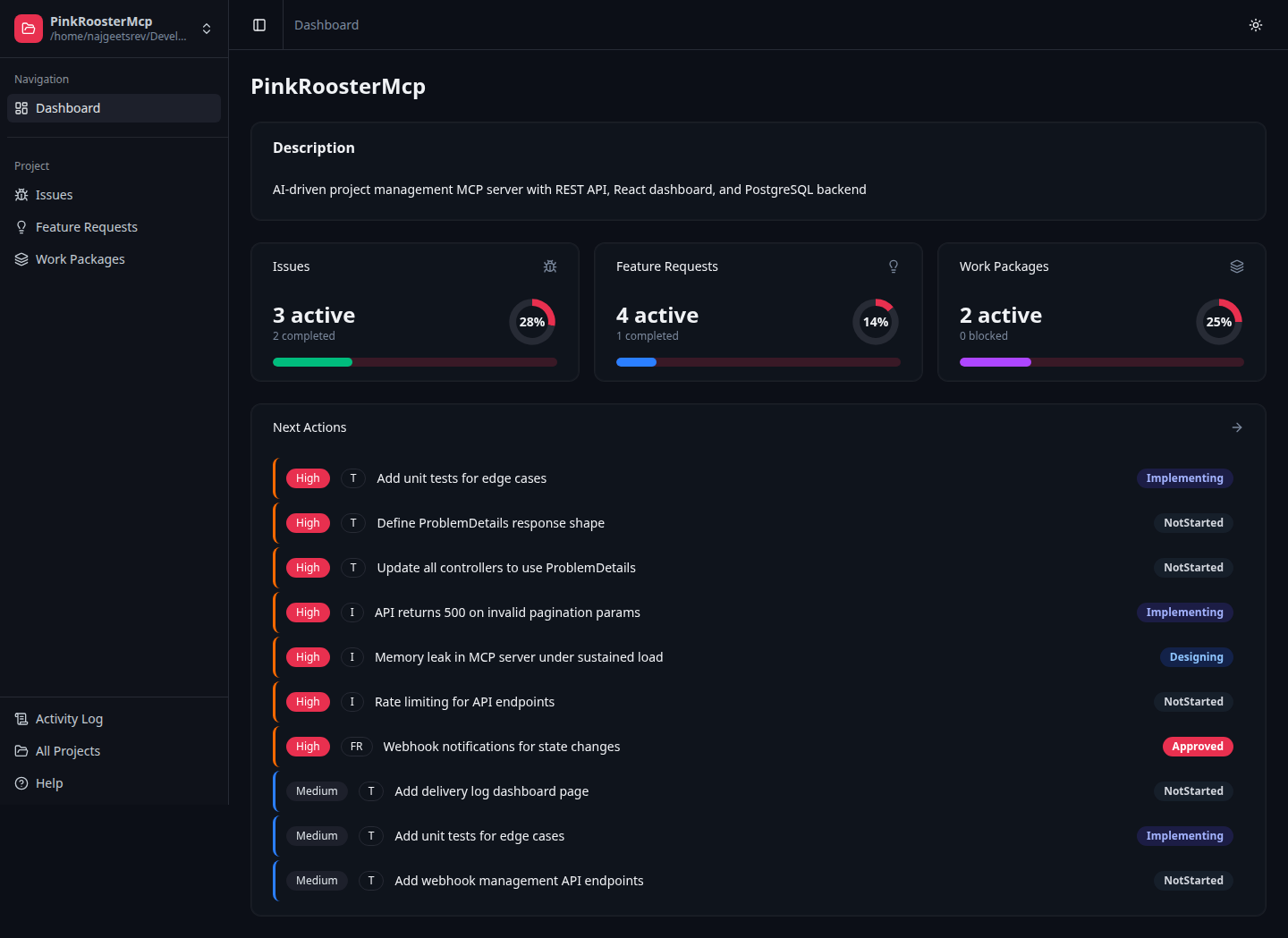
A real-time React dashboard lets you see everything your AI agent is tracking — at a glance or in full detail.
Project Overview
The dashboard home shows active counts, completion percentages, and priority next actions across all entity types.
Issue Tracking
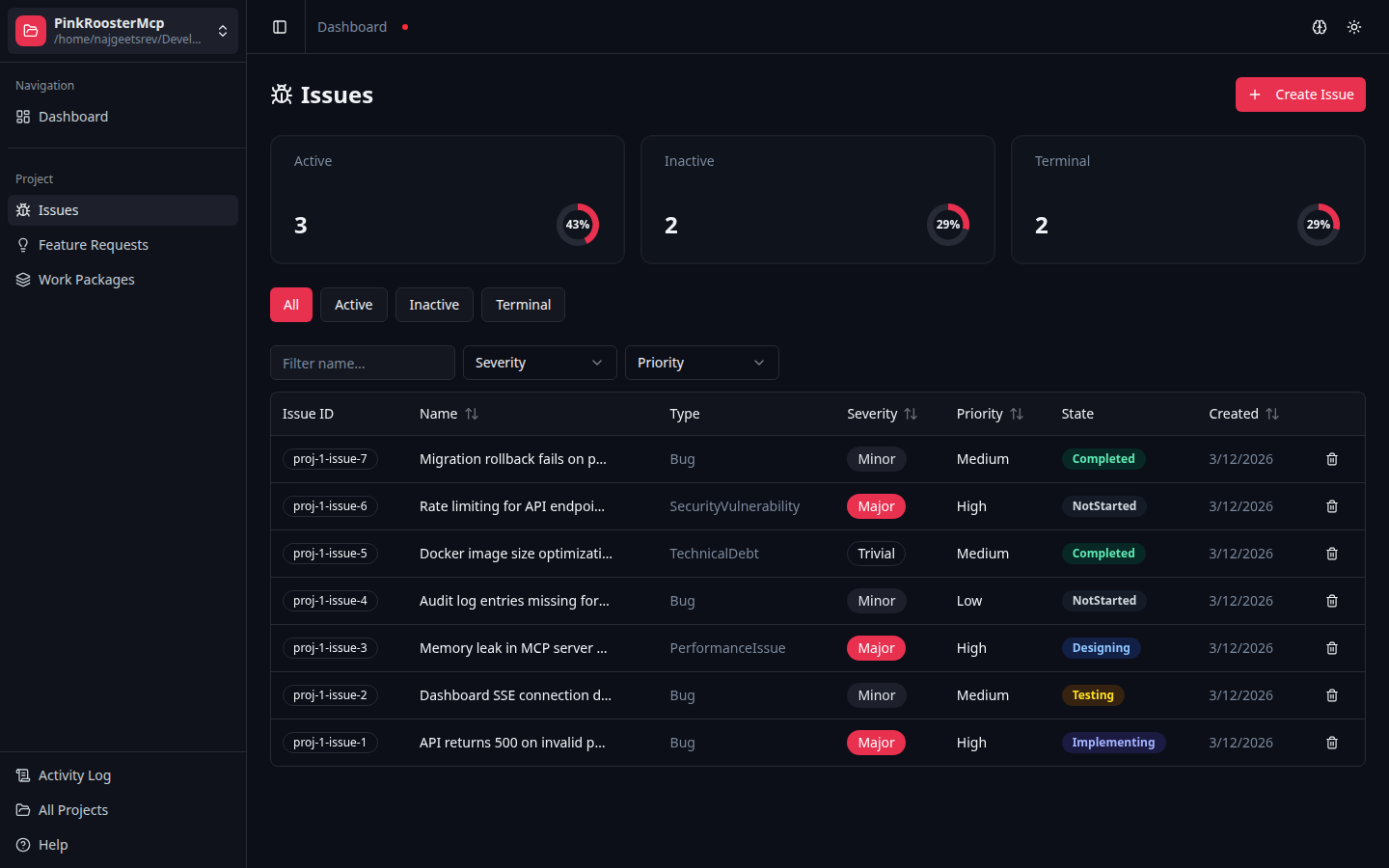
Filter and sort issues by severity, priority, type, and state. Summary cards show active/inactive/terminal breakdowns with mini donut charts.
Rich Detail Pages
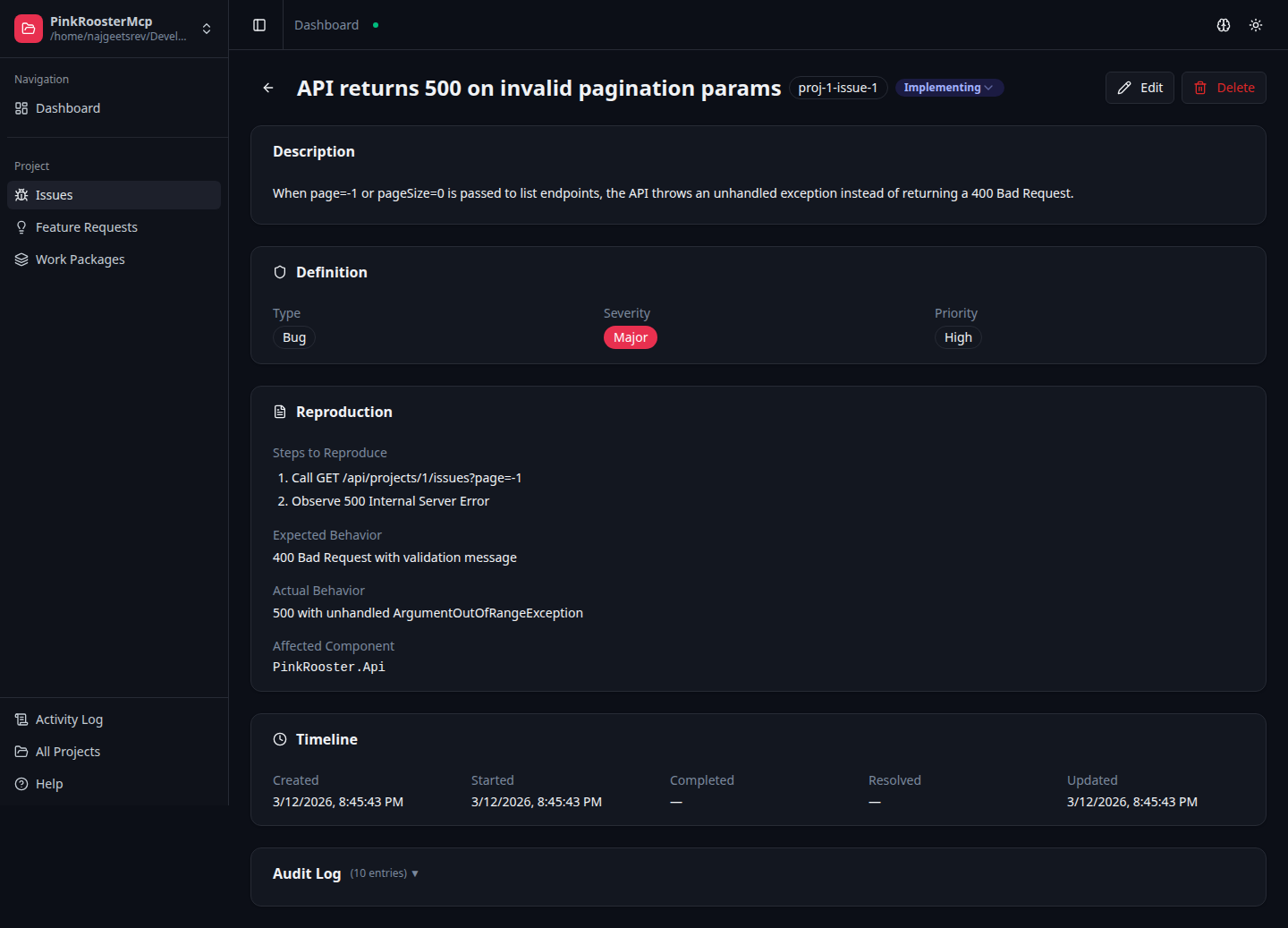
Every entity has a structured detail page with inline editing, state management, related entities, timeline, and a collapsible audit log.
Work Packages
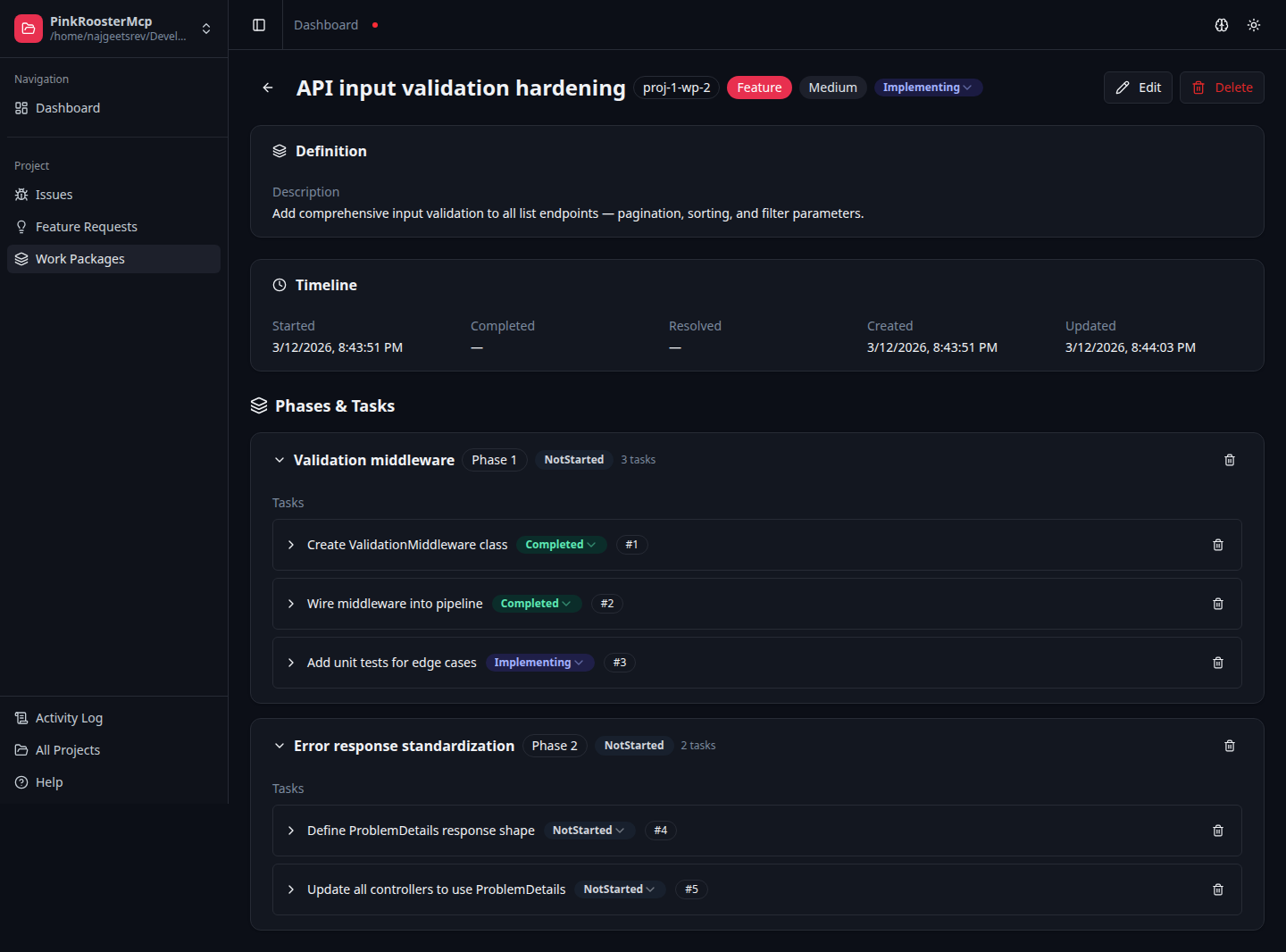
Work packages are the execution unit — each one contains phases and tasks with dependency tracking and automatic state propagation.
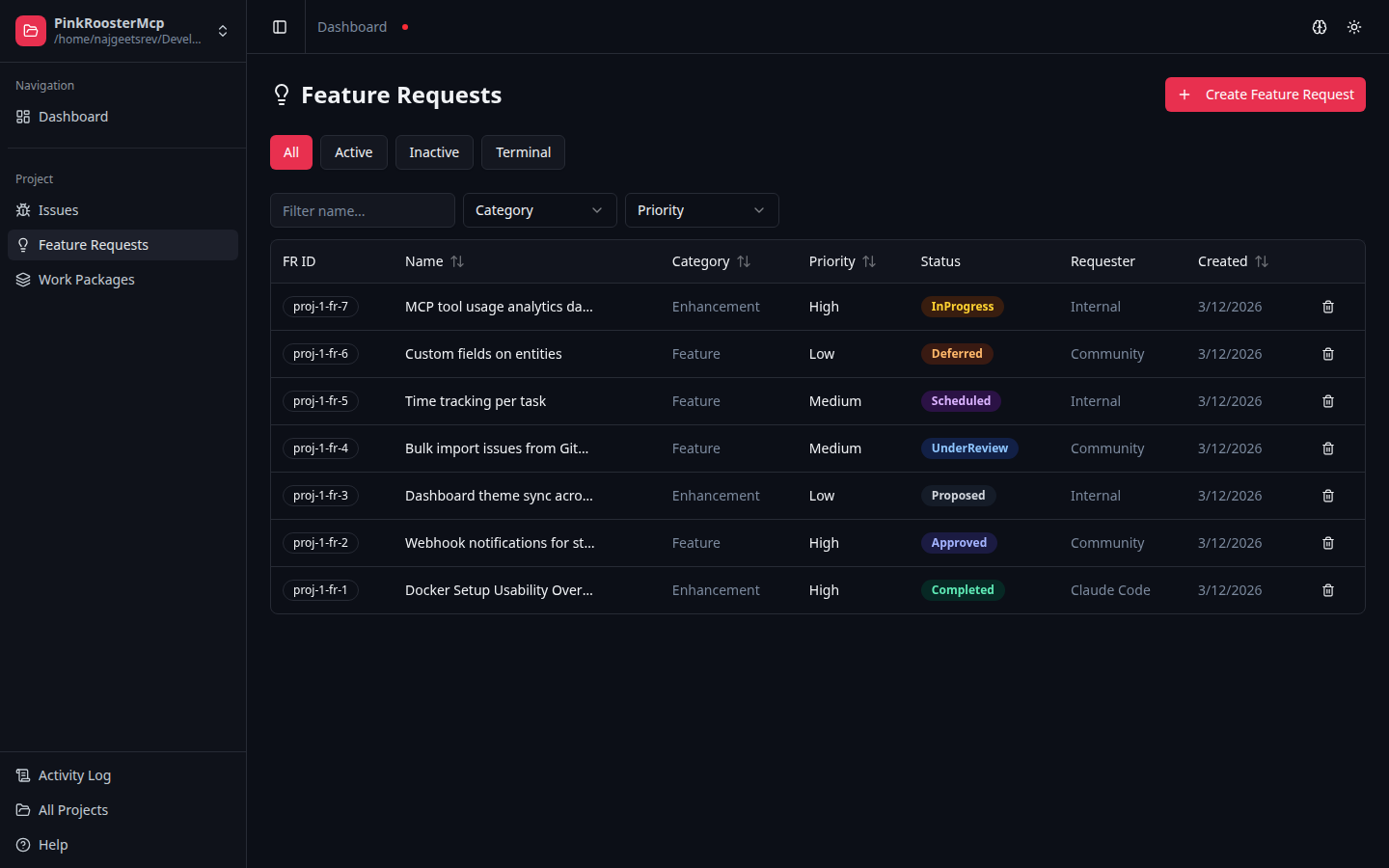
Feature Requests
Track ideas from proposal through completion with an 8-state lifecycle. Link feature requests to work packages to connect "what" to "how."
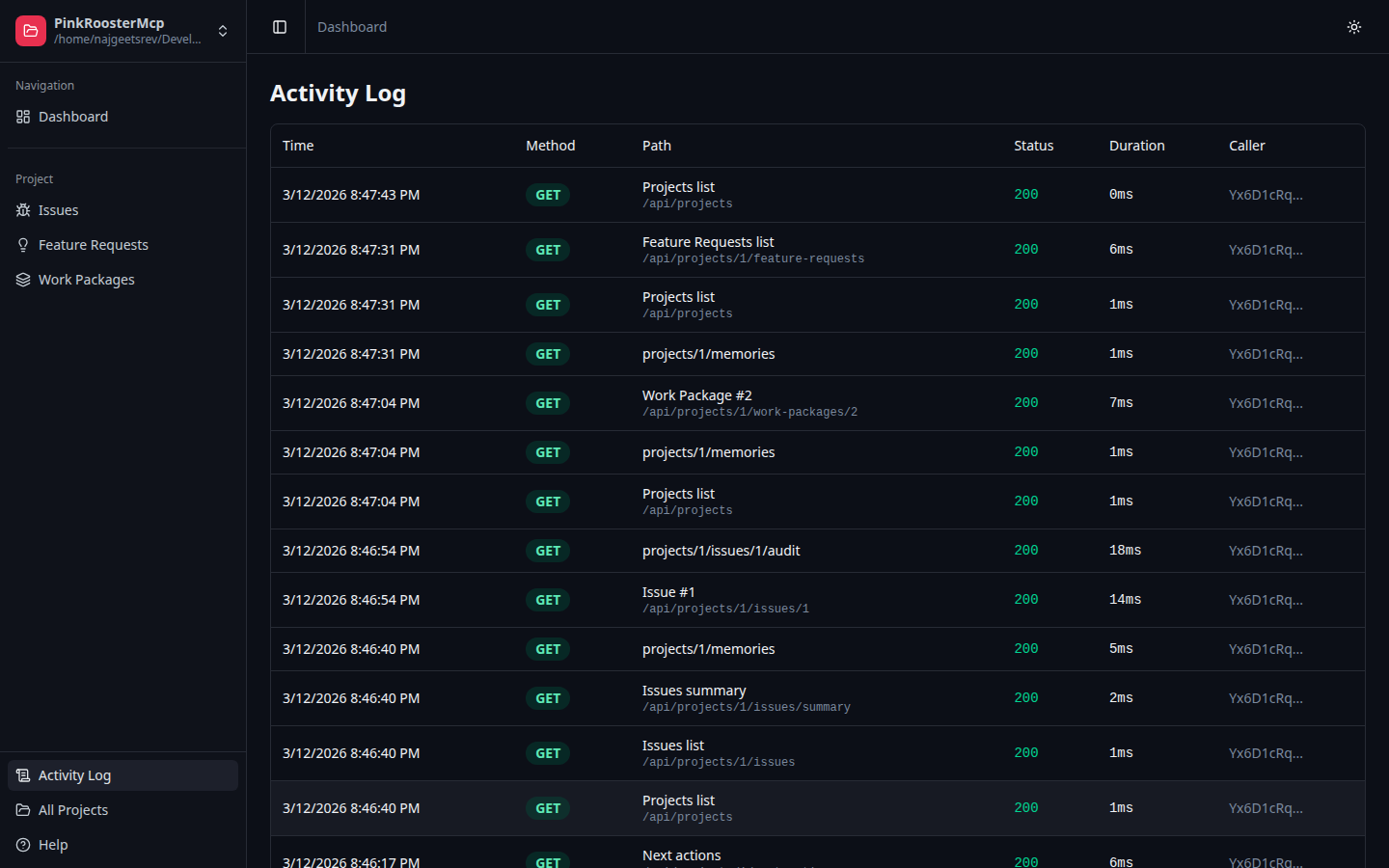
Activity Log
Every API request is logged with method, path, status, duration, and caller identity — giving you full observability into agent behavior.
How It Works
┌─────────────────┐     MCP (Streamable HTTP)     ┌─────────────────┐
│  Claude Code /  │ ◄──────────────────────────► │   MCP Server    │
│  Cursor / etc.  │                                │   :5200         │
└─────────────────┘                                └────────┬────────┘
                                                            │ HTTP
┌─────────────────┐          HTTP / REST           ┌────────▼────────┐
│   Dashboard     │ ◄──────────────────────────► │   REST API      │
│   :3000         │                                │   :5100         │
└─────────────────┘                                └────────┬────────┘
                                                            │ EF Core
                                                   ┌────────▼────────┐
                                                   │   PostgreSQL    │
                                                   │   :5432         │
                                                   └─────────────────┘
Key design decisions:
- The MCP server calls the API over HTTP — no shared database access, clean separation
- Human-readable IDs everywhere (
proj-1-issue-3,proj-1-wp-2-task-5) — easy for both agents and humans - State cascades automatically — completing all tasks in a phase completes the phase, which can complete the work package, which can complete linked issues and feature requests
- Full audit trail — every field change is recorded with old/new values
Entities
| Entity | Purpose | States |
|---|---|---|
| Project | Top-level container, identified by filesystem path | Active |
| Issue | Bugs, defects, regressions, tech debt, performance, security | NotStarted → Designing → Implementing → Testing → InReview → Completed |
| Feature Request | Ideas and enhancements with business context | Proposed → UnderReview → Approved → Scheduled → InProgress → Completed |
| Work Package | Execution plan with phases, tasks, and dependencies | Same as Issue + automatic upward propagation |
| Phase | Grouping of related tasks within a work package | Auto-completes when all tasks reach terminal state |
| Task | Atomic unit of work with target files | Same states as Issue, supports dependency blocking |
| Project Memory | Stored knowledge, decisions, patterns, and context | Stateless (no lifecycle) |
| User | Multi-user accounts with Argon2id password hashing | Active / Inactive (soft delete) |
| User Project Role | Per-project role assignment (Admin, Editor, Viewer) | — |
MCP Tools
PinkRoosterMcp exposes 24 MCP tools organized by entity:
| Tool | Description |
|---|---|
get_project_status | Compact status dashboard — counts, active/blocked items |
get_next_actions | Priority-ordered actionable items with enriched context (linked entity names, complexity) |
create_or_update_issue | Create or update issues with full field support |
get_issue_details / get_issue_overview | Read issue data |
create_or_update_feature_request | Create or update feature requests |
get_feature_request_details / get_feature_requests | Read feature request data |
manage_user_stories | Add, update, or remove structured user stories on feature requests |
create_or_update_work_package | Create or update work packages |
get_work_package_details / get_work_packages | Read work package trees |
scaffold_work_package | One-call creation of WP + phases + tasks + dependencies |
create_or_update_phase / create_or_update_task | Manage phases and tasks (phase supports batch task creation) |
batch_update_task_states | Update multiple task states in one call with consolidated cascades |
verify_acceptance_criteria | Record verification results for phase acceptance criteria |
manage_dependency | Add/remove WP or task dependencies with auto-block (auto-detects from ID format) |
list_memories / get_memory_details | Read project memories (filter by name pattern or tag) |
create_or_update_memory | Create or merge memory by name (append content, union tags) |
delete_memory | Permanently delete a project memory |
delete_entity | Permanently delete an entity by type with cascade handling |
All write operations return structured OperationResult JSON with state change cascades, so the agent always knows what happened downstream.
PM Workflow Skills
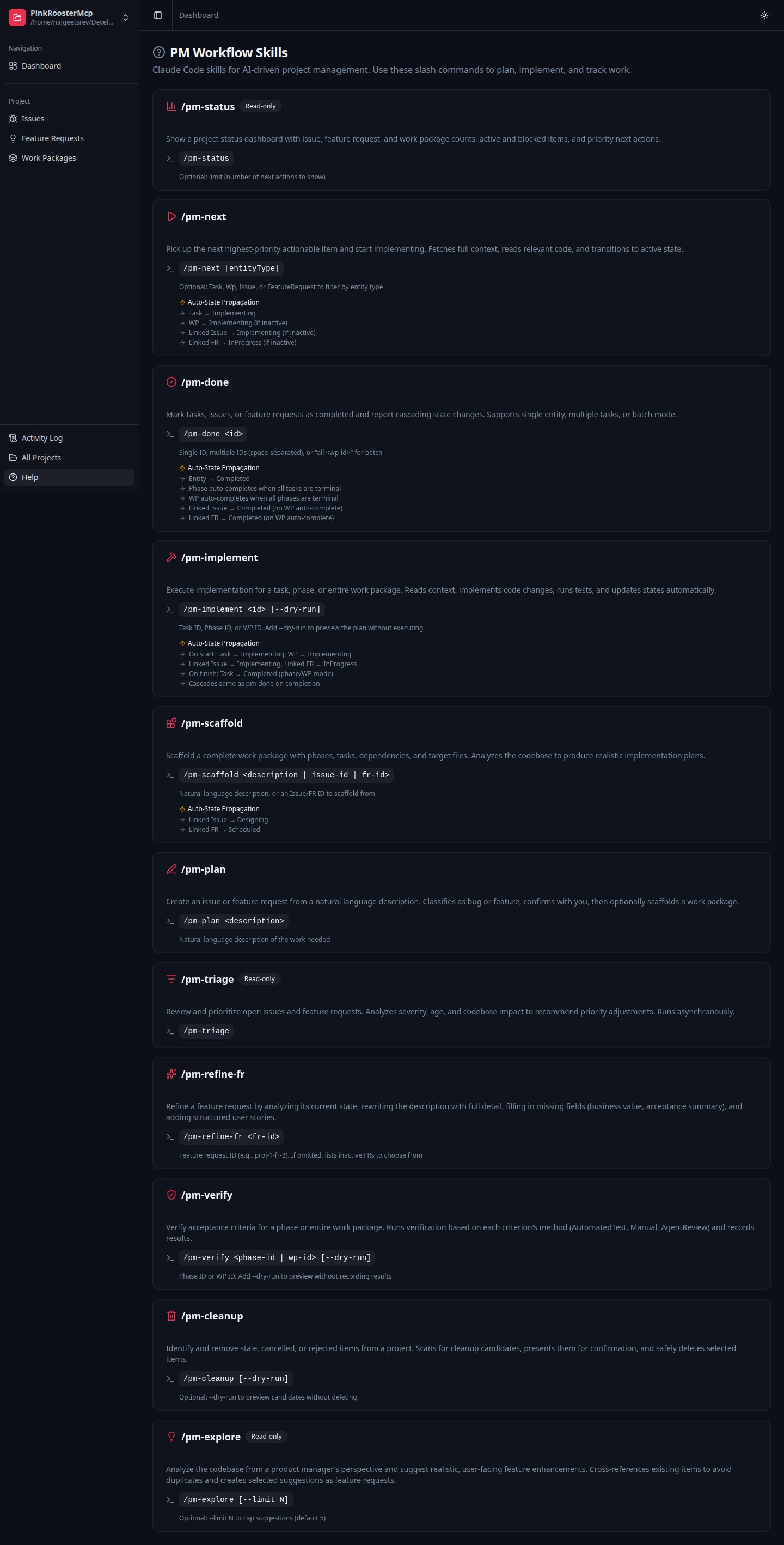
Sixteen Claude Code slash commands provide high-level project management workflows on top of the MCP tools:
| Command | What it does |
|---|---|
/pm-status | Show project dashboard with counts, blocked items, and next actions |
/pm-next [--auto] | Pick the highest-priority item and start implementing. --auto loops until done |
/pm-done <id> | Mark entity completed, report all cascades |
/pm-implement <id> | Full implementation loop — read context, write code, run tests, update state |
/pm-scaffold <desc|id> | Scaffold a work package from a description or linked issue/FR |
/pm-plan <desc> | Create an issue or FR from natural language, optionally scaffold |
/pm-triage | Analyze and prioritize open items |
/pm-refine-fr <fr-id> | Refine a feature request — rewrite description, add user stories, fill gaps |
/pm-explore [--limit N] | Analyze codebase as a PM and suggest user-facing features |
/pm-verify <id> | Verify acceptance criteria for a phase or work package |
/pm-cleanup [--dry-run] | Analyze codebase for dead code and debt, scaffold a cleanup work package |
/pm-codesmells | Scan for code smells using threshold-based metrics — long methods, god classes, deep nesting, and more |
/pm-housekeeping [--dry-run] | Delete stale, cancelled, rejected, or replaced project entities |
/pm-brainstorm [topic] | Interactive feature brainstorming via Socratic dialogue and web research |
/pm-audit [--focus domain] | Proactive codebase audit — creates tracked issues from confirmed findings |
/pm-troubleshoot | Diagnose root cause of bugs by tracing code, logs, and git history |
Skills automatically propagate state to related entities. Starting a task activates its work package and linked issue/FR. Completing all tasks cascades completion upward through phases, work packages, and linked entities.
Getting Started
Prerequisites
- Docker and Docker Compose
- Claude Code (recommended —
make installauto-registers the MCP server) - .NET 9 SDK and Node.js 20+ (for local development only)
Quick Start
git clone https://github.com/pinkroosterai/PinkRoosterMcp.git
cd PinkRoosterMcp
make install
That's it. make install will:
- Create
.envwith working defaults (no edits needed) - Register the MCP server in Claude Code (global scope, skipped if CLI not found)
- Install PM workflow skills to
~/.claude/skills/ - Pull and start the pre-built Docker Hub image (no local build required)
To build from source instead, use make setup (same steps but builds the image locally).
Services will be available at:
| Service | URL |
|---|---|
| Dashboard | http://localhost:3000 |
| REST API | http://localhost:5100 |
| MCP Server | http://localhost:5200 |
| Swagger | http://localhost:5100/swagger/index.html |
Deploy with Docker Hub Image
You can run PinkRoosterMcp without cloning the repository by using the pre-built image from Docker Hub.
- Create a
docker-compose.yml:
services:
  postgres:
    image: postgres:17
    environment:
      POSTGRES_DB: pinkrooster
      POSTGRES_USER: pinkrooster
      POSTGRES_PASSWORD: ${POSTGRES_PASSWORD:-pinkrooster}
    ports:
      - "5432:5432"
    volumes:
      - pgdata:/var/lib/postgresql/data
    healthcheck:
      test: ["CMD-SHELL", "pg_isready -U pinkrooster"]
      interval: 5s
      timeout: 5s
      retries: 5

  pinkrooster:
    image: pinkrooster/pinkroostermcp:latest
    ports:
      - "3000:80"      # Dashboard
      - "5100:8080"    # REST API
      - "5200:8081"    # MCP Server
    environment:
      DATABASE_URL: "Host=postgres;Database=pinkrooster;Username=pinkrooster;Password=${POSTGRES_PASSWORD:-pinkrooster}"
      API_KEY: ${API_KEY:-}
      MCP_API_KEY: ${MCP_API_KEY:-}
    depends_on:
      postgres:
        condition: service_healthy

volumes:
  pgdata:
- Start the services:
docker compose up -d
- Register the MCP server in Claude Code:
claude mcp add --transport http --scope user pinkrooster http://localhost:5200
To pin a specific version, replace latest with a version tag (e.g., pinkrooster/pinkroostermcp:1.0.1).
Connect Your AI Agent
If you ran make install with Claude Code installed, the MCP server is already registered. For other MCP clients, point them to http://localhost:5200 (Streamable HTTP) or http://localhost:5200/sse (legacy SSE).
Developer Setup
For contributors making changes to PinkRoosterMcp:
make setup-dev # Install deps, register MCP, start multi-image containers with hot reload
Or use local processes with hot reload:
make dev          # Start PostgreSQL in Docker + API/MCP/Dashboard locally with dotnet watch
make dev-api      # API only (hot reload)
make dev-dashboard # Dashboard only (Vite dev server)
Authentication
Dashboard: Multi-user authentication is built in. On first visit, you'll see a registration form — the first user automatically becomes SuperUser. Subsequent users are created via the Users management page and assigned per-project roles (Admin, Editor, Viewer).
API / MCP: Optional API key authentication. Everything runs with open access by default. To enable, edit .env:
API_KEY=your-api-key          # API authentication (required by MCP→API calls)
MCP_API_KEY=your-mcp-key      # MCP server authentication (optional, separate from API_KEY)
Troubleshooting
| Problem | Solution |
|---|---|
| Port already in use | Stop conflicting services or change ports in docker-compose.yml |
| Container unhealthy | Run make logs to see error output |
| MCP not registered | Run claude mcp add --transport http --scope user pinkrooster http://localhost:5200 |
| Database connection error | Ensure PostgreSQL container is healthy: docker compose ps |
Testing
# .NET integration tests (requires Docker for Testcontainers)
dotnet test

# Dashboard frontend tests
cd src/dashboard && npm test
700+ tests: 343 API integration tests + 112 unit tests + 255 dashboard frontend tests. 98.3% MCP E2E pass rate across 59 test scenarios.
Tech Stack
| Layer | Technology |
|---|---|
| MCP Server | .NET 9, ModelContextProtocol SDK |
| REST API | .NET 9, ASP.NET Core, Argon2id (Konscious.Security.Cryptography) |
| Database | PostgreSQL 17, EF Core 9 |
| Dashboard | React 19, TypeScript, Vite, Tailwind CSS v4, shadcn/ui, TanStack Query/Table, Recharts |
| Testing | xUnit v3, Testcontainers, Respawn, Vitest, React Testing Library, MSW |
| Infrastructure | Docker Compose, nginx |
Contributing
Contributions are welcome! See the Developer Setup section to get started. The project uses make setup-dev for the full contributor workflow with hot reload across all services.
License
MIT