MCP DB Wizard
officialAn MCP server for Oracle that won't get you fired. The MCP server does not expose a SQL prompt, and can't tell you how to log into Oracle. Only the selected objects and SQL statements are usable.
What can you do with DB Wizard MCP?
- Fetch a row by primary key — Ask for a specific activity log entry and get it back as a JSON object via
synuser_activity_log_get_by_pk. - Insert into the activity log — Have the assistant add a new log record, with update and delete operations available from the same curated table via
synuser_activity_log_insert. - Call a PL/SQL routine — Invoke
synuser_js_admin_getadmintoolinfoto run a business procedure and receive records, collections, and all OUT parameters. - Get the next sequence value — Request the next ID from
synuser_job_id_nextvalwithout exposing any other sequence data. - Run only pre-approved SQL — Execute a tested, typed SQL statement you selected, with arguments as bind values and no ad-hoc query composition.
Documentation
An MCP server for Oracle that won't get you fired
The config is the whole security model
Reachable by the agent
synuser_activity_log_get_by_pktable — one row by primary key, as a JSON objectsynuser_activity_log_inserttable — with _update and _delete, from the same selectionsynuser_js_admin_getadmintoolinfoPL/SQL routine — records, collections and every OUT parametersynuser_job_id_nextvalsequence — the next value, and nothing else
Not reachable, by construction
- SQL text from the caller — arguments are bind values
- DDL — create, alter, drop
- Any object you did not select
- Any schema the config does not name
- The Oracle password — it lives in the environment
An agent that can write SQL can write DROP TABLE. An agent holding a tool called check_flight_availability can check availability on a flight, because that's all the code in front of it does.
Curation happens before the code exists
Least privilege is easy to claim and hard to verify. Here the config decides what is emitted: an object nobody selected has no tool, no method and no class. It is absent from the binary rather than guarded by a running process, so no prompt can reach it.
What an MCP server with no run-sql tool changes
Your business rules are already in PL/SQL
Decades of validation, referential logic and audit behaviour live inside packages. MCPDBWizard calls those routines as they are — records, collections, ref cursors, and every OUT parameter returned — instead of asking a language model to reinvent the rules in a SELECT.
What an agent sees when your PL/SQL becomes tools
Every call is a named tool, not a query
Requests arrive as synuser_activity_log_get_by_pk(entry_id) against a strict schema — a misspelled argument is rejected before the database is touched. Far easier to log, rate-limit, review after the fact, and explain to an auditor.
Curated MCP tools and a SQL prompt, side by side
Two audiences, two records
The proxy writes who called which tool and whether it was allowed; each server writes what the tool did and how it ended. Argument names always; values only if you turned that on, because a model chose them.
Where an MCP server's logs should go
Oracle 12c through 26ai
Including the types added since: native JSON, BOOLEAN and VECTOR, and document CRUD over JSON-relational duality views. Anything that cannot cross JSON honestly — SDO_GEOMETRY, BFILE — is skipped whole, and the log says which and why.
Accounts, tokens and a grant matrix
Many accounts, many configs, one tick per grant. Two teams needing different tools over the same schema is two configs, not one config and a rule — which keeps the guarantee in the first panel intact.
Role-based access for an MCP server
Weighing it against Oracle's own routes? Read an alternative to Oracle's MCP server, SQLcl MCP server alternatives when ad-hoc SQL is ruled out, or start from the question most people actually ask: can I let an AI agent query my production database?
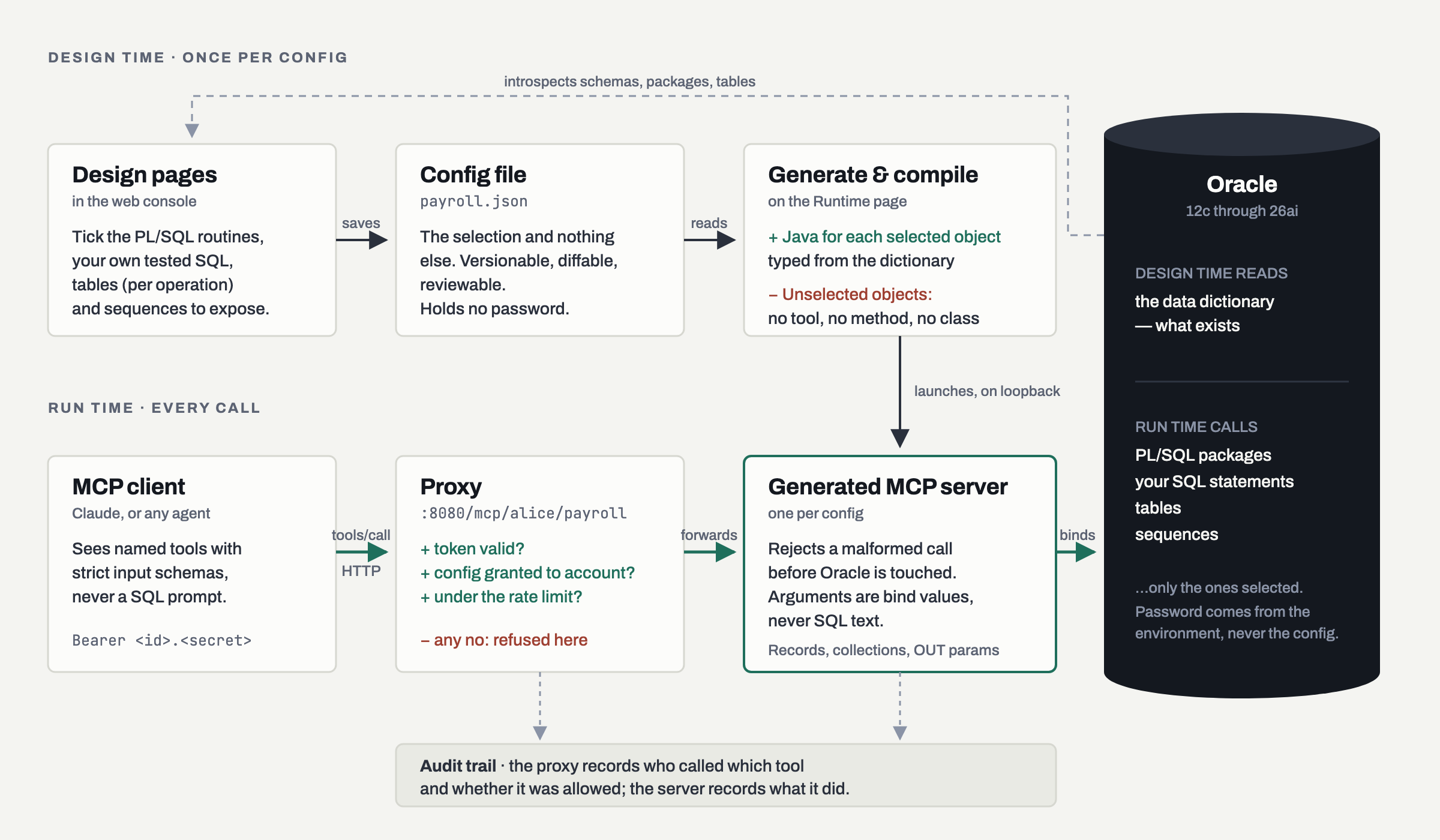
The config decides what is generated; the proxy decides who may call it.
- 01
Select the objects
Connect the Design pages to Oracle and tick the PL/SQL packages you are willing to expose, plus any SQL statements you have written and tested yourself, plus the tables and sequences you want reachable directly. That selection is saved as a config file — properties or JSON, versionable, and containing no password. PL/SQL first, because it is the point: tick the packages and procedures you are willing to expose, and each becomes one tool with its parameters typed.
 Then your own SQL — statements you wrote and tested, with bind parameters typed inline. The agent runs these; it does not compose its own.
 Finally tables, curated per operation rather than per table — a newly selected one is read-only, and create, update and delete are yours to tick.
 - 02
Generate, compile, run
The Runtime page emits Java for exactly those objects, compiles it, and launches it as its own server on loopback. Anything you did not select has no tool, no method and no class — it is absent from the binary rather than merely refused.docker run -d --name mcpdbwizard \ -p 8080:8080 \ -e MCPDBWIZARD_ORACLE_HOST=db.example.com \ -e MCPDBWIZARD_ORACLE_PORT=1521 \ -e MCPDBWIZARD_ORACLE_SID=/PDB1 \ -e MCPDBWIZARD_ORACLE_USER=appuser \ -e DB_PASS_FILE=/run/secrets/oracle \ -v mcpdbwizard-demo:/data \ ghcr.io/srmadscience/mcpdbwizard:2.0.32 - 03
Point your MCP client at the proxy
Agents connect on 8080, over Streamable HTTP, with a token issued to their account. The proxy is the only component that knows who is calling — it checks the account, the grant and the rate limit, then forwards.{ "mcpServers": { "payroll": { "url": "http://localhost:8080/mcp/alice/payroll", "headers": { "Authorization": "Bearer <id>.<secret>" } } } }
The quickstart has the whole path, including issuing the token and granting the config.