FluxGit MCP Server
Git MCP server with 23 read-only tools. Write proposals run only after a person reviews the operation-specific impact and approves them in FluxGit Desktop.
Documentation
fluxgit-mcp-sidecar
mcp-name: io.github.fluxgit-hq/fluxgit-mcp-server



Safety-first Model Context Protocol (MCP) server for Git.
AI agents inspect. FluxGit keeps control.
A Rust MCP server with 34 contracts for AI code agents: 23 read-only tools and 11 human-gated operation tools (10 proposals plus cancellation of a pending proposal). The sidecar never executes a Git write; it bridges approved proposals to the FluxGit desktop application.
For context-budget comparisons, see the public Git context token benchmark. It publishes the fixture, raw outputs, scripts and checksums, including both the broad CLI sweep and a smaller hand-tuned counterexample.
Why this exists
AI coding agents are increasingly asked to navigate real repositories: explain branch state, summarize diffs, find lost commits, recommend safe next steps. To do this well, an agent needs Git context that is richer than git status and structured enough to reason over. To do this safely, an agent must never be able to silently mutate refs, force-push, discard work, or apply patches without a human approving the consequence.
Other MCP Git servers face a choice: stay strictly read-only (limited utility) or expose write tools directly (dangerous — agents hallucinate, prompts can be poisoned, mistakes are destructive). This sidecar chooses neither. Inspection is schema-validated and bounded; operations go through a write-with-UI-handshake: the agent proposes, FluxGit shows the preview, the user approves in the app, and FluxGit executes through its safety pipeline with restore points and audit.
What's exposed
23 read-only tools
| Tool | Purpose |
|---|---|
repo.brief | One-call situational awareness — branch, ahead/behind, in-progress operation, working-tree summary, stashes, aggregated submodule drift, recent commits, detected conventions and next-step hints. The recommended first call of an agent session; replaces 6-10 raw git calls and is token-budgeted by design |
repo.scope | Monorepo scoping — one subtree's working-tree changes, recent commits, churn (commits + authors over a window) and CODEOWNERS owners in a single call |
repo.status | Working tree, current branch, dirty paths |
repo.refs | Branches, tags, remotes, stashes |
repo.branchStack | Current branch vs upstream / base / related |
repo.history | Paginated commit history |
repo.reflog | Movement timeline with recovery hints |
repo.conflictPreflight | Predict merge/rebase outcome before running |
conflict.read | Active conflict as structured data — in-progress operation, ours/theirs producing commits, per-file stage classification, base/ours/theirs contents (size-capped, binary-flagged) and marker region line ranges. No more parsing <<<<<<< soup |
commit.details | Single commit metadata + changed files |
worktree.changes | Per-path working tree change summary |
worktree.list | All worktrees (main + linked) with branch/detached, HEAD SHA and locked/prunable flags — the read-only base for parallel agent worktrees |
submodule.status | Submodule list and state |
diff.text | Standard text patch (git diff compatible) |
diff.semantic | Capability-negotiated semantic explanation |
diff.semanticFallbacks | Paths that fell back from semantic to text |
fleet.radar | Multi-repo attention queue |
safety.timeline | Synthesized safety events from restore points + reflog |
safety.eventDetails | Drill-down into one timeline event |
flux.latestRestorePoint | Newest FluxGit restore point |
flux.restorePoints | List of restore points |
flux.restorePointDetails | One restore point with before/after refs |
operation.status | Authoritative asynchronous status by previewId; poll after a preview returns accepted: true and do not report a Git outcome before it becomes terminal |
11 write-with-UI-handshake tools
All 10 operation.preview.* proposals dispatch through the FluxGit gateway when
configured. The sidecar POSTs the proposal, performs one bounded status read,
and normally returns immediately with accepted: true, the canonical
previewId, current status and nextAction.tool: "operation.status". The
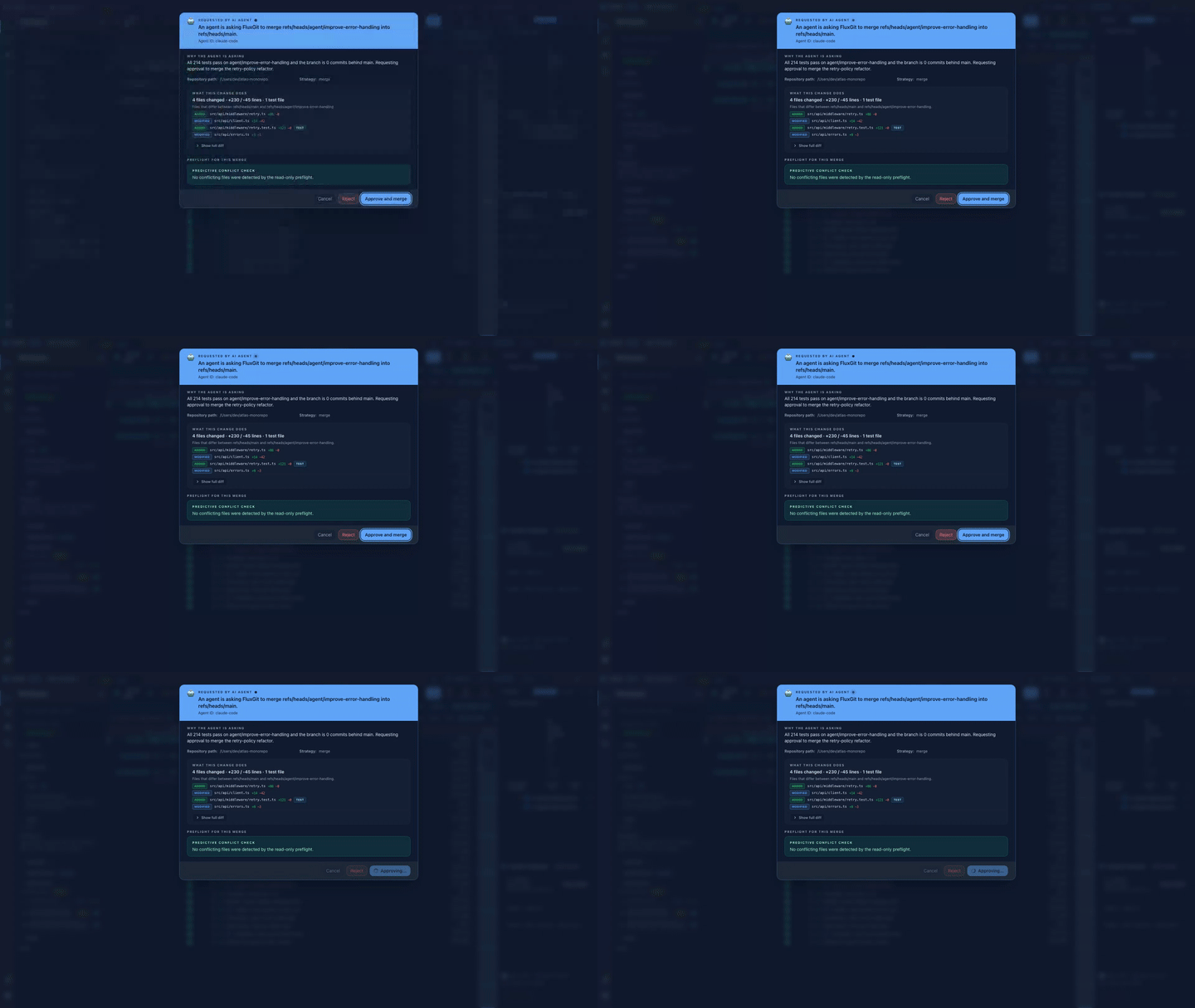
FluxGit app renders a “Requested by AI agent” approval card while human review
continues asynchronously. Code 10003 is reserved for a bridge that is absent,
invalid or unreachable; it is not a human-approval timeout.
All 10 preview schemas accept an optional bounded idempotencyKey. Reuse it
only when retrying the same logical intent; the sidecar scopes it to the
operation type so that retry resolves to the existing gateway proposal. Omit
it for a new intent—even when the other arguments match—and the sidecar sends
a fresh UUID-backed key. Preview tools therefore continue to advertise
idempotentHint: false.
| Tool | Purpose | Gateway dispatch |
|---|---|---|
operation.preview.merge | Propose a merge for human review | POST /v1/mcp/operation/preview/merge → approval card in FluxGit |
operation.preview.rebase | Propose a non-interactive rebase | interactive: true fails schema validation before POST/card creation; accepted requests POST /v1/mcp/operation/preview/rebase and open a rewrites-history warning card |
operation.preview.discard | Propose discarding working-tree changes | POST /v1/mcp/operation/preview/discard → path-specific warning; FluxGit requires a safety stash before it discards matching changes |
operation.preview.reset | Propose soft / mixed / hard reset | POST /v1/mcp/operation/preview/reset → mode-aware card (hard mode forces strong confirmation) |
operation.preview.patch | Propose applying an agent-generated patch | POST /v1/mcp/operation/preview/patch → monospace patch preview + applyToIndex toggle |
operation.preview.plan | Propose a 1-10 step sequence using the five supported plan-step types (merge, rebase, discard, reset, patch) | POST /v1/mcp/operation/preview/plan → numbered step card; destructive steps require an explicit checkbox. A rebase step with interactive: true is rejected by schema validation before dispatch; execution stops at the first failure. Its pre-plan checkpoint anchors only the branch commit: guarded recovery restores HEAD/tracked files, while the original index, working tree and untracked files require the separate step snapshots/Safety Timeline recovery surfaces |
operation.preview.worktree | Propose creating an isolated worktree for a parallel task (non-destructive; never touches history) | POST /v1/mcp/operation/preview/worktree → approval card with branch + target path + reason; runs through the same worktree-create action a manual click uses |
operation.preview.commit | Propose staging + committing with a message (non-destructive; amend not supported) | POST /v1/mcp/operation/preview/commit → approval card lists the exact files that will be staged and committed; runs through the normal commit pipeline (hooks, signing, policy); completion returns the new SHA |
operation.preview.push | Propose pushing a branch to a remote (optional set-upstream; force-with-lease shows a HIGH-risk warning) | POST /v1/mcp/operation/preview/push → approval card with remote + branch + force warning when applicable; runs the guarded push flow |
operation.preview.branch | Propose creating (and optionally checking out) a branch from a start point | POST /v1/mcp/operation/preview/branch → approval card with name + start point + checkout choice |
operation.cancel | Cancel the agent's own still-pending proposal by previewId | POST cancel; the card disappears from the user's queue like an expired proposal |
All write proposals require a free-text reason so the user sees the agent's justification in the approval modal. All reuse the same durable gateway lifecycle (pending → approved → executing → completed|failed, with rejection/cancellation/expiry branches) and the same Tauri bridge in the UI. Six shims cover pending, recoverable, approve, claim, reject and complete. After restart, Approved proposals may resume only after repo/ref revalidation and claim; Executing proposals are shown for explicit reconciliation and are never blindly re-executed. When an approved operation captures a restore point, the completion result exposes that recovery metadata so the agent can report it without guessing.
The boundary is deliberately fail-closed at approval time. FluxGit resolves the
proposal's repoPath to its canonical open-repository id and requires it to
match the repository the human is reviewing; an unresolved path, mismatch, or
repository switch blocks execution. Tool arguments are validated before
dispatch and again by the gateway. An optional declarative agent policy can
deny proposals before a card opens; if FLUXGIT_MCP_AGENT_POLICY is configured
but the file is missing, unreadable, malformed, or unsupported, the gateway
does not start. With no configured policy, compatibility remains permissive,
but per-operation human approval is still mandatory.
Write protocol details
Every operation.preview.* call follows the same wire protocol. Example for operation.preview.merge:
1. Sidecar POSTs the proposal:
POST /v1/mcp/operation/preview/merge HTTP/1.1
Host: 127.0.0.1:59647
Content-Type: application/json

{
  "previewId": "1f3c5b9a-...-uuid",
  "agentId": "external-mcp-sidecar",
  "operationType": "merge",
  "repoPath": "/Users/dev/projects/checkout",
  "sourceRef": "feature/cart-redesign",
  "targetRef": "main",
  "reason": "Cart redesign work is complete; tests pass on the feature branch.",
  "strategy": "merge",
  "requestedAt": "2026-05-28T11:42:09.512Z"
}
2. Gateway responds 202 Accepted:
{ "previewId": "1f3c5b9a-...-uuid", "status": "pending", "expiresAt": "2026-05-28T11:47:09.512Z" }
3. Sidecar performs one bounded status read:
GET /v1/mcp/operation/status/1f3c5b9a-...-uuid HTTP/1.1
Host: 127.0.0.1:59647
If the proposal is still live, the preview tool returns promptly:
{
  "tool": "operation.preview.merge",
  "readOnly": false,
  "accepted": true,
  "previewId": "1f3c5b9a-...-uuid",
  "status": "pending",
  "nextAction": {
    "tool": "operation.status",
    "data": { "previewId": "1f3c5b9a-...-uuid" }
  }
}
This is a successful proposal submission, not a successful Git operation.
4. Client polls operation.status until the gateway reports a terminal state:
{
  "previewId": "1f3c5b9a-...-uuid",
  "operationType": "merge",
  "status": "completed",
  "result": {
    "commitSha": "9a8b7c6d...",
    "restorePointId": "rp_2026_05_28_1142",
    "conflicts": []
  }
}
completed returns isError: false. A live pending or approved proposal
also returns as a successful accepted result, but it does not claim Git changed.
Any non-completed terminal state (rejected, failed, expired, cancelled)
returns isError: true with the structured payload, so the agent can report the
real outcome instead of inventing one.
The same pattern applies to all 10 operation.preview.* tools. Only the request
body fields and result shape differ; proposal submission, the one immediate
read, asynchronous operation.status continuation and error semantics are
shared. The public contract summary is maintained at
fluxgit.com/features/mcp-agent-git.
Boundary: free shell vs FluxGit-powered
The sidecar speaks MCP without FluxGit installed. Standard Git inspection works (status, refs, history, reflog, diff.text, etc). The tools that require FluxGit return JSON-RPC error code 10001 with an upgradeHint pointing the agent at the install/configure flow.
Tier classification:
- Free shell — work with local
gitonly:repo.brief,repo.scope,repo.status,repo.refs,repo.branchStack,repo.history,repo.reflog,commit.details,worktree.changes,worktree.list,submodule.status,diff.text,conflict.read. - Hybrid — work locally with documented fallback, enriched by FluxGit:
fleet.radar,diff.semantic,diff.semanticFallbacks,repo.conflictPreflight. - FluxGit-required — return
gateway_not_configuredwithout FluxGit because synthesizing them from local refs alone would mislead the agent:safety.timeline,safety.eventDetails,flux.latestRestorePoint,flux.restorePoints,flux.restorePointDetails. - Write handshake — route through FluxGit UI approval via the gateway
handshake server. The 10
operation.preview.*tools return an accepted live proposal promptly and continue throughoperation.status;operation.cancelwithdraws a pending proposal owned by the same agent. Code10003is used only when the bridge cannot accept or serve the handshake.
Quick start
Install the published crate (puts fluxgit-mcp-sidecar on your PATH):
cargo install fluxgit-mcp-sidecar --locked
To install the current source branch instead:
cargo install --git https://github.com/fluxgit-hq/fluxgit-mcp-server fluxgit-mcp-sidecar --locked
Or build from a clone:
# Build
cargo build --release

# Run as MCP server (stdin/stdout transport)
./target/release/fluxgit-mcp-sidecar
Connect any MCP-compatible agent
Paste the generic block below into any MCP host config. No client-specific install required.
{
  "mcpServers": {
    "fluxgit": {
      "type": "stdio",
      "command": "/absolute/path/to/fluxgit-mcp-sidecar",
      "env": {
        "FLUXGIT_MCP_HANDSHAKE_ADDR": "127.0.0.1:59647",
        "FLUXGIT_MCP_AUDIT_LOG": "/optional/path/to/audit.jsonl"
      }
    }
  }
}
FLUXGIT_MCP_HANDSHAKE_ADDR is the canonical bridge address generated by
FluxGit Quick Connect. FLUXGIT_GATEWAY_ADDR and FLUXGIT_GATEWAY_URL remain
compatibility fallbacks. The sidecar accepts only plain HTTP on a loopback host
with an explicit port; a remote host, credentials, path, query, fragment, HTTPS,
or missing port is rejected. Without a valid local bridge, the free-shell tier
still works.
FLUXGIT_MCP_AUDIT_LOG enables an append-only JSONL audit log of every tools/call. Arguments are hashed; raw paths and identifiers are never written verbatim.
Semantic diff contract
diff.semantic is the most-used tool for AI agents and the easiest to misuse. The rule is strict:
A result may only be called semantic if
data.supportedis exactlytrue.
When the FluxGit semantic engine is not available (FluxGit app not running, gateway address not configured, or the repository not registered in FluxGit), diff.semantic returns:
{
  "tool": "diff.semantic",
  "readOnly": true,
  "data": {
    "supported": false,
    "fallback": "diff.text",
    "reason": "Semantic diff is not available in local sidecar fallback mode.",
    "textDiffArguments": { "repoPath": "...", "base": "...", "head": "...", "path": "..." }
  }
}
With the FluxGit app running and the repository registered in FluxGit, the same call is served by the FluxGit diff-engine through the gateway's read-only bridge and returns supported: true with per-file semantic hunks:
{
  "tool": "diff.semantic",
  "readOnly": true,
  "source": "fluxgit-gateway",
  "data": {
    "supported": true,
    "engine": "fluxgit-diff-engine",
    "files": [
      {
        "path": "src/main.rs",
        "fallbackToText": false,
        "hunks": [{
          "header": "fn main",
          "lines": [{
            "type": "modified", "oldLine": 3, "newLine": 3,
            "content": "let x = 2;", "oldContent": "let x = 1;",
            "changedTokens": ["2"], "oldChangedTokens": ["1"]
          }]
        }]
      },
      {
        "path": "logo.bin",
        "fallbackToText": true,
        "hunks": [],
        "reason": "The semantic engine could not parse this file (unsupported language, binary or unreadable source); use a text diff for it.",
        "textDiffArguments": { "repoPath": "...", "base": "...", "head": "...", "path": "logo.bin" }
      }
    ],
    "changedFiles": 2,
    "filesTruncated": false
  }
}
Honesty is per file, not just per call: files the engine could not parse arrive with fallbackToText: true, a reason, and ready-to-use textDiffArguments — never as synthesized semantic hunks. diff.semanticFallbacks follows the same split and, when connected, lists the engine's real per-file fallback records.
Connected agents must:
- Call
diff.semantic. - Read
data.supported. - If
true, use the semantic payload and label results as semantic — except entries withfallbackToText: true, which must be presented as text fallbacks. - If
false, calldiff.textwithdata.textDiffArgumentsand present results as a text-diff fallback. - Never infer function- or class-level moves from a text patch alone.
Allowed wording: "FluxGit reported a text-diff fallback for this file".
Prohibited wording: "This is a semantic diff" when supported=false.
Audit log
Unless FLUXGIT_MCP_AUDIT_DISABLED is set, the sidecar attempts to append each
tools/call to the shared JSONL ledger. The gateway attempts human-decision
appends through the same writer. FLUXGIT_MCP_AUDIT_LOG overrides the path;
otherwise both processes use <FluxGit run dir>/audit/mcp.jsonl (including
FLUXGIT_RUN_DIR):
{
  "id": "bdeca765-488c-4e2a-b86b-25cd734f2988",
  "timestamp": 1712345678901,
  "auditSchemaVersion": 1,
  "auditChainVersion": 1,
  "sequence": 42,
  "segmentId": "7ab6fa7a-c5bf-4d82-86a8-26b4728b5acd",
  "previousHash": "sha256:...",
  "entryHash": "sha256:...",
  "tool": "repo.status",
  "event_type": "tool_call",
  "repo_scope": "repoPath:sha256:...",
  "args_fingerprint": "sha256:...",
  "risk": "read",
  "approval": "none",
  "result": "success",
  "session_id": "my-agent",
  "duration_ms": 12,
  "summary": "...",
  "readOnly": true,
  "sidecarReadOnly": true,
  "signature": "base64url-ed25519",
  "signatureKeyId": "1a2b3c4d5e6f7a8b",
  "signatureVersion": 3
}
Sensitive paths and identifiers are hashed, never stored verbatim. One stable cross-process lock protects validation, rotation and the complete append plus sync. Lines are limited to 256 KiB. The active segment rotates at 4 MiB and at most four rotated segments are retained, with a signed checkpoint when signing is configured.
Per-entry Ed25519 signatures (shipped 2026-05-28)
Audit signing is opt-in. When FLUXGIT_MCP_AUDIT_SIGN_KEY points to a PEM PKCS8 Ed25519 private key, every appended entry is signed with that key. Signed entries add:
signature— base64url (no padding) Ed25519 signature over the canonical JSON of the entry without the signature field.signatureKeyId— 16-char hex prefix of the matching public key, so rotated keys can co-exist in the same JSONL.signatureVersion: 3— current chained signing domain; the key id, sequence, previous hash and entry hash are included in the signed bytes.
Canonical JSON rule (verifier must match exactly): recursively sort every
object's keys lexicographically by UTF-8 byte order; arrays preserve order;
strip signature; serialize compactly. For versions 2 and 3, keep
signatureKeyId and signatureVersion in the signed object. For legacy signed
entries with no version, the verifier also strips signatureKeyId.
If the env var is unset, new entries are chained but unsigned for backward compatibility. If it is explicitly set, an empty, missing, unsafe, oversized or invalid key fails audit startup closed; it never degrades to unsigned output.
Verifying an audit log
The sidecar binary doubles as a verifier:
fluxgit-mcp-sidecar verify-audit /path/to/mcp.jsonl --pubkey /path/to/install.pub.pem
The CLI streams the active file and retained rotations with bounded memory. It
validates sequence, hashes, segment names, checkpoints and signatures, then
reports only bounded counters (entries, chained, legacy, signed,
unsigned, segments and the retained sequence range). Legacy per-entry
records remain readable and verifiable but are reported as legacy, never as
part of the tamper-evident chain. For a strict evidence gate, run:
fluxgit-mcp-sidecar verify-audit /path/to/mcp.jsonl --pubkey /path/to/install.pub.pem --require-signed
Exit code is 0 on success, 3 for malformed data, broken chain/rotation, a
bad signature and, in strict mode, any unsigned entry; usage errors return 2.
Programmatic full-ledger verification uses verify_audit_ledger; the older
verify_audit_event_signature remains available for compatible per-entry
checks. A local chain cannot prove deletion or replacement of the entire
retained history (or its local checkpoint) without an independently trusted
external anchor. Signed retained entries do prevent an attacker without the
private key from recomputing a modified chain.
Audit configuration (including an explicit signing key) fails closed at startup. A later filesystem/full-disk append failure is logged as degraded but does not undo a tool response or an already-durable gateway lifecycle transition; the gateway lifecycle journal remains authoritative for recovery.
Protocol details
The server supports two protocol eras:
2026-07-28(preferred, stateless): callserver/discover, then includeparams._meta.io.modelcontextprotocol/protocolVersionandparams._meta.io.modelcontextprotocol/clientCapabilitieson every request. Modern results carryresultType: "complete"and server metadata; list results addttlMsandcacheScope.tools/listincludestitle,inputSchema,outputSchemaand annotations.tools/callincludes both presentationalcontentand the same payload instructuredContent.2024-11-05(legacy compatibility): older hosts continue to useinitialize. Modern-only fields are omitted from legacy results.
Stdio output is standard newline-delimited JSON-RPC 2.0: exactly one compact
JSON value per line. Pre-standard Content-Length framing remains accepted as
input only for old FluxGit clients; the server never emits it. Frames are
limited to 8 MiB. JSON-RPC notifications receive no response, and request
methods sent without an id are not executed.
There are 34 tools in modern tools/list: 23 advertise
annotations.readOnlyHint: true; the 10 operation.preview.* tools and
operation.cancel advertise readOnlyHint: false. These annotations describe
effects for the host; they are not authorization.
Error codes:
| Code | Meaning |
|---|---|
-32700 | Parse error |
-32600 | Invalid request (malformed JSON-RPC) |
-32601 | Method not found |
-32602 | Invalid params or unknown tool |
-32603 | Internal error |
-32022 | Unsupported modern MCP version; data contains supported and requested |
10001 | Gateway not configured — install/start FluxGit to use FluxGit-required tools |
10002 | A configured FluxGit bridge had no payload to serve (for example, a local fallback lacked an absolute repoPath) |
10003 | The local write-handshake bridge is absent, invalid or unreachable; no accepted proposal should be inferred |
10004 | Proposal ended without completion (rejected, failed, expired or cancelled) |
10005 | The gateway does not know the requested previewId (wrong/never-accepted id or pruning after terminal retention). Restart alone does not justify a new proposal: Approved/Executing records recover durably and a possibly-started Git outcome must be reconciled first. |
10006 | Gateway refused the proposal before opening a card (policy, validation or quota) |
10007 | Gateway returned a malformed/unsafe canonical previewId; the sidecar refuses to follow it |
10010 | Local read-only Git command failed |
Status
This is a working MCP server. The read-only surface and all 10
operation.preview.* routes are implemented; operation.cancel manages only a
pending proposal owned by the same self-reported agent id. The write handshake
renders an approval card in FluxGit and completes through the app's guarded
pipeline. Clients receive structured lifecycle results instead of a synthetic
success. clientInfo.name is sanitized attribution for policy, quota and audit;
it is self-reported and must never be treated as authenticated identity.
Roadmap
- End-to-end demo video — public recording of the agent-proposes → user-approves → FluxGit-executes loop, captured from a live install.
- Audit log exportable CSV/JSON — shipped: per-entry Ed25519 signing (2026-05-28). Remaining: exportable CSV/JSON and retention policy for the FluxGit app's audit panel.
- HTTP / SSE transport — for cloud / shared MCP host deployments.
- Official MCP Registry —
io.github.fluxgit-hq/fluxgit-mcp-serveris live and resolves to the publishedfluxgit-mcp-sidecarcrate.
License
Apache-2.0. See LICENSE.
Related
- FluxGit — the desktop app that produces the FluxGit-powered context.
- MCP agent Git — public product and protocol overview.
- Claude Code, Cursor, and Codex — setup and workflow guides.
- Git context token benchmark — reproducible fixture, raw outputs, scripts and checksums.
- Public source — this Apache-2.0 server.