mcp-expect
Jest-style assertions for testing MCP servers — checks tools exist, respond in time, reject invalid input, and match their declared schema.
Documentation
mcp-expect





Jest-style assertions for testing MCP (Model Context Protocol) servers.
flowchart LR
    A["Your test file<br/>(*.mcptest.ts)"] --> B["mcp-expect<br/>expect().tool() assertions"]
    B --> C["Official @modelcontextprotocol/sdk<br/>Client"]
    C --> D["stdio or<br/>Streamable HTTP"]
    D --> E["Your MCP Server"]
defineTest("search tool", { command: "node", args: ["server.js"] }, async ({ expect }) => {
  await expect.tool("search").exists();

  await expect.tool("search")
    .withInput({ query: "hello" })
    .respondsWithin(2000);

  await expect.tool("search")
    .withInput({ query: 123 })       // wrong type
    .rejectsInvalidInput();

  await expect.tool("search")
    .withInput({ query: "hello" })
    .returnsSchema({ results: "array" });
});
Run it, get a real pass/fail report — no writing raw client.callTool() calls, no guessing why an AI coding assistant thinks your working server is broken.
Why
MCP servers fail in a small number of very specific ways: a tool isn't actually
registered, a handler hangs, a schema silently accepts bad input, or a result
doesn't look like what the caller expects. Those are exactly the four
assertions below. This is deliberately not a general test framework — it's a
thin, opinionated layer on the official @modelcontextprotocol/sdk client
aimed at catching those four failure modes in CI, before an agent has to
discover them at runtime.
Runs in CI out of the box
npx mcp-expect "dist/**/*.mcptest.js" → fails the build on any red assertion → annotates the exact line on the PR diff
- run: npx mcp-expect "dist/**/*.mcptest.js"
A non-zero exit code on failure means it works in any CI system with zero
configuration. When GITHUB_ACTIONS=true is set (which GitHub does
automatically), failures are also emitted as ::error file=...::
annotations, so they show up inline on the PR diff — not just buried in a
log.
Install
npm install --save-dev mcp-expect zod
Quickstart
- Write a test file ending in
.mcptest.ts(compile it, or run viatsx/ts-node):
// search.mcptest.ts
import { defineTest } from "mcp-expect";

const server = { command: "node", args: ["./dist/server.js"] };

defineTest("search tool is registered", server, async ({ expect }) => {
  await expect.tool("search").exists();
});
- Run it:
npx mcp-expect "dist/**/*.mcptest.js"
You'll get colored pass/fail output and a non-zero exit code on failure, so it drops straight into CI.
Server configs
Two transports are supported out of the box:
// stdio — the server is a local process
{ command: "node", args: ["server.js"], env: { API_KEY: "..." } }

// Streamable HTTP — the server is already running somewhere
{ url: "http://localhost:3000/mcp", headers: { Authorization: "Bearer ..." } }
A fresh connection is made per defineTest and closed afterward, so tests
don't leak state into one another. If you have several tests against the
same server, describeServer() groups them under one shared connection
instead — see Performance characteristics.
import { describeServer } from "mcp-expect";

describeServer({ command: "node", args: ["server.js"] }, (defineTest) => {
  defineTest("search exists", async ({ expect }) => {
    await expect.tool("search").exists();
  });

  defineTest("search responds", async ({ expect }) => {
    await expect.tool("search").withInput({ query: "hi" }).respondsWithin(1000);
  });
});
The defineTest you get, whether top-level or scoped inside
describeServer, supports .only(...) (run just this test, skipping every
other test in the whole invocation) and .skip(...) (never run it), for
focusing during debugging.
API reference
expect.tool(name)
Returns a ToolAssertion for the given tool name, bound to the client for the
current test.
.withInput(args)
Sets the arguments used by the assertions below it. Returns this, so it
chains.
.exists()
Asserts the tool is registered and discoverable via tools/list.
.respondsWithin(ms)
Asserts a call with the current input completes within ms and does not
return isError: true. This is the single most useful assertion in practice —
a hanging handler is the most common reason an AI coding assistant decides
your working MCP server is broken and starts "fixing" it.
.rejectsInvalidInput()
Asserts the current input is rejected, either by a protocol-level schema
error or by an isError: true result. If the call silently succeeds, the
assertion fails — that's a sign your input schema is too loose.
.returnsSchema(shape)
Asserts the result matches a shallow shape, e.g.
{ results: "array", count: "number" }. Intentionally not full JSON Schema
validation — a quick shape check, not a validator. See .matchesOutputSchema()
below for the real thing.
.matchesOutputSchema()
Asserts the result validates against the tool's own declared outputSchema
(from tools/list), using ajv — full
JSON Schema validation, no shape spec to write yourself. Throws a clear error
if the tool doesn't declare an outputSchema at all; use .returnsSchema()
for those.
.isSafeAgainst(field, categories)
Fuzzes the given input field with known malicious payloads —
"path-traversal" and/or "command-injection" — and asserts every one is
rejected (isError: true, or a thrown error). Any payload that gets through
is a real finding: the failure message includes exactly which payload
succeeded and what the server returned. This is a narrow smoke test for the
single most common class of real-world MCP tool bug (an argument passed
unchecked into a filesystem or shell call), not a general security scanner.
await expect.tool("read_file").withInput({ path: "safe.txt" }).isSafeAgainst("path", "path-traversal");
Working example
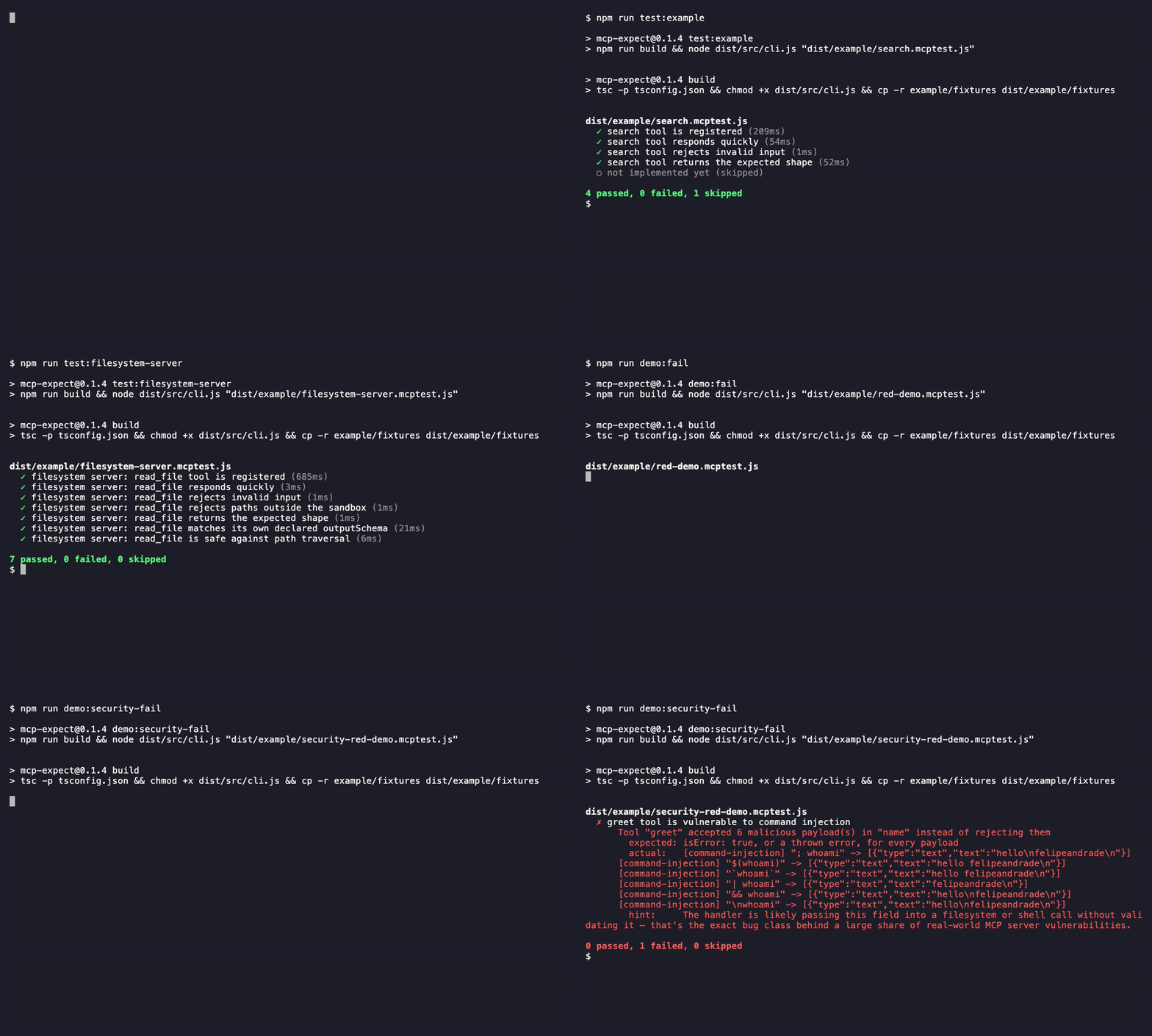
See example/ for a complete demo: a small MCP server exposing
a search tool, and a test file exercising all four assertions.
npm install
npm run test:example
There's also a fast unit test suite (test/, Node's built-in node:test
runner) for everything that's awkward to trigger against a real server on
demand — most of it against a fake Client (a tool with no outputSchema,
a malformed JSON-RPC result, an unknown security category, the .only()/
.skip() registry logic, ...), and a handful spawning the real compiled CLI
binary as a black box (usage errors, a glob matching nothing, the
GITHUB_ACTIONS annotation, real captured server stderr on failure):
npm run test:unit
Want to see what a failing assertion looks like? example/red-demo.mcptest.ts
is the same server with one deliberately-wrong expectation, kept in its own
file so it doesn't turn the main demo (or CI) red:
npm run demo:fail
Not convinced a testing library that only tests its own demo server proves anything? It's also run against two of the official MCP reference servers, maintained independently of this project — deliberately different from each other and from the demo server, to shake out transport and schema quirks:
@modelcontextprotocol/server-everything(example/real-server.mcptest.ts) — a stdio server with no startup arguments, returningstructuredContentshaped as a flat object.@modelcontextprotocol/server-filesystem(example/filesystem-server.mcptest.ts) — takes a startup argument (the allowed directory), rejects invalid input two different ways (bad argument type and a path outside the sandbox, both surfaced asisError: truerather than a thrown error), and nests its result under acontentstring instead of an object.- A minimal but spec-correct Streamable HTTP server
(
example/http-server.ts+example/http-server.mcptest.ts) — every other example here runs over stdio, so this is the only real coverage of the other transport this library supports. The test file starts and stops the server itself, since (per Server configs) this library only connects to an HTTP server, it doesn't manage one.
All three use describeServer() to share one connection across all their
assertions.
npm run test:everything-server
npm run test:filesystem-server
npm run test:http-server
Want proof .isSafeAgainst() actually catches a real bug, not just passes
against servers that are already safe? example/vulnerable-demo-server.ts is
a deliberately naive tool (interpolates unchecked input into a shell command)
and example/security-red-demo.mcptest.ts shows the assertion catching it —
including the leaked whoami output proving the command actually ran:
npm run demo:security-fail
Performance characteristics
A plain defineTest opens a fresh connection before running its assertion,
so per-test wall time is dominated by process startup, not the assertion
logic itself:
- Local stdio server (already-installed binary): ~300-370ms per test
- Server launched via
npx(like the reference servers above): ~700-820ms per test, mostlynpx's own resolution overhead, not this library
describeServer() avoids paying that cost per test by sharing one
connection across a group. Measured on the real reference-server suites in
example/: the first test in a group still pays the ~700-800ms connection
cost, but every subsequent test in the same group runs in 1-18ms — a
7-test suite that would've taken ~5s sequentially now takes about 1s total.
The Streamable HTTP transport is faster still: ~50ms for the first
(session-initializing) call, then 2-4ms per call after — see
example/http-server.mcptest.ts.
Test execution is still sequential — independent connections (or groups) run one after another, not concurrently. Parallelizing across them is a reasonable future improvement; it isn't built yet, so this README doesn't claim it.
Runtime dependencies are @modelcontextprotocol/sdk (the client you're
already relying on to talk to the server), ajv
for .matchesOutputSchema(), chalk
for colored output, and fast-glob
for test file discovery — not zero, but small and deliberate.
Code coverage (via c8) is wired up
with npm run coverage — it runs both the unit suite and every real-server
suite together, currently around 98% of statements in src/ (the remaining
gaps are things like an unreachable top-level crash handler — not worth
chasing to 100%). It isn't
tracked in CI or published as a badge yet — there's no history to compare
against, so a single snapshot number would be more decorative than useful.
Releasing
Publishing to npm is automated via .github/workflows/publish.yml
using npm's OIDC trusted publishing — no long-lived npm token is stored in
the repo. To cut a release:
npm version patch   # or minor / major — updates package.json and creates a git tag
git push --follow-tags
The workflow verifies the pushed tag matches package.json's version, runs
the full test suite (local demo + both real-server suites), and then
publishes. If any of that fails, nothing gets published.
What this is not (v1 scope)
- Not a multi-model grading harness — it doesn't judge how well an LLM interprets your tool descriptions.
- Not a general fuzzer —
.isSafeAgainst()checks a small, curated set of known path-traversal and command-injection payloads, not arbitrary input generation. - Not a registry or discovery tool.
These may show up in later versions once the core assertion set has proven useful in practice. Contributions and issues welcome — see CONTRIBUTING.md, or pick up a good first issue. Found a real vulnerability? See SECURITY.md instead of opening a public issue.
If mcp-expect proves useful, the plan is a small family of focused MCP
developer tools rather than one monolithic framework — published under the
@mcp-expect npm org as they're
built. Nothing beyond this package exists yet.
License
MIT