mcpfold
Connect every MCP server without paying the context-window tax.
Documentation


Connect every MCP server without paying the context-window tax.
One canonical config, folded out to every client — loading only the tools each agent needs,
and resolving secret references instead of hardcoding values.






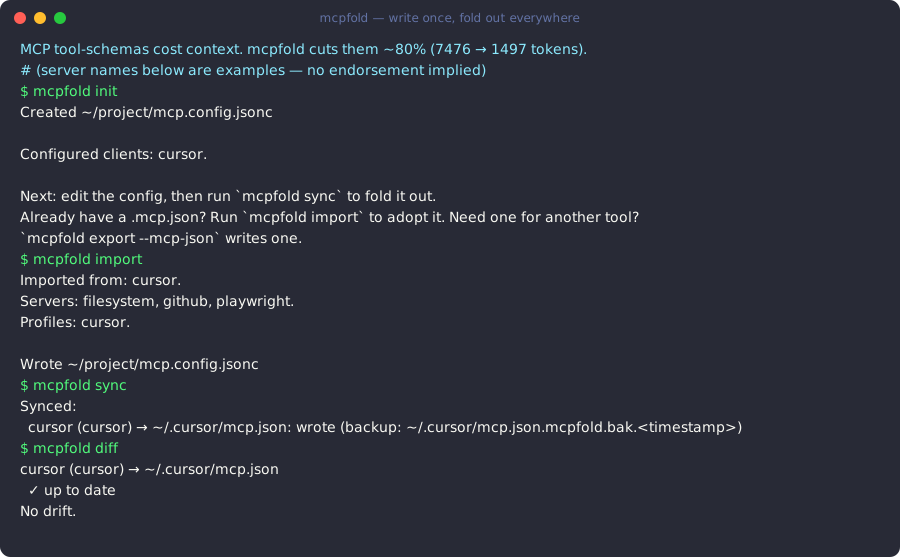
Demo regenerated from the real CLI with pnpm demo:record (an asciinema cast + this SVG; a GIF renders in CI via demo/mcpfold.tape). Server names shown are examples — no endorsement implied.
v1.0.0 is live. The local-first CLI + core are stable and free forever, MIT-licensed — install below. The optional hosted cloud (accounts, config sync, teams) is self-hostable. Full docs live in
docs/; the story-by-story build history is inprd.json.
Why mcpfold
The context-window tax
Every MCP server you connect dumps its full tool schema into your agent's context window on every
turn — used or not. mcpfold's local proxy curates the toolset per client. In a
reproducible benchmark — github (20 tools), supabase (15), playwright (10),
45 tools total — curating down to the 9 actually needed cuts tool-schema tokens by ~80%
(7,476 → 1,497), with no extra config because the shim already in the launch path does the filtering.
…and one config for every client
MCP config sprawls across clients (Claude Code, Cursor, VS Code, Windsurf, Zed, …), and the formats
have quietly diverged: VS Code uses the root key servers, Zed uses context_servers, everyone else
uses mcpServers. Secrets get hardcoded into plaintext JSON. mcpfold keeps one canonical file and
folds it out to each client — resolving secret references (never values) and curating which servers
and tools each client loads.
- One source of truth — a commented
mcp.config.jsonc, version-safe and editor-validated. - Secret-safe — configs carry
${scheme:path}references; resolved values never touch disk. - Fewer tokens — per-client, per-agent tool curation via a local proxy.
- Portable — deterministic, byte-stable output for every client format.
Install
Every channel resolves to the same version for a given release (a CI check enforces parity), so mix them across machines. Full details in docs/install.md.
npm / npx — no install needed to try it:
npx mcpfold init
npm install -g mcpfold      # or: pnpm add -g mcpfold   (installs `mcpfold` + the `mcpf` alias)
Homebrew (macOS / Linux):
brew install dj-pearson/tap/mcpfold
Scoop (Windows):
scoop bucket add mcpfold https://github.com/dj-pearson/scoop-bucket
scoop install mcpfold
curl | sh (macOS / Linux) — standalone binary, no Node, checksum-verified:
curl -fsSL https://mcpfold.com/install.sh | sh
Standalone binary — download for your platform from the
latest release (macOS arm64/x64, Linux
x64/arm64, Windows x64), verify the .sha256, and put it on your PATH.
mcpfold --version
Quickstart
Requires Node 20+ (for the npm/npx install; the binaries need nothing). mcpfold auto-detects
whichever MCP clients you have installed.
mcpfold init      # 1. scaffold a commented mcp.config.jsonc (+ $schema for editor autocomplete)
mcpfold import    # 2. scan installed clients and merge their servers into the canonical file
mcpfold sync      # 3. fold the canonical config out to every detected client (native formats)
mcpfold diff      # preview what sync would change, per client, before applying
mcpfold doctor    # health-check config, clients, and secret references
Other commands: secret (manage secret references), run (launch the curating proxy), status,
add. See the full Quickstart and command reference.
Cut the token tax with curation
The savings above come from curation — exposing only the tools an agent actually uses. curate
writes an allow-list; sync folds each curated server out as a mcpfold run proxy shim, so clients
only ever load the trimmed toolset:
mcpfold add fs --package @modelcontextprotocol/server-filesystem  # add a server
mcpfold curate fs --tools read_text_file,write_file,list_directory # keep only what you use
# → fs: keeping 3 of 14 tools, ~3.2k → ~684 tokens (approx)
mcpfold sync                                                       # fold it out (writes a proxy shim)
Already been running your servers? Plain mcpfold curate reads the local audit trail and
recommends the allow-list from your actual tool usage. Check the measured savings on your own
config anytime with mcpfold status.
Supported clients
18 clients, each read and written in its own native format from a single source of truth:
Claude Code · Claude Desktop · Cursor · VS Code · Visual Studio · Windsurf · Zed · Cline · Continue · Roo Code · Gemini CLI · Codex CLI · Copilot CLI · JetBrains · Goose · LM Studio · Warp · opencode
New adapters are a one-PR on-ramp.
Editor autocomplete (JSON Schema)
mcpfold init adds a $schema line so editors give you autocomplete + inline validation:
{
  "$schema": "https://mcpfold.com/schema/v1.json",
  "version": 1,
  // …
}
The schema is generated from the zod source (packages/schema); a CI check fails if the committed
mcp.config.schema.json drifts — regenerate with
pnpm --filter @mcpfold/schema generate.
How it's built
| Package | Purpose |
|---|---|
packages/core | @mcpfold/core — pure, I/O-free engine: schema, resolution, drift, diff. |
packages/adapters | @mcpfold/adapters — one module per client (render native ↔ parse canonical). |
packages/secrets | @mcpfold/secrets — env / dotenv / infisical / keychain / 1Password. |
packages/proxy | @mcpfold/proxy — local MCP proxy for tool-level curation. |
packages/cli | mcpfold — the CLI binary (init/import/sync/diff/doctor/…). |
packages/schema | Published JSON Schema for mcp.config.jsonc. |
apps/web | React/TS visual editor + directory (Cloudflare Pages). |
services/edge | Deno edge service — device-code auth, config push/pull, teams. |
Core purity is enforced: packages/core may not import node:fs, node:os, node:path, or any
network/process library. All I/O is injected through ClientAdapter / SecretProvider. Guarded by an
ESLint no-restricted-imports rule and the scripts/check-core-purity.mjs CI gate.
Security
Secret values never touch disk or logs — only references (${scheme:path}) are stored, and
values are resolved in memory at launch. Every security property is paired with the test or CI job
that proves it in the Security posture ledger (CI-guarded so a claim
can't outlive its evidence); the narrative Security and
Threat model pages cover the surfaces and honest boundaries.
Development
Requires Node 20+ and pnpm 10+ (corepack enable).
pnpm install          # install workspace deps
pnpm lint             # eslint + core-purity check
pnpm typecheck        # tsc --noEmit across packages
pnpm test             # vitest (unit + fixture snapshots)
pnpm -r build         # build every package
pnpm verify_all       # lint + typecheck + test + build (the full gate)
CI runs verify_all on a Windows/macOS/Linux × Node 20 matrix — path resolution is central to this
product, so the cross-OS matrix is non-negotiable. New client adapters, secret providers, and
doctor checks are especially welcome — see CONTRIBUTING.md.
Pricing, funding & roadmap
The CLI and everything local are free forever and MIT-licensed; the hosted cloud is the paid surface (and you can self-host it yourself for free). See the pricing model, the public roadmap, and how the project is run in governance.
Support the project
If mcpfold saves you time, you can help fund ongoing work:
- Recurring — GitHub Sponsors or Open Collective
- One-time — donate via Stripe
Sponsorships fund the free, open-source core. Thank you 🙏
License
MIT for packages/* core + CLI. The cloud layer (apps/web, services/edge) is commercial/closed.
See prd.json meta.license.