MCP Front
An OAuth 2.1 proxy for MCP servers that enables single sign-on with Google, domain validation, and per-user tokens.
Documentation
mcp-front 


[!WARNING] This project is a work in progress and should not be considered production ready.
Though I'm fairly confident the overall architecture is sound, and I myself rely on the implementation — so it should work :tm:. But definitely alpha software.
Expect breaking changes! :)
Also, don't rely too much on the docs, they drift fairly quickly, I do not always keep them updated when doing changes or adding/removing features. They are mostly here to anchor me and help me stay focus on my initial vision.
[!TIP] Looking for the easiest way to get an MCP server for your API? Check out Stainless✨. We offer best-in-class SDK and MCP generation. Build a complete MCP server and publish it to Cloudflare and Docker Hub in a few minutes!
Disclaimer: the author of mcp-front is an early Stainless employee
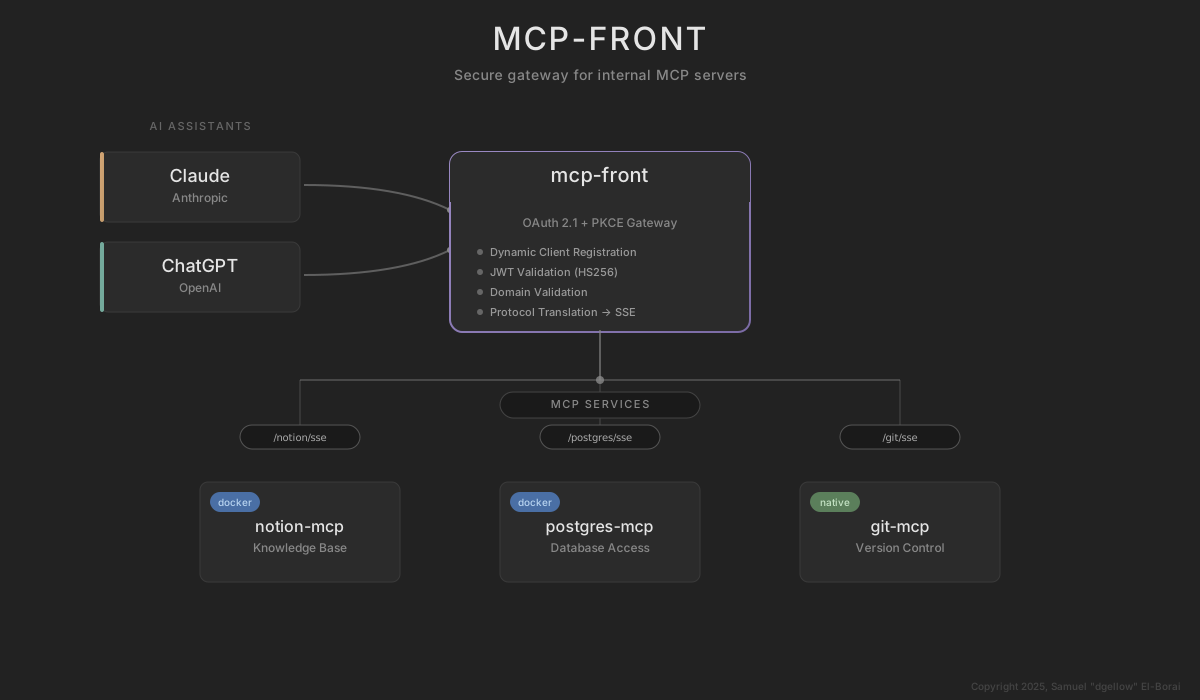
An authentication gateway for MCP (Model Context Protocol) servers. Let your team use Claude with internal databases, APIs, and tools without exposing them to the internet.
The problem
You want your team to use Claude with internal MCP servers (databases, Linear, Notion, internal APIs). But MCP servers don't have built-in multi-user authentication. You either expose them to the public internet, build authentication yourself, or run separate instances per user. None of these are great.
The solution
mcp-front sits between Claude and your MCP servers as an authentication gateway. Your team authenticates via OAuth once (Google, Azure AD, GitHub, or any OIDC provider). When Claude connects, mcp-front validates the token, checks the user belongs to your organization, and proxies to the actual MCP server in your secure environment.
For stdio servers, each user gets an isolated subprocess. For services that need individual API keys (Notion, Linear), users connect them once through a web UI and mcp-front injects tokens automatically. Tokens are scoped to specific services (RFC 8707) — a token for your Postgres server won't work for Linear.
Organization-wide access control with per-user isolation. No modifications to your MCP servers. Nothing exposed to the internet.
How it works
- User adds
https://your-domain.com/<service>/sseto Claude - Claude redirects to the identity provider for login (first time only)
- mcp-front validates the user belongs to your organization
- If the service needs a user API key (Notion, Linear), user connects it through a web page
- mcp-front proxies all MCP requests to the backend server
Try it locally
Save this as config.json:
{
  "version": "v0.0.1-DEV_EDITION_EXPECT_CHANGES",
  "proxy": {
    "baseURL": "http://localhost:8080",
    "addr": ":8080"
  },
  "mcpServers": {
    "filesystem": {
      "transportType": "stdio",
      "command": "npx",
      "args": ["-y", "@modelcontextprotocol/server-filesystem", "/tmp"],
      "serviceAuths": [
        {
          "type": "bearer",
          "tokens": ["dev-token-123"]
        }
      ]
    }
  }
}
# With Go
go install github.com/stainless-api/mcp-front/cmd/mcp-front@main
mcp-front -config config.json

# Or with Docker
docker run -p 8080:8080 -v $(pwd)/config.json:/app/config.json dgellow/mcp-front:latest
In Claude.ai, add an MCP server with URL http://localhost:8080/filesystem/sse, auth type Bearer Token, token dev-token-123.
See the Quickstart for a full walkthrough.
Going further
Identity Providers — Set up Google, Azure AD, GitHub, or any OIDC provider for production OAuth.
Configuration — All config options including Firestore persistence, HTTPS, and per-user service authentication.
Server Types — Stdio, SSE, streamable HTTP, inline tools, and aggregate endpoints.
Service Authentication — Per-user tokens for services like Notion, Linear, and other OAuth or API key services.
Architecture — Per-service audience validation, token flow, and MCP spec compliance.
API Reference — HTTP endpoints, OAuth discovery, and client registration.
Security
mcp-front uses OAuth 2.0 with PKCE for public clients, domain and organization-based access control, per-user session isolation for stdio servers, per-service audience claims (RFC 8707) to prevent token reuse across services, and AES-256-GCM encryption for sensitive data at rest.
Security boundary: mcp-front handles authentication. MCP servers handle authorization and input validation. Only use MCP servers you trust with your data.
License
Licensed under the Elastic License 2.0 with commercial exceptions for Stainless Software Ltd and its affiliates, and the author. Using mcp-front as infrastructure for your own services (including public/commercial) is permitted; offering mcp-front itself as a hosted product is not.
Copyright 2025 Samuel "dgellow" El-Borai (sam@elborai.me)