Hayhooks
Deploy and serve Haystack pipelines as REST APIs, MCP Tools, and OpenAI-compatible chat completion backends.
Documentation

Hayhooks
Serve Haystack pipelines and agents as APIs.
REST APIs, OpenAI-compatible chat, MCP tools, and A2A agents, with durable execution and built-in tracing.




Serve your pipelines and agents
Write a Python wrapper around your pipeline or agent. Choose the interfaces and runtime features you need:
- REST APIs. Deploy Python wrappers or YAML pipelines as typed, validated endpoints with OpenAPI docs, file uploads, and custom routes.
- OpenAI-compatible APIs. Serve streaming Chat Completions and Responses endpoints. Connect Open WebUI or use the embedded Chainlit UI.
- MCP support. Run an MCP server that exposes pipelines and agents as tools for Cursor, Claude Desktop, and other Model Context Protocol clients.
- A2A support. Expose chat-capable pipelines and agents through the Agent2Agent protocol, with generated agent cards for discovery and task delegation.
- Durable execution. Checkpoint long-running work in Redis, wait for human approval, retry failures, and recover after restarts.
- Tracing and observability. Inspect executions and component traces in the terminal dashboard, or export spans to an OpenTelemetry backend with
hayhooks[tracing].
Terminal dashboard
Inspect deployments, follow executions, and find slow components in your terminal.
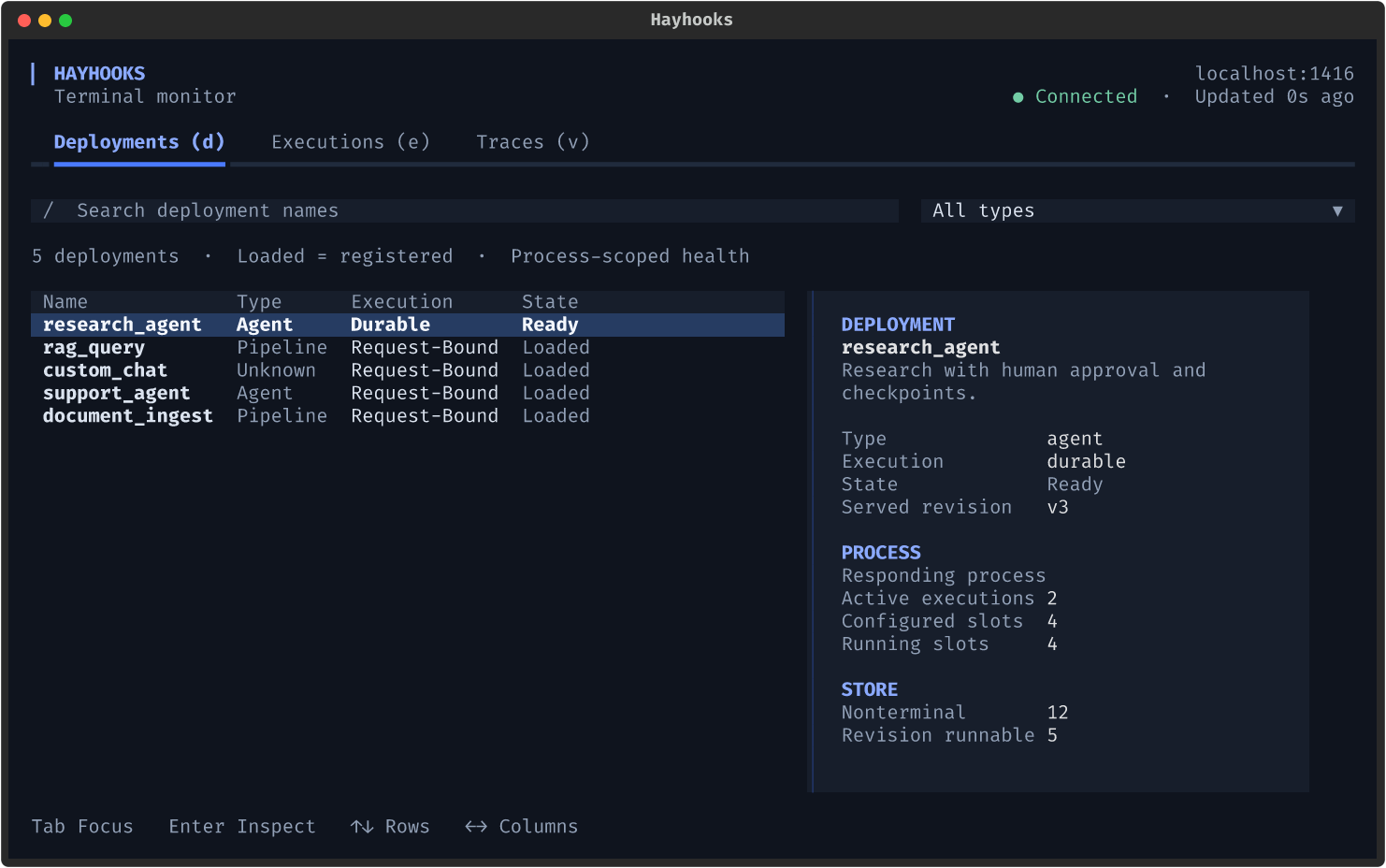
Actual terminal UI with demo data. Explore the dashboard.
Quick start
Serve a Haystack agent through a typed HTTP endpoint. You need Python 3.10 through 3.14 and an OpenAI API key.
Install and start
In your Python environment, install Hayhooks and set the API key before starting the server:
pip install hayhooks
export OPENAI_API_KEY="your-api-key"
hayhooks run
Leave the server running. Use a second terminal for the following commands.
Create an agent
Create a directory named my_agent_dir and save this as my_agent_dir/pipeline_wrapper.py:
from haystack.components.agents import Agent
from haystack.components.generators.chat import OpenAIResponsesChatGenerator
from haystack.dataclasses import ChatMessage
from haystack.tools import tool

from hayhooks import BasePipelineWrapper


@tool
def search(query: str) -> str:
    """Search the knowledge base."""
    return f"This is a demo tool."


class PipelineWrapper(BasePipelineWrapper):
    def setup(self) -> None:
        self.pipeline = Agent(
            chat_generator=OpenAIResponsesChatGenerator(model="gpt-4o-mini"),
            tools=[search],
        )

    async def run_api_async(self, question: str) -> str:
        result = await self.pipeline.run_async(messages=[ChatMessage.from_user(question)])
        return result["last_message"].text
Hayhooks uses the method's type hints to validate requests and generate the API schema.
Deploy and run
hayhooks pipeline deploy-files -n my_agent ./my_agent_dir
curl http://localhost:1416/my_agent/run \
  -H 'Content-Type: application/json' \
  -d '{"question": "What can you do?"}'
The response contains the agent's answer. Open the API docs to inspect and try the endpoint.
Add streaming chat
Implement run_chat_completion_async to expose the agent through the OpenAI-compatible Chat Completions API.
Add these imports at the top of pipeline_wrapper.py:
from collections.abc import AsyncGenerator
from hayhooks import async_streaming_generator
Add this method inside PipelineWrapper:
    async def run_chat_completion_async(
        self, model: str, messages: list[dict], body: dict
    ) -> AsyncGenerator[str, None]:
        return async_streaming_generator(
            pipeline=self.pipeline,
            pipeline_run_args={
                "messages": [ChatMessage.from_openai_dict_format(m) for m in messages],
            },
        )
Redeploy the wrapper, then request a streamed response:
hayhooks pipeline deploy-files -n my_agent ./my_agent_dir --overwrite
curl -N http://localhost:1416/chat/completions \
  -H 'Content-Type: application/json' \
  -d '{
    "model": "my_agent",
    "messages": [{"role": "user", "content": "What can you do?"}],
    "stream": true
  }'
The response arrives as server-sent events. Connect Open WebUI or use the embedded Chainlit UI to chat with the agent.
Inspect your run in the dashboard
On macOS or Linux, open the dashboard in the second terminal under the same OS account as the server:
pip install "hayhooks[tui]"
hayhooks dashboard
Press e for executions or v for traces, then Enter for details. Local capture is enabled by default. Recent ordinary runs remain available until the server restarts or the buffer evicts them.
For Windows or remote access, follow the dashboard connection guide. To export spans to an external OpenTelemetry backend, see tracing and OpenTelemetry.
Durable execution
Run work beyond the lifetime of a request. Hayhooks checkpoints pipelines and agents in Redis so another worker can resume after a restart.
Suspend a run for human approval, retry failures, or reconnect to its output stream from any replica.
stateDiagram-v2
    direction LR
    [*] --> queued: submit (202)
    queued --> running: worker claims
    running --> waiting: suspend for a human
    waiting --> queued: resume
    running --> queued: retry or crash recovery
    running --> completed
    running --> failed
    running --> canceled
Run an agent with human approval
This example waits for approval before calling a demo search tool. Save the wrapper as pipelines/research_agent/pipeline_wrapper.py.
from haystack.components.agents import Agent
from haystack.components.generators.chat import OpenAIResponsesChatGenerator
from haystack.dataclasses import ChatMessage
from haystack.tools import tool
from pydantic import BaseModel

from hayhooks import BasePipelineWrapper, DurableContext


@tool
def search(query: str) -> str:
    """Search the knowledge base."""
    return f"Hayhooks serves Haystack pipelines and agents; results for {query!r}."


class Task(BaseModel):
    question: str


class Approval(BaseModel):
    approved: bool


class Report(BaseModel):
    answer: str


class PipelineWrapper(BasePipelineWrapper):
    durable_revision = "research-agent-v1"  # compatibility key for persisted inputs and checkpoints
    durable_resume_model = Approval  # typed input for human-in-the-loop waits

    def setup(self) -> None:
        generator = OpenAIResponsesChatGenerator(model="gpt-4o-mini")
        self.pipeline = Agent(chat_generator=generator, tools=[search])

    async def run_durable_async(self, context: DurableContext, task: Task) -> Report:
        # Persist the wait in Redis so a worker serving this revision can resume it.
        if not context.state.get("approved"):
            decision = context.resume_input  # consumed on first read
            if decision is None:
                await context.suspend({"kind": "approval", "message": f"Research {task.question!r}?"})
            if not Approval.model_validate(decision).approved:
                raise ValueError("research was rejected")
            context.state["approved"] = True

        # Agent state is checkpointed after tool calls: recovery continues the loop.
        result = await context.run_agent_async(messages=[ChatMessage.from_user(task.question)])
        return Report(answer=result["last_message"].text)
Stop the quick-start server if it is still running. Install the extra, start Redis, and serve the pipelines directory in durable mode:
pip install "hayhooks[durable]"
docker run -d -p 6379:6379 redis
export OPENAI_API_KEY="your-api-key"
HAYHOOKS_DURABLE_MODE=true hayhooks run --pipelines-dir ./pipelines
In a second terminal, submit the run:
curl -i http://localhost:1416/research_agent/run-durable \
  -H 'Content-Type: application/json' -d '{"question": "What does Hayhooks do?"}'
The server returns 202 Accepted with the execution ID and links. Replace EXECUTION_ID below with that ID and check the run's status:
curl http://localhost:1416/research_agent/executions/EXECUTION_ID
When the status is waiting, you can test recovery: stop the server and start it again with the same command. The wait survives the restart.
Recovery requires a worker serving the same revision. When deploying an incompatible change, keep the old revision running until its work finishes. See revision compatibility.
Approve the run and follow its output:
curl -X POST http://localhost:1416/research_agent/executions/EXECUTION_ID/resume \
  -H 'Content-Type: application/json' -d '{"approved": true}'

curl -N http://localhost:1416/research_agent/executions/EXECUTION_ID/stream
Read the durable execution guide for checkpoint behavior and the operations guide for deployment and recovery. The same engine also embeds in any FastAPI app.
Next steps
- Quick Start Guide - Get started with Hayhooks
- Installation - Install Hayhooks and dependencies
- Configuration - Configure Hayhooks for your needs
- Terminal Dashboard - Inspect deployments, executions, and component traces
- Durable Execution - Run Pipelines and Agents beyond the request
- Examples - Explore example implementations
Community & Support
- GitHub: deepset-ai/hayhooks
- Issues: GitHub Issues
- Documentation: Full Documentation
Hayhooks is actively maintained by the deepset team.