Ramen
Governed MCP for teams: a self-hosted MCP platform that enforces your org's security and structure. Python tools from git become canary-deployed workers on GKE/EKS/AKS with SSO roles, NeMo guardrails per tool, promptfoo evals + SkillSpector scans gating deploys, Phoenix traces and audit. MCP 2026-07-28.
Documentation
Build your MCP tools, apps and skills in Python, deploy them across zones on GKE, EKS and AKS.
MCP 2026-07-28 over Streamable HTTP and gRPC, canary deploys gated by golden cases, evals and skill scans,
guardrails, client policies enforced at every sign-in, telemetry per group and user — managed from one console.









Docs: https://bkraad47.github.io/ramen/ · Get started · Deploy your first group · MCP features · Roles · Threat model · Contracts · Releases
What it is
Try the demo — Ramen on your laptop, step by step · Join the Discussions · fork it and make it yours
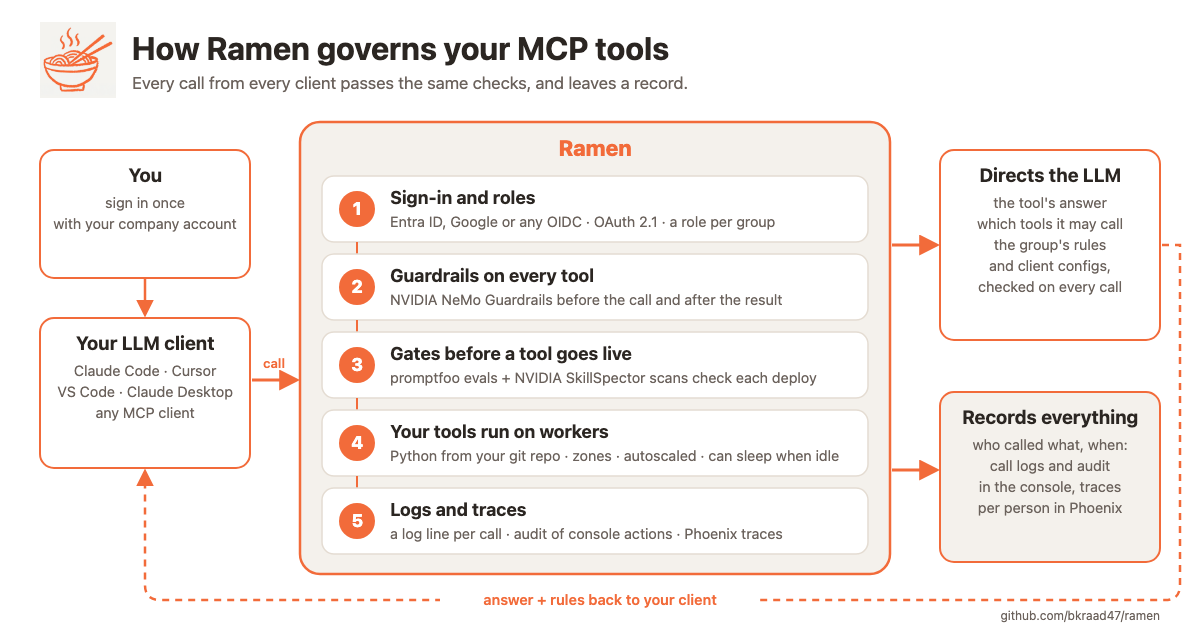
An MCP that enforces your organisation's security and structure — governance, built in. Ramen is a self-hosted, multizone MCP server for teams: the sanctioned place for your team's tools, instead of shadow MCP servers on laptops. Each team (a group) keeps a git repo of tools, resources, prompts, MCP Apps and skills in plain Python; Ramen deploys it as a fleet of MCP workers behind a cloud load balancer, canary first, gated by the repo's golden cases, a promptfoo eval suite and an NVIDIA SkillSpector scan. People sign in with a role per group (a Ramen password, Entra ID or Google Workspace), agents use a group key, and every call — whichever client sends it — must carry the group's current policy versions: telemetry, evals, scans, LLM configs and guardrails. Each worker pairs a Rust MCP node (transport, auth, gates, limits) with a Python 3.12 runtime (your code, in its own process); a FastAPI console runs everything else. It is a platform for your tools, not a gateway in front of someone else's.
Why teams pick it
- Sanctioned MCP, not shadow MCP. Your tools live in a git repo you review, run on your cluster, and answer only people who signed in with your identity provider (Entra ID, Google or any OIDC) and hold a role in the group.
- No eval, no deploy. Every deploy goes to a canary first and must pass the repo's golden cases; with the engines on, a promptfoo eval suite and an NVIDIA SkillSpector scan run against the canary too, and a group admin can make either one stop the deploy.
- Guardrails per tool, not per chat. NVIDIA NeMo Guardrails (static or LLM-judged rails) or your own
policy.pyrun inside the worker before the tool and after its result, whichever client called. Fail-closed. - Every tool call has a name. Calls run under a person's sign-in or a named group key; each one is a line in the
worker's access log (the person or the key id), every console action is in the audit log, and with telemetry on
each call is a trace in Arize Phoenix, one project per group,
ramen.useron every span. - It directs the LLM, too. The group's rules and client configs (
mcp/llm-config/) are versioned, accepted per person, written into Claude Code, Cursor, VS Code or Codex by the bridge, and checked on every call. - Scales for what you need now. One worker on a laptop; on a cloud, zones across regions behind one load balancer, autoscaled by Ramen on load and latency, and idle zones that can sleep at zero workers.
- Follows MCP's 2026 direction. Spec 2026-07-28 next to 2025-06-18 on one endpoint: stateless requests, tasks for long-running tools, multi round-trip requests for tools that ask before they act, MCP Apps and Skills over MCP.
Built-in governance and dev tools
| Tool | What it does in Ramen | Where it runs |
|---|---|---|
| NVIDIA NeMo Guardrails | rails per tool, before the call and after the result; LLM rails go through the console's judge proxy | inside every worker, locally too |
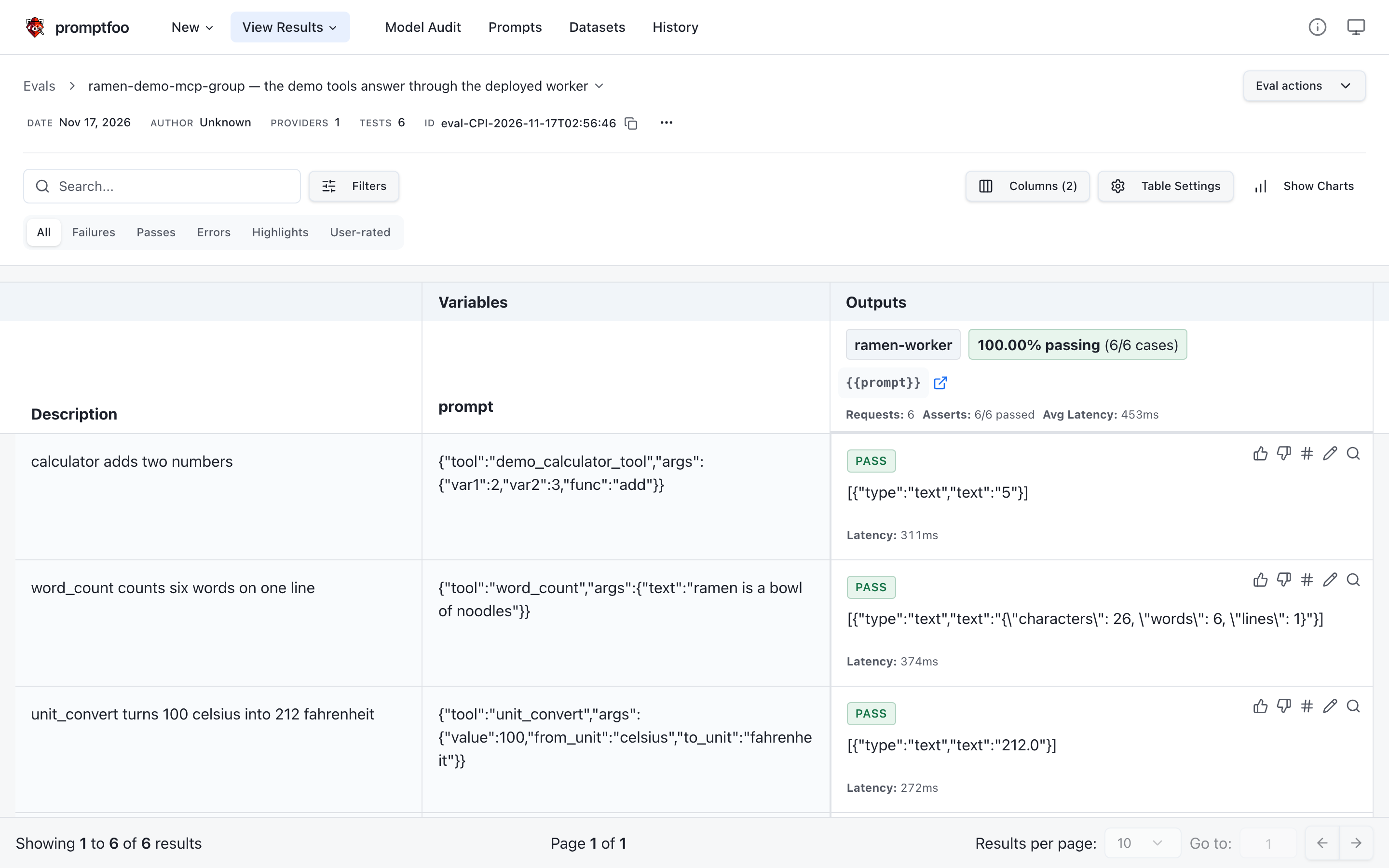
| promptfoo | the repo's mcp/evals/ suite against the canary on every deploy; report or gate per group | an evals Job in the cluster (evals_engine = "promptfoo"); not on compose |
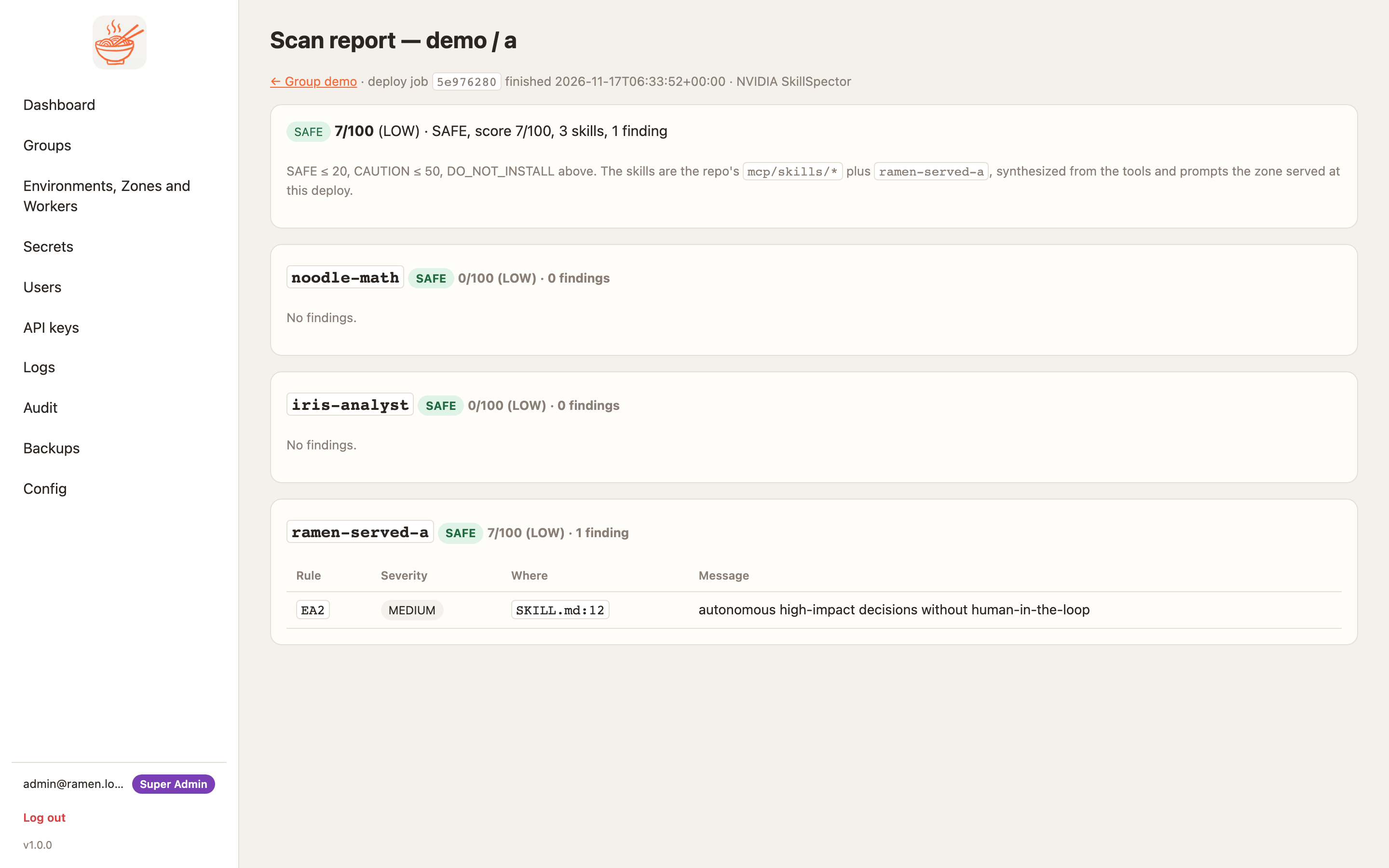
| NVIDIA SkillSpector | scans the repo's skills and what the zone serves on every deploy; a report page per zone | a scan Job in the cluster (skillspector_engine); not on compose |
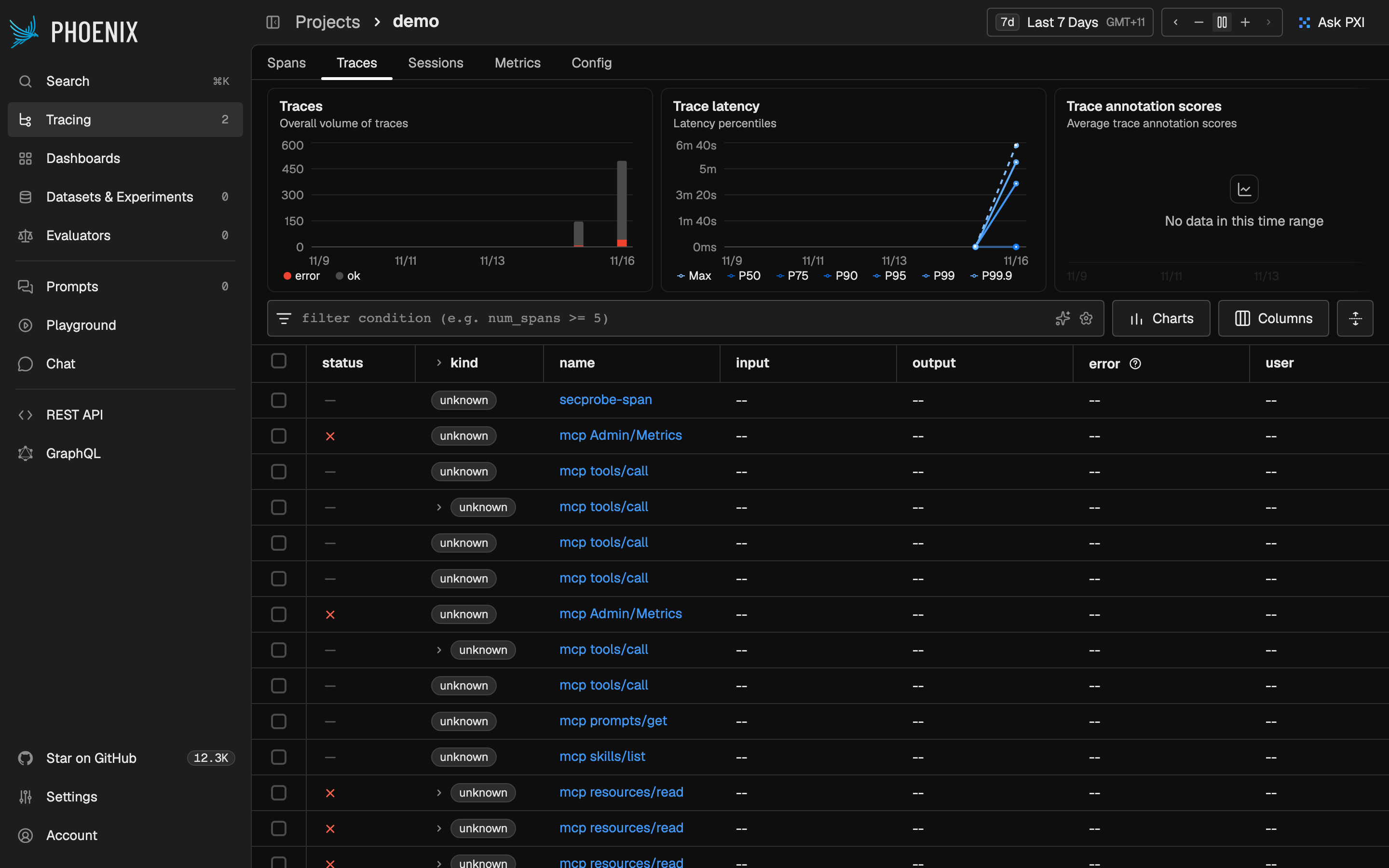
| Arize Phoenix | OpenTelemetry traces, one project per group, the person on every span | next to the console (otel_collector = "phoenix"), and on compose with ENGINES=phoenix |
Key features
- MCP 2026-07-28 next to 2025-06-18 on the same endpoint, per request: stateless requests, standard headers,
server/discover, subscriptions, progress, completion; the official conformance suite runs in CI against checked-in baselines (MCP features). - Tasks for long-running tools, and multi round-trip requests (elicitation, sampling, roots) for tools that ask before they act.
- MCP Apps —
mcp/apps/<name>/index.htmlserved asui://<group>/<name>, previewed in a sandbox on the group page — and Skills over MCP —mcp/skills/<name>/SKILL.mdserved byskills/listandskill://. - Streamable HTTP and gRPC on one port through one set of guards, and the stdio bridge for clients that only speak stdio.
- Guardrails in the worker before the call and after the result: NeMo rails, static or LLM-backed
(self-check, jailbreak, topical, hallucination, fact-checking), or your own
policy.py; fail-closed. - promptfoo evals from
mcp/evals/, run against the canary on every deploy; report or gate per group, runs shared in the optional promptfoo UI. - NVIDIA SkillSpector scans of the repo's skills and of what the zone serves, on every deploy, with a report page.
- Telemetry by group and user: OpenTelemetry from nodes and the console, one Arize Phoenix project per group,
ramen.useron every span; clients' own telemetry through the console's OTLP ingest. - LLM configs enforced at every sign-in:
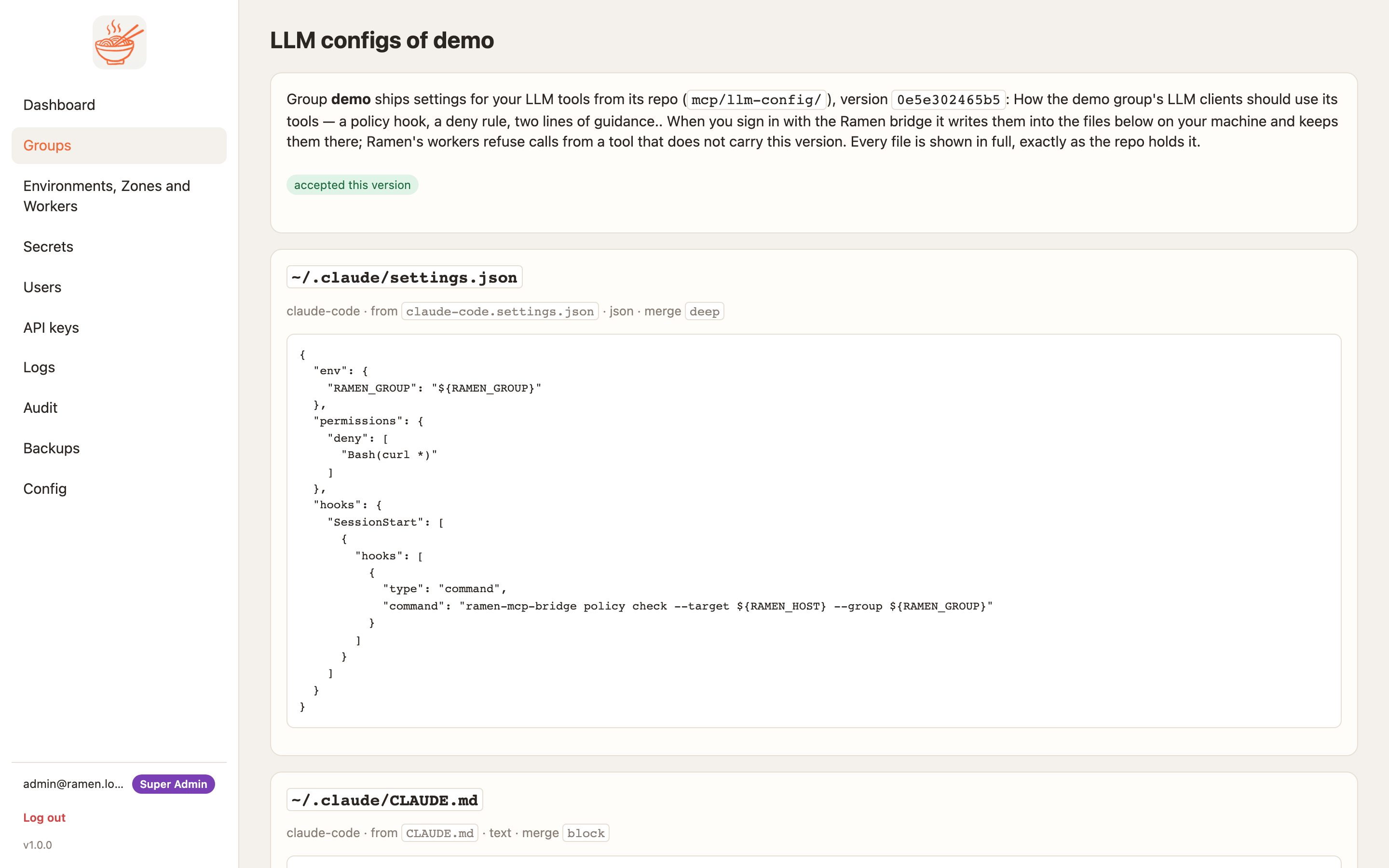
mcp/llm-config/fragments for any client, accepted per person and version on every sign-in path, written by the bridge, gated by the workers. - LLM judge proxy: rails, evals and scans call providers through the console (Anthropic, OpenAI, Azure OpenAI, Vertex AI, Bedrock, Azure AI Foundry, any OpenAI-compatible server), with per-group allowed models; provider keys never leave the console.
- Per-group image builds on deploy from
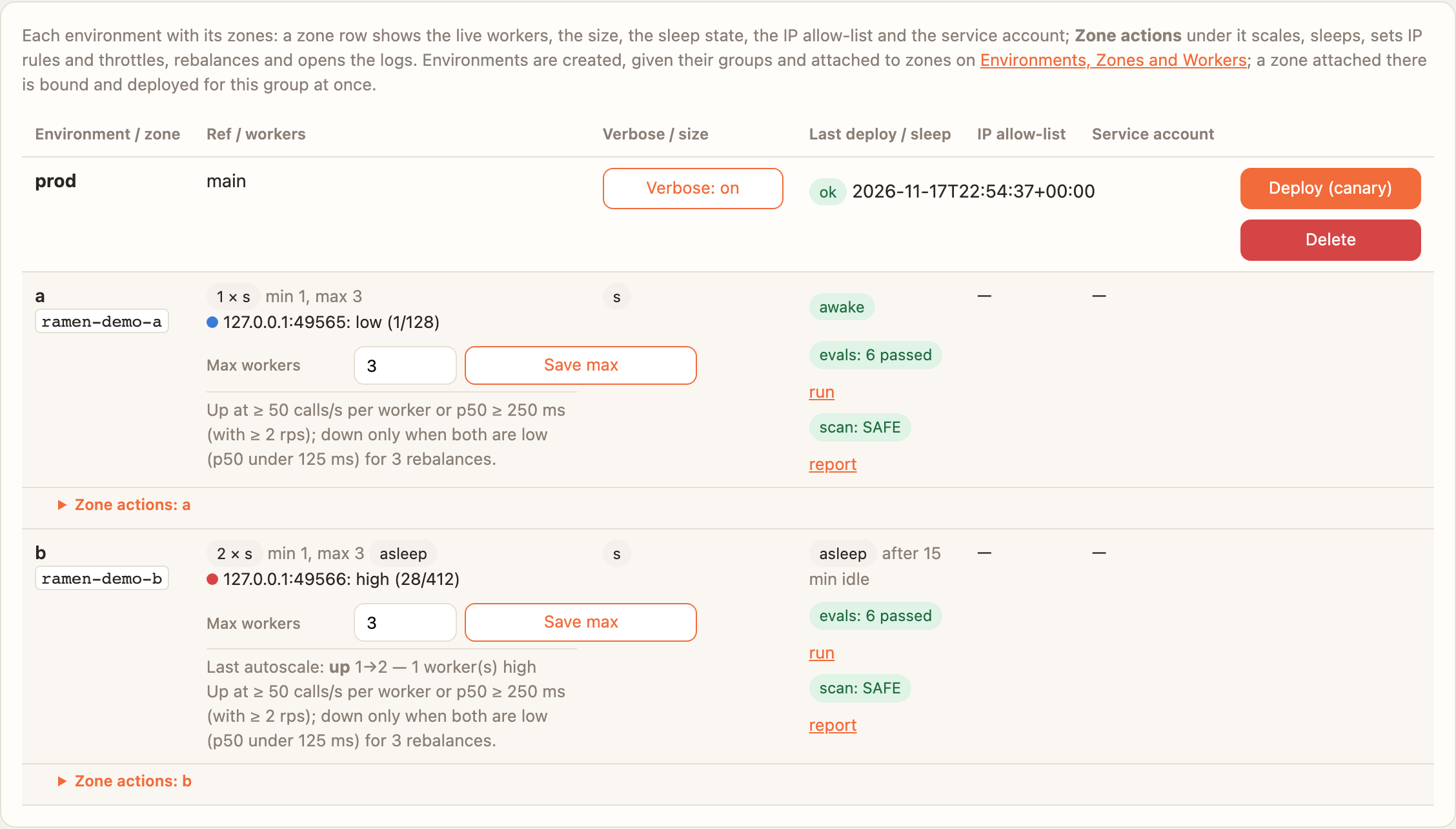
requirements.txt, each group pushing only to its own repository, images pinned by digest. - Throttling with Redis per address and per token, shared across zones; autoscaling by Ramen on load and latency (no HPA); sleeping workers that scale an idle zone to 0 and wake on the first call.
- Satellite clusters for zones in other regions, driven by the one console.
- TLS on every hop inside an install, with Ramen's own per-install CA (no cert-manager, no mesh); plaintext is refused on cloud installs, and the local stack runs TLS too.
- GCP, AWS and Azure from Terraform and Helm (CloudFormation too on AWS), each optional engine — Phoenix, promptfoo, SkillSpector — one switch.
Roles
| Role | Scope | May |
|---|---|---|
| Super admin | everything | users, groups, Config (identity providers, roles, org LLM providers, telemetry, regions, satellite clusters), API keys, backups, audit, worker sizes, plus all of the below |
| Group admin | one group | environments and zones wholly within their groups, deploys, worker counts, sleep, IP rules, throttles, secrets, MCP keys, tool access, the Evals / Scans / Guardrails cards, the group's own LLM providers, members below admin |
| Viewer | one group | read the group page, deploy jobs and logs, packages, apps and skills, scan reports, app previews; not secret values |
| MCP user | one group | sign in an MCP client and accept the group's LLM configs; nothing else in the console |
Custom role (e.g. analyst) | one group | what its base (Group admin, Viewer or MCP user) may, optionally OAuth-only, and its own kind in per-tool access |
Group key (rmk_) | one group's workers | call tools for agents and automation; refused by the console |
Every member may connect a client and call the tools that tool access lets their role (or a key) list and call,
per environment. devops API keys (rmn_) drive the console API with a role and groups no wider than their
creator's. Details: Roles.
Architecture
- Console (
console/, FastAPI + HTMX): the UI and/api/v1, the OAuth 2.1 authorization server, deploys, builds, evals and scans, the autoscaler, the OTLP ingest and the LLM judge proxy. State in Firestore, DynamoDB or Table Storage; secrets in the cloud's secret manager. - Node (
node-rs/, Rust): one port for Streamable HTTP and gRPC; bearer auth, IP rules, throttle, in-flight cap, tool access, the policy gates, the access log and spans. - Runtime (
runtime-py/, Python 3.12): a child process of the node that loads the group's repo from the bucket, rendersenv.yamlfrom its secrets, runs guardrails and the tool. - Environments → zones → workers. An environment is a name with a git ref, shared by the groups it lists; a zone
names its environments and runs, for each group that yields, a namespace
ramen-<group>-<zone>with its own cloud identity, route andworker+worker-canaryDeployments. The load balancer routes on theramen-groupandramen-zoneheaders, so one client config reaches any zone. - Home and satellite clusters. The home cluster runs the console, the optional engines and the Jobs; satellites are worker-only clusters in other regions, joined to the home network.
More: Architecture · IAM and network on GCP, AWS, Azure.
How enforcement works
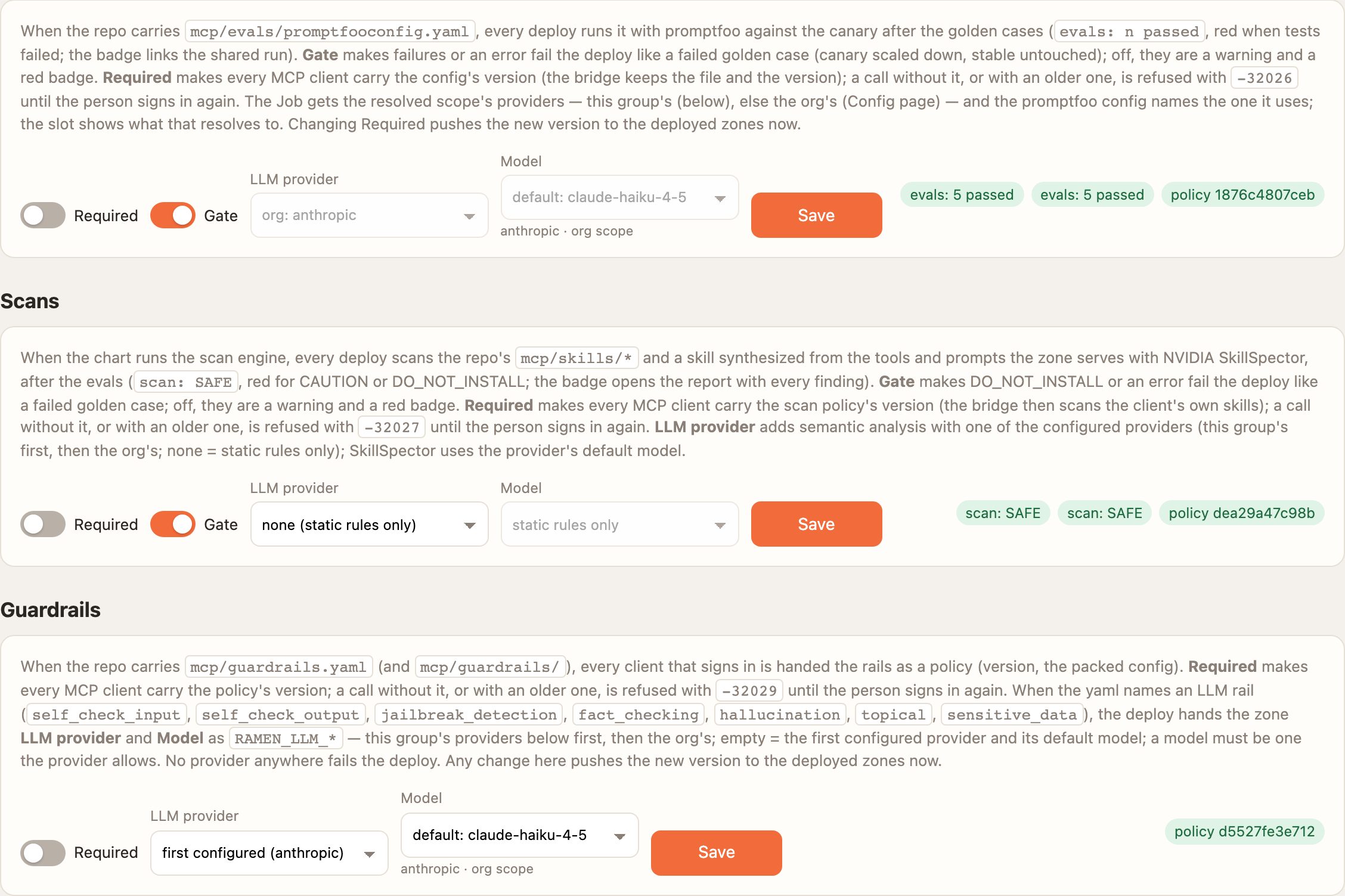
- Policy. A group's settings and repo produce up to five policies, each with a version: telemetry (Config page,
plus the group's consent switch), evals (
mcp/evals/), scans (SkillSpector), LLM configs (mcp/llm-config/) and guardrails (mcp/guardrails.yaml). Group admins make each Required on the group page; LLM configs are required whenever the repo has them. - Sign-in hands it out. Every sign-in path — OAuth (Claude Code, the bridge), password or magic link, a group key minted by an admin — answers the same policy bundle. LLM configs must be accepted per person and version (the configs page or the OAuth consent page) before a token or key is issued (Connect a client with OAuth).
- Workers check every call.
tools/call,prompts/getandresources/readwithout the current version are refused, on both transports and both protocol eras:-32024/-32025telemetry,-32026evals,-32027scans,-32028configs,-32029guardrails (HTTP 428 on 2026-07-28). A changed policy is pushed to the running workers without a deploy, so the next call needs the new version. - The bridge keeps clients in line (bridge 1.0.0, the bridge for Ramen 1.0.0). It holds the bundle, carries every version, writes the accepted client
configs and Ramen's OTel settings into Claude Code, Cursor, VS Code, Codex and any other target the repo names,
signs in again once on a stale version, runs
policy checkfrom a Claude CodeSessionStarthook (exit 3 when a file was removed), scans local skills with SkillSpector and, with itsnemoextra, runs the guardrails locally too.
Quick start (local)
New to Docker or MCP? Try the demo walks through the same in
fourteen small steps with a picture for each. Needs Docker with compose v2, uv, git and make.
git clone https://github.com/bkraad47/ramen && cd ramen
make up                               # Firestore emulator + console https://localhost:8443 + one worker on :8080
make up ENGINES=phoenix,promptfoo     # optional: the same plus Arize Phoenix (:6006) and promptfoo (:3000)
# before the demo: a key on Config → LLM providers (its rails ask a model), or RAMEN_DEMO_REF=v0.8.0 make demo
make demo                             # zone, group `demo` from the demo repo, a key, a canary deploy, a tools/call
#   PASS: demo_calculator_tool(2,3,add) -> 5
make down                             # stop everything, engines included, and remove volumes
Sign in at https://localhost:8443 as admin@ramen.local with the generated password
(grep RAMEN_ADMIN_PASSWORD deploy/local/.env). Nothing in the stack is a static secret. Compose has no Job
runner, so evals, scans, image builds and sleeping zones run on a cluster (kind or a cloud), not on compose.
Deploy to the cloud
Each is terraform apply → helm upgrade --install with the values Terraform prints → add a zone and a group → Deploy.
About 35 minutes on GCP, most of it waiting for the cluster and the managed certificate. The optional engines are three Terraform variables, all none by default, passed to the chart by
the engines_set output (Azure's helm_set includes it):
# deploy/terraform/<cloud>/terraform.tfvars
otel_collector      = "phoenix"        # none | jaeger | phoenix
evals_engine        = "promptfoo"      # none | promptfoo
skillspector_engine = "skillspector"   # none | skillspector
| Cloud | What Terraform and Helm build | Guide |
|---|---|---|
| GCP | GKE Autopilot, Firestore, GCS, Secret Manager, Artifact Registry, global HTTPS load balancer (GKE Gateway) with a Google-managed certificate, Cloud Armor | Deploy on GCP · IAM and network |
| AWS | EKS, DynamoDB, S3, Secrets Manager, ECR, ALB, WAF (Terraform or CloudFormation) | Deploy on AWS · IAM and network |
| Azure | AKS, Table and Blob Storage, Key Vault, ACR, Azure Managed Redis, Envoy Gateway with Let's Encrypt | Deploy on Azure · IAM and network |
| kind | a local cluster for the Kubernetes paths; engines via RAMEN_OTEL_COLLECTOR, RAMEN_EVALS_ENGINE, RAMEN_SKILLSPECTOR_ENGINE | deploy/kind/up.sh |
The edge is HTTPS on 443 only, on a free sslip.io hostname with a publicly trusted certificate (self-signed on
AWS). Then follow Deploy your first group.
Screenshots
| Group page: each zone with its last deploy's evals and scan badges | Evals, Scans and Guardrails policy cards |
|---|---|
 |  |
| SkillSpector scan report | LLM configs every member accepts |
|---|---|
 |  |
Arize Phoenix, project demo (live GKE run) | promptfoo, the demo's evals (live GKE run) |
|---|---|
 |  |
| A call refused by a NeMo rail, in the Logs page (local stack) | One call in Arize Phoenix with ramen.user (local stack) |
|---|---|
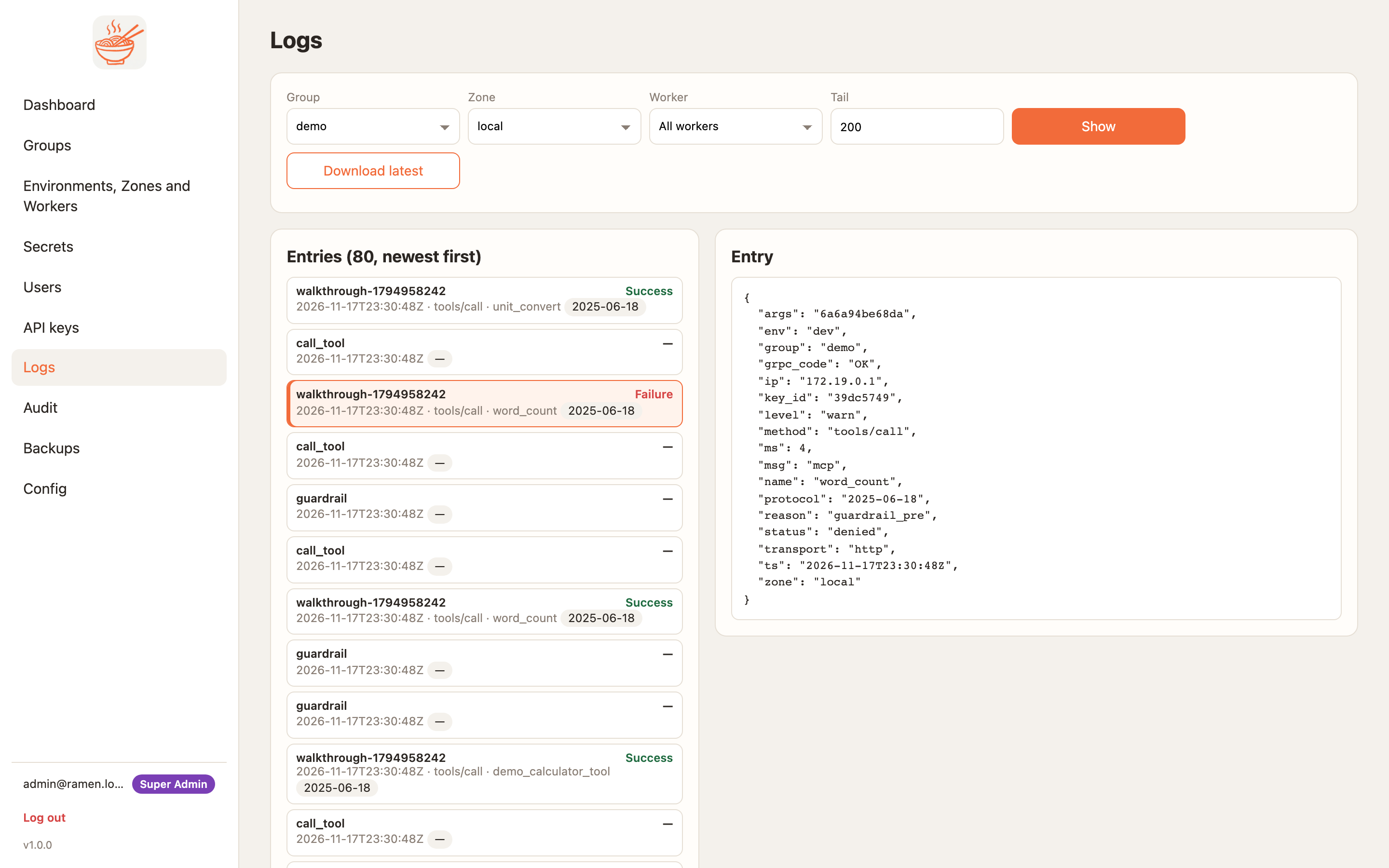 | 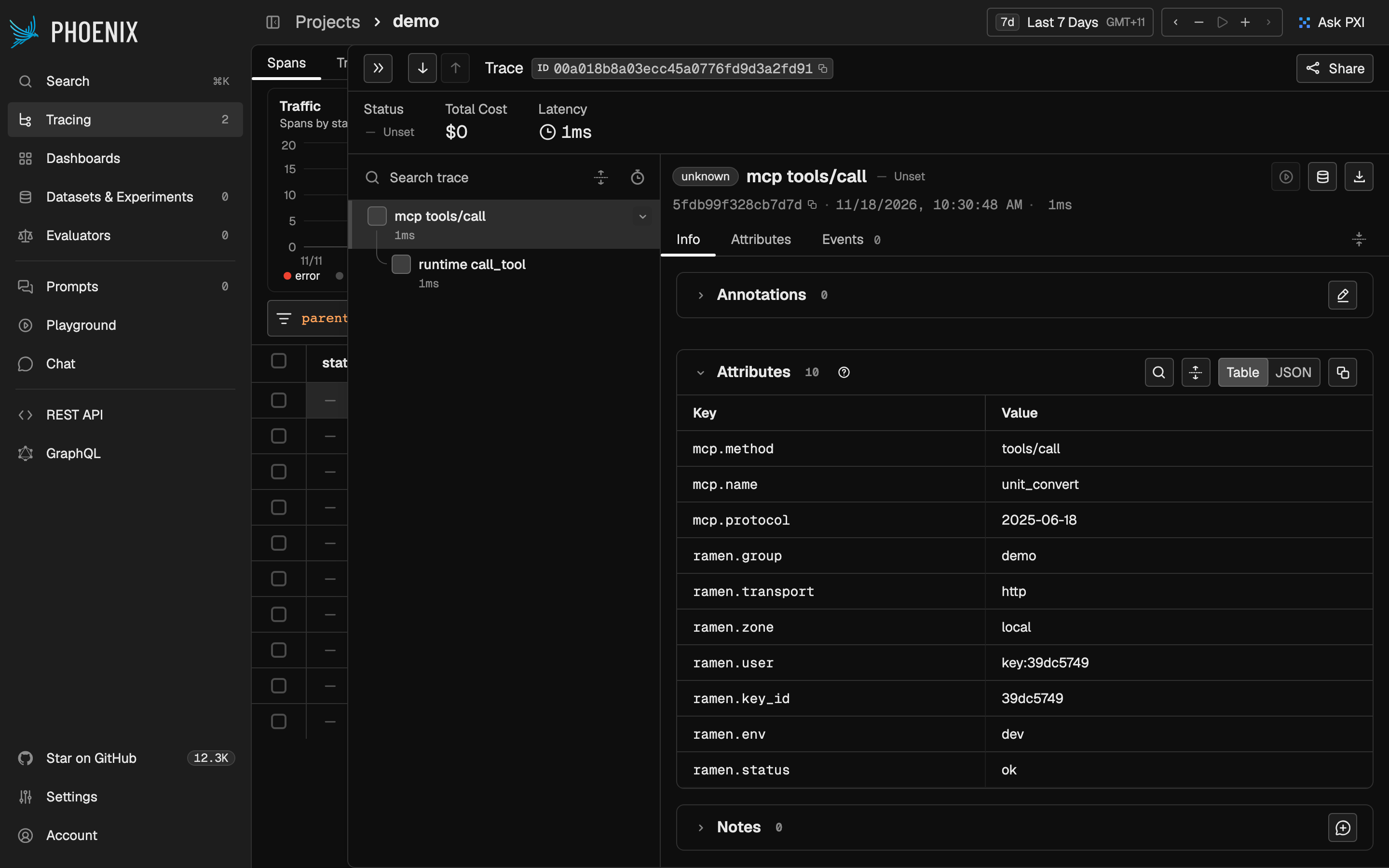 |
| An MCP App previewed in a sandbox | LLM providers, keys never shown |
|---|---|
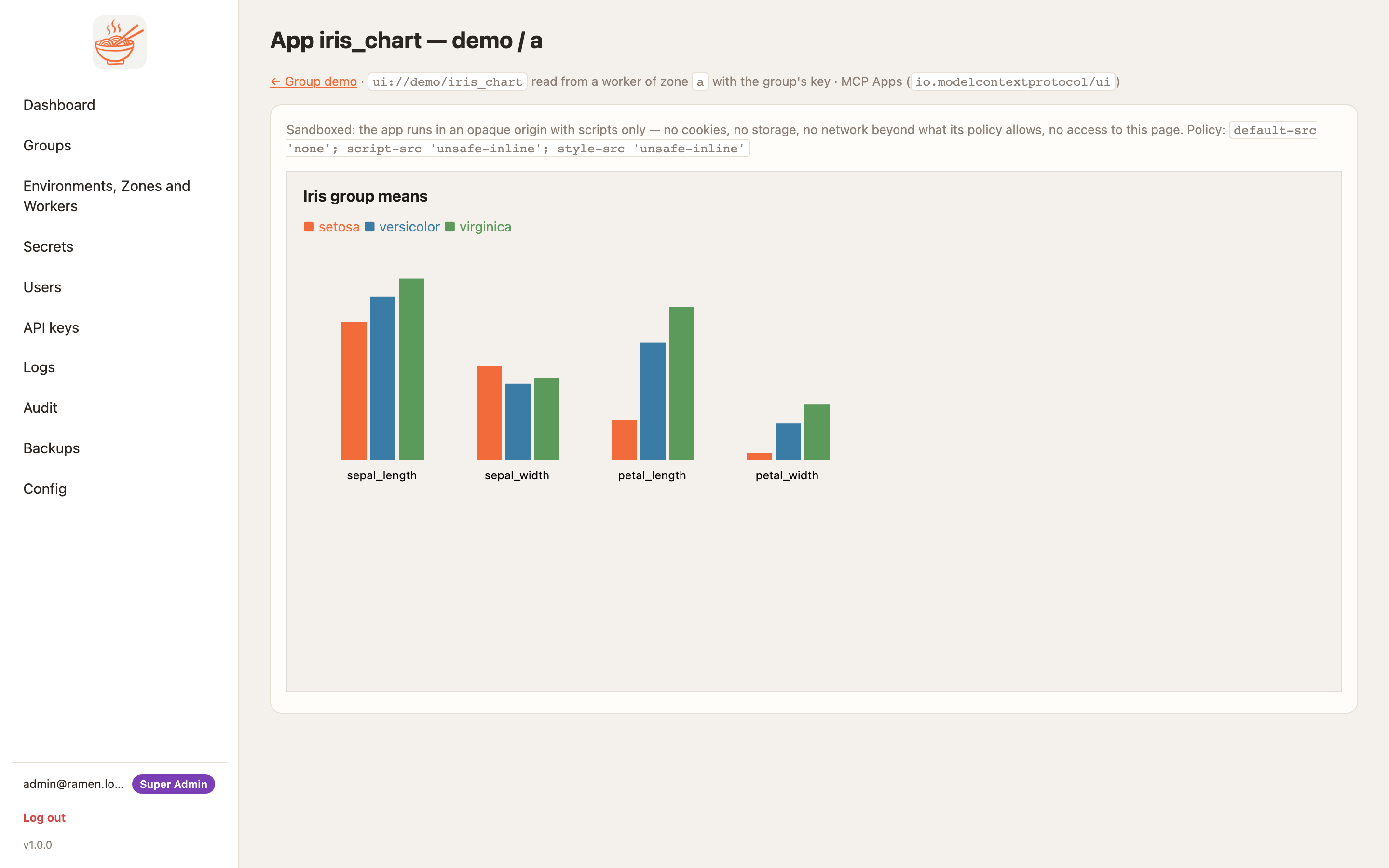 | 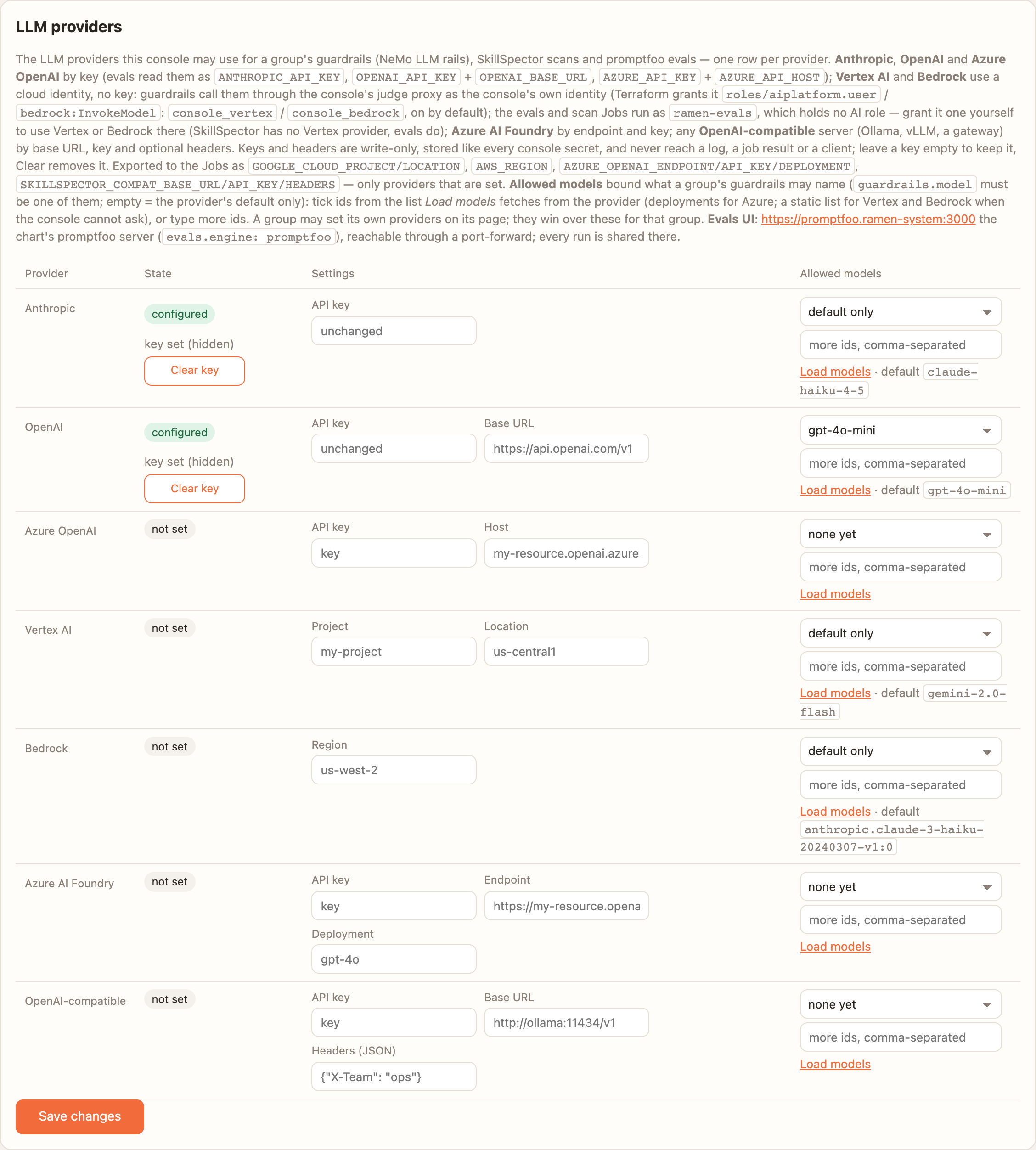 |
| Environments, Zones and Workers | A deploy job |
|---|---|
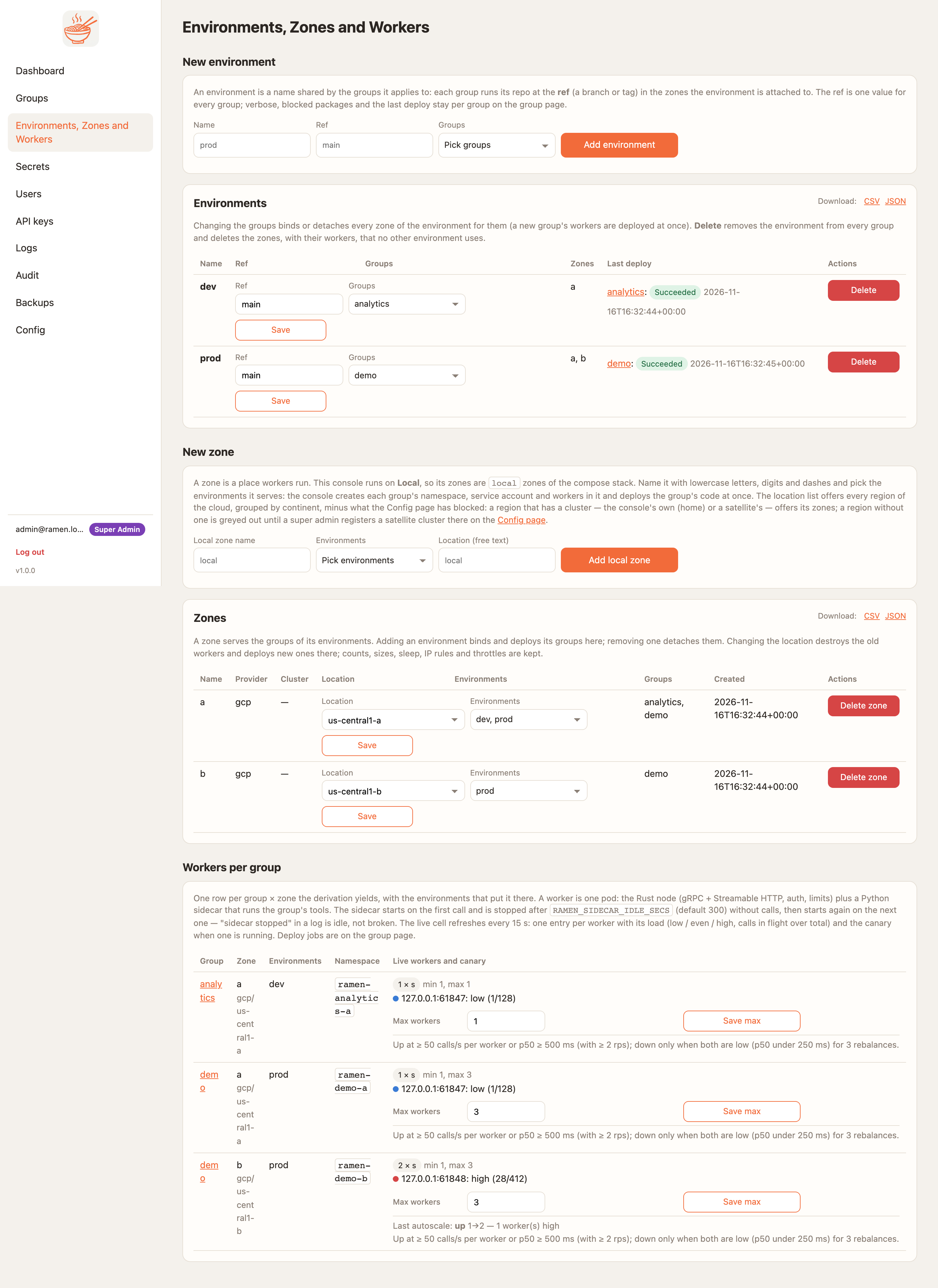 | 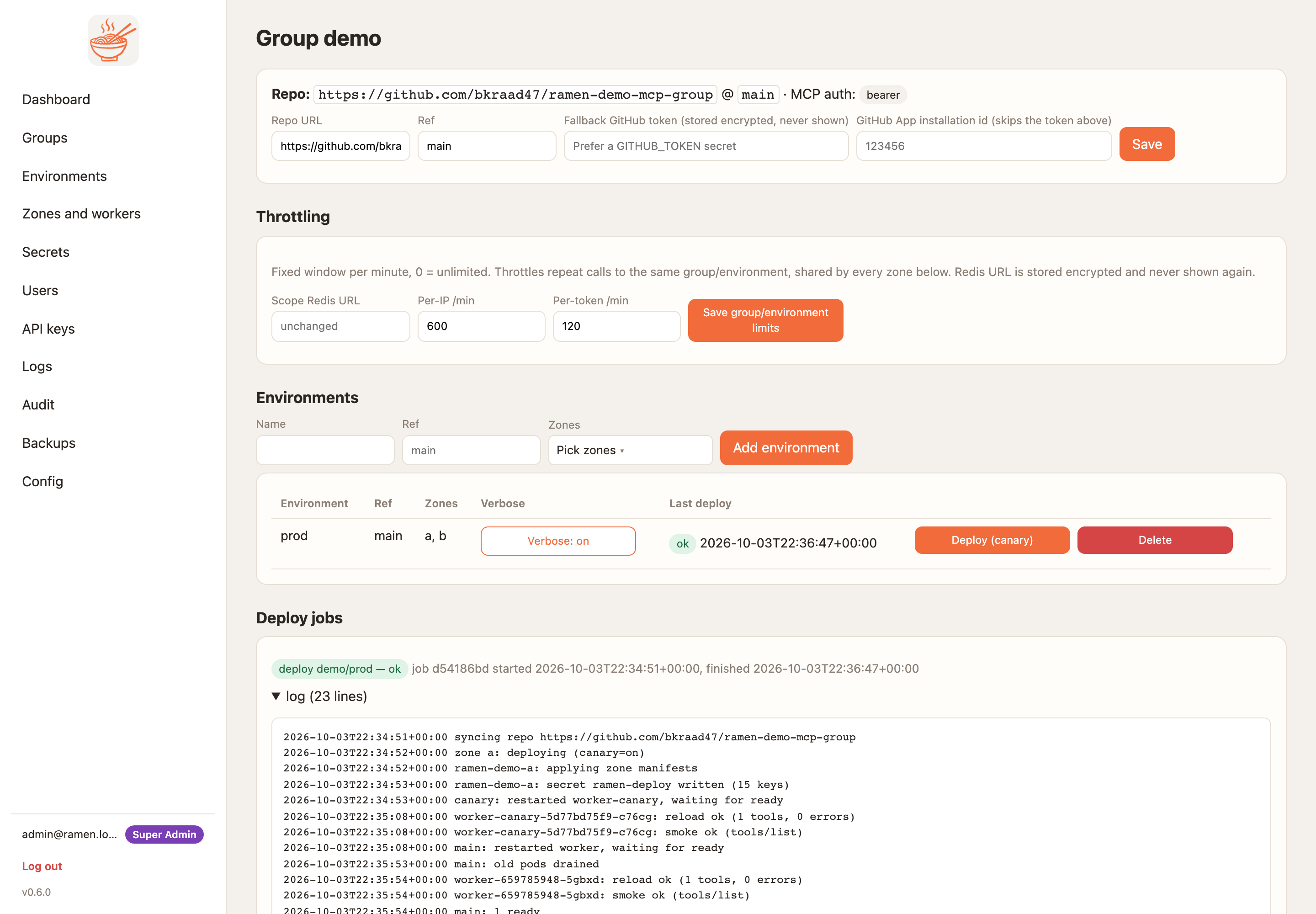 |
Console screenshots come from make shots (a throwaway local console with fictional data and canned evals and scan
Jobs); the Phoenix-project and promptfoo ones from the live GKE run; the guardrail and Phoenix-trace ones from the local
compose stack.
The honest limits
- An LLM that never calls Ramen's workers and never reads the files the bridge writes cannot be forced to report telemetry or keep the group's configs. Enforcement is the worker gate on every Ramen call plus the client files.
- A Required policy shuts out clients that do not carry versions. A plain HTTP client config (Claude Code with a
key header,
curl) is refused on gated calls until it sends the_metaversions; the bridge does it for you. A group whose repo hasmcp/llm-config/always requires its configs version. - LLM rails reduce prompt injection; they do not eliminate it. Use deterministic rails for what must hold.
- NetworkPolicies need an enforcing CNI. GKE Autopilot enforces them; since 1.0.0c Terraform turns on the VPC CNI's policy agent on EKS (enforcement seen live on 1.0.0b35) and Calico on AKS (not yet checked live) (threat model, S6b).
- The optional engines are for trying things out: Phoenix, Jaeger and promptfoo have no edge route and one
install-wide sign-in (Secret
ramen-engines) — whoever holds it sees every group's traces and evals runs. - A compromised console is a compromised platform; on Azure it could grant itself write on the platform image repository (pin platform images by digest; on GCP its repository rights are fenced by a resource tag, on AWS by repository name). Run one console replica.
- Load. One worker of the smallest size (250m CPU) served about 30–45 calls/s of a guarded trivial tool in the 1.0.0b34–b36 runs, and the p95 bound of 1.5 s missed on EKS's small nodes and on the 8→64-client ramp. The 1.0.0 per-call fixes (schema checks compiled once, NeMo's unused flows dropped, Colang expressions parsed once) take a worker at 250m from about 30 to about 70 calls/s locally (p95 2.1 → 0.8 s at 32 clients), and the autoscaler asks for another worker at a p50 of 250 ms instead of 500; the cloud tables are re-measured for 1.0.0 (Autoscaling → Load tests).
- Local compose runs no evals, scans, image builds or sleeping zones (no Job runner, one fixed worker); those need a cluster (kind or a cloud). Guardrails, LLM rails (with a key on Config → LLM providers), OAuth and Phoenix run locally.
Write your own group repo
Start from ramen-demo-mcp-group: mcp/tools/<name>/<name>.py +
<name>.json, resources/, prompts/, apps/, skills/, tests.yaml, guardrails.yaml, evals/, llm-config/,
env.yaml, requirements.txt. Every feature with the demo's code: MCP features ·
the file contract and local testing: The MCP repo.
Repository
| Dir | What |
|---|---|
console/ | FastAPI + Jinja2 + HTMX console and /api/v1 |
node-rs/ | Rust MCP node (ramen.v1.Mcp, ramen.v1.Admin, health; auth, gates, sidecar supervisor) |
runtime-py/ | Python 3.12 runtime (packages, apps, skills, MRTR, tasks, guardrails) |
proto/ | ramen/v1/mcp.proto, admin.proto |
deploy/ | compose, kind, Helm charts (console, worker, satellite), Terraform (GCP, AWS, Azure and satellites), CloudFormation, the SkillSpector image |
glama/, mcpb/ | the directory image and the MCPB bundle for Claude Desktop; both pin the bridge |
skills/ | Agent Skills for any coding agent: deploy on GCP, AWS and Azure, rotate keys, backup and restore, scale, test, iterate |
tests/ | conformance, e2e, kind, cloud and load suites |
docs/ | the site's sources; docs/CONTRACTS.md is binding for every component |
Changes: CHANGELOG.md · Versions: tracker · Which versions go together: Releases
Develop
make up BUILD=1      # the compose stack from source instead of the published images
make test            # runtime-py and console (pytest, 90% coverage gate) plus node-rs (fmt, clippy, test)
make test-harness    # tests/: conformance + e2e (skips without a running stack)
make shots           # regenerate the console screenshots in docs/img
uv run --project docs --group docs mkdocs serve   # docs at http://127.0.0.1:8000
Community: fork it, shape it
Ramen is BSD-3-Clause and built to be forked: copy the demo group repo for your own tools, or fork Ramen itself and change the console, the node or the runtime for your organisation. Collaboration is welcome — ideas, issues, pull requests, write-ups of how you run it.
- GitHub Discussions: Q&A, Ideas, and Show and tell for what you built.
- Issues for bugs; open one before anything larger than a fix.
- Security reports go to the maintainer privately (SECURITY.md).
Contributing
See CONTRIBUTING.md — use it, fork it, change it, with attribution; renaming it as a new commercial product of your own is not acceptable.
License
BSD-3-Clause © 2026 Raad. See LICENSE.