cie
▎ A code graph that extends to any language via pluggable adapters, with task/QA traceability and real MCP tools — zero-config to try. ▎
Documentation
cie — the only code graph that knows which tasks and tests actually implement your code.
Code Insight Engine. No other surveyed code-graph tool can answer "which files implement this task, and are they tested?" as one query — they're all pure retrieval. cie can, because task/QA traceability lives in the same graph as the code. It also extends to languages with no LSP and no tree-sitter grammar (proven on Nirdosha, a from-scratch language, via nothing but the compiler's own AST dump).
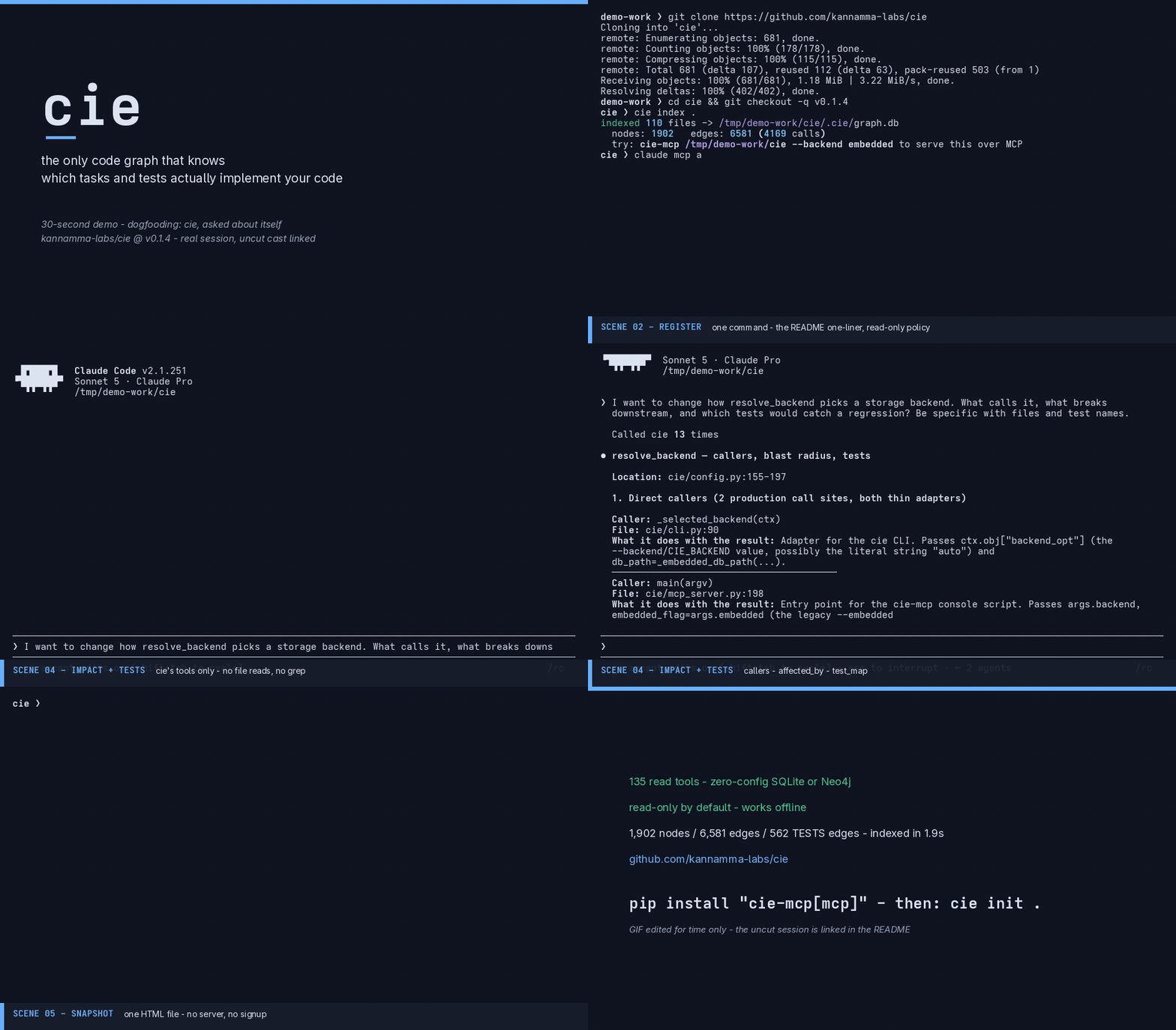
Every line above is a real command against a real clone of
psf/requests (52k+ stars, not this
project's own code) — cie index ., then a real MCP stdio client
calling callers("close") on a running cie-mcp --embedded server.
Reproduce it yourself: scripts/record_demo.sh.
Full methodology, including where this exact query under-resolves (3 of
6 real call sites, a real gap not hidden here) is in
docs/benchmarks-requests.md.
One real number, measured against a real 36-file codebase (full
methodology in docs/benchmarks.md, including a
case where it didn't help): resolving every real caller of an ambiguous
function name took 1 cie tool call (callers(), correct-by-
construction on every result it returns) vs. 3 for grep-only (1 grep
- 2 reads to disambiguate, still not guaranteed correct). Not every task
favors a graph — the same doc reports a tie and a real loss, honestly,
not just the wins — and re-run on a second, independent public repo
(
psf/requests, not this project's own code) indocs/benchmarks-requests.md, the pattern holds on a real win (a 1,184-line file skeletonizes to 43% of its raw size) and surfaces a real miss too (the same ambiguous-caller query resolved only 3 of 6 real call sites on that repo) — published because it's true, not adjusted to look better.
A second hook, also measured, not asserted: cie ships ~121
LLM-callable tools — not a generic "run arbitrary code" surface the
model has to improvise a workaround from, but specific ones (callers,
file_skeleton, traceability_orphans...) that let it express intent
directly. The obvious worry is that more tools means more chances to
pick the wrong one — tested it
instead of assuming: a fresh agent, given cie's real tool list plus 14
tasks hand-picked to be confusable (cie has 5 different
"coverage"-named tools alone), picked the exactly correct tool 14/14
against the full 81-tool surface — the same 14/14 it got against a
14-tool subset. One run, real caveats in the linked doc — but the
"more tools, more room to mess up" worry didn't hold up when actually
checked.
Try it in two commands, no server, no signup — index a project into a local SQLite file and serve it to Claude Code, Cursor, or any MCP client, task/QA traceability included. Point it at Neo4j instead for a real team/multi-project setup (see Quickstart below for what's in each mode).
See docs/competitive-landscape.md for
the full comparison against CodeGraph, CodeGraphContext, Serena, and
others, including where cie is honestly behind.
Quickstart (zero-config, no Neo4j)
pip install "cie[mcp]"
cie index /path/to/your/project
cie-mcp /path/to/your/project --embedded
That's an MCP server over stdio — add it to Claude Code / Cursor / Codex /
any MCP client the way you'd add any other local MCP server, and it can
call search_symbol, callers, callees, file_skeleton,
path_between, and everything else in cie.tools.ToolService against
your project's real call graph, indexed locally in .cie/graph.db.
--policy inspector (read-only) is available if you want the connecting
client to only ever see read tools — see
cie/tool_policy.py. Task/QA tracking works here
too, backed by a second local SQLite file (.cie/tasks.db, via
cie.embedded_task_repository.EmbeddedTaskRepository) — pass
--no-task-tracking to cie-mcp if you'd rather skip creating it.
See "What it is — three layers" below for the full breakdown (structural extraction, ~121 tools, the task/QA layer).
Install
pip install cie # core: graph, tools, task/hierarchy layer over Neo4j
pip install "cie[mcp]" # + the MCP server (cie-mcp) — what most people want
pip install "cie[http]" # + the HTTP tool-mount / mock server (cie/routes.py)
Core dependencies (pyproject.toml): Neo4j driver, Pydantic v2,
tree-sitter (+ Python/JS/TS/Java/Go/Rust grammars), watchdog, Click, Rich.
Requires Python ≥ 3.10. Only routes.py / mock_server.py pull in
FastAPI/uvicorn (the [http] extra); only mcp_server.py pulls in the
MCP SDK (the [mcp] extra). The query engine, extraction, task/hierarchy
repos, and ToolService itself have no HTTP dependency at all.
What it is — three layers
- A generic code graph. Structural extraction (symbols, call graph,
imports, inheritance, test links) via pluggable
LanguageAdapters — ships with tree-sitter support for Python / JavaScript / TypeScript / Java / Go / Rust out of the box (Go/Rust: function+method extraction, signatures, and receiver/impl-method call resolution; import-edge extraction and docstrings are a documented gap for these two — seecie/extract.py's module docstring); add your own adapter for any other language (wrapping a compiler's own AST dump, an LSP server, or a tree-sitter grammar) viacie.lang_adapter.register_adapteror thecie.language_adaptersentry-point group, no code change to this package required. - ~121 LLM-callable tools (
cie.tools.ToolService, exposed 1:1 as MCP tools andPOST /tools/{tool}endpoints) — symbol search, call-graph traversal, clone/community/drift detection, quality reports, test-intelligence, traceability, confidence scoring, decomposition, APM, and a jailed virtual filesystem (view_file/write_file/edit_file/delete_file/write_files_atomic), all self-describing (ToolService.describe()), exposable as typed JSON-Schema tool definitions (cie.tool_schema) with per-agent-type authorization (cie.tool_policy), and servable over the real Model Context Protocol (cie.mcp_server,cie-mcp). - A task / PRD-hierarchy layer (
cie.task_repository,cie.hierarchy) for tracking atomic dev/QA tasks and (optionally) a project's PRD decomposition tree. Task/QA CRUD and traceability (cie.task_repository.TaskRepository— push/list/status, dependency traversal, coverage/cycle/API-contract validation) works zero-config too, viacie.embedded_task_repository.EmbeddedTaskRepository(SQLite,.cie/tasks.db; passtask_tracking=Falsetobuild_tool_service_embedded, or--no-task-trackingtocie-mcp, forcie.embedded_repository.NullTaskRepository's fail-fast behavior instead). The separate PRD-decomposition tree (cie.hierarchy,prd_coverage/prd_orphans/prd_traceability_chain) is still Neo4j only — those three tools callcie.factory.get_hierarchy_repodirectly regardless of which backend built theToolService.
Capabilities (grounded in the code)
The cie/ package is ~28k lines across ~60 modules. The capability
surface maps cleanly onto the spec sections the code itself documents in
its module docstrings. Nothing below is aspirational — each bullet is a
real module and (where noted) a real tool on ToolService / the CLI /
the HTTP routes.
Two-pass code-graph extraction & loading (extract.py, callgraph.py, testlink.py)
- Pass 1 (
extract.py): tree-sitter parse of every supported file into file/class/function/methodNodes withsignature,line_start/line_end,docstring, plus the raw inputs for pass 2 —importsandcall_sites. Pure: no DB/FS side effects. - Pass 2 (
callgraph.py): resolves call sites into confidence-taggedcallsedges — EXTRACTED (same-file def or import-map resolved), INFERRED (receiver-type heuristic), or AMBIGUOUS (exactly one same-named symbol project-wide). Also resolvesinheritance/extendsedges and synthesizesexternal::stub nodes for unresolved base classes. testlink.py: a third pass that emitsTESTSedges from test symbols to the implementation symbols they test, via three heuristics — naming convention (test_foo→foo), confidence upgrade when a naming match is backed by a realcallsedge, and@patch(...)/@mock.patch(...)decorator resolution.- Loaders:
cie load <dirs> --project <name>(Neo4j, full replace of one project's nodes) andcie index <path>(embedded SQLite, zero-config).reindex/reindex_filefor incremental single-file refresh after a patch;watchfor file-system-driven auto-reindex (watchdog).
Core data model (models.py, repository.py, neo4j_repository.py, in_memory_repository.py, embedded_repository.py)
NodeKindcovers the structural kinds (FILE/CLASS/FUNC/METHOD/SYMBOL) and every analysis-result kind — CloneCluster, AntiPattern, DriftFinding, MetricSnapshot, CommunitySummary, Type, Package, Document, Contract, TestSkeleton, StateMachine, State, Transition, AgentVerdict, ConfidenceReport, JustificationTrace, InvariantViolation, SemanticDiffFinding, RuntimeErrorTrace, Page, ImpliedPage, InteractiveElement, DerivedTaskHint, TestExecution, MockEndpoint, MockCall, ContractViolation, ApmMetric, PerformanceBaseline, PerformanceRegression, CoverageGap. Analysis nodes are never produced byextract.py— only by on-demand passes, written viareplace_analysis_nodes.Edgeconfidence: EXTRACTED / INFERRED / AMBIGUOUS, stamped with IN-08 provenance (extracted_at,extractor_version,source_ref).- Three
Repositorybackends behind one Protocol:Neo4jRepository(Cypher, per-project namespacing, vector index, query/write/schema timeouts),InMemoryRepository(the reference test double both backends are verified against), andEmbeddedRepository(SQLite, two tables, full graph re-persisted per call — simple, single-project, local-first). QueryEngine(query.py): thin, backend-agnostic orchestration — search, traversal, neighbors, community, god nodes, stats, shortest path, signatures, methods-of-class, file listing, feature discovery, semantic search (requires embeddings written at load time).
Storage backends & config (config.py, factory.py)
Neo4jConfig.from_env()— readsNEO4J_*(or legacyCIE_NEO4J_*override) plus per-operation timeouts (CIE_NEO4J_QUERY_TIMEOUT_S,..._WRITE_TIMEOUT_S,..._SCHEMA_TIMEOUT_S). Driver-level bounds alone don't stop a lock-wait hang;cie.timeoutsenforces independent wall-clock budgets around each query round trip.CieConfig— one explicit bootstrap object for an external caller (project root, project name, Neo4j config, allowed root, file-size ceiling, language adapters). No "disable the jail" toggle — the file tools jail unconditionally (cie.tools.view._jail).factory.pybuildsToolServicethree ways:build_tool_service(Neo4j, per-project cached engines/task-repos sharing one driver),build_tool_service_from_config(one-call, no env vars), andbuild_tool_service_embedded(SQLite graph +EmbeddedTaskRepositoryby default,NullTaskRepositoryopt-in viatask_tracking=False).
Tool surface — ToolService (cie/tools/__init__.py, ~121 methods)
Every method returns the standard SPEC §0 envelope (ok/tool/results/
truncated/total/hint/elapsed_ms, cie.envelope); errors carry a
mandatory hint. Grouped by capability (all also exposed over MCP and
POST /tools/{tool}):
Core graph navigation — search_symbol, resolve_import,
semantic_search, callers, callees, file_skeleton, path_between,
failing_context, affected_by, class_hierarchy, test_map,
actual_callers, dead_code_confirm, hybrid_search (lexical + dense
vector + graph-centrality, with per-component scores), entity_context,
view_file (windowed, line-numbered, joined with the symbol index).
GraphRAG Q&A — qa (cie.graphrag): a real pipeline —
query_plan.classify picks a retrieval strategy, hybrid_search
retrieves, rerank reorders by an LLM relevance judgment,
entity_context expands the neighborhood, and a final LLM call answers
with citations assembled separately from the graph (the LLM never
emits citations itself).
Section 13 — Code Intelligence (on-demand analysis passes written as analysis nodes):
- Clone detection (
clone_detect.py, CI-01..05): three fused signals — token-Jaccard (copy-paste), AST-shape Jaccard (renamed clones), embedding cosine (semantic clones) →CloneClusternodes. Tools:clone_detect_run,clone_clusters,clone_find. - Performance analysis (
perf_analyze.py, CI-06..08): Big-O estimation (loop nesting + recursion) written onto FUNC/METHOD nodes, plus anti-pattern detection (N+1 queries, nested loops, sync I/O in a loop, unbounded growth). Tools:performance_analyze_run,performance_profile,antipattern_scan. - Drift detection (
drift_detect.py, CI-10..12): requirement gaps (task file_path vs indexed FILE nodes), API contract drift (reusesapi_routesextraction), architectural drift. Tools:drift_detect_run,drift_report,architecture_check. - Metrics (
metrics.py, CI-19..21): rolls clone/drift/tech-debt into append-onlyMetricSnapshots (trend answerable from history). Tools:metrics,tech_debt_report,metric_trend. - Communities (
community_detect.py, RQ-04/AI-03): label-propagation detection (the real write-path behindNode.community— previously read-only with nothing populating it) + LLM-thematicCommunitySummarynodes carrying embeddings. Tools:community_detect_run,community_summarize_run,community_search. - Quality governance:
accuracy_check,freshness_report,comprehensiveness_report,salience_report.
Section 0 — Population & Real-Time Sync (sync.py): a two-graph model
(speculative vs canonical), a 4-stage GateRunner quality gate, tiered
confidence, symbol-level AST delta + move detection, soft-delete-on-
revert, idempotent commit-linked batch population, sync-event
classification. Tools: sync_quality_gate, sync_promote, sync_revert,
sync_ast_delta, sync_evict_speculative, sync_load_commit,
configure_layer_rules, get_layer_rules, install_git_hook.
Section 1 — Core Data Model extensions (data_model.py): export_rdf,
related_edges, validate_property_constraints, type-flow resolution
(type_flow_run/type_flow), dependency-graph (dependency_graph_run/
dependency_graph), documentation graph from markdown (doc_graph_run/
doc_search).
Section 14 — Confidence Framework (spec-vs-code assurance):
- Contracts (
contracts.py, CF-01..03):python_assert-form contracts, best-effort binding by name to PRD scope, parameter-name domain-type validation,inject_assertions/strip_assertions. Tools:contracts_run,contracts,validate_types,inject_assertions,strip_assertions. - Test synthesis (
test_synthesis.py, CF-04/05): template-generated skeletons across six test types, bound to code via the sameTESTSedges DM-14 uses. Tools:test_skeletons_run,test_skeletons,test_coverage. - State machines (
state_machine.py, CF-06/07): FSM extraction, dead/unreachable-state detection (real graph algorithms), structural code-vs-FSM check. Tools:state_machine_run,state_machine,fsm_validate. - Traceability (
traceability.py, CF-08/09): graph-traversal coverage/orphans/chain on the code side and the PRD-hierarchy side. Tools:traceability_coverage,traceability_orphans,traceability_chain,prd_traceability_coverage,prd_traceability_orphans,prd_traceability_chain. - Semantic diff (
semantic_diff.py, CF-10/11): pattern-matching spec-vs-code check (deliberately conservative, high false-negative by design). Tool:semantic_diff. - Multi-agent consensus (
consensus.py, CF-12/14): verdict storage + query (a durable exactly-once bus is explicitly not built here). Tools:record_verdict,agent_verdicts. - Confidence scoring (
confidence.py, CF-15/16): pure composition over contract/test/consensus signals; generation/runtime layers reported asNone. Tools:confidence_report,justification(CF-17/18). - Invariants & telemetry backflow (
invariants.py, CF-19..21): safe contract-expression evaluation against a state snapshot + violation recording; graph traversal from a code node back to its contracts/tests. Tools:check_invariant,invariant_violations,telemetry_to_spec.
Section 15 — Decomposition Engine (decompose.py): reuses the
existing HTML walker + interactive-element detector to decompose pages
into Page/ImpliedPage/InteractiveElement/DerivedTaskHint nodes.
Tools: decompose_page, page_tree, promote_hint_to_task,
element_coverage, implied_pages_run, implied_pages.
Section 16 — Test Execution & APM (test_orchestration.py,
mocking.py, mock_server.py, apm.py): test-plan generation over
interactive elements / contracts / transitions / API endpoints / PRD error
scenarios, test execution, coverage-gap reporting, nook-and-corner
testing, unified coverage reports; third-party mock orchestration with a
real runnable FastAPI mock server (explicit base-URL override, not
network interception); APM metric ingestion incl. automatic pytest
--junitxml timing collection, baselines, regression detection. Tools:
test_plan, run_tests, record_test_result, test_results,
coverage_gaps, nook_and_corner_test, unified_coverage_report,
mock_registry_run, mock_registry, mock_coverage, start_mock_server,
stop_mock_server, mock_violations, record_apm_metric, apm_metrics,
performance_baseline, performance_regressions.
Section 17 — System Intelligence (subsystems.py): a static registry
of every subsystem actually built in this codebase, with
(repo, project) -> int population queries (callable, not raw Cypher, so
the same test passes against both Neo4j and the in-memory double). Tools:
subsystem_health, subsystem_gaps, subsystem_dependency_graph,
subsystem_dependency_graph_run, population_path.
Runtime telemetry ingestion (telemetry.py, CI-15..17): real
OpenTelemetry span ingestion over OTLP/HTTP with JSON encoding
(received at POST /telemetry/otlp), distinct from test-time APM. Raw
protobuf decoding is deliberately not attempted.
Virtual filesystem & sandbox (cie/tools/view.py, edit.py,
runner.py, blame.py): jailed view_file (line-numbered, with a
graph-joined symbol index, configurable size ceiling), write_file,
write_files_atomic, edit_file, delete_file, run (subprocess +
cwd jail + hard timeout — CIE_RUN_ROOT widens the jail), blame_history
(git history joined with task-graph artifacts). Every write keeps the
in-process heuristic symbol index incrementally fresh and re-resolves
callers of unchanged files.
Heuristic fallback (cie/tools/index.py, heuristic.py): when a
graph call fails or returns empty, ToolService lazily builds an
in-memory SymbolIndex by walking+parsing the project tree, so
search_symbol/file_skeleton/view_file keep working against an
unindexed or partially-indexed tree — same result-shaping code path as
the graph-backed path.
Task & PRD-hierarchy layer (tasks.py, task_repository.py, embedded_task_repository.py, hierarchy.py)
AtomicTask/AtomicTaskBatch(pydantic, schema-versioned at ingest), with status/attempts write-back, artifacts, repair events, dependency cycles validation, coverage validation, API-contract validation.Neo4jTaskRepository(real write-behind entity cache,cie.graph_cache) orEmbeddedTaskRepository(SQLite, zero-config — sameTaskRepositoryprotocol, sameplan_pushvalidation code, no Neo4j) —NullTaskRepositoryremains available as an explicit opt-out.hierarchy.py: stores/traverses a PRD tree (Module → Feature → Workflow → UseCase → UserStory →REALIZED_BYAtomicTask), APOC-free Cypher — Neo4j only, not yet ported to the embedded backend (its three tools —prd_coverage/prd_orphans/prd_traceability_chain— callcie.factory.get_hierarchy_repodirectly). CLI:hierarchy:push,hierarchy:children,hierarchy:lineage.
Three front-ends, one envelope
- MCP (
cie.mcp_server/cie-mcp): real Model Context Protocol over stdio (orsse/streamable-http), built with the officialmcpSDK. Each tool's JSON Schema comes from SDK introspection of the bound method — one source of truth. Denied-by-policy tools are never registered, not merely refused. Policies:forge/orchestrator(read+write),miner/inspector(read-only). - HTTP (
cie.routes.py):routermounted into the host FastAPI app (not a separate process).POST /tools/{tool}(kwargs in body),GET /tools,GET /health,GET /schema-version, plus dedicatedPOST /tasks,GET /tasks/{name},GET /tasks/pending,POST /hierarchy,POST /telemetry/otlp, etc. - CLI (
cie.cli, 49 commands): human Rich tables by default; every command honors--json(group-level, before the subcommand) emitting the same SPEC §0 envelope as the HTTP surface, so an agent can drive cie entirely over JSON. Commands mirror the tools above (search,node,neighbors,community,communities,god,stats,search-symbol,view-file,callers,callees,skeleton,failing-context,affected-by,blame,run,reindex,watch,tasks:*,hierarchy:*,coverage:*,validate:*,schema-version,schema:dump, …).
Security & determinism notes (from the code)
- File tools jail unconditionally under the project root
(
cie.tools.view._jail);CIE_RUN_ROOTcan widen therunjail only. There is no "disable the jail" option. - Every edge carries provenance (
extracted_at/extractor_version/source_ref); confidence is stamped at write time, never invented by the pure extractor. - Per-operation wall-clock timeouts (
cie.timeouts) bound lock-wait hangs that the driver's own timeouts don't — a direct lesson from a real 2026-08-04 Aura schema-lock incident documented incie.timeouts. - Citations in GraphRAG are assembled from the graph, never emitted by the LLM, so they can't be fabricated mid-generation.
Two tiers
cie has two tiers, and the split is deliberate — they target two different audiences:
Acquisition tier — zero-config, embedded. One local SQLite file, no server, nothing to configure (see Quickstart). The full code graph (search, traversal, call graph, file skeleton, the virtual filesystem, the heuristic fallback, GraphRAG Q&A) + ~121 tools over MCP/HTTP/CLI. No task/QA tracking, no quality-governance layer (clone/drift detection, confidence, contracts). This is the tier a solo dev or a first-time visitor tries — the sharp hook that wins the first star.
Retention tier — Neo4j-backed. Every capability, multi-project namespacing, and the things a team keeps querying every day (not a one-time "wow"): task/QA traceability (which tasks and tests implement which code), continuous quality-governance, the PRD hierarchy, and coverage trending. This is the tier that makes cie worth keeping installed past week one — the story no pure code graph has.
from pathlib import Path
from cie.config import CieConfig, Neo4jConfig
from cie.factory import build_tool_service_from_config
config = CieConfig(
project_root=Path("/path/to/your/project"),
project="my-project",
neo4j=Neo4jConfig(uri="bolt://localhost:7687", user="neo4j", password="password"),
)
service = build_tool_service_from_config(config)
service.reindex()
print(service.search_symbol("main"))
Or over MCP: cie-mcp /path/to/your/project (no --embedded) — reads
CIE_NEO4J_*/NEO4J_* env vars, or pass --neo4j-uri/--neo4j-user/
--neo4j-password explicitly.
Docs
- Competitive landscape — nearest competitors (CodeGraphContext, CodeGraph, Serena, and others), where cie differs, and where it's honestly behind.
- Benchmarks — psf/requests — the same methodology re-run on a well-known public repo this project didn't write, not a self-referential proof case; a real win and a real recall gap, both reported.
- Tool-selection accuracy — does having 81+ tools instead of ~14 cost an agent selection accuracy? Measured, not asserted: 14/14 correct in both conditions, one run — the hypothesis that breadth costs accuracy didn't hold up here.
- Benchmarks — real tool-call/response-size measurements against a real codebase, published honestly (including where it didn't win).
- Competitor benchmarks — the same real codebase indexed and queried with CodeGraphContext and Serena actually installed and run (not estimated), including a real ambiguous-name resolution bug this digging uncovered, diagnosed precisely, and fixed.
- Adding a language — a complete, verified
LanguageAdapterfor a language cie has never seen, no tree-sitter grammar or LSP involved.
Project layout
cie/
models.py # NodeKind/Edge/Confidence + all result dataclasses (one source of truth)
repository.py # Repository Protocol
neo4j_repository.py # Neo4j (Cypher) backend
in_memory_repository.py # reference test double + embedded query/traversal logic
embedded_repository.py # zero-config SQLite backend
query.py # QueryEngine (backend-agnostic orchestration)
extract.py # tree-sitter extraction (Python/JS/TS/Java/Go/Rust)
callgraph.py # pass-2 calls/inheritance edge resolution
testlink.py # TESTS edge resolution
lang_adapter.py # pluggable language-adapter registry + entry points
config.py factory.py # bootstrap (Neo4jConfig / CieConfig / build_tool_service*)
tools/ # ToolService (~121 tools) + jailed fs/run/blame helpers
mcp_server.py # real MCP server (cie-mcp)
routes.py # FastAPI router (mounted into host app)
cli.py # 49-command CLI (Rich tables + --json envelope)
tool_schema.py tool_policy.py # typed JSON-Schema + per-agent authorization
# analysis passes (on-demand, write analysis nodes):
clone_detect.py perf_analyze.py drift_detect.py metrics.py
community_detect.py graphrag.py query_plan.py graph_diff.py
contracts.py test_synthesis.py state_machine.py traceability.py
semantic_diff.py consensus.py confidence.py justification.py
invariants.py telemetry.py decompose.py subsystems.py
sync.py data_model.py api_routes.py source_analysis.py
test_orchestration.py mocking.py mock_server.py apm.py
tasks.py task_repository.py hierarchy.py # task / PRD-hierarchy layer
envelope.py embed.py graph_cache.py timeouts.py telemetry.py
tests/ # test_standalone_smoke / test_mcp_server / test_embedded_repository
License
cie is released under the MIT License.
By contributing, you agree your contributions are licensed under the same
MIT license — see CONTRIBUTING.md.