Google Tasks
Integrate with Google Tasks to manage your to-do lists and tasks.
Documentation
Google Tasks MCP Server
This Model Context Protocol (MCP) server provides a bridge between MCP clients and Google Tasks, allowing you to manage your task lists and tasks directly from clients like Claude Desktop, Cursor, and Codex.
[!NOTE] All (bar some edits) code in this project was "vibe coded" - generated with Claude/Copilot with instructions from me.
Features
This MCP server provides the following functionality:
Task List Management
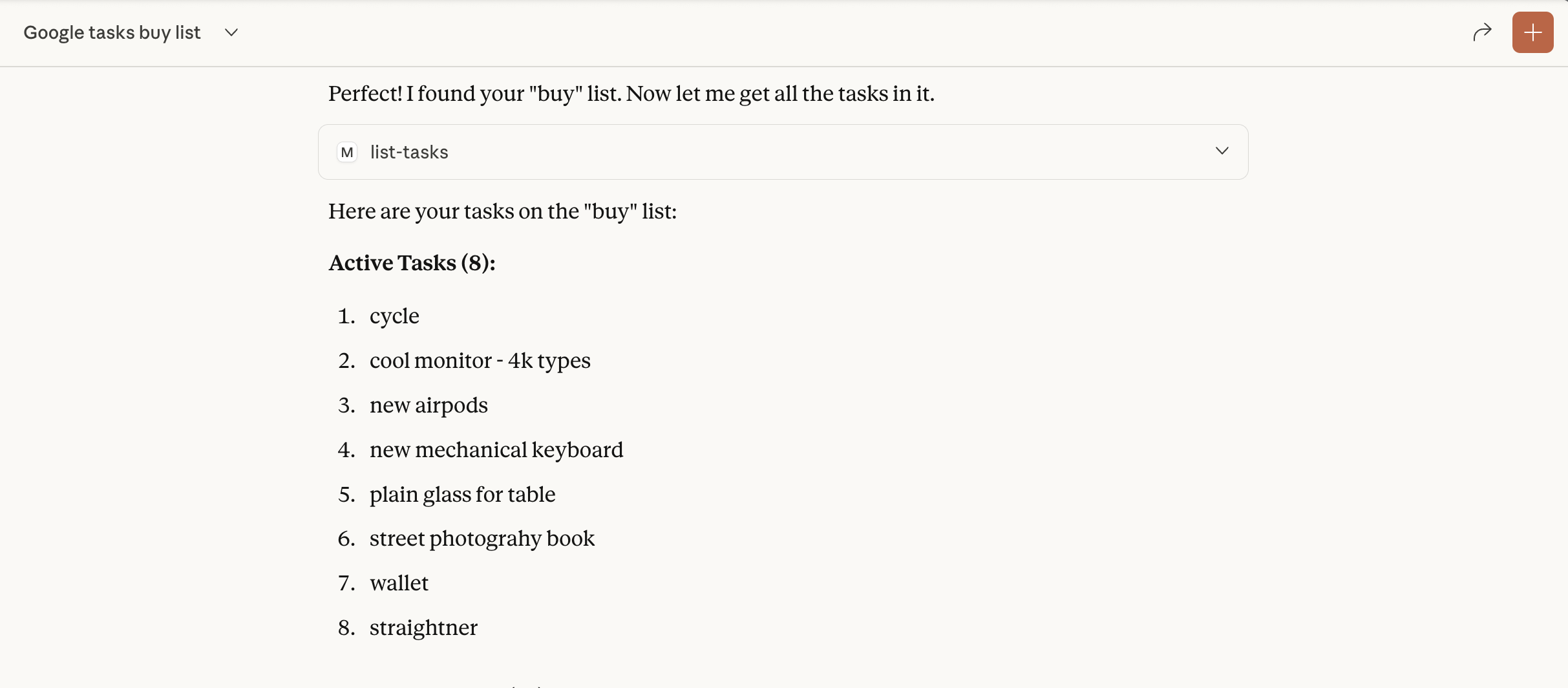
list-tasklists- List all your task listsget-tasklist- Get details about a specific task listcreate-tasklist- Create a new task listupdate-tasklist- Update an existing task listdelete-tasklist- Delete a task list
Task Management
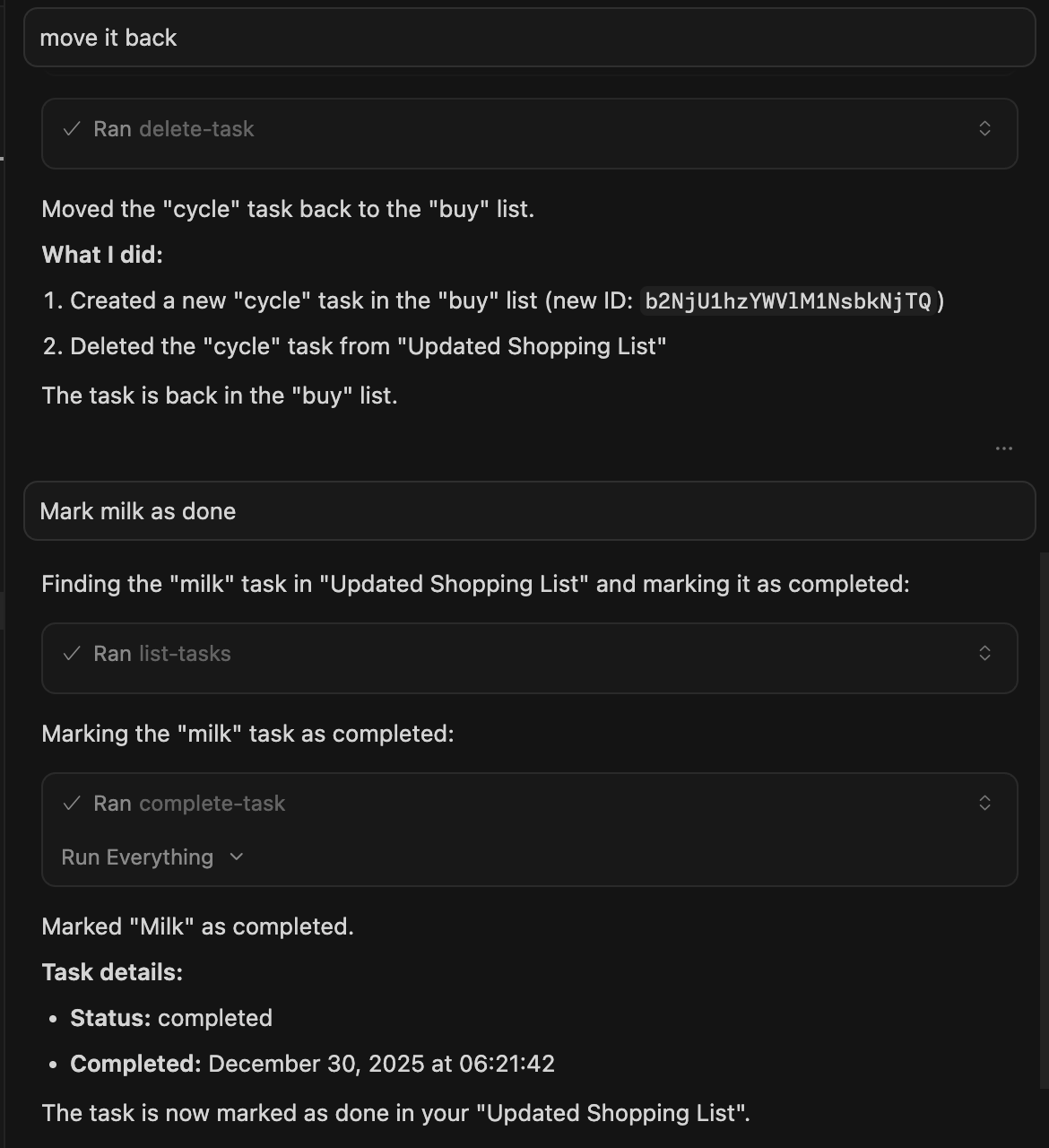
list-tasks- List all tasks in a task list, including paginated resultsget-task- Get details about a specific taskcreate-task- Create a new taskupdate-task- Update an existing taskdelete-task- Delete a taskcomplete-task- Mark a task as completedmove-task- Move a task (reorder, change parent, or move across task lists)clear-completed-tasks- Clear all completed tasks from a list
Setup Instructions
1. Create Google Cloud Project & Enable API
- Go to the Google Cloud Console
- Create a new project
- Navigate to "APIs & Services" > "Library"
- Search for "Google Tasks API" and enable it
- Go to "APIs & Services" > "Credentials"
- Click "Create Credentials" > "OAuth Client ID"
- Configure the OAuth consent screen (External is fine for personal use)
- For Application Type, select "Web application"
- Add "http://localhost:3000/oauth2callback" as an authorized redirect URI
- Create the client ID and secret
2. Configure Environment Variables
Create a .env file in this project directory:
GOOGLE_CLIENT_ID=your_client_id_here
GOOGLE_CLIENT_SECRET=your_client_secret_here
GOOGLE_REDIRECT_URI=http://localhost:3000/oauth2callback
Environment Variables:
GOOGLE_CLIENT_ID(required) - Your Google OAuth Client IDGOOGLE_CLIENT_SECRET(required) - Your Google OAuth Client SecretGOOGLE_REDIRECT_URI(optional) - OAuth redirect URI (defaults tohttp://localhost:3000/oauth2callback)
Note: The server validates that GOOGLE_CLIENT_ID and GOOGLE_CLIENT_SECRET are set at startup and will fail with clear error messages if they are missing or invalid.
3. Build the Server
- Install dependencies:
npm install
- Build the server:
npm run build
4. Configure an MCP Client
Codex
Add the server to ~/.codex/config.toml:
[mcp_servers.google-tasks]
command = "zsh"
args = ["-lc", "cd /path/to/google-tasks-mcp && exec node build/index.js"]
Replace /path/to/google-tasks-mcp with the path to this project, then restart Codex.
To verify the server is registered:
codex mcp list
codex mcp get google-tasks
Claude for Desktop
- Install Claude for Desktop
- Open the Claude configuration file:
- MacOS:
~/Library/Application Support/Claude/claude_desktop_config.json - Windows:
%APPDATA%\Claude\claude_desktop_config.json
- MacOS:
- Add the Google Tasks MCP server configuration:
{
  "mcpServers": {
    "google-tasks": {
      "command": "node",
      "args": ["/path/to/google-tasks-mcp/build/index.js"]
    }
  }
}
Replace the path with your own value, then restart Claude for Desktop.
Authentication Flow
When you first use the Google Tasks MCP server:
- Use the
authenticatetool to get an authorization URL - Visit the URL in your browser and sign in with your Google account
- After authorizing, you'll receive a code on the browser page
- Use the
set-auth-codetool with this code to complete authentication - You can now use all other tools to interact with Google Tasks
Note: Your authentication tokens (including refresh tokens) are automatically saved to disk at ~/.config/google-tasks-mcp/credentials.json with restricted permissions (600). This means:
- You only need to authenticate once - credentials persist across server restarts
- Automatic token refresh - Access tokens are automatically refreshed when they expire (typically after 1 hour) using the saved refresh token
- No re-authentication needed - After the initial setup, you won't need to authenticate again unless you revoke access or delete the credentials file
Requirements
- Node.js 20+ (see
package.jsonengines) - An MCP-compatible client
- Google Cloud Project with Tasks API enabled
Implementation Features
This MCP server includes the following improvements:
- Persistent token storage - Authentication credentials are saved to disk (
~/.config/google-tasks-mcp/credentials.json) with restricted permissions, so you only need to authenticate once - Environment variable validation - Startup validation ensures required credentials are configured with clear error messages
- Automatic token refresh - OAuth tokens are automatically refreshed when they expire, eliminating the need to re-authenticate during active sessions or after restarts
- Enhanced input validation - Comprehensive validation of all inputs including ID formats, string lengths, and RFC 3339 date formats
- HTML sanitization - OAuth callback responses are sanitized to prevent XSS vulnerabilities
- Graceful shutdown - Proper cleanup of resources on SIGINT/SIGTERM signals
- Type safety - Full TypeScript type safety throughout the codebase with proper interfaces
- Configurable redirect URI - The OAuth redirect URI can be customized via the
GOOGLE_REDIRECT_URIenvironment variable
Screenshots
Claude Desktop
Cursor
License
This project is for demonstration purposes only. Use at your own risk.