imessage-mcp
25 read-only tools for searching, analyzing, and exploring your entire iMessage history on macOS. Spotify Wrapped for texts, conversation analytics, streaks, read receipts, reactions, and more.
imessage-mcp
26 tools for locally exploring your iMessage history with AI.
An MCP server that gives AI assistants read-only access to your local iMessage database. Nothing is written, modified, or uploaded. Your messages stay on your Mac; the AI only sees what you ask about.
Read-only access to 2 local files (
chat.db+AddressBook). Zero network requests. Nothing is written, uploaded, or shared. All 26 tools are annotatedreadOnlyHint: true— your MCP client can auto-approve every call without prompts.
Install
npm install -g imessage-mcp
Or run without installing:
npx imessage-mcp doctor
Smithery: One-click install via the Smithery registry — search for imessage-mcp.
Add to your AI client
# Claude Code (one command)
claude mcp add imessage -- npx -y imessage-mcp
# Claude Desktop — add to ~/Library/Application Support/Claude/claude_desktop_config.json
{
"mcpServers": {
"imessage": {
"command": "npx",
"args": ["-y", "imessage-mcp"]
}
}
}
See Setup for Cursor, Windsurf, VS Code, Codex CLI, Cline, JetBrains, and Zed.
Claude Code Plugin
For slash commands and agents:
claude plugin add anipotts/imessage-mcp
Prerequisites
- macOS (iMessage is macOS-only)
- Node.js 18+ (
node --version) - Database access for your host application — macOS protects
chat.dbwith its Application Data permission. Grant access in: System Settings > Privacy & Security > Full Disk Access and enable the app running the MCP server (your terminal, Claude Desktop, or Cursor). GUI apps like Claude Desktop and Cursor may already have this permission. - Messages in iCloud enabled on your Mac (if you use multiple devices) — see iCloud Sync & Multiple Devices
Privacy & Security
imessage-mcp reads your local iMessage database in read-only mode. No data leaves your machine. Nothing is written, modified, uploaded, or shared.
| Path | Access | Purpose |
|---|---|---|
~/Library/Messages/chat.db | Read-only | Your iMessage database |
~/Library/Application Support/AddressBook/ | Read-only | Contact name resolution |
No other files are accessed. No external APIs are called.
chat.db --> [imessage-mcp] --> stdio/http --> [Your MCP Client] --> AI Provider
^ ^
Your Mac only Already authorized by you
What Can You Ask?
Once connected, ask your AI assistant anything about your messages in plain language:
- "Give me my 2024 iMessage Wrapped"
- "Do I always text first with [name]?"
- "What's my longest texting streak?"
- "Who reacts to my messages the most?"
- "What was the first text I ever sent my partner?"
- "What was I texting about on this day last year?"
- "Do I double-text [name] a lot?"
- "Who have I lost touch with?"
- "Show me the longest silence between me and [name]"
- "How many messages have I sent this year?"
- "Show my conversation with Mom"
- "What time of day am I most active texting?"
- "Show me messages people unsent"
- "What are the most popular group chats?"
Tools
26 tools across 10 categories. All read-only. All annotated with readOnlyHint: true.
| Tool | Description |
|---|---|
search_messages | Full-text search with filters: query, contact, date range, direction, group chat, attachments |
yearly_wrapped | Spotify Wrapped for iMessage — full year summary |
who_initiates | Who starts conversations? Initiation ratio per contact |
streaks | Consecutive-day messaging streaks |
get_reactions | Tapback distribution, top reactors, most-reacted messages |
on_this_day | Messages from this date in past years |
| Tool | Description |
|---|---|
search_messages | Full-text search with filters: query, contact, date range, direction, group chat, attachments |
get_conversation | Conversation thread with cursor-based pagination |
list_contacts | All contacts with message counts and date ranges |
get_contact | Deep contact info with stats and yearly breakdown |
resolve_contact | Fuzzy-match a name, phone number, or email to a contact |
message_stats | Aggregate stats with time-series grouping |
contact_stats | Per-contact volumes, trends, and hourly patterns |
temporal_heatmap | 7x24 activity heatmap (day-of-week by hour) |
on_this_day | Messages from this date in past years |
first_last_message | First and last message ever exchanged with a contact |
who_initiates | Who starts conversations? Initiation ratio per contact |
streaks | Consecutive-day messaging streaks |
double_texts | Detect double-texting and unanswered message patterns |
conversation_gaps | Find the longest silences in a conversation |
forgotten_contacts | Contacts you've lost touch with |
yearly_wrapped | Spotify Wrapped for iMessage — full year summary |
list_group_chats | Group chats with member counts and activity |
get_group_chat | Per-member stats and monthly activity timeline |
list_attachments | Query attachments by contact, MIME type, and date range |
get_reactions | Tapback distribution, top reactors, most-reacted messages |
get_read_receipts | Read/delivery latency and unread patterns |
get_thread | Reconstruct reply thread trees |
get_edited_messages | Edited and unsent messages with timing |
get_message_effects | Slam, loud, confetti, fireworks analytics |
check_new_messages | Track new messages since your last check (baseline + delta) |
help | Full tool guide with usage examples |
Setup
Claude Desktop
Add to ~/Library/Application Support/Claude/claude_desktop_config.json:
{
"mcpServers": {
"imessage": {
"command": "npx",
"args": ["-y", "imessage-mcp"]
}
}
}
Restart Claude Desktop after saving.
Claude Code
claude mcp add imessage -- npx -y imessage-mcp
Or add to .mcp.json in your project root:
{
"mcpServers": {
"imessage": {
"command": "npx",
"args": ["-y", "imessage-mcp"]
}
}
}
codex --mcp-config '{"imessage":{"command":"npx","args":["-y","imessage-mcp"]}}'
Or add to ~/.codex/config.json:
{
"mcpServers": {
"imessage": {
"command": "npx",
"args": ["-y", "imessage-mcp"]
}
}
}
Add to ~/.cursor/mcp.json:
{
"mcpServers": {
"imessage": {
"command": "npx",
"args": ["-y", "imessage-mcp"]
}
}
}
Add to ~/.codeium/windsurf/mcp_config.json:
{
"mcpServers": {
"imessage": {
"command": "npx",
"args": ["-y", "imessage-mcp"]
}
}
}
Add to .vscode/mcp.json in your project root:
stdio (default):
{
"servers": {
"imessage": {
"command": "npx",
"args": ["-y", "imessage-mcp"]
}
}
}
HTTP transport (remote / Docker):
{
"servers": {
"imessage": {
"type": "http",
"url": "http://localhost:3000/mcp"
}
}
}
Add via the Cline MCP settings UI, or edit cline_mcp_settings.json:
{
"mcpServers": {
"imessage": {
"command": "npx",
"args": ["-y", "imessage-mcp"]
}
}
}
Settings > Tools > AI Assistant > MCP Servers > Add:
- Name:
imessage - Command:
npx - Args:
-y imessage-mcp
Add to ~/.config/zed/settings.json:
{
"context_servers": {
"imessage": {
"command": {
"path": "npx",
"args": ["-y", "imessage-mcp"]
}
}
}
}
CLI Commands
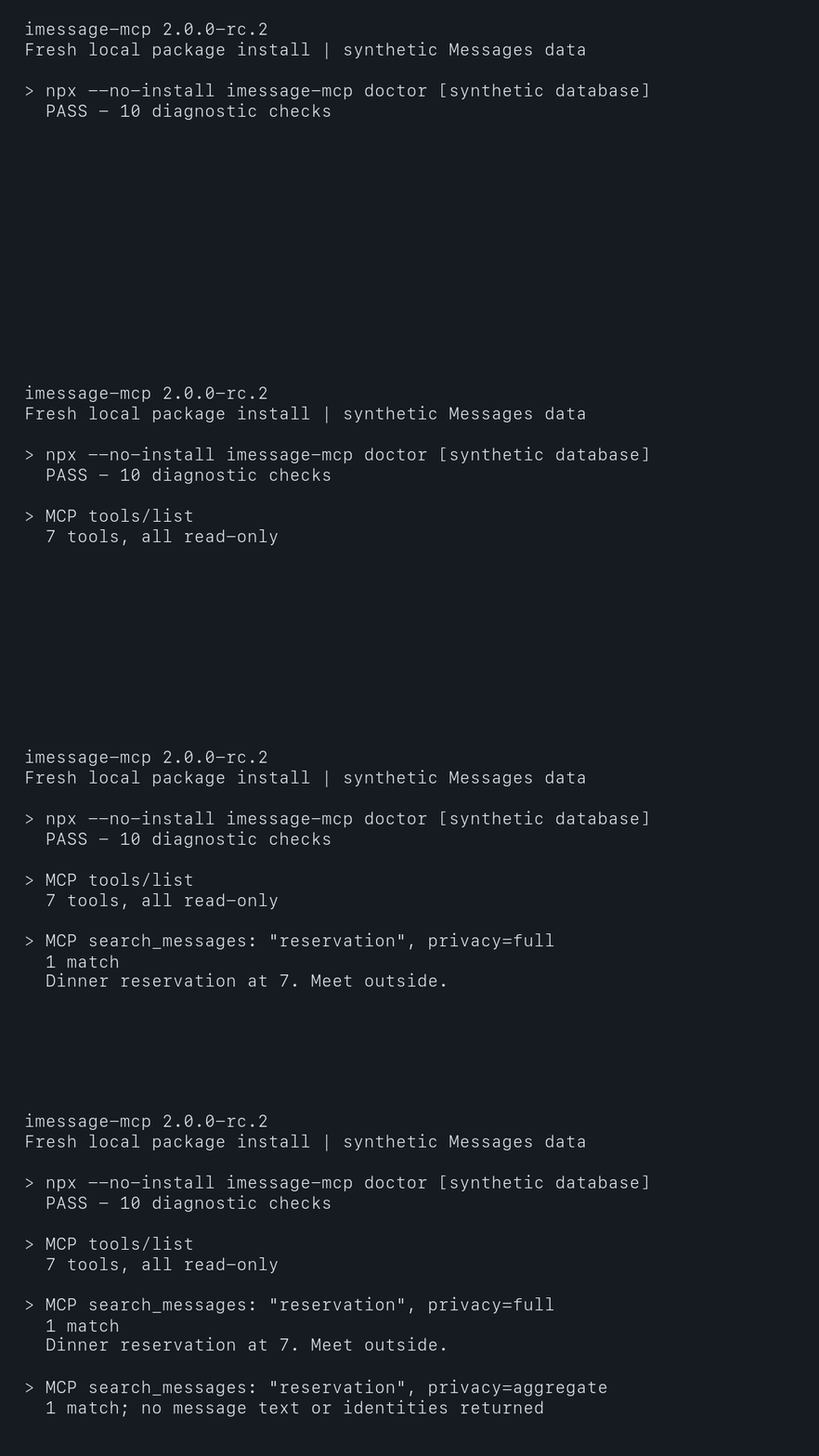
Checks macOS version, Node.js version, chat.db access, database permissions, AddressBook, and message count.
$ npx imessage-mcp doctor
imessage-mcp doctor
✓ macOS: Running on macOS (darwin)
✓ Node.js: Node v22.0.0 (>= 18 required)
✓ chat.db: Found at /Users/you/Library/Messages/chat.db
✓ Database access: Database readable
✓ Messages: 97,432 messages indexed
✓ AddressBook: 342 contacts resolved
All checks passed — ready to use!
Pass --json for machine-readable output:
npx imessage-mcp doctor --json
# Export last 1000 messages
npx imessage-mcp dump > messages.json
# Filter by contact
npx imessage-mcp dump --contact "+15551234567"
# Date range with custom limit
npx imessage-mcp dump --from 2024-01-01 --to 2024-12-31 --limit 5000
# Export contacts (excluding spam/promo by default)
npx imessage-mcp dump --contacts > contacts.json
# Include all contacts (even ones you never replied to)
npx imessage-mcp dump --contacts --all > all-contacts.json
# Export all messages (including unfiltered contacts)
npx imessage-mcp dump --all > all-messages.json
Transport Modes
By default, imessage-mcp uses stdio transport — the standard for local MCP clients like Claude Desktop and Claude Code. For workflow tools (n8n, Lutra, Copilot Studio) or remote access, HTTP transport is available.
| Flag | Short | Default | Description |
|---|---|---|---|
--transport | -t | stdio | Transport mode: stdio, http, or sse |
--port | -p | 3000 | Port for HTTP/SSE transport |
--host | -H | 127.0.0.1 | Bind address (use 0.0.0.0 for Docker/remote) |
npx imessage-mcp --transport http --port 3000
Starts a Streamable HTTP server on http://127.0.0.1:3000/mcp. Supports POST, GET, and DELETE on /mcp with session management via mcp-session-id headers. This is the MCP 2025-03-26 standard.
npx imessage-mcp --transport sse --port 3000
Starts a legacy SSE server: GET /sse to establish the stream, POST /messages?sessionId=<id> for JSON-RPC requests. Use this only if your client does not support Streamable HTTP.
Docker
Run imessage-mcp as an HTTP server in Docker. Copy your chat.db to a volume mount:
docker build -t imessage-mcp .
docker run -p 3000:3000 -v /path/to/chat.db:/data/chat.db:ro imessage-mcp
The container starts with --transport http --host 0.0.0.0 on port 3000 by default. Connect any MCP client to http://localhost:3000/mcp.
To secure the HTTP endpoint with authentication:
docker run -p 3000:3000 -e IMESSAGE_API_TOKEN=your-secret-token -v /path/to/chat.db:/data/chat.db:ro imessage-mcp
All requests must then include the Authorization: Bearer your-secret-token header.
Prevent message bodies from being sent to the AI. Only metadata (counts, dates, contact names) is returned. No actual message text.
{
"mcpServers": {
"imessage": {
"command": "npx",
"args": ["-y", "imessage-mcp"],
"env": { "IMESSAGE_SAFE_MODE": "1" }
}
}
}
Useful for demos, shared environments, or when you want analytics without exposing private conversations.
By default, listing and global search tools only include contacts you have actually replied to. This filters out spam, promo texts, and unknown senders.
Filtered tools: search_messages (global), list_contacts, message_stats (global), temporal_heatmap (global), who_initiates (global), streaks (global), on_this_day (global), forgotten_contacts, yearly_wrapped.
Unfiltered tools: get_conversation, get_contact, contact_stats, first_last_message, conversation_gaps, get_reactions, get_read_receipts, get_thread, get_edited_messages, get_message_effects, group chats, attachments, check_new_messages.
To include all contacts (including unrecognized senders), pass include_all: true to any filtered tool.
Looking for iCloud sync? This section covers real-time message tracking within imessage-mcp. To sync your full message history from iPhone/iPad to your Mac, see iCloud Sync & Multiple Devices.
By default, every query reads the latest data — if someone texts you, your next tool call sees it immediately. No sync needed.
For proactive awareness, the check_new_messages tool tracks what arrived since your last check:
- First call sets a baseline
- Subsequent calls report the delta — count, who messaged, and optional text previews
For push notifications (opt-in):
{
"mcpServers": {
"imessage": {
"command": "npx",
"args": ["-y", "imessage-mcp"],
"env": { "IMESSAGE_SYNC": "watch" }
}
}
}
This watches your iMessage database for changes and notifies your AI client within seconds. Uses macOS FSEvents — zero CPU when idle.
Configuration
| Variable | Default | Description |
|---|---|---|
IMESSAGE_DB | ~/Library/Messages/chat.db | Path to iMessage database |
IMESSAGE_SAFE_MODE | false | Set to 1 to redact all message bodies |
IMESSAGE_SYNC | off | Sync mode: off, watch (FSEvents), or poll:N (every N seconds) |
IMESSAGE_API_TOKEN | (none) | Bearer token for HTTP/SSE auth. If set, requests must include Authorization: Bearer <token> |
iCloud Sync & Multiple Devices
imessage-mcp reads your Mac's local database (~/Library/Messages/chat.db). This database only contains messages that have been synced to your Mac. If your conversations live on your iPhone or iPad but haven't synced, imessage-mcp won't see them.
If you only use iMessage on your Mac, you can skip this — your messages are already in
chat.db.
How iMessage sync works
Apple's "Messages in iCloud" keeps your full message history synchronized across all your Apple devices:
┌─────────────┐ ┌──────────┐ ┌──────────────┐
│ iPhone/iPad │ ──────► │ iCloud │ ──────► │ Your Mac │
│ (sends & │ ◄────── │(Messages │ ◄────── │ │
│ receives) │ │in iCloud)│ │ chat.db │
└─────────────┘ └──────────┘ └──────┬───────┘
│
▼
imessage-mcp
reads this ↑
Without "Messages in iCloud" enabled on your Mac, the Mac's chat.db only contains messages sent and received while Messages.app was actively running on that Mac.
Setup
1. Enable on your Mac
- Open Messages.app on your Mac
- Go to Settings (Cmd+,) > iMessage tab
- Check "Enable Messages in iCloud"
- Keep Messages.app open — sync begins automatically
2. Enable on your iPhone/iPad
- Open Settings > tap your name (Apple ID) > iCloud > Messages
- Toggle "Use on this iPhone" ON
3. Same Apple ID on all devices
All devices must be signed into the same Apple ID. Check: Mac (System Settings > Apple ID), iPhone (Settings > tap your name).
4. Wait for sync to complete
Initial sync can take hours or even days for large message histories. During sync:
- Messages.app must remain open on your Mac
- Your Mac should be connected to Wi-Fi and power
- You'll see a "Syncing with iCloud" status in Messages.app
5. Sync contacts for name resolution
imessage-mcp resolves phone numbers to names using your Mac's AddressBook. If contacts only exist on your iPhone:
- Open System Settings > Apple ID > iCloud
- Find Contacts and toggle it ON
- Wait for contacts to sync (usually under a minute)
Verify sync is complete
npx imessage-mcp doctor
Look for the Messages line — it shows how many messages are indexed locally. If this number seems low, iCloud sync is likely still in progress. Run doctor again later to confirm the count has stabilized.
Tip: On your iPhone, go to Settings > General > iPhone Storage > Messages to see your total message history size. Compare with what
doctorreports on your Mac.
Common sync issues
Messages on iPhone don't appear on Mac: "Messages in iCloud" must be enabled on both devices. Ensure both use the same Apple ID. Keep Messages.app open on your Mac. Run npx imessage-mcp doctor periodically to check if the count is growing.
Brand-new Mac shows no history: Expected — enable "Messages in iCloud," connect to Wi-Fi and power, keep Messages.app open. For large histories (100K+ messages), initial sync may take 1–2 days.
History is incomplete: Sync may still be in progress. If iCloud storage is full, sync pauses (check System Settings > Apple ID > iCloud > Manage Storage). Messages sent while sync was disabled won't sync retroactively.
Group chats missing members: Group chat sync can lag behind 1:1 conversations. Ensure sync is enabled on all devices and has had time to complete. If members show as phone numbers, enable iCloud Contacts sync (step 5 above).
Troubleshooting
macOS protects chat.db with its Application Data permission. To grant access:
- Open System Settings > Privacy & Security > Full Disk Access
- Enable the app running the MCP server (your terminal, Claude Desktop, Cursor, etc.)
- Restart the app after granting access
GUI apps like Claude Desktop and Cursor may already have this permission — try running npx imessage-mcp doctor first.
imessage-mcp reads only messages synced to your Mac. See iCloud Sync & Multiple Devices for full setup steps.
Quick checklist:
- Open Messages.app > Settings > iMessage > enable "Messages in iCloud"
- Ensure the same Apple ID is signed in on all your devices
- Connect to Wi-Fi and power — initial sync can take hours
- Run
npx imessage-mcp doctorto check message count
Make sure Messages.app has been used on this Mac and has synced your messages. If you recently set up this Mac or just enabled "Messages in iCloud," sync may still be in progress — see iCloud Sync & Multiple Devices. Run npx imessage-mcp doctor to verify your setup and message count.
Contact resolution uses your macOS AddressBook. If contacts are only on your phone and not synced to your Mac, names will not resolve. See iCloud Sync & Multiple Devices for instructions on enabling iCloud contact sync, or add contacts manually in the Contacts app.
Your MCP client's bundled Node.js version differs from the one that compiled better-sqlite3's native module. Fix by pointing to your system Node directly:
- Find your Node path:
which node - Find imessage-mcp:
npm root -g - Replace
"command": "npx"with your system Node:
{
"mcpServers": {
"imessage": {
"command": "/opt/homebrew/bin/node",
"args": ["/path/to/node_modules/imessage-mcp/bin/imessage-mcp.js"]
}
}
}
- Verify the config file is at
~/Library/Application Support/Claude/claude_desktop_config.json - Restart Claude Desktop completely (Cmd+Q, then reopen)
- Run
npx imessage-mcp doctorto confirm the server works independently
Uninstall
npm uninstall -g imessage-mcp
How It Works
imessage-mcp reads ~/Library/Messages/chat.db using better-sqlite3 in read-only mode with query_only = ON. Zero network requests. Contact names are resolved from your macOS AddressBook automatically.
On macOS 14 (Sonoma) and later, Apple changed how message text is stored. Some messages have NULL in the text column but contain the actual text in the attributedBody binary blob. imessage-mcp extracts text from this blob automatically so no messages are left behind.
All 26 tools are annotated with readOnlyHint: true so MCP clients can auto-approve them without user prompts.
License
MIT
Related Servers
WhatsApp MCP server by Kapso
WhatsApp Cloud API MCP server by Kapso
HeyReach MCP Server
Integrates with the HeyReach API for LinkedIn automation and outreach management.
MCP Server Whisper
Advanced audio transcription and processing using OpenAI's Whisper and GPT-4o models.
Salesforce MCP Server - Enhanced Edition
A Salesforce MCP server with automatic integrations for services such as WhatsApp, Slack, email, and custom webhooks.
Sinch Engage / MessageMedia MCP server
Sinch Engage (Sinch MessageMedia in AU) MCP server, which provides Sinch Engage APIs as MCP tools.
Telegram MCP
An MCP server for interacting with the Telegram messaging service using the mtcute library.
Beehiiv
Manage your Beehiiv newsletter by adding subscribers and fetching posts using natural language.
Didlogic MCP Server
Interact with the Didlogic API for telecommunication services, including virtual phone numbers and SMS.
ClaudePost
A seamless email management interface powered by Claude.
Inbox MCP
An intelligent, LLM-powered email assistant using the Nylas v3 API.