x402-agent-data
Paid on-chain data for agents over x402: token reports, contract due-diligence signals, pool depth and slippage, wallet activity. USDC per call on Base, no signup and no API key.
Hosted MCP Server
npx add-mcp 'https://x402-agent.majighufron.workers.dev/mcp'Installs into Claude Code, Codex, Cursor and more
Documentation
x402-agent-data
Paid on-chain data for AI agents (and humans). Pay per call in USDC on Base over HTTP 402 (x402) — no signup, no API key, no account. The money goes straight to the wallet advertised in the 402 response; nothing is held by the service.
- Landing / discovery: https://x402-agent.majighufron.workers.dev
- MCP server (remote, streamable HTTP):
https://x402-agent.majighufron.workers.dev/mcp - Machine-readable catalogue:
https://x402-agent.majighufron.workers.dev/api - Agent instructions:
https://x402-agent.majighufron.workers.dev/llms.txt
Services
| Service | Price | What you get |
|---|---|---|
token_report · GET /api/token-report | $0.01 | ERC-20 metadata, supply, recent transfer activity, optional pool balance. Chains: Base, Base Sepolia, Robinhood Chain |
pool_risk · GET /api/pool-risk | $0.02 | Pool reserves, implied price, constant-product slippage for a given notional |
wallet_profile · GET /api/wallet-profile | $0.03 | Transfers in/out, distinct counterparties, first and last block seen |
contract_dd · GET /api/contract-dd | $0.05 | Due-diligence signals: risky selectors present in bytecode, owner + renounced status, activity, largest-transfer share |
Free endpoints: / discovery · /api catalogue · /llms.txt agent text · /api/sample truncated
report so you can check the data shape before paying · /mcp MCP server (the service_catalog
tool is free).
Use it from an MCP client
Add the remote server to any MCP client (Claude Desktop, Cursor, or your own agent):
{
  "mcpServers": {
    "x402-agent-data": {
      "type": "streamable-http",
      "url": "https://x402-agent.majighufron.workers.dev/mcp"
    }
  }
}
Tools: service_catalog (free), token_report, pool_risk, wallet_profile, contract_dd.
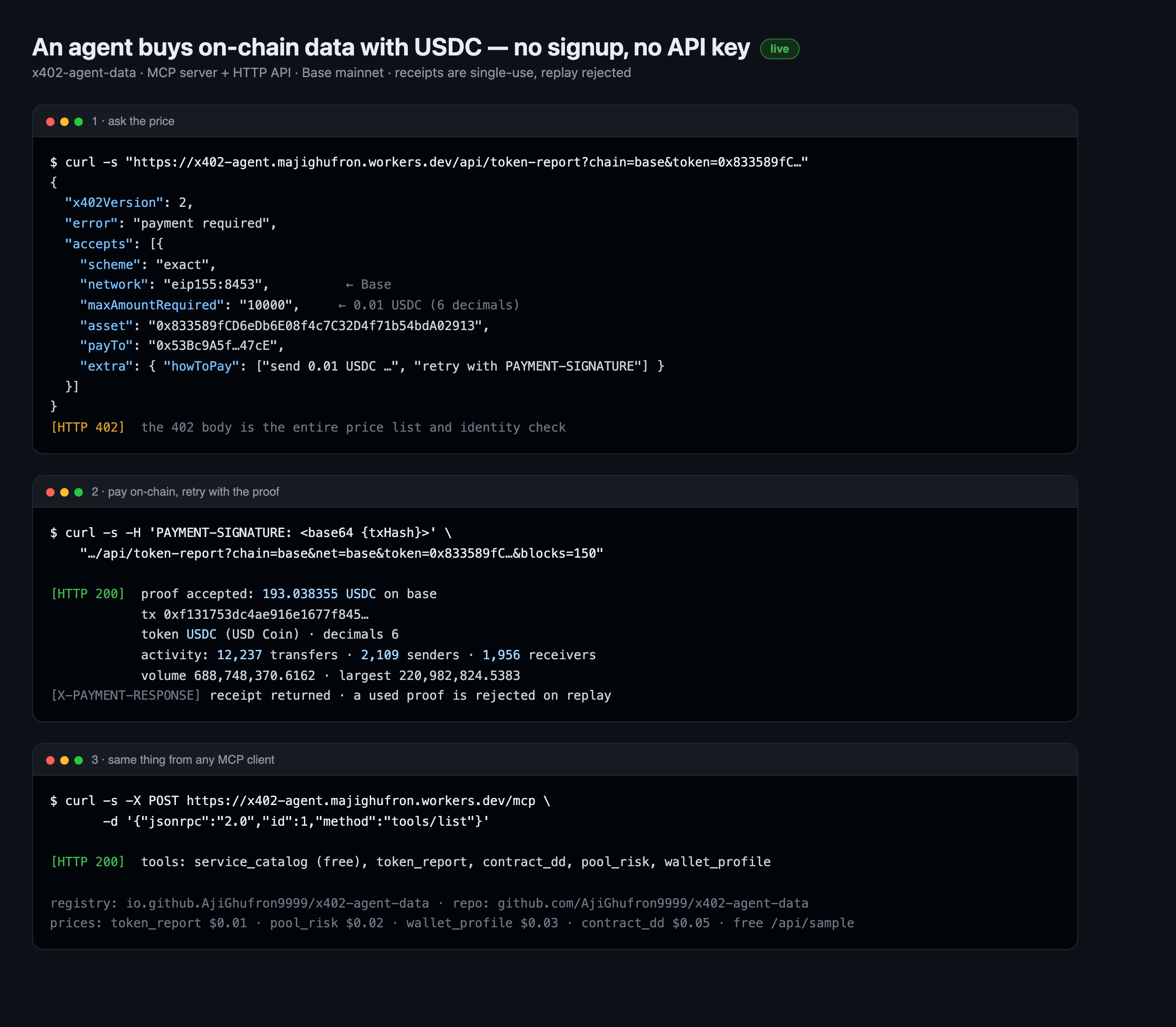
Call a paid tool once without payment_signature and it returns the payment requirements; pay,
then call again with payment_signature = base64 of {"txHash":"0x…"}.
Use it over plain HTTP
# 1. Ask without paying -> HTTP 402 + payment requirements
curl -s "https://x402-agent.majighufron.workers.dev/api/token-report?chain=base&token=0x833589fCD6eDb6E08f4c7C32D4f71b54bdA02913"

# 2. Send the quoted USDC amount to the payTo address on Base (USDC, 6 decimals)

# 3. Retry with the proof
TX=0x…   # your transfer hash
PROOF=$(printf '{"txHash":"%s"}' "$TX" | base64)
curl -s -H "PAYMENT-SIGNATURE: $PROOF" \
  "https://x402-agent.majighufron.workers.dev/api/token-report?chain=base&token=0x833589fCD6eDb6E08f4c7C32D4f71b54bdA02913"
A proof is single-use and must be from the last 15 minutes. If the service itself fails (upstream
RPC throttling), it answers 503 retryable: true and releases your proof, so you can call again
without paying twice.
See examples/pay_and_fetch.py for a runnable walkthrough.
Why it exists
On-chain data is usually sold as a monthly subscription behind an API key. Agent software cannot fill in signup forms, so this exposes the same data per call: the HTTP 402 response is the price list, and the wallet is the identity.
Honest limits
- Upstream public RPCs throttle shared egress IPs, so a call can occasionally answer
503; proofs are released so retries are free. contract_ddreports signals, not verdicts: selector presence says what is in the bytecode, not how it behaves. Proxies and dead code both hide intent.- Payment uses a plain USDC transfer plus a proof header (self-verified). It is not the EIP-3009 facilitator flow yet.
License
MIT