Proxmox MCP Suite
Run Proxmox VE and Backup Server from Claude — 69 token-efficient, safety-gated tools with dry-run previews and a tamper-evident audit trail.
Documentation
Proxmox MCP Suite
Run your Proxmox VE cluster and Backup Server from Claude — deeply, safely, and without drowning the context window.








Quick start · Why this suite · What's inside · Safety · Config
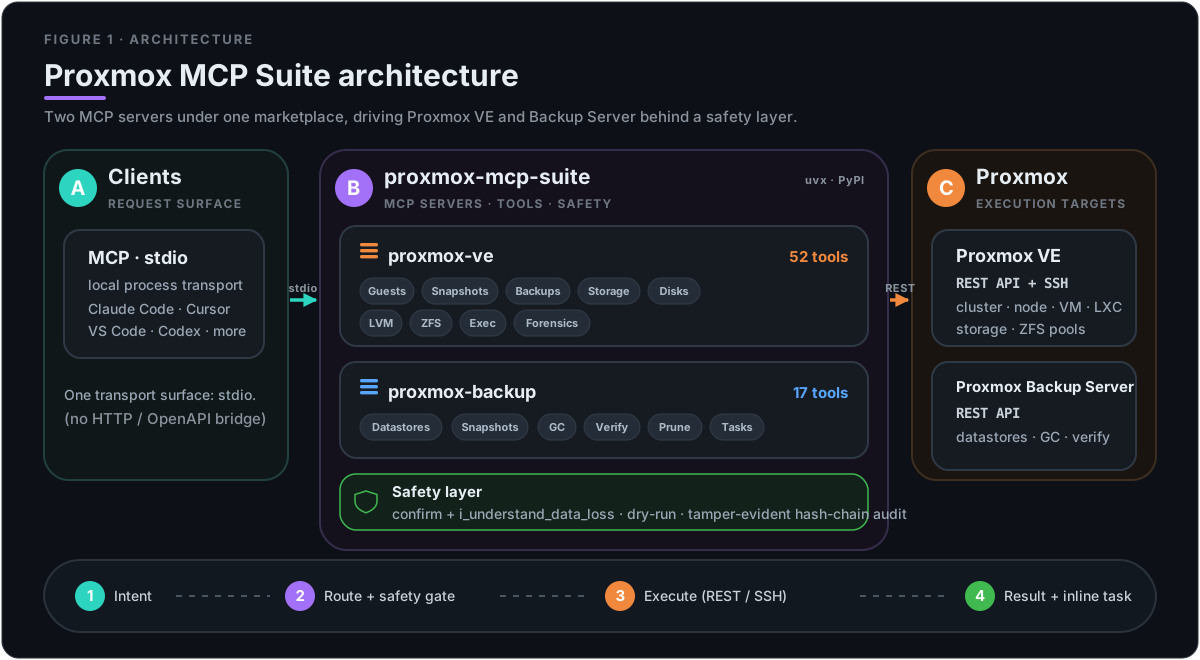
Two Model Context Protocol servers, packaged as Claude Code plugins, that turn Claude into a capable Proxmox operator — 69 tools across virtualization and backup, engineered to run inside an LLM's context: compact output, one-call health, inline task results, and a two-tier safety model with dry-run previews and a tamper-evident audit trail.
⚡ Quick start
Prereq: Claude Code and uv (uvx). The servers run via uvx — nothing to pip install by hand.
/plugin marketplace add ahmetem/proxmox-mcp-suite
/plugin install proxmox-ve@proxmox-mcp-suite
/plugin install proxmox-backup@proxmox-mcp-suite
Export your Proxmox credentials (see Configuration), restart Claude Code, and ask:
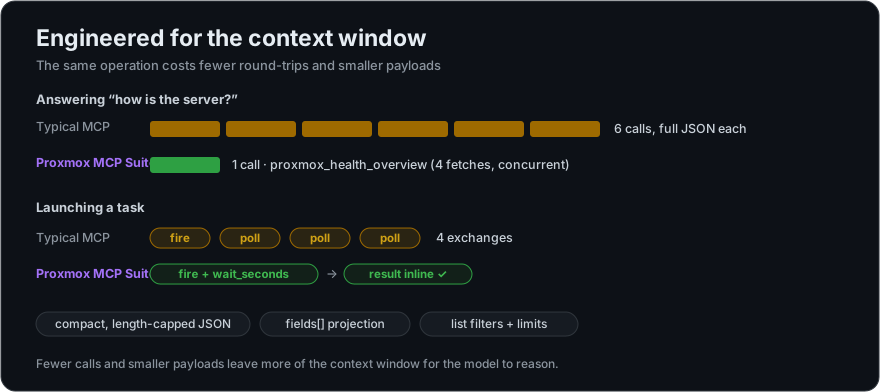
"How is the server? Any storage filling up?" — one
proxmox_health_overviewcall."Snapshot VM 102 as pre-upgrade, then reboot it."
"Is my last backup of CT 200 healthy?"
🎯 Why this suite
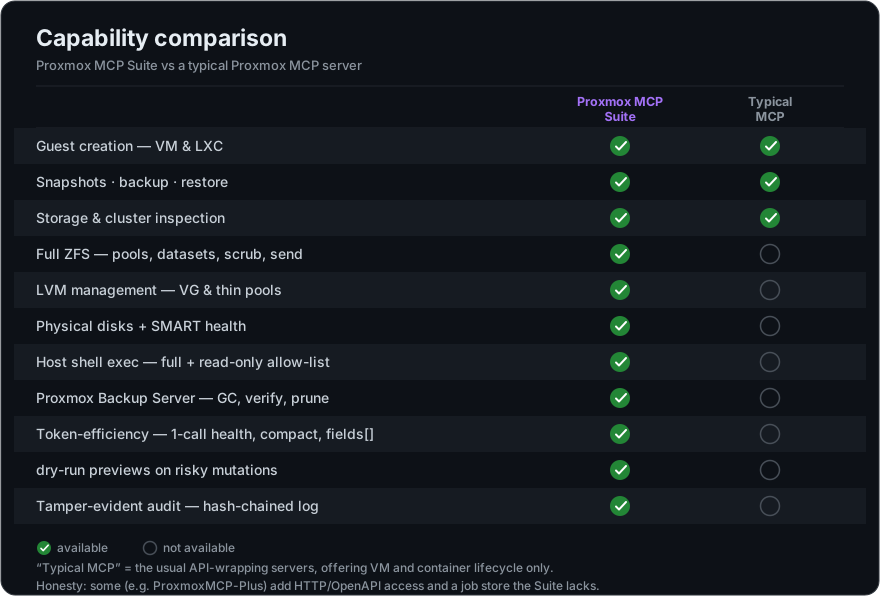
Most Proxmox MCP servers wrap the API and hand Claude raw JSON. This one is built for the thing that actually constrains an agent — context — and for not breaking your infrastructure.
| Proxmox MCP Suite | Typical Proxmox MCP | |
|---|---|---|
| Output | Compact, length-capped JSON · one-call health_overview · list filters · fields projection | Verbose full-object dumps |
| Task launches | wait_seconds polls the task and returns the final result inline | Fire, then a second call to check status |
| Mutations | Two-tier gate: confirm + i_understand_data_loss, plus dry_run previews on the risky ones | Single flag, or nothing |
| Auditability | Host/guest shell exec appended to a hash-chained, tamper-evident log (proxmox_audit_verify) | Plain log, or none |
| Depth (VE) | Guests, snapshots, backups, storage, disks, LVM, full ZFS, disk-prep, provisioning, task forensics, backup self-heal | VM/CT lifecycle only |
| Backup (PBS) | Dedicated server: datastores, snapshots, GC, verify, prune, read-only by default | Usually absent |
| Install | One marketplace, uvx — zero manual Python setup | Clone + venv + pip + JSON config |
Modular by design — install only Proxmox VE, only PBS, or both.
📦 What's inside
proxmox-ve — 52 tools
Repo: homelab-proxmox-mcp
- Guests — list/status, create VM & LXC from scratch, clone, power, resize
- Snapshots — create / rollback / delete (data-loss gated)
- Backups — vzdump create / list / restore (refuses silent overwrite)
- Storage & disks — pools, usage breakdown, physical disks + SMART
- LVM / ZFS — VG/thin, full ZFS: pools, datasets, snapshots, scrub, send, properties, disk-prepare & provisioning
- Exec — guest-VM SSH, host SSH (free + a read-only allow-listed variant safe for agents), LXC
pct exec, service control, log tail - Forensics & self-heal — task list/logs, backup-job inspection, stale
@vzdumpsnapshot cleanup that unblocks failing backups
proxmox-backup — 17 tools
Repo: homelab-pbs-mcp
- Datastores & snapshots — status, usage, list, protect/forget
- Maintenance — garbage collection, verify jobs, prune (with dry-run)
- Tasks — status and logs by UPID
- Read-only by default — write-side tools stay inert until
PBS_ALLOW_WRITE=true
🛡️ Safety model
Read-only tools run freely. Everything that changes state requires confirm=true;
anything that destroys persistent data additionally requires
i_understand_data_loss=true — so Claude only fires these after you clearly ask.
dry_runpreviews on the highest-consequence mutations (create VM/CT, clone, restore) return the exact API call they would make (secrets masked), without touching anything.- Tamper-evident audit — every host/guest shell exec is appended to a
hash-chained log (SHA-256, or HMAC-SHA256 with
PROXMOX_AUDIT_HMAC_KEY).proxmox_audit_verifyrecomputes the chain and flags any altered, deleted, or reordered line. - Token auth, never root passwords — API tokens are revocable and scope the blast radius.
⚙️ Configuration
Credentials are passed to the servers via environment variables — export them in the shell that launches Claude Code (no secret is stored in the plugin).
Proxmox VE — required: PROXMOX_HOST, PROXMOX_USER, PROXMOX_TOKEN_NAME,
PROXMOX_TOKEN_VALUE. Optional: PROXMOX_PORT, PROXMOX_VERIFY_SSL, and the
SSH-backed tools' PROXMOX_SSH_*. → full list in the
server repo.
Proxmox Backup Server — required: PBS_HOST, PBS_TOKEN_ID,
PBS_TOKEN_SECRET, PBS_NODE. Optional: PBS_VERIFY_TLS,
PBS_DEFAULT_DATASTORE, and PBS_ALLOW_WRITE (gates GC/prune/forget). →
PBS server repo.
Verify servers loaded with /mcp.
🔧 How it runs
Each plugin launches its server with uvx, which fetches, installs and isolates
it automatically from PyPI (pve-mcp,
pbs-mcp) — no clone, no virtualenv, no
manual pip install. uvx caches the environment after the first launch, so
later starts are instant. To pin a specific release, set a plugin's args to
e.g. ["pve-mcp==1.2.0"].
🔒 Security notes
- Keep the Proxmox / PBS APIs on a trusted LAN or behind a VPN.
- Privilege-separate the API tokens; grant the narrowest role that works.
- Don't remove the
confirm/i_understand_data_lossguards.
📄 License
GNU General Public License v3.0. Not affiliated with or endorsed by Proxmox Server Solutions GmbH. "Proxmox" is a trademark of its respective owner.