BioMCP
Conecta assistentes de IA a fontes autoritativas de dados biomédicos como PubMed e ClinicalTrials.gov, permitindo consultas em linguagem natural.
Documentação
BioMCP
Um binário. Uma gramática. Evidências das fontes biomédicas em que você já confia.
Termos de dados
O BioMCP recupera dados de fontes biomédicas upstream. Os termos dessas fontes regem como você usa os dados que elas retornam: algumas restringem uso comercial ou clínico. Verifique os termos de cada fonte e obtenha qualquer licença necessária antes de confiar nos dados. Consulte Licenciamento e Termos das Fontes para o detalhamento por fonte.
O que é o BioMCP?
O BioMCP é um único binário de CLI sobre uma única gramática de comandos que alcança 70 fontes biomédicas confiáveis diretamente (PubMed, ClinVar, ClinicalTrials.gov, OncoKB, Reactome e outras; dez fontes adicionais chegam dentro da resposta de outra fonte). Também é um servidor MCP (Model Context Protocol), então as mesmas ferramentas estão disponíveis para agentes de IA como Claude Code, Codex e Claude Desktop.
O BioMCP atravessa o labirinto usual de dados biomédicos: uma única consulta alcança as fontes que normalmente vivem atrás de diferentes APIs, identificadores e hábitos de busca. Pesquisadores, clínicos e agentes usam a mesma gramática de comandos para buscar, focar e pivotar sem reconstruir o fluxo de trabalho para cada fonte. Você obtém resultados compactos e orientados a evidências em dados públicos ao vivo, além de análises locais de estudos.
Recursos
- Busque na literatura:
search articlese expande pelo PubTator3 e Europe PMC, deduplica identificadores PMID/PMCID/DOI e pode adicionar uma etapa do Semantic Scholar quando seus filtros suportarem. - Pivote sem retrabalho: vá de um gene, variante, fármaco, doença, via, proteína ou artigo direto para a próxima visão integrada, em vez de reconstruir filtros manualmente.
- Escolha um playbook:
biomcp skill listmostra exemplos práticos prontos para você abrir o fluxo de trabalhobiomcp skill <slug>correspondente. - Analise estudos localmente: os comandos
studycobrem fluxos locais de consulta, coorte, sobrevivência, comparação e co-ocorrência com gráficos nativos em terminal, SVG e PNG para conjuntos de dados baixados no estilo cBioPortal. - Siga o rastro do artigo:
article citations,article references,article recommendationsearticle entitiestransformam um artigo conhecido em um mapa de evidências mais amplo. - Enriqueça e processe em lote: use
biomcp enrichpara enriquecimento g:Profiler de nível superior ebiomcp batchpara até 10 chamadas focadas degetem um único comando.
Início rápido
Primeira consulta útil em menos de 30 segundos:
uv tool install biomcp-cli
biomcp health --apis-only
biomcp skill list
biomcp list gene
biomcp search all --gene BRAF --disease melanoma  # unified cross-entity discovery
biomcp get gene BRAF pathways hpa
Assista à introdução
Um projeto que usa o BioMCP venceu o KIDS BioHackathon do St. Jude em 2025. A palestra que se seguiu é uma introdução de uma hora ao BioMCP, gravada em 24 de outubro de 2025.
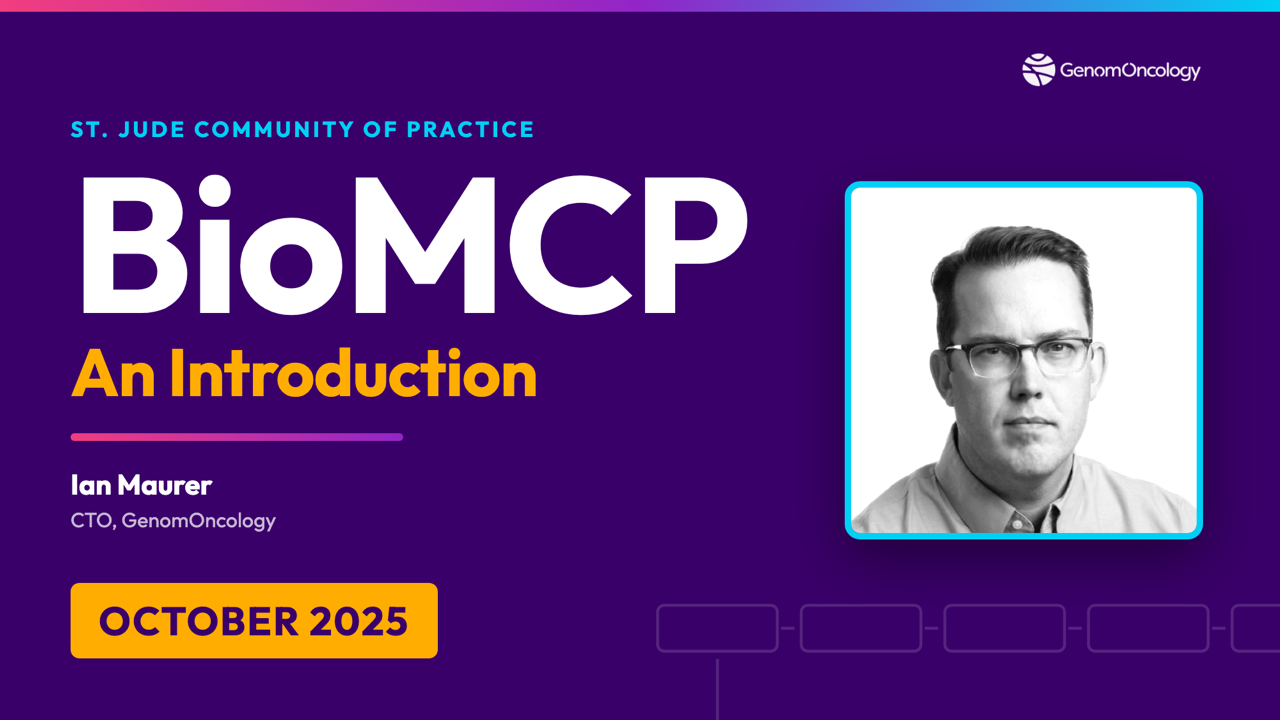
Assista no YouTube · Leia o artigo · Transcrição completa
Instalação
Instalação binária
curl -fsSL https://biomcp.org/install.sh | bash
Instalação via ferramenta PyPI
uv tool install biomcp-cli
# or: pip install biomcp-cli
Aviso sobre o pacote PyPI: instale
biomcp-cli, nãobiomcp. O pacote PyPIbiomcpnão tem relação com este projeto.
Marcador de propriedade do MCP Registry: mcp-name: io.github.genomoncology/biomcp.
Isso instala o binário biomcp em ~/.local/bin. Se esse diretório ainda não estiver no PATH, o instalador imprime um comando para adicioná-lo; ele nunca edita seus arquivos de inicialização do shell.
Homebrew
brew tap genomoncology/biomcp
brew install biomcp
O repositório de tap separado genomoncology/homebrew-biomcp deve existir antes que esses comandos funcionem.
Docker
docker run --rm ghcr.io/genomoncology/biomcp --version
docker run --rm ghcr.io/genomoncology/biomcp list
docker run --rm -i ghcr.io/genomoncology/biomcp serve
Use a imagem GHCR para verificações rápidas de CLI ou clientes MCP stdio sem instalação local.
Plugin do Claude Code
Instale o binário biomcp primeiro, depois adicione o marketplace de plugins hospedado e instale o plugin BioMCP no Claude Code:
/plugin marketplace add genomoncology/biomcp
/plugin install biomcp@biomcp
O plugin conecta o Claude Code ao servidor MCP stdio local com biomcp serve. Para fluxos de trabalho guiados do BioMCP, instale também os assets de habilidades abaixo.
Servidor MCP do Codex
Instale o binário biomcp primeiro, depois registre o mesmo servidor MCP stdio com o Codex:
codex mcp add biomcp -- biomcp serve
Extensão do Claude Desktop (.mcpb)
Instale o BioMCP pelo Diretório Anthropic no Claude Desktop quando esse caminho estiver disponível no seu ambiente. Para configurações locais/manuais, use a configuração JSON MCP abaixo.
Instale as habilidades
Instale fluxos de investigação guiados no diretório do seu agente:
biomcp skill install ~/.claude --force
Clientes MCP
{
  "mcpServers": {
    "biomcp": {
      "command": "biomcp",
      "args": ["serve"]
    }
  }
}
Servidor HTTP remoto
Para implantações compartilhadas ou remotas:
biomcp serve-http --host 127.0.0.1 --port 8080
Clientes remotos conectam-se a http://127.0.0.1:8080/mcp. As rotas de sondagem são GET /health, GET /readyz e GET /.
Demonstração executável:
uv run --script examples/streamable-http/streamable_http_client.py
Consulte Servidor HTTP Remoto para o guia de iniciantes.
A partir do código-fonte
make install
"$HOME/.local/bin/biomcp" --version
Para verificação local do repositório, execute as verificações padrão diretamente: make lint, make test e make spec. make test inclui tanto o Rust nextest quanto a trilha de contrato Python/docs, enquanto make release-gate adiciona a prova nomeada de recursos completos e executa as especificações contra o binário de release com todos os recursos. Não há comando make check suportado. Use make verify apenas para confiança opcional em upstream público ao vivo; make release-live-smoke permanece como um alias de compatibilidade.
Gramática de comandos
search <entity> [filters]    → discovery
skill list                   → playbook catalog for how-to questions
discover <query>             → concept resolution before entity selection
get <entity> <id> [sections] → focused detail
<entity> <helper> <id>       → cross-entity pivots
enrich <GENE1,GENE2,...>     → gene-set enrichment
batch <entity> <id1,id2,...> → parallel gets
search all [slot filters]    → counts-first cross-entity orientation
Entidades e fontes
As tabelas abaixo distinguem entidades de cartão de detalhes de superfícies somente de busca, para que agentes não sintetizem comandos get não suportados.
Entidades obtíveis
| Entidade | Provedores upstream usados pelo BioMCP | Exemplo |
|---|---|---|
| gene | MyGene.info, UniProt, Reactome, QuickGO, STRING, GTEx, Human Protein Atlas, DGIdb, ClinGen, NIH Reporter, DisGeNET, pivô de diagnósticos baseado em GTR | biomcp get gene BRAF pathways hpa |
| variante | MyVariant.info, ClinVar, dados diretos de população gnomAD v4, CIViC, Cancer Genome Interpreter, OncoKB, cBioPortal, GWAS Catalog, AlphaGenome | biomcp get variant "BRAF V600E" clinvar |
| artigo | PubMed, PubTator3, Europe PMC, PMC OA, NCBI ID Converter, Semantic Scholar (auth opcional; S2_API_KEY recomendado) | biomcp search article -g BRAF --limit 5 |
| autor | Semantic Scholar, ORCID | biomcp get author semanticscholar:1716151 |
| ensaio clínico | ClinicalTrials.gov API v2, NCI CTS API | biomcp search trial -c melanoma -s recruiting |
| diagnóstico | Pacote local consolidado do NCBI Genetic Testing Registry + CSV local da OMS IVD + overlay opcional de dispositivos OpenFDA | biomcp get diagnostic GTR000006692.3 regulatory |
| fármaco | MyChem.info, pacote local DDInter, lote local EMA, exportações locais de Pré-qualificação da OMS, ChEMBL, OpenTargets, Drugs@FDA, rótulos/escassez/aprovações/FAERS/MAUDE/recalls OpenFDA, CIViC | biomcp drug interactions warfarin |
| doença | MyDisease.info, Monarch Initiative, MONDO, OpenTargets, Reactome, CIViC, SEER Explorer, NIH Reporter, DisGeNET, pivô de diagnósticos GTR/OMS IVD | biomcp get disease "Lynch syndrome" genes |
| via | Reactome, KEGG, WikiPathways, g:Profiler, seções de enriquecimento baseadas em Enrichr | biomcp get pathway hsa05200 genes |
| proteína | UniProt, InterPro, STRING, ComplexPortal, PDB, AlphaFold | biomcp get protein P15056 complexes |
| evento adverso | OpenFDA FAERS/MAUDE/recalls mais busca agregada de vacinas CDC WONDER VAERS | biomcp search adverse-event --drug pembrolizumab |
| pgx | CPIC, PharmGKB | biomcp get pgx CYP2D6 recommendations |
| linhagem celular | Cellosaurus com referências cruzadas ChEMBL, PharmacoDB, DepMap, COSMIC, GDSC e LINCS | biomcp get cell-line CVCL_0004 xrefs |
Entidades somente de busca
| Entidade | Provedores upstream usados pelo BioMCP | Exemplo |
|---|---|---|
| gwas | GWAS Catalog | biomcp search gwas --trait "type 2 diabetes" |
| fenótipo | Monarch Initiative (similaridade semântica HPO mais verificações de suporte direto) | biomcp search phenotype "HP:0001250" |
Auxiliares entre entidades
Pivote entre entidades relacionadas sem reconstruir filtros.
Consulte o guia de pivô entre entidades para saber quando usar um auxiliar versus uma nova busca.
biomcp variant trials "BRAF V600E" --limit 5
biomcp variant articles "BRAF V600E"
biomcp drug adverse-events pembrolizumab
biomcp drug trials pembrolizumab
biomcp disease trials melanoma
biomcp disease drugs melanoma
biomcp disease articles "Lynch syndrome"
biomcp gene trials BRAF
biomcp gene drugs BRAF
biomcp gene articles BRCA1
biomcp gene pathways BRAF
biomcp pathway drugs R-HSA-5673001
biomcp pathway drugs hsa05200
biomcp pathway articles R-HSA-5673001
biomcp pathway trials R-HSA-5673001
biomcp protein structures P15056
biomcp article entities 22663011
biomcp article citations 22663011 --limit 3
biomcp article references 22663011 --limit 3
biomcp article recommendations 22663011 --limit 3
Enriquecimento de conjuntos de genes
biomcp enrich BRAF,KRAS,NRAS --limit 10
O biomcp enrich de nível superior usa g:Profiler. As seções de enriquecimento de genes dentro de outras visões de entidade ainda referenciam Enrichr quando essa é a fonte de apoio.
Seções e divulgação progressiva
Todo comando get suporta seções selecionáveis para saída focada:
biomcp get gene BRAF                    # summary card
biomcp get gene BRAF pathways           # add pathway section
biomcp get gene BRCA1 diagnostics       # diagnostic-test pivot from GTR
biomcp get gene BRAF hpa                # protein tissue expression + localization
biomcp get gene BRAF civic interactions # multiple sections
biomcp get gene BRAF all                # standard sections; diagnostics/funding stay opt-in

biomcp get variant "BRAF V600E" clinvar population conservation
biomcp get article 22663011 tldr
biomcp get drug pembrolizumab label targets civic approvals
biomcp get drug trastuzumab regulatory --region who
biomcp get disease "Lynch syndrome" genes phenotypes variants
biomcp get disease tuberculosis diagnostics
biomcp get diagnostic GTR000006692.3 regulatory
biomcp get trial NCT02576665 eligibility locations outcomes
No modo JSON, as respostas get expõem _meta.next_commands para os próximos acompanhamentos prováveis e _meta.section_sources para proveniência em nível de seção. batch ... --json retorna objetos por entidade com o mesmo formato de metadados.
Chaves de API
A maioria dos comandos funciona sem credenciais. Chaves opcionais melhoram limites de taxa ou desbloqueiam enriquecimentos opcionais:
export NCBI_API_KEY="..."        # ClinVar, PubTator, PubMed/efetch, PMC OA, NCBI ID converter
export S2_API_KEY="..."          # Optional Semantic Scholar auth; dedicated quota at 1 req/sec
export OPENFDA_API_KEY="..."     # OpenFDA rate limits
export NCI_API_KEY="..."         # NCI CTS trial search (--source nci)
export ONCOKB_TOKEN="..."        # OncoKB variant helper
export ALPHAGENOME_API_KEY="..." # AlphaGenome variant effect prediction
search article, get article, batch article, get article ... tldr e os auxiliares explícitos do Semantic Scholar funcionam todos sem S2_API_KEY. Com a chave, o BioMCP envia solicitações autenticadas e usa um limite de taxa dedicado de 1 req/seg. Sem ela, o BioMCP usa o pool compartilhado não autenticado de 1 req/2 seg. search article --source suporta all, pubtator, europepmc, pubmed, semanticscholar e litsense2. A federação padrão de artigos compatível usa PubTator3, Europe PMC, PubMed e Semantic Scholar automático; use --source semanticscholar ou --source litsense2 explicitamente quando quiser apenas uma dessas fontes. A seleção explícita de fonte também desativa o enriquecimento de linhas entre provedores. Referências e recomendações podem ficar vazias para artigos atrás de paywall devido à elisão de editoras na cobertura upstream do Semantic Scholar.
Configuração
Configurações da extensão do Claude Desktop
O pacote de diretório expõe apenas as configurações opcionais necessárias para a primeira versão voltada a revisores:
| Campo do Claude Desktop | Variável de ambiente em runtime | Finalidade |
|---|---|---|
| OncoKB Token | ONCOKB_TOKEN | Habilita evidências de terapia e nível biomcp variant oncokb "<gene> <variant>" |
| DisGeNET API Key | DISGENET_API_KEY | Habilita seções DisGeNET pontuadas em consultas de gene e doença |
| Semantic Scholar API Key | S2_API_KEY | Melhora a confiabilidade dos auxiliares de TLDR, citação, referência e recomendação de artigos |
A primeira versão do diretório expõe apenas essas três configurações opcionais. Variáveis de ambiente avançadas somente CLI permanecem documentadas em Chaves de API para o caminho geral do CLI BioMCP.
Exemplos de uso
Visão geral pública entre entidades
Prompt do usuário: Dê-me uma visão geral de baixo ruído do BRAF no melanoma.
Chamada de ferramenta esperada: biomcp search all --gene BRAF --disease melanoma --counts-only
Comportamento esperado: Retorna um resumo de contagens entre entidades que orienta o próximo comando em vez de despejar longas tabelas de detalhes.
Saída esperada: Resumo com foco em contagens e sugestões de próximos comandos para os acompanhamentos de entidade de maior rendimento.
Evidência pública de variante
Prompt do usuário: Resuma a significância do ClinVar e a frequência populacional para BRAF V600E.
Chamada de ferramenta esperada: biomcp get variant "BRAF V600E" clinvar population
Comportamento esperado: Recupera o cartão focado da variante, a seção ClinVar e os dados de frequência populacional em uma única chamada somente leitura.
Saída esperada: Resumo da variante, detalhes de significância do ClinVar e frequências populacionais do gnomAD.
Exemplo OncoKB com credenciais
Prompt do usuário: Mostre evidências de terapia OncoKB para BRAF V600E.
Chamada de ferramenta esperada: biomcp variant oncokb "BRAF V600E"
Comportamento esperado: Usa ONCOKB_TOKEN quando configurado e, caso contrário, retorna orientação útil sobre a credencial ausente.
Saída esperada: Evidências de terapia e nível quando ONCOKB_TOKEN estiver definido, ou uma dica clara de configuração quando não estiver.
Exemplo DisGeNET com credenciais
Prompt do usuário: Mostre associações DisGeNET pontuadas para TP53.
Chamada de ferramenta esperada: biomcp get gene TP53 disgenet
Comportamento esperado: Usa DISGENET_API_KEY para recuperar a seção pontuada de associação gene-doença.
Saída esperada: Tabela classificada de associações de doenças com contagens de evidência e pontuações quando DISGENET_API_KEY estiver configurado.
Política de privacidade
O BioMCP não adiciona telemetria, análises ou upload remoto de logs. Revise a declaração completa de privacidade em https://biomcp.org/policies/.
Implantação multiworker
A limitação de taxa do BioMCP é local ao processo. Para muitos workers concorrentes, execute um endpoint compartilhado Streamable HTTP biomcp serve-http para que todos os workers compartilhem um único orçamento de limitador:
biomcp serve-http --host 0.0.0.0 --port 8080 \
  --allowed-hosts biomcp.example.org
Servidores loopback aceitam apenas valores locais de Host por padrão. Um bind não-loopback
exige --allowed-hosts. A saída de emergência explícita --unsafe-allow-any-host
desativa apenas essa verificação de Host; ela não adiciona autenticação, TLS ou
criptografia. Coloque implantações remotas atrás de um proxy TLS autenticado e confiável ou
dentro de uma rede privada.
Clientes remotos devem se conectar a http://<host>:8080/mcp. Sondas de processo
leves estão disponíveis em GET /health, GET /readyz e GET /.
Skills
O BioMCP inclui um guia de agente embutido e um catálogo de exemplos práticos.
Use biomcp skill list quando precisar do exemplo prático certo,
depois use biomcp skill para ler o guia BioMCP embutido ou instalá-lo no
seu diretório de agente quando quiser cópias locais das referências de fluxo de trabalho:
biomcp skill list
biomcp skill
biomcp skill install ~/.claude --force
Consulte Skills para destinos de instalação suportados, arquivos instalados e notas de compatibilidade legadas.
Análises locais de estudo
study é a família de análise local do BioMCP para conjuntos de dados baixados no estilo cBioPortal.
A superfície de entidades públicas lida com descoberta/detalhe baseado em API, runtime local e híbrido;
os comandos study funcionam em conjuntos de dados locais quando você precisa de
fluxos de trabalho de consulta por estudo, coorte, sobrevivência, comparação ou co-ocorrência. Consultas por gene incluem mutações, CNA, expressão e variantes estruturais/fusões de arquivos locais data_sv.txt. Os resumos de mutação permanecem apenas com mutações e observam quando fusões/SV precisam de --type sv.
Use study download para buscar um conjunto de dados na sua raiz de estudo local. Defina
BIOMCP_STUDY_DIR quando quiser um local explícito de conjunto de dados para scripts
e demonstrações reproduzíveis; se não estiver definido, o BioMCP usa a raiz de estudo padrão.
export BIOMCP_STUDY_DIR="$HOME/.local/share/biomcp/studies"
biomcp study download msk_impact_2017
biomcp study query --study msk_impact_2017 --gene TP53 --type mutations --chart bar --theme dark --palette wong -o docs/blog/images/tp53-mutation-bar.svg
biomcp study query --study msk_impact_2017 --gene RET --type sv
Consulte a referência de CLI
para a família completa de comandos study e pré-requisitos de conjuntos de dados.
Operações
biomcp version                            # show version and build info
biomcp health                             # inspect API connectivity plus local DDInter/EMA/cache readiness
biomcp update                             # self-update with release SHA256 checksum verification
biomcp update --check                     # check for updates without installing
biomcp uninstall                          # remove biomcp from ~/.local/bin
Suporte
- Problemas no GitHub: https://github.com/genomoncology/biomcp/issues
- Solução de problemas: docs/troubleshooting.md
- Documentação completa: https://biomcp.org/
Documentação
- Começando
- Fluxo de Trabalho de Busca Geral
- Benchmark BioASQ
- Guia de Pivô Entre Entidades
- Política de Privacidade
- Licenciamento e Termos da Fonte
- Fontes de Dados
- Referência Rápida
- Solução de Problemas
Citação
Se você usar o BioMCP em pesquisa, cite-o via CITATION.cff.
O GitHub também expõe Cite this repository na barra lateral do repositório quando esse arquivo está presente.
Fontes de Dados e Licenciamento
O BioMCP é licenciado sob MIT. Ele realiza consultas sob demanda contra provedores upstream em vez de revender ou espelhar seus conjuntos de dados, mas os termos upstream regem a reutilização dos resultados recuperados.
Alguns provedores são totalmente abertos, alguns recursos do BioMCP exigem registro ou chaves de API, e algumas fontes consultáveis ainda impõem limites notáveis de reutilização. As duas maiores ressalvas são KEGG, que distingue uso acadêmico e não acadêmico, e COSMIC, que o BioMCP mantém apenas indireto porque seu modelo de licenciamento é incompatível com uma integração aberta direta.
Use Licenciamento e Termos da Fonte para o detalhamento por fonte e Chaves de API para etapas de configuração e links de registro.
Licença
MIT