phantom-secrets
Impede que agentes de IA de codificação vazem suas chaves de API. Proxy local + MCP que troca segredos reais por tokens phm_. Funciona com Claude Code, Cursor, Windsurf e Codex.
Documentação
Phantom
Your agent can use the key. It never sees it.
Delegate more to AI without putting real keys in agent context.
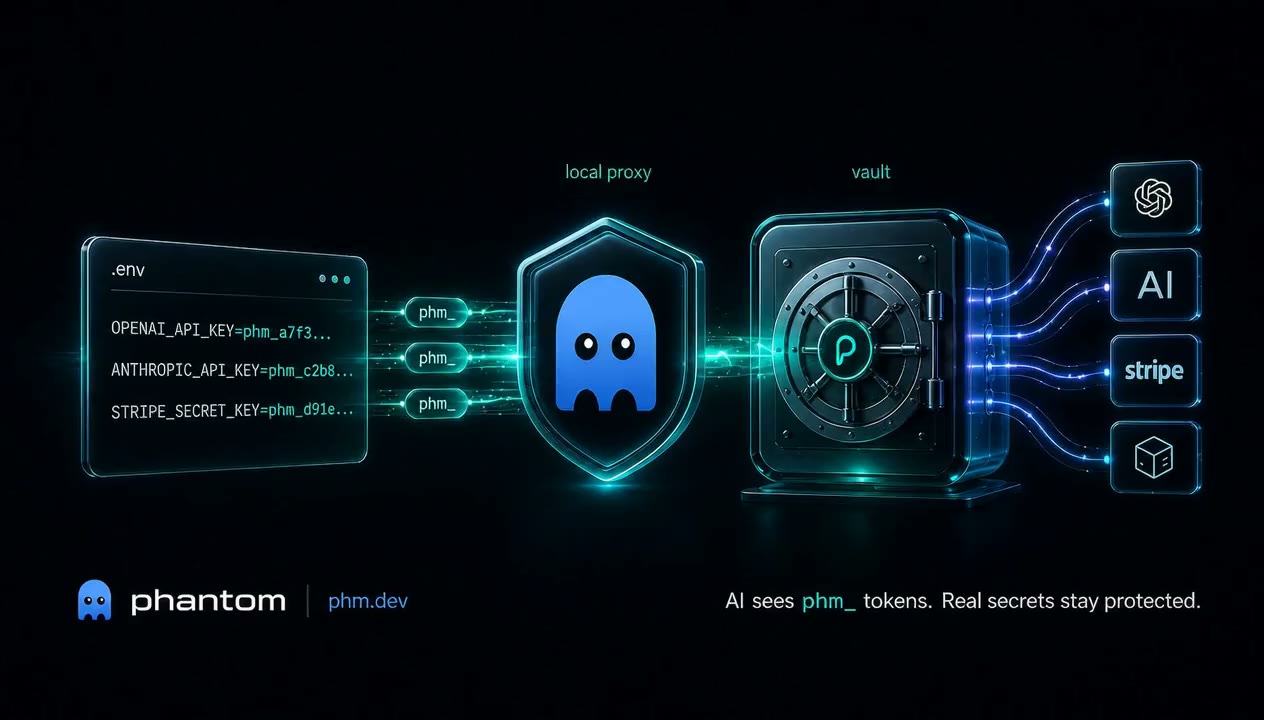
Phantom replaces project secrets with scoped phm_ placeholders. Applications use those placeholders through an authenticated local proxy, while agents use value-blind MCP tools for inventory, diagnostics, and governed requests.






Quick start · Delegate safely · Why Phantom? · MCP setup · Docs · Contribute · phm.dev

Install
brew tap ashlrai/phantom
brew trust --formula ashlrai/phantom/phantom
brew install ashlrai/phantom/phantom
macOS via Homebrew; installs phantom and phantom-mcp (reviewed v0.7.8). Linux and Windows:
use the matching release asset. Then run
phantom init in your project and phantom setup --client claude (or
cursor, windsurf, codex). Full walkthrough: Quick Start.
▶ Historical v0.4 demo — current behavior differs · 🛡 Security model · 📋 Threat model · 💬 Discussions
Start here
Choose the smallest path that answers your next question. The first path uses no credential, makes no network request, and does not install or configure Phantom.
| Goal | Start | What it establishes |
|---|---|---|
| See the delegation boundary with no secret or setup | Run node examples/first-five-minutes/run.mjs, then read the first-five-minutes walkthrough | A deterministic, read-only example contract; not vault, proxy, provider, or deployment acceptance. |
| Protect a real local project | Follow Quick Start with the reviewed v0.7.9 GitHub release | Local initialization and diagnostics on your machine. |
| Connect an AI coding client | Complete the first MCP task | Value-blind capability, status, and repository checks; no provider action. |
| Copy a tested client or CI setup | Run the Claude Code, Cursor, or GitHub Actions recipe (node examples/<name>/run.mjs) | Each recipe runs your phantom binaries (from PATH or --phantom <path>) in a temporary HOME with a fake, non-provider key and is exercised in CI. |
| Define a bounded task for an agent | Use the safe delegation quickstart | A reviewable task contract with explicit authority and acceptance boundaries. |
| Evaluate a team rollout | Use the enterprise adoption guide | A controlled evaluation plan; not a claim of commissioned cloud or enterprise service. |
| Audit the trust model first | Read the security model and threat model | Documented controls, assumptions, and residual risks. |
Why Phantom?
AI coding agents routinely work in repositories that also contain local credentials. Once a real API key enters an agent context, transcript, tool call, or generated file, you have lost control of where that value may persist.
Traditional secrets managers focus on keys at rest and in transit. Phantom adds a boundary for agent context:
- 🔒 Reduces one credential-exposure path — managed project dotenv files contain sensitive
phm_mappings, MCP responses remain value-blind, and exact proxy routes inject their own configured authentication values. Unmanaged files, broader shell authority, and same-user processes remain in the threat model. - ⚡ Fast local setup — after installing the reviewed
v0.7.9GitHub release,phantom initprotects a project without requiring an account, DNS changes, or a custom CA. - 🧰 Agent-native integrations — setup helpers and value-blind MCP workflows for Claude Code, Cursor, Windsurf, and Codex, plus project instructions for GitHub Copilot.
- 🦀 Open source, local-first, MIT — secrets use the native OS credential store when it is available, with an explicit encrypted-file fallback. Optional cloud sync encrypts vault payloads client-side before the server stores them.
Project status and trust boundary
Phantom's implemented user-facing surfaces are the CLI, vault, authenticated local proxy, MCP server, and optional cloud/team workflows documented below. Cloud and team behavior additionally depends on the deployed service, account plan, and provider configuration; source code alone is not deployment or customer-acceptance evidence. The conversation facade is intentionally narrow:
phantom_dois proposal-only. It canonicalizes a closed Cargo action and reports its digest, effect, and activation blockers;executeis hard denied.phantom_setup_workspacecan propose setup, create a bearerless request, and report authenticated status. Applying a request remains a separate trusted-terminal operation.- Advanced MCP tools remain a compatibility catalog, disabled by default, with separate explicit confirmation and informed terminal-approval gates. They are not governed by the conversation facade's capability card.
phantom grantretains value-blind lifecycle metadata and design-source foundations, but 0.7.9 hard-denies every live provider issuance/renewal path before credential or network access. A provider grant is not an execution-kernel authority grant, broker lease, or permission for an agent to execute work.- The authority, broker, runtime, session, and evidence crates are inactive, fail-closed foundations. They do not establish live Locus authority, broker credentials, execute agent actions, or produce externally trusted receipts today.
See the documentation map, architecture, security policy, and threat model for the evidence behind those boundaries.
Measured: leak rate on a scripted adversary
Reproduce with python3 eval/leak-rate/harness.py 5 (about 3 minutes, Linux, phantom 0.7.9; fake canary keys only, no paid keys). Method and limits: eval/leak-rate/README.md.
| setup | in-boundary attacks that exposed a canary key |
|---|---|
plain .env, no protection | 210 of 450 |
after phantom init | 0 of 450 |
450 = 30 attack techniques x 3 secrets x 5 runs (cat .env, printenv, /proc/self/environ, base64 and hex dumps, git add -f, ps eww, phantom reveal/export/exec, every MCP tool called with confirm=true, and a README prompt injection the scripted agent obeys). Per-technique table: eval/leak-rate/table.md.
What this does not show: it is a scripted worst case, not an LLM, so it measures where a key can appear, not how often a model goes looking. One out-of-scope case is reported separately: an unmanaged key file the developer never put in .env stays readable (15 of 15 in both setups). Same-user access to the OS keychain is outside the documented boundary and is not tested. Proxy use of a key on an allowed route is by design. One machine, no external audit.
Quick Start
Install both binaries from the reviewed v0.7.9 GitHub release.
On macOS, the Homebrew formula is the shortest path; it currently installs the
previous reviewed v0.7.8 binaries until the tap is bumped to v0.7.9:
$ brew tap ashlrai/phantom
$ brew trust --formula ashlrai/phantom/phantom
$ brew install ashlrai/phantom/phantom
For exact v0.7.9 on macOS, Linux, or Windows, use the matching release asset
in Installation. Then protect and verify the project:
$ phantom init
# Auto-detects .env, .env.local, or .env in subdirectories
# Stores real secrets in the native credential store or encrypted vault,
# then rewrites .env with phantom tokens
# Auto-configures Claude Code MCP server if detected

$ phantom agent doctor
# One human-readable readiness check for AI-agent safety

$ phantom exec -- claude
# Authenticated proxy running on an ephemeral 127.0.0.1 port
# App/test processes use phantom tokens; agents use value-blind metadata
For a task contract you can hand to Claude Code, Codex, Cursor, Windsurf, or Copilot, use the safe delegation quickstart and the copyable policy and task templates. Teams evaluating a controlled rollout can start with the enterprise adoption guide.
Windows
The same core command surface is implemented for native Windows, with remaining
native acceptance limits tracked in the platform matrix. Install the exact v0.7.9
Windows ZIP for your architecture from Installation, verify its
published .sha256 sidecar, and place both executables on PATH. WSL is a
separate Linux environment with its own filesystem and credential-store context.
For an explicitly supervised foreground proxy, run phantom start with stdin,
stdout, and stderr each attached to a trusted terminal. Terminal attachment is
an admission check, not proof of who controls a PTY. The CLI detects your shell and prints the matching env-var syntax;
copy those exports into the terminal that launches the client, keep the owning
terminal open, and press Ctrl-C there to stop. Detached --daemon mode and
external process control are fail-closed until Phantom has a separately reviewed
private cross-platform control channel. phantom stop only authenticates a
legacy v0.7.3 .phantom.pid session to report migration guidance; v0.7.3 had no
authenticated shutdown endpoint, so the new binary never kills that process or
deletes its record. Stop it from its owning v0.7.3 terminal with Ctrl-C, or use
the bounded recovery procedure in Troubleshooting.
For reference:
PowerShell:
$env:OPENAI_BASE_URL = "http://127.0.0.1:PORT/openai/_phantom/TOKEN/"
$env:PHANTOM_PROXY_PORT = "PORT"
$env:PHANTOM_PROXY_TOKEN = "TOKEN"
cmd.exe:
set OPENAI_BASE_URL=http://127.0.0.1:PORT/openai/_phantom/TOKEN/
set PHANTOM_PROXY_PORT=PORT
set PHANTOM_PROXY_TOKEN=TOKEN
Git Bash / WSL: use the export X=Y syntax from the main quick-start.
Notes:
PHANTOM_PROXY_TOKENis the proxy session authenticator. By default,phantom execandphantom startinclude it in local*_BASE_URLvalues as/_phantom/TOKEN/so unmodified SDKs work. Header-aware clients can setPHANTOM_PROXY_HEADER_AUTH_ONLY=1and sendx-phantom-proxy-token: $PHANTOM_PROXY_TOKENinstead.- If
phantom.exeis blocked by Windows application-control policy, do not automatically remove Mark-of-the-Web. First verify the archive checksum and both binary identities against the release metadata. If local policy permits the verified binaries, a user may then remove the mark explicitly with PowerShell:Get-ChildItem "$env:USERPROFILE\.phantom-secrets\bin\*.exe" | Unblock-File. - The pre-commit hook installed by
phantom initis a#!/bin/shscript. Native git from the command line invokes it via Git for Windows' bundledsh.exe, which is what the official Git for Windows installer ships. GUI clients (GitHub Desktop, some IDE integrations) may run with a stripped-downPATHthat lackssh.exeand silently skip the hook — for these, run commits from a terminal, or usephantom check --stageddirectly. CI is the durable safety net regardless. - The immutable
v0.7.9release contains x64 and ARM64 Windows ZIPs, and both native Windows rows passed the tag-bound release acceptance workflow. The archives are not Authenticode-signed; this receipt does not prove every enterprise application-control policy will accept them. See the platform support matrix.
How It Works
  .env file (AI read denied)       OS Keychain / Vault
  +--------------------------+      +---------------------+
  | OPENAI_API_KEY=phm_a7f3  | ---> | sk-real-secret-key  |
  | STRIPE_KEY=phm_c9d1...   |      | sk_live_real-key... |
  +--------------------------+      +---------------------+
           |                                 |
           v                                 v
  App / test process                Phantom Proxy (127.0.0.1)
  +--------------------------+      +------------------------------+
  | Loads phm_ tokens        |      | Intercepts HTTP requests     |
  | Agent gets MCP metadata  | ---> | Injects route-owned auth key |
  | Makes API calls to proxy |      | Forwards over TLS to real API|
  +--------------------------+      +------------------------------+
phantom initreads.env, stores real secrets in the native OS credential store or encrypted-file fallback, and rewrites.envwithphm_tokensphantom exec -- claudestarts a local reverse proxy, sets SDK-compatible service base URLs such asOPENAI_BASE_URL=http://127.0.0.1:PORT/openai/_phantom/TOKEN/, exposesPHANTOM_PROXY_TOKENto the child process, and launches the command- API calls hit the proxy, which authenticates the local session, removes its local auth token, injects only the matched route's vault value into that route's exact configured authentication header, and forwards over TLS. Client-controlled headers and bodies never resolve
phm_tokens. - When the session ends, the proxy shuts down and its bearer is invalid.
phantom execalso replaces project tokens with fresh child-process tokens for that run. Projectphm_values persist until rotation; they are not provider credentials and are never client-resolved, but a process controlling an authenticated active proxy can still invoke its configured provider routes.
Phantom does not grant AI tools permission to read .env or other dotenv files. phantom setup removes legacy Phantom-managed dotenv read grants and preserves deny rules; agents use value-blind MCP inventory instead.
Provider grants
phantom grant retains value-blind lifecycle metadata and provider protocol
design foundations. In 0.7.9, all live provider issuance, enrollment exchange,
refresh, renewal, and revocation execution is hard-denied before Phantom reads a
provider credential or opens a provider network connection. Do not use grant or
rotation commands expecting a vendor-side change. Test-only mocks demonstrate
local transaction behavior only; they are not live-provider acceptance.
In these docs, provider grant means design-era credential lifecycle metadata;
no live grant flow runs in 0.7.9. Authority grant means the inactive, value-free execution
authority type in phantom-authority. A provider grant cannot be reinterpreted
as an authority grant, Locus credential, broker lease, or execution permit. See
the design-era grant lifecycle specification; the
issuance contract is the original design contract and
retains design-era status language.
MCP Integration (Claude Code, Cursor, Windsurf, Codex)
Phantom ships an MCP server so AI coding tools can inspect value-blind metadata and request gated lifecycle operations. MCP responses do not return real secret values.
First MCP task: verify the boundary
Use this read-only path before exploring the full tool catalog:
- Install both binaries from the reviewed
v0.7.9GitHub release. - From the project you want to inspect, run
phantom setup --client codex, replacingcodexwithclaude,cursor, orwindsurfwhen appropriate. - Restart the AI client so it loads the generated MCP configuration.
- Ask the client: “Call
phantom_capability, thenphantom_status. Report the value-blind authority, hard denials, project ID, dotenv protection counts, and service mappings. Do not request or reveal secret values.” - Ask the client: “Call
phantom_checkwith no arguments. Report findings without changing files or credentials.”
These calls inspect the configured local surface. They do not prove that cloud, team, deployment, provider, authority-kernel, or customer workflows are active or accepted.
- Conversation facade —
phantom_capabilityreports authority and hard denials for the small facade (not the separately gated advanced compatibility catalog);phantom_docanonicalizes one closed Cargo action and reports the exact activation blockers without executing it;phantom_setup_workspaceproposes an exact value-blind plan, creates a bearerless apply request after revalidation, or reads authenticated request status. Provisioning the machine-local seal key and creating a request both requireconfirmplus an out-of-band approval token; MCP never claims or applies the request. - Vault —
phantom_list_secrets,phantom_status,phantom_init,phantom_add_secret_interactive,phantom_add_secret(deprecated; refuses plaintext),phantom_remove_secret,phantom_rotate,phantom_copy_secret - Detection + diagnostics —
phantom_doctor,phantom_why,phantom_check,phantom_env,phantom_validate_secret,phantom_validate_all - Local-to-cloud —
phantom_wrap,phantom_unwrap,phantom_sync,phantom_cloud_push,phantom_cloud_pull,phantom_cloud_status - Teams —
phantom_team_list,phantom_team_create,phantom_team_members,phantom_team_invite,phantom_team_key_publish,phantom_team_vault_push,phantom_team_vault_pull - Advanced audit, rotation, expiry, and compliance —
phantom_audit_recent,phantom_audit_stats,phantom_audit_analytics,phantom_audit_anomalies,phantom_audit_anomalies_realtime,phantom_audit_hotspot_alerts,phantom_audit_incidents,phantom_leak_incidents_realtime,phantom_audit_alerts,phantom_audit_export_report,phantom_compliance_status,phantom_rotate_with_candidate,phantom_rotate_promote,phantom_rotate_provider,phantom_rotate_with_expiry,phantom_list_with_expiry,phantom_secret_rotation_due,phantom_validation_schedule,phantom_validation_history,phantom_secrets_expiry_check,phantom_secrets_auto_rotate,phantom_expiry_enforce,phantom_rotation_schedule_next,phantom_apply_expiry_policy
phantom_secrets_auto_rotate and phantom_rotate_with_expiry are deprecated
compatibility names for approved local phm_ token remaps. They do not rotate
a provider credential, renew TTL/rotated_at metadata, clear leak incidents,
or sync credentials. phantom_rotate_provider is also hard-denied before
credential or network access in 0.7.9. Team invites may assign only member or admin; ownership transfer
is not an invite role.
Tools that write state, retrieve or use credentials, or make provider/network
requests are disabled by default. They can reach their confirm: true and
one-use approval_token gates only when the operator sets
PHANTOM_MCP_EFFECTS=trusted-terminal in a server environment outside agent
authority. phantom mcp-approve requires attached stdin/stderr, shows the
bounded value-blind effect plus exact parameters, and requires a fresh typed
challenge before approval. A same-user shell or agent-controlled PTY can
defeat that ceremony; leave effects disabled unless the approval command and
~/.phantom approval storage are outside the requesting agent's authority.
Conditional tools keep
their inspection mode ungated and activate both gates only for the effectful
parameters. Real secret values are never accepted as MCP tool arguments; new
secrets are entered out-of-band in a trusted terminal. The exact 54-tool names,
descriptions, and JSON schemas are mirrored from runtime tools/list into
mcp-registry/server.json, and release smoke tests
reject any drift.
phantom_rotate_with_candidate and phantom_rotate_promote remain in the
54-tool compatibility catalog as deprecated hard denials. They never create,
validate, or promote a candidate and never change vault or shadow metadata;
phantom_rotate_provider is also hard-denied before credential or network
access in 0.7.9. phantom add creates new names only and refuses existing-name
replacement before reading a value. Replacing a credential therefore requires
a separately reviewed provider rotation plus an explicit trusted-terminal
remove-and-add sequence; those are distinct, non-atomic operations.
Workspace setup is deliberately split across trust boundaries. MCP can call
phantom_setup_workspace with phase=propose, then phase=request_apply using
the exact returned plan_id and pre_state_id. The first proposal requires
dual approval only when it must provision the machine-local plan-seal key;
request_apply always requires dual approval because it persists a value-free
request outside the repository. Apply it from an attached trusted terminal
with phantom workspace apply --request <ID>; MCP has no claim or apply
operation.
One command per AI client — Phantom writes the right config file in the right place:
phantom setup --client claude     # project MCP; see docs/claude-code.md for v0.7.9 migration
phantom setup --client cursor     # ~/.cursor/mcp.json
phantom setup --client windsurf   # ~/.codeium/windsurf/mcp_config.json
phantom setup --client codex      # ~/.codex/config.toml
phantom setup --client gemini     # ~/.gemini/settings.json (Gemini CLI)
phantom setup --client claude --print   # snippet to stdout for any other client
Install both v0.7.9 release binaries before setup. Version 0.7.9 records the
running phantom executable with mcp serve when it can resolve that executable,
otherwise it looks for a local standalone phantom-mcp. Setup has no network
package-runner fallback and fails closed when neither local runtime is
executable. Inspect the generated entry, then restart the AI tool so it picks up
the new config.
Phantom's stdio MCP server can be configured in MCP clients that support local command servers. The setup writer currently has reviewed presets for Claude Code, Cursor, Windsurf, Codex, and Gemini CLI; other clients require their own compatible configuration.
Cloud backup + Dashboard
Back up and restore a vault on the same keychain machine with client-side encryption. Phantom Cloud receives the encrypted vault payload rather than the decrypted secret values; endpoint, client, account, and OS-keychain security remain part of the trust boundary. The cloud encryption key is generated and stored in the local OS keychain. Phantom does not currently ship key transfer or recovery, so account sign-in without that key cannot decrypt this backup. Login, logout, cloud push/pull, and browser open are not headless agent actions: run them with stdin, stdout, and stderr attached to a terminal outside the requesting agent's authority and complete each fresh exact typed challenge. The public hosted service is not currently commissioned for authenticated cloud or dashboard use. The commands below document the source-backed flow for a future verified deployment and entitled account; they are not a live-service acceptance receipt.
$ phantom login
# Opens GitHub OAuth (device code flow)

$ phantom cloud push
# After commissioning: encrypted client-side and uploaded to the configured service

$ phantom cloud pull   # restore on the machine that holds the original cloud key
# Downloaded and decrypted locally

$ phantom open
# After commissioning: opens the configured read-only dashboard.
Cloud backup uses ChaCha20-Poly1305 with a random client-side passphrase stored in the OS keychain and derived via Argon2id for encryption. The server stores only ciphertext. Team vaults are separate: they wrap a shared vault key to each registered member's X25519 public key; that does not make personal cloud backups portable.
Team vaults (source-backed pilot)
The repository includes fixed-membership team-vault workflows intended for a
planned hosted Pro pilot. Pilot eligibility, team and vault limits, and pricing
are TBD; no self-serve checkout is commissioned. The
service path stores ciphertext plus per-member encrypted key shares. Team roles
gate invitation management, but all members can read and write the shared vault;
member removal and atomic offboarding rotation are not shipped. Treat this as a
pilot capability until the hosted service and account entitlement are commissioned.
CLI team mutations require the same attached trusted-terminal ceremony before
credential, keypair, vault-value, or network access. MCP team reads and writes
are provider requests and remain disabled by default behind confirm plus a
one-use out-of-band approval token.
$ phantom team create "engineering"
# Creates a team; you become the owner.

$ phantom team invite <team_id> <github-username>
# Invites by GitHub login.

$ phantom team key-publish <team_id>
# Registers your X25519 public key on the team.
# (Run once per team; the private key stays in the OS keychain.)

$ phantom team vault-push <team_id>
# Encrypts the current project's vault with a fresh symmetric key,
# wraps that key (X25519 + ChaCha20-Poly1305) for every member that
# has a registered public key, then uploads.

$ phantom team vault-pull <team_id>   # on a teammate's machine
# Pulls, decrypts the per-member share with their private key,
# decrypts the vault, writes secrets locally.
Experimental: X-Wing hybrid team share
The pq-hybrid cargo feature adds an experimental X-Wing (X25519 + ML-KEM-768)
team key share. It is off by default and does not change default behavior: the
default build keeps the X25519 share described above. The X-Wing share is local
only. phm.dev does not accept it yet, because the hosted team key route takes
32-byte public keys and an X-Wing public key is 1216 bytes. The x-wing and
ml-kem crates are unaudited, and X-Wing is pre-1.0. Do not rely on it for
production secrets.
After a hosted deployment is commissioned and accepted, its read-only team dashboard is designed to show team memberships and member lists.
Command Reference
| Command | Description |
|---|---|
phantom init | Import .env secrets into vault and rewrite with phantom tokens. Use --empty to initialize a new project before its first phantom add; add does not auto-create project state. --all <DIR> processes eligible repositories found by the bounded five-level scan; discovery stops below the first matching repository. Use --dry-run to inspect the exact set and --jobs N / -j N to control parallelism. An existing .env.example is left unchanged. |
phantom exec -- <cmd> | Start an authenticated proxy and run a command with secret injection |
phantom start | Run an explicitly supervised foreground proxy; keep its trusted terminal open and press Ctrl-C there to stop |
phantom start --daemon / phantom stop | Detached start fails closed; stop is a TTY-only legacy-state diagnostic that never kills or deletes, not current process control |
phantom list | Show secret names stored in vault (never values; --json for machine-readable output) |
phantom add <KEY> | Create a new secret name transactionally in an initialized project through a hidden terminal prompt or trusted --stdin producer; existing names are denied before any value read and are never replaced |
phantom remove <KEY> | After exact trusted-terminal confirmation, transactionally remove the vault value, lifecycle config, and exact managed-dotenv mapping; headless use fails before value access or mutation |
phantom reveal <KEY> | From an attached trusted terminal, review and type the exact challenge before printing one value or copying it for an auto-cleared 30-second clipboard window |
phantom status | Show vault/mapping state and whether the machine-local lifecycle lock is held; a held lock does not authenticate or identify a listener |
phantom rotate | After an exact attached-terminal challenge bound to the project, config, managed dotenv, and sorted protected-name digest, regenerate every local phantom token (old mappings become invalid). Headless use fails before vault access or mutation. Provider-backed --name/--provider execution is hard-denied before credential or network access in 0.7.9. |
phantom grant add <provider> | Reserved provider-enrollment surface; hard-denied before credential or network access in 0.7.9. See Provider grants. |
phantom grant list / status | Read provider-grant names, providers, lifecycle state, and expiry metadata without returning credential values. |
phantom grant revoke <provider> | Reserved remote-revocation surface; currently fails closed before local mutation because provider revocation is not wired. |
phantom doctor | Check configuration and vault health (--fix to auto-repair). Reports install source, vault backend, audit-log status, Argon2 params, and MCP wiring per client |
phantom agent report | Emit a read-only AI-agent readiness report (--json for automation). Reports unsafe, protected, verified, team-ready, or compliance-ready |
phantom agent doctor | Human-readable agent readiness view backed by the same policy engine |
phantom agent setup | Preview or apply safe defaults for agent use (--dry-run first, --apply to write changes) |
phantom workspace plan [--json] | Build an exact sealed setup plan and create a value-free pending request; does not change the workspace or vault |
phantom workspace apply --request <ID> | Recompute and claim the exact request in an attached trusted terminal, require typed confirmation, then apply transactionally with rollback on failure |
phantom workspace status --request <ID> [--json] | Read authenticated, value-free request state |
phantom vault migrate-linux | From an attached trusted terminal on a headed Linux desktop, copy and exactly verify this project's keyutils credentials in Secret Service, retain the source entries, and publish the private backend marker last |
phantom check | Scan for unprotected secrets (pre-commit hook, --staged, --runtime) |
phantom sync | Push secrets to Vercel / Railway (--dry-run --json previews safely; --only PATTERN filters by glob, repeatable) |
phantom pull | Pull secrets from Vercel / Railway into vault |
phantom setup | Wire Phantom into an AI client. --client claude (default), cursor, windsurf, codex, or gemini. Add --print to emit the config snippet to stdout. --status is read-only: it reports which clients have Phantom wired (--json for automation) |
phantom mcp serve | Run the MCP stdio server in-process; this is the entry phantom setup writes into AI-client configs |
phantom mcp-approve <NONCE> | From an attached trusted terminal, review the bounded value-blind effect and exact parameters for a pending MCP nonce, type its fresh challenge, and receive the one-use approval_token |
phantom env | Generate .env.example for team onboarding |
phantom export | From an attached trusted terminal, review an exact value-blind plan, type its fresh challenge, and enter a dedicated passphrase through the hidden prompt. Export --passphrase-file, plaintext export, argv passphrases, existing targets, symlinks, and paths outside the project fail closed. |
phantom import | From an attached trusted terminal, review and type the exact source/target/name/overwrite challenge before restoring a backup or importing Doppler, Infisical, dotenvx, 1Password, or env data. --force selects the reviewed overwrite set but never bypasses consent. A bounded private passphrase file is accepted only on non-Windows platforms and still requires the terminal ceremony. |
phantom audit show | Print recent audit events from the newest 8 MiB of the log (--last N, --op OP, --name NAME, --json); says when older events were not examined or lines were skipped. Requires PHANTOM_AUDIT=1 |
phantom audit tail | Follow the audit log live (--op, --name filters) |
phantom audit path | Print the absolute path to the audit log file |
phantom audit verify | Verify HMAC-SHA256 chain integrity; exits 1 if tampering detected |
phantom leaks plan | Read-only dry run of what leak response would do for active incidents (--min-confidence, --json). Writes nothing, makes no network calls, prints names only. Reads the optional [leak_response] policy (`on_leak = "off" |
phantom login | From an attached trusted terminal, approve an exact network plan, then separately approve browser opening/polling and keychain persistence |
phantom logout | From an attached trusted terminal, approve deletion of persistent cloud authorization from the OS keychain |
phantom cloud push | After exact trusted-terminal confirmation, push a client-encrypted vault. A remote success followed by local reconciliation failure is partial success and must not be retried automatically. |
phantom cloud pull | After exact trusted-terminal confirmation, pull and decrypt a vault. With force=false, skipped existing entries preserve the prior merge base and block later push until a fully reconciled approved pull. |
phantom cloud status | Authenticated provider read; requires attached trusted terminals and an exact challenge before stored-bearer or network access |
phantom wrap | Wrap package.json scripts with phantom exec automatically |
phantom unwrap | Restore original package.json scripts |
phantom watch | Watch managed dotenv files and report new unprotected secrets. --auto hard-denies before mutation in 0.7.9; use transactional phantom init. |
phantom why <KEY> | Explain why a key is or is not protected and how phantom exec delivers it (no_route means no built-in proxy route injects it). Works before init; --json prints the same shape as MCP phantom_why |
phantom copy <KEY> | Copy a secret to an initialized target after exact trusted-terminal confirmation; refuses existing target vault, config, or managed-dotenv ownership rather than overwriting |
phantom team list/members | Authenticated, value-blind provider reads. CLI requires attached trusted terminals and an exact challenge before bearer/network access; MCP requires confirm plus out-of-band approval. |
phantom team create/invite/key-publish/vault-push/vault-pull/rotate-vault | Run CLI team effects only from an attached trusted terminal and complete the exact challenge before credential, keypair, vault-value, or network access. Invites assign only member or admin. |
phantom validate / --watch | Send selected credentials to configured validators only after exact trusted-terminal consent; watch authorization ends when config or the vault name set changes |
phantom validate schedule | Read status without mutation; setting or disabling persistent scheduler policy requires attached terminals and an exact typed challenge |
phantom expiry set | Persist lifecycle policy only after attached-terminal confirmation; expiry enforce is read-only, while expiry rotate is only a deprecated local token remap |
phantom secrets-expiring-soon | List expired or expiring secrets (--days N, default 7; --json). --auto-rotate is a deprecated local phm_ token remap only; provider credentials and expiry metadata stay unchanged, and --sync is rejected |
phantom open [page] | From an attached trusted terminal, open only the reviewed aliases dashboard, billing, team, docs, pricing, github, issues, or site; arbitrary URLs, paths, and unknown aliases are rejected |
phantom upgrade | --check-only performs a read-only version lookup only for an eligible standalone install. Live standalone replacement requires attached terminals and two exact challenges; managed installs route to their owner, ambiguous installs fail closed, and --force is rejected. |
phantom completion <shell> | Print a shell-completion script (bash, zsh, fish, powershell, elvish) |
phantom crypto inventory | List the algorithms and format tags Phantom uses, with role, status and quantum class (--format text or json). Reads no vault, key, or config; not a CycloneDX CBOM |
Rotating real provider credentials
Phantom 0.7.9 does not execute live provider issuance or rotation. Every
provider path—single-provider CLI, batch CLI, MCP, grant enrollment, additive
issuance, and destructive/rolling refresh—is hard-denied before provider
credential access and before network I/O. Operators must rotate at the vendor,
then use Phantom's trusted local secret-entry path. Source adapters and exact
cfg(test) mocks are transaction-design evidence, not provider activation,
commissioning, or acceptance.
Provider support matrix
| Provider | Support | Notes |
|---|---|---|
vercel | Hard denied | Additive issuance can orphan a live successor after a local failure; no provider call in 0.7.9 |
google | Hard denied | Secret Manager version creation remains disabled pending durable successor recovery and verified abort |
github | Hard denied | GitHub App installation-token issuance remains disabled pending the same recovery contract |
stripe | Hard denied | Raw keys are manual; rolling OAuth refresh can invalidate the predecessor before successor recovery |
aws | Hard denied | SigV4 access-key-pair rotation is not implemented |
sentry | Hard denied | Installation-token issuance remains disabled pending durable successor recovery |
supabase | Hard denied | PAT rotation is manual; OAuth/additive issuance paths are not commissioned |
phantom rotate --batch remains metadata-only discovery/manual guidance and
fails closed before vendor execution. No single-provider exception exists.
Features
- Encrypted vault -- macOS Keychain, Linux keyutils by default, or Windows Credential Manager, with a ChaCha20-Poly1305 encrypted-file fallback for CI and headless environments. Linux keyutils entries do not survive a reboot; a headed Linux project can run
phantom vault migrate-linuxfrom a trusted terminal to copy and verify its vault in persistent Secret Service before switching. Phantom does not claim Secure Enclave hardware binding. Argon2id uses m=64 MiB, t=3, p=1. - Phantom tokens -- 256-bit CSPRNG
phm_placeholders in.env, rotatable on demand - Authenticated proxy sessions -- each proxy run generates a fresh
PHANTOM_PROXY_TOKEN; CLI-generated SDK URLs include it for compatibility, and header-aware clients can opt intox-phantom-proxy-tokenwithPHANTOM_PROXY_HEADER_AUTH_ONLY=1 - Route-owned credential injection -- Client headers and bodies never resolve
phm_tokens. After authenticating and matching an exact built-in route, the proxy injects that route's configured vault secret only into its fixed authentication header; a missing mapping fails before any upstream call. Request bodies are still collected under a hard byte cap before forwarding. - Full SSE/streaming support -- Response streaming preserved end-to-end for OpenAI, Anthropic, and other streaming APIs
- Smart detection -- Heuristic engine distinguishes secrets (
*_KEY,*_TOKEN,sk-*,ghp_*) from config (NODE_ENV,PORT) - Platform sync -- Push/pull secrets to Vercel and Railway
- Pre-commit hook -- Runs
phantom check --stagedwhen Git invokes the hook; it checks staged dotenv content plus a bounded set of hardcoded-key prefixes. Hooks can be bypassed or skipped, so CI and a broader secret scanner remain necessary. - MCP server -- value-blind vault, diagnostics, cloud, team, audit, rotation, validation, expiry, and compliance responses for Claude Code, Cursor, Windsurf, and Codex; effectful compatibility tools remain separately gated and disabled by default
- Cloud backup -- client-encrypted same-keychain-machine backup and restore; key transfer and recovery are not shipped, and deployed-service and account configuration remain separate operational gates
- Export/import -- Encrypted export requires an attached terminal, exact challenge, and hidden passphrase; export passphrase files, plaintext, and argv passphrases are disabled. Import uses its own exact terminal ceremony; only non-Windows encrypted-backup import may read a bounded private passphrase file. Competitor imports support Doppler, Infisical, dotenvx, 1Password, and plain
.env. - Tamper-evident audit log --
PHANTOM_AUDIT=1writes vault events as JSONL to~/.phantom/audit.log. Each entry is chained with HMAC-SHA256;phantom audit verifydetects tampering.phantom audit show/tail/pathfor log access. - Response scrubbing -- Scrubs configured secret values from supported API response paths before returning data to the caller
- Script wrapping --
phantom wrapwraps selected runtime/build scripts (dev,start,serve,build,deploy,preview) and deliberately leaves test, lint, type, and format scripts alone - Watch mode --
phantom watchreports new unprotected secrets; legacy--autohard-denies before mutation, so protection stays a reviewed transactionalphantom init - Multi-project scanner --
phantom init --all <DIR>processes eligible repositories found within a five-level bounded scan and stops below the first matching repository; use--dry-runto verify the exact set and--jobs Nto control parallelism - Multi-IDE setup --
phantom setup --client claude|cursor|windsurf|codex|geminiwrites the right MCP config for each AI tool, or--printfor a generic snippet - Agent readiness --
phantom agent doctorandphantom agent report --jsonreport bounded protection findings and activation gaps; they do not certify a repository or agent as safe - Enriched diagnostics --
phantom doctorreports install source, vault backend, audit-log status, Argon2 params, and MCP wiring per client - Secret explainer --
phantom why <KEY>explains detection heuristics - Cross-project copy --
phantom copyshares secrets between project vaults - Team vaults -- Fixed-membership encrypted sharing; owner/admin roles gate invitations, while current vault access is member-wide and offboarding rotation is not shipped
- Fail-closed service routing -- agentic proxy sessions accept Phantom's exact built-in OpenAI, Anthropic, Stripe, Supabase, and other reviewed routes; repository-defined destinations are rejected pending trusted-terminal approval support
- Threat model -- See THREAT_MODEL.md for assets, actors, mitigations, and known gaps
Installation
Homebrew (macOS; formula currently at v0.7.8)
Homebrew 6 requires explicit formula trust for third-party taps:
$ brew tap ashlrai/phantom
$ brew trust --formula ashlrai/phantom/phantom
$ brew install ashlrai/phantom/phantom
This formula installs both phantom and phantom-mcp from the immutable
v0.7.8 GitHub release.
It has not yet been bumped to v0.7.9. Until it is, a Homebrew install writes
Claude Code MCP registration to the legacy location; see the
Claude Code guide for the manual .mcp.json step, or use
the v0.7.9 assets below.
Exact v0.7.9 GitHub assets
Use the asset matching your OS and architecture. Download its adjacent
.sha256 file from the release, verify it before extraction, and place both
phantom and phantom-mcp (.exe on Windows) on PATH.
| Platform | v0.7.9 archive | Published checksum |
|---|---|---|
| macOS Apple Silicon | phantom-aarch64-apple-darwin.tar.gz | sha256 |
| macOS Intel | phantom-x86_64-apple-darwin.tar.gz | sha256 |
| Linux x86_64 | phantom-x86_64-unknown-linux-gnu.tar.gz | sha256 |
| Linux ARM64 | phantom-aarch64-unknown-linux-gnu.tar.gz | sha256 |
| Windows x64 | phantom-x86_64-pc-windows-msvc.zip | sha256 |
| Windows ARM64 | phantom-aarch64-pc-windows-msvc.zip | sha256 |
On Linux, verify with sha256sum -c <archive>.sha256. On Windows, compare
Get-FileHash -Algorithm SHA256 <archive> with the published sidecar.
Build the exact release source
The v0.7.9 tag resolves to source commit
7a51ce512ec4aee12cc29ff859036af63fbe93db:
$ git clone https://github.com/ashlrai/phantom-secrets.git
$ cd phantom-secrets
$ git checkout 7a51ce512ec4aee12cc29ff859036af63fbe93db
$ cargo build --release --locked --bin phantom --bin phantom-mcp
Do not treat unpinned package-manager commands as v0.7.9. In the exact
2026-09-29 registry snapshot, npm latest remains 0.6.0; the immutable npm 0.7.4 wrappers
exist only under release-candidate after failing cross-platform acceptance.
No npm 0.7.9, crates.io 0.7.9, or MCP Registry 0.7.9 publication is
represented by this GitHub release receipt. Homebrew is separately published
and verified through its tap, and currently remains at v0.7.8.
Release-state snapshot
[!IMPORTANT] Release-state snapshot (verified 2026-09-29): the current release is the immutable
v0.7.9GitHub release at source commit7a51ce512ec4aee12cc29ff859036af63fbe93db. Its 19-asset release set, checksums, archive-specific SPDX SBOMs, GitHub provenance and SBOM attestations, and all six native release rows are bound to that immutable release record by tag-bound workflow 34153902556. Exact public registry endpoints were requeried on 2026-09-29. The Homebrew formula still installs the previous reviewedv0.7.8until its tap is bumped; npmlatestremains0.6.0, and the npm0.7.4wrappers remain quarantined underrelease-candidateafter failed npm-channel acceptance. The GitHub receipt alone does not prove the separately verified Homebrew formula, an npm or crates.io package, MCP Registry entry, hosted-service commissioning, provider activation, signing/notarization, certification, or customer acceptance. See release readiness and platform support.
Connect an MCP client
$ phantom setup --client claude # or cursor, windsurf, codex, gemini
Architecture
The Rust workspace is organized as product crates plus fail-closed execution-kernel foundations. Presence in the workspace does not mean a foundation is activated in production.
| Layer | Crate | Role and current status |
|---|---|---|
| Product | phantom-core | Config, dotenv parsing/rewriting, tokens, auth, cloud client, audit, validation, and shared policy. |
| Product | phantom-vault | VaultBackend trait, OS keychain and encrypted-file backends, and shared cryptography. |
| Product | phantom-proxy | Authenticated loopback reverse proxy with fixed route-owned auth-header injection, inert client tokens, response scrubbing, and streaming support. |
| Product | phantom-cli | Operator CLI for initialization, proxy lifecycle, readiness, audit, import/export, sync, team, and workspace workflows. |
| Product | phantom-mcp | Stdio MCP server. The governed conversation facade is narrow; the advanced compatibility catalog uses separate legacy gates. |
| Product | phantom-core/src/issuance, CLI grant | Provider protocol/design foundations and value-free grant metadata. All live provider issuance/enrollment execution is hard-denied before credential or network access in 0.7.9. |
| Local effect layer | phantom-core::fs, phantom-vault transactions | Retained project/config directory capabilities, exact identity/content/permission before-images, no-follow targets, single-link checks, and typed durable, committed-verified-with-durability-warning, or CommittedButUncertain (Partial) effects. |
| Setup kernel | phantom-workspace | Value-blind discovery, sealed planning, and recoverable trusted-terminal setup transactions. Non-Unix durable mutation fails closed. |
| Inactive foundation | phantom-authority | Closed authority contracts and deny-all production verification boundary. No live Locus verifier. |
| Inactive foundation | phantom-locus-contract | Value-free compatibility contract describing requirements for a future Phantom/Locus integration. |
| Inactive foundation | phantom-broker | Bounded broker protocol and durable replay/accounting primitives. No active transport, lease issuer, or runtime connection. |
| Inactive foundation | phantom-runtime | Closed engineering action schemas with a deny-all production executor. |
| Inactive foundation | phantom-session | Crash-explicit session journal. Not wired into active execution. |
| Inactive foundation | phantom-evidence | Value-free evidence and receipt primitives. Not externally anchored or wired into active execution. |
Project-local effects resolve from the retained root acquired with the project transaction lock; global editor configuration is separately bounded beneath a retained user-config authority. A renamed ambient path and replacement decoy do not redirect those in-progress governed writes. These controls are not a same-user sandbox: local locks coordinate Phantom writers, and another process with equivalent user authority remains inside the threat model. See the architecture, threat model, and platform evidence matrix.
Initialization retains the reviewed project-root identity and exact dotenv/config leaf snapshots before vault provisioning, then revalidates root and leaf identity, bytes, and permissions under the project lock before mutation. On Windows, new private anchored files/directories establish a protected current-user DACL before content bytes, while replacements preserve the reviewed exact DACL and inheritance state before writing. Those Windows properties are source contracts; protected native Windows CI acceptance remains pending.
CommittedVerifiedButDurabilityUncertain is committed, exactly verified
success with a value-free warning/receipt and must not be rolled back or
retried. CommittedButUncertain is the distinct Partial case requiring
operator reconciliation because verification or durability remains unresolved.
Vault-backed mutations resolve machine-local vault/application authority before the project transaction lock, then compare the acquired root identity and reread the exact config through that lock. This avoids the shared process-environment/project-lock inversion without trusting project bytes during the gap.
Phantom also tracks a pinned Rama-derived engineering standard for explicit network stacks, modular crates, runnable examples, and tiered platform CI. Rama is a benchmark, not a dependency, and the comparison is not a feature or platform-parity claim.
apps/web contains the Next.js site and backend routes for cloud vault sync, GitHub device authentication, and Stripe billing. The repository source and local tests are separate evidence from the currently deployed state at phm.dev.
Registry tracks: npm latest currently resolves
phantom-secrets and
phantom-secrets-mcp at
0.6.0. Exact 0.7.4 wrappers remain public only under release-candidate
after failing native npm-channel acceptance; do not use that candidate as the
reviewed v0.7.9 GitHub release path.
CI runs locked, all-target workspace builds and tests on macOS, Linux, and Windows runner environments, plus formatting, Clippy, and npm release-mapping checks. Release builds and native end-to-end acceptance are separate evidence layers; see Platform support.
Security
- Managed dotenv replacement -- after successful initialization, Phantom-managed dotenv values are tokens; unmanaged files, backups, logs, and external tools remain outside this claim
- ChaCha20-Poly1305 encryption for file vault and cloud sync, Argon2id key derivation
- Client-encrypted cloud vaults -- the cloud vault API stores ciphertext; decryption happens in the authenticated client. This claim does not cover plaintext sent intentionally to deployment providers during
phantom sync. - 256-bit CSPRNG tokens --
phm_prefix distinguishes Phantom tokens from supported real-key formats; random collisions are cryptographically negligible, not mathematically impossible - Proxy binds 127.0.0.1 only -- not bound to a non-loopback interface; same-user local-process and bearer theft remain in the threat model
- Targeted memory zeroization for major vault retrieval, serialization, and decrypted-file buffers; some proxy lookup copies remain ordinary strings, so zeroization is defense in depth rather than a complete memory-erasure guarantee
- Allowlist model -- proxy only injects secrets for explicitly configured service patterns
See SECURITY.md for the responsible disclosure policy and THREAT_MODEL.md for the full threat model (assets, actors, mitigations, known gaps, cryptography summary).
Open source and commercial offerings
| Current offering | What it covers | Commercial boundary |
|---|---|---|
| Open source ($0) | Use, modify, and distribute the local CLI, vault, proxy, MCP server, and deployment-sync workflows under MIT | No hosted entitlement or support commitment is included |
| Enterprise (written scope) | Reversible evaluation, environment-specific integration, security review, and support terms | Scope, deliverables, price, schedule, and acceptance are defined in a separate agreement |
| Government (written scope) | Bounded public-sector evaluation and integration in a named non-production environment | No authorization, certification, contract vehicle, procurement schedule, hosted service, or SLA is represented |
A Pro hosted pilot remains roadmap direction only. It is not a current public
offering, has no commissioned self-serve checkout, and has no published price
or entitlement. See the enterprise adoption guide
for shipped-versus-planned gates, or contact mason@ashlr.ai to discuss a
written scope.
Links
- phm.dev -- Hosted site; deployment and authenticated acceptance remain separate from source
- Documentation map
- Getting Started Guide
- Safe delegation quickstart
- Enterprise adoption guide
- Agent delegation templates
- Examples index
- Security Model
- Threat Model
- Roadmap
- Troubleshooting
- Changelog
- Contributing
- Support
- Governance
- Citation
Part of the Ashlr ecosystem
Phantom Secrets is one of the open-source tools from Ashlr, a forward-deployed engineering company. Its siblings: Lexicon, Locus, Ashlr Stack, Ashlr Markdown, Ashlr plugin.
Contributing
Focused contributions are welcome. Start with
CONTRIBUTING.md, the
examples index, or a
discussion. The
project does not assume that a good first issue label is populated. Follow
CODE_OF_CONDUCT.md, and use
SECURITY.md rather than a public issue for vulnerabilities.
Star history
License
MIT — see LICENSE.