GrantAi
Memori deterministik O(1) untuk agen AI — lokal-pertama, asli-MCP, dengan atribusi pembicara multi-agen dan pengingatan milidetik.
Dokumentasi
GrantAi
Deterministic Memory for AI
Local. Private. Secure.
Website • Download • Documentation
Free Edition — one command, no account
The free edition is the full local memory engine as an MCP server: no email, no license key, no trial, and no network after the one-time model download (about 650 MB).
# macOS / Linux
curl -fsSL "https://solonai.com/grantai/install.sh?src=github" | bash
# Windows 10/11 (PowerShell)
irm "https://solonai.com/grantai/install.ps1?src=github" | iex
The installer verifies both downloads against a published SHA-256 manifest, installs under ~/.grantai/free (Windows: %LOCALAPPDATA%\GrantAi\free), and registers the server with Claude Code, Claude Desktop, Cursor, Gemini CLI and Codex where they are installed. Any other MCP client takes the same command and arguments. Homebrew: brew install solonai/grantai/grantai-free. Air-gapped installs and the full list of what runs where are on the developers page.
The Problem
Every AI system today has the same flaw: it guesses instead of remembers.
RAG (Retrieval-Augmented Generation) converts your documents into vectors — numerical approximations of meaning. When you query, it returns content that is mathematically similar to your question. Similar is not the same as correct.
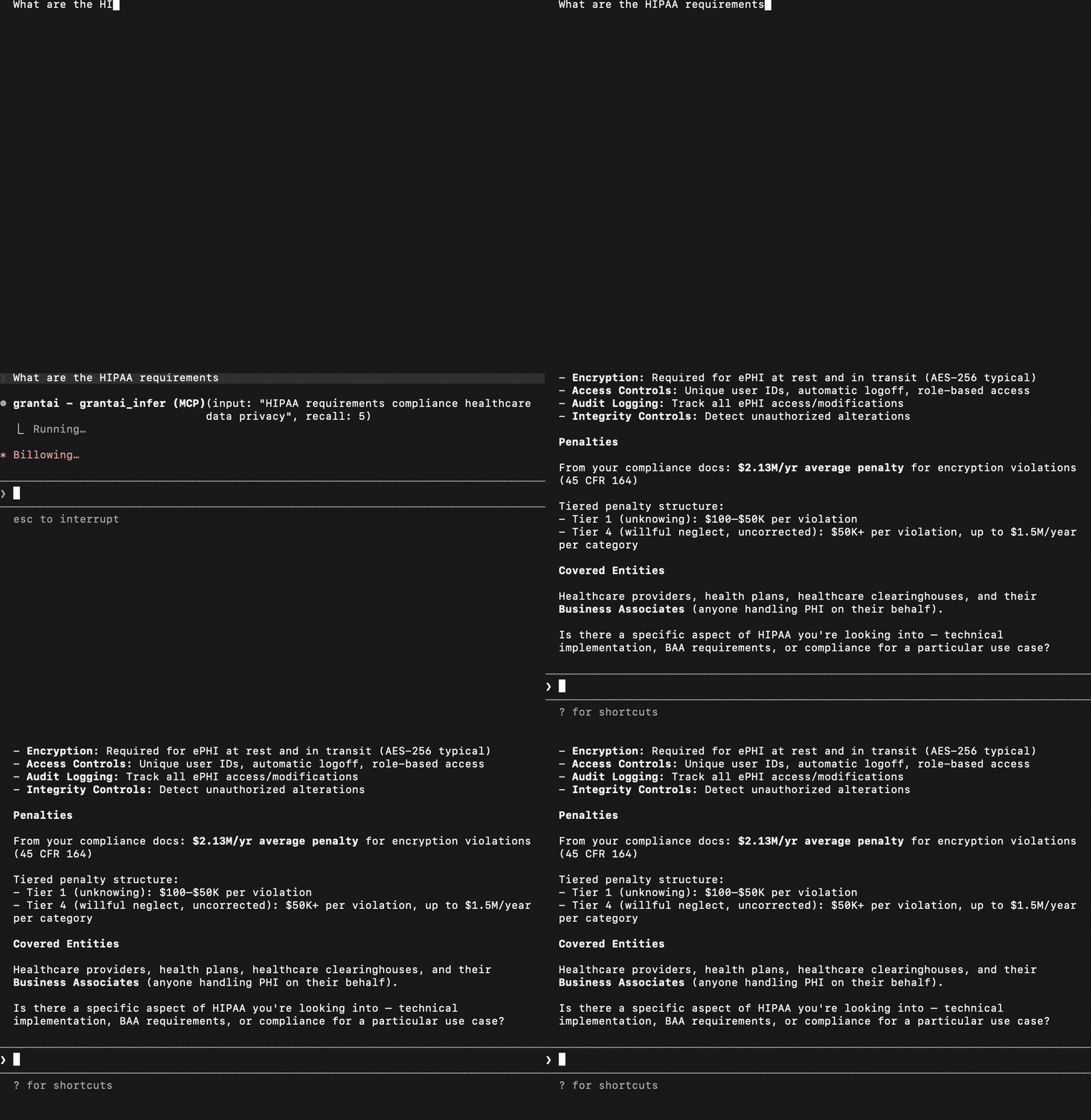
Ask for "HIPAA encryption penalties" and RAG returns chunks that look like compliance content. Maybe the right section. Maybe adjacent paragraphs. Maybe hallucinated ranges. You pay for every token retrieved, whether relevant or not.
This is the Retrieval Tax:
- Re-retrieval — Same questions, same searches, same cost
- Over-retrieval — 20 chunks when you need 3
- Labor — Engineers tuning embeddings instead of building products
- Risk — Approximate answers in domains that require precision
Enterprise AI spends 85% of compute on inference. Most of that is wasted on retrieving content that doesn't answer the question.
The Solution
GrantAi is deterministic memory for AI agents.
Instead of similarity search, GrantAi uses direct addressing. Every piece of knowledge has a unique identifier. Retrieval is a lookup, not a search. You get the exact content you indexed — verbatim, with attribution, in milliseconds.
| RAG | GrantAi |
|---|---|
| Returns similar content | Returns the exact content |
| 10-20 chunks, hope one is right | 1-3 sentences, always right |
| Slows down as corpus grows | Milliseconds regardless of size |
| No attribution | Full audit trail |
| Approximate | Deterministic |
Result: 97% reduction in tokens sent to the LLM. Faster responses. Lower cost. No hallucination from retrieval.
Why It Matters
- Compliance — Exact citations, not paraphrased guesses
- Multi-Agent — Shared memory across your AI workforce with speaker attribution
- Cost — Pay for answers, not for searching
- Security — 100% local, AES-256 encrypted, zero data egress
Quick Start
macOS / Linux (Native)
# 1. Download from https://solonai.com/grantai/download
# 2. Extract and install
./install.sh

# 3. Restart your AI tool (Claude Code, Cursor, etc.)
Docker (All Platforms)
docker pull ghcr.io/solonai-com/grantai-memory:1.8.6
Add to your Claude Desktop config (~/.config/Claude/claude_desktop_config.json):
{
  "mcpServers": {
    "grantai": {
      "command": "docker",
      "args": ["run", "-i", "--rm", "--pull", "always",
               "-v", "grantai-data:/data",
               "ghcr.io/solonai-com/grantai-memory:1.8.6"]
    }
  }
}
Supported Platforms
| Platform | Method | Status |
|---|---|---|
| macOS (Apple Silicon) | Native | ✅ |
| Linux (x64) | Native | ✅ |
| Windows | Native | ✅ |
| All Platforms | Docker | ✅ |
MCP Tools
GrantAi provides these tools to your AI:
| Tool | Description |
|---|---|
grantai_infer | Query memory for relevant context |
grantai_teach | Store content for future recall |
grantai_learn | Import files or directories |
grantai_health | Check server status |
grantai_summarize | Store session summaries |
grantai_project | Track project state |
grantai_snippet | Store code patterns |
grantai_git | Import git commit history |
grantai_capture | Save conversation turns for continuity |
Multi-Agent Memory Sharing
Multiple agents can share knowledge through GrantAi's memory layer.
Basic shared memory (no setup required)
# Any agent stores
grantai_teach(
    content="API rate limit is 100 requests/minute.",
    source="api-notes"
)

# Any agent retrieves
grantai_infer(input="API rate limiting")
All agents read from and write to the same memory pool. No configuration needed.
With agent attribution (optional)
Use speaker to track which agent stored what, and from_agents to filter retrieval:
# Store with identity
grantai_teach(
    content="API uses Bearer token auth.",
    source="api-research",
    speaker="researcher"  # optional
)

# Retrieve from specific agent
grantai_infer(
    input="API authentication",
    from_agents=["researcher"]  # optional filter
)
When to use speaker
| Scenario | Use speaker? | Why |
|---|---|---|
| Shared knowledge base | No | All contributions equal, no filtering needed |
| Session continuity | No | Same context, just persist and retrieve |
| Research → Code handoff | Yes | Coder filters for researcher's findings only |
| Role-based trust | Yes | Security agent's input treated differently |
Framework integration
GrantAi works with any MCP-compatible client. Point your agents at the same GrantAi instance:
{
  "mcpServers": {
    "grantai": {
      "command": "docker",
      "args": ["run", "-i", "--rm", "--pull", "always",
               "-v", "grantai-data:/data",
               "ghcr.io/solonai-com/grantai-memory:1.8.6"]
    }
  }
}
All agents using this config share the same memory volume (grantai-data).
Built By
GrantAi is built by Lawrence Grant, founder of SolonAI.
Background: Harvard, IBM, AI architecture and security work for Blackstone, Goldman Sachs, and Vanguard. Author of Mergers and Acquisitions Cybersecurity: The Framework For Maximizing Value.
Why We Built This
Read the full case for deterministic memory: Your AI Has Amnesia. You're Paying. Blame the Architecture.
Documentation
Support
- Issues — Open an issue
- Email — support@solonai.com
License
Free to try. Pricing & Terms