ProxmoxMCP-Plus
Server MCP Proxmox VE untuk VM, LXC, snapshot, backup, penyimpanan, dan operasi klaster.
Dokumentasi
ProxmoxMCP-Plus

Operate Proxmox VE from MCP clients, AI agents, and OpenAPI tooling through one security-conscious control plane for VMs, LXCs, snapshots, backups, ISOs, container commands, and persistent long-running jobs.




Quick Start | Client Install | Demo | Tools | Safety | Scenarios | Docs | Wiki
Why ProxmoxMCP-Plus
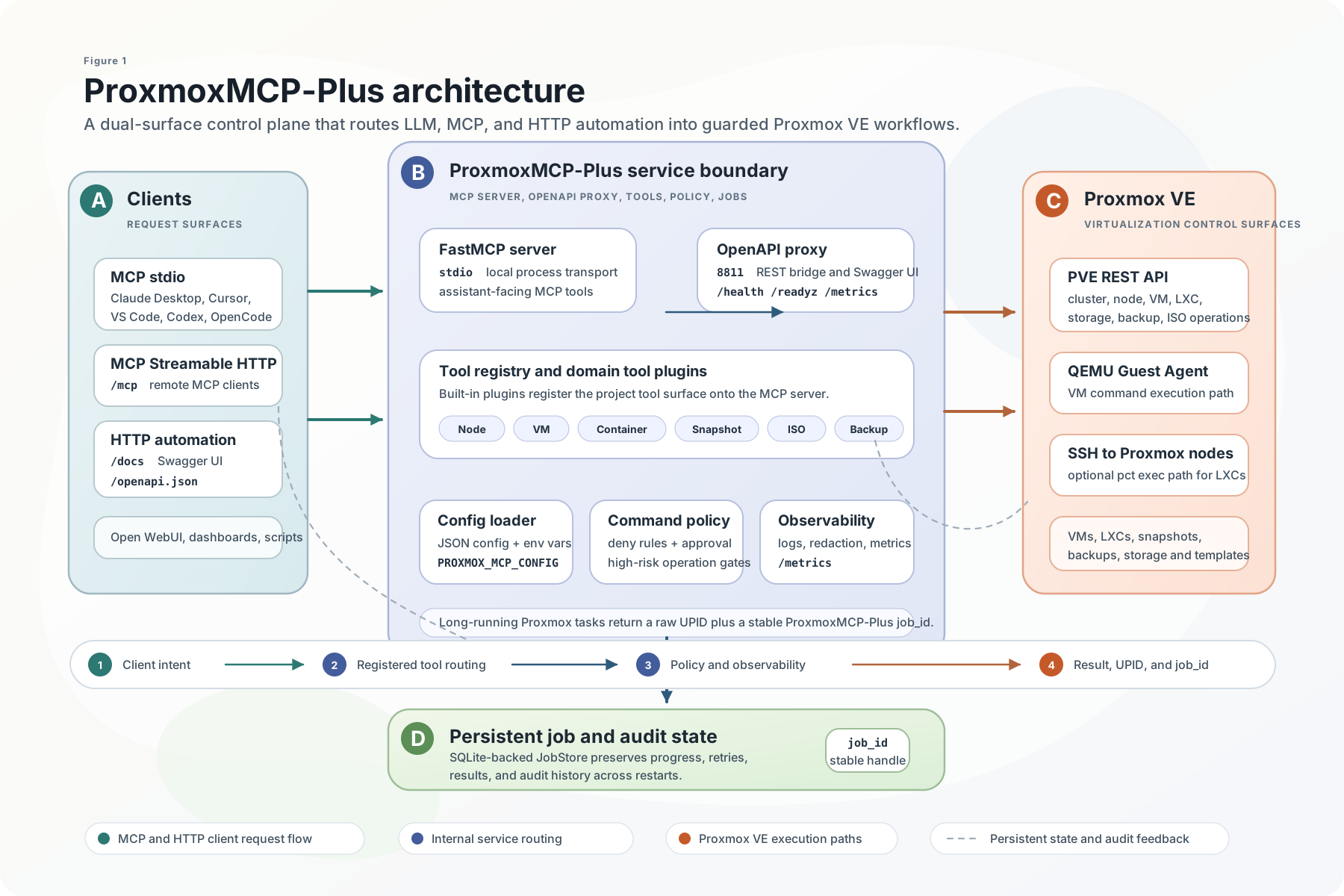
ProxmoxMCP-Plus sits between AI clients and Proxmox VE so operators do not have to stitch together raw API calls, one-off shell scripts, and custom job polling for every workflow.
It exposes the same operational surface in two ways:
MCPfor Claude Desktop, Cursor, VS Code, Open WebUI, Codex, and other MCP-capable agentsOpenAPIfor HTTP automation, dashboards, internal tools, and no-code workflows
What you get:
- VM and LXC lifecycle actions
- snapshot create, rollback, and delete
- backup and restore workflows
- ISO download and cleanup
- node, storage, and cluster inspection
- SSH-backed container command execution with guardrails
- persistent job tracking for async Proxmox tasks
What Makes It Different
| Priority | How the project handles it |
|---|---|
| Dual access paths | Native MCP for agent workflows and OpenAPI for standard HTTP automation |
| Proxmox-oriented workflows | Day-2 VM, LXC, snapshot, backup, ISO, storage, and cluster operations |
| Long-running operations | Stable job_ids, Proxmox UPID tracking, polling, retry, cancel, and audit history |
| Safer execution | Proxmox API tokens, OpenAPI bearer auth, command policy, approval tokens, TLS validation, and MCP HTTP Host/Origin controls |
| Real validation | Unit, integration, Docker/OpenAPI, and live Proxmox e2e entry points are documented in the repo |
Quick Start
1. Prepare Proxmox Credentials
Create a Proxmox API token with only the permissions your workflows need. Then create the local config file:
cp proxmox-config/config.example.json proxmox-config/config.json
Then edit proxmox-config/config.json with your environment. At minimum, it needs:
proxmox.hostproxmox.portauth.userauth.token_nameauth.token_value
Add an ssh section as well if you want container command execution.
Add a jobs section if you want job state persisted somewhere other than the default local SQLite file.
For real live verification, use a separate proxmox-config/config.live.json created from proxmox-config/config.live.example.json.
Do not point live e2e at a placeholder or local-only config.json unless you intentionally run a local API tunnel there.
Optional job persistence config:
{
  "jobs": {
    "sqlite_path": "proxmox-jobs.sqlite3"
  }
}
Optional tool exposure filtering can reduce the schemas sent to MCP clients. It is
disabled by default, so existing configurations continue to expose every available
tool. Configure exactly one mode under mcp:
{
  "mcp": {
    "tool_allowlist": ["get_nodes", "get_vms", "get_containers", "get_storage"]
  }
}
Alternatively, use tool_denylist, or the comma-separated environment variables
MCP_TOOL_ALLOWLIST and MCP_TOOL_DENYLIST. Do not configure both modes. Environment
selection replaces the file-level filtering mode. An empty allowlist exposes no tools;
an empty denylist hides none. Exact lowercase tool names are required, and unknown names
fail startup so a typo cannot silently widen access. Restart or reconnect the MCP server
after changing the filter.
2. Choose One Runtime Path
| Path | Best for | Start command | Verify |
|---|---|---|---|
| MCP stdio from PyPI | Claude Desktop, Cursor, VS Code, Codex, local agents | uvx proxmox-mcp-plus | client lists get_nodes, get_vms, and job tools |
| Native MCP HTTP from Docker | remote MCP clients that support Streamable HTTP | docker compose --profile mcp-http up -d proxmox-mcp-http | connect to http://localhost:8000/mcp |
| OpenAPI bridge from Docker | HTTP clients, dashboards, scripts, no-code tools | docker compose up -d | curl -f http://localhost:8811/livez |
MCP stdio with PyPI
uvx proxmox-mcp-plus
Or install it first:
pip install proxmox-mcp-plus
proxmox-mcp-plus
Use this path when the MCP client launches a local stdio server.
Native MCP HTTP with Docker
Use this path when a remote MCP client supports Streamable HTTP:
export MCP_API_KEY="$(openssl rand -hex 32)"
docker run --rm -p 8000:8000 \
  -e PROXMOX_MCP_MODE=mcp-http \
  -e MCP_HOST=0.0.0.0 \
  -e MCP_PORT=8000 \
  -e MCP_TRANSPORT=STREAMABLE_HTTP \
  -e MCP_API_KEY="$MCP_API_KEY" \
  -v "$(pwd)/proxmox-config/config.json:/app/proxmox-config/config.json:ro" \
  ghcr.io/rekklesna/proxmoxmcp-plus:latest
Point MCP clients at:
http://<docker-host>:8000/mcp
Send Authorization: Bearer <MCP_API_KEY> with every MCP HTTP request. MCP_API_KEY
is deliberately separate from the OpenAPI-only PROXMOX_API_KEY, so the two surfaces
can be rotated independently. If MCP_API_KEY is unset, Streamable HTTP remains
unauthenticated for backward compatibility and logs a security warning at startup.
When serving MCP HTTP behind a reverse proxy, keep DNS rebinding protection enabled and allow only the hostnames you expect:
docker run --rm -p 8000:8000 \
  -e PROXMOX_MCP_MODE=mcp-http \
  -e MCP_HOST=0.0.0.0 \
  -e MCP_PORT=8000 \
  -e MCP_TRANSPORT=STREAMABLE_HTTP \
  -e MCP_API_KEY="$MCP_API_KEY" \
  -e MCP_DNS_REBINDING_PROTECTION=true \
  -e MCP_ALLOWED_HOSTS=mcp.example.com:*,localhost:* \
  -e MCP_ALLOWED_ORIGINS=https://mcp.example.com \
  -v "$(pwd)/proxmox-config/config.json:/app/proxmox-config/config.json:ro" \
  ghcr.io/rekklesna/proxmoxmcp-plus:latest
OpenAPI bridge with Docker
OpenAPI mode is the default Docker runtime and requires an API key:
export PROXMOX_API_KEY="$(openssl rand -hex 32)"
docker run --rm -p 8811:8811 \
  -e PROXMOX_API_KEY="$PROXMOX_API_KEY" \
  -v "$(pwd)/proxmox-config/config.json:/app/proxmox-config/config.json:ro" \
  ghcr.io/rekklesna/proxmoxmcp-plus:latest
Verify the OpenAPI surface:
curl -f http://localhost:8811/livez
curl -f -H "Authorization: Bearer $PROXMOX_API_KEY" http://localhost:8811/health
curl -H "Authorization: Bearer $PROXMOX_API_KEY" http://localhost:8811/openapi.json
For local unauthenticated development only, set PROXMOX_ALLOW_NO_AUTH=true.
Source checkout
git clone https://github.com/RekklesNA/ProxmoxMCP-Plus.git
cd ProxmoxMCP-Plus
uv venv
uv pip install -e ".[dev]"
python main.py
The 8811 service is the OpenAPI/REST bridge. The 8000 service is the native MCP HTTP endpoint.
Client Install
Use the one-click buttons when your client supports MCP install deeplinks, or copy the JSON config below.


Recommended stdio config:
{
  "mcpServers": {
    "proxmox-mcp-plus": {
      "command": "uvx",
      "args": ["proxmox-mcp-plus"],
      "env": {
        "PROXMOX_HOST": "your-proxmox-host",
        "PROXMOX_USER": "root@pam",
        "PROXMOX_TOKEN_NAME": "mcp-token",
        "PROXMOX_TOKEN_VALUE": "your-token-secret",
        "PROXMOX_PORT": "8006",
        "PROXMOX_VERIFY_SSL": "true"
      }
    }
  }
}
Use a local config file if you prefer not to keep credentials in the client config:
{
  "mcpServers": {
    "proxmox-mcp-plus": {
      "command": "uvx",
      "args": ["proxmox-mcp-plus"],
      "env": {
        "PROXMOX_MCP_CONFIG": "/path/to/ProxmoxMCP-Plus/proxmox-config/config.json"
      }
    }
  }
}
Client-specific examples for Claude Desktop, Cursor, VS Code, Codex, OpenCode, Open WebUI, Streamable HTTP, and OpenAPI are in the Client Setup Guide and Integrations Guide.
Demo
This demo is a direct terminal recording of qwen/qwen3.6-plus driving a live MCP session in English against a local Proxmox lab. It shows natural-language control flowing through MCP tools to create and start an LXC, execute a container command, and confirm the authenticated HTTP /health surface.

Choose The Right Tool
Start with read-only discovery, then move to mutating tools only after the target node, storage, VMID, and permissions are clear.
| Operator goal | Start with | Then use | Notes |
|---|---|---|---|
| Inspect the cluster | get_nodes, get_cluster_status | get_storage, get_vms, get_containers | Best first health check after client install |
| Create or manage a VM | get_nodes, get_storage | create_vm, start_vm, stop_vm, delete_vm | Long-running mutations return job_id and Proxmox task_id |
| Manage LXCs | get_containers, get_storage | create_container, start_container, stop_container, delete_container | SSH-backed command tools require the optional ssh config |
| Roll back risky changes | list_snapshots with vm_type=qemu or vm_type=lxc | create_snapshot, rollback_snapshot, delete_snapshot | Create a snapshot before destructive workflow tests |
| Run commands inside guests | VM or container status tools | execute_vm_command, execute_container_command | VM path needs QEMU Guest Agent; LXC path needs SSH to the Proxmox node |
| Track async work | mutation response with job_id | poll_job, get_job, list_jobs, retry_job, cancel_job | Use job_id for agent/user conversations and task_id for raw Proxmox traceability |
| Inspect logs | get_node_syslog, get_cluster_log | get_task_log, get_node_firewall_log, get_guest_firewall_log | All log tools are read-only; get_task_log accepts any Proxmox UPID |
| Automate from HTTP tools | /openapi.json | /jobs, /health, generated tool routes | Use bearer auth and keep CORS restricted outside local development |
For the full tool map, see the Tool Selection Guide and API & Tool Reference.
Safety Model
ProxmoxMCP-Plus is an access layer, not a replacement for Proxmox RBAC, network controls, or client-side MCP approval prompts.
The project gives operators several control points:
- Proxmox API tokens decide what the backend can do.
PROXMOX_API_KEYprotects the OpenAPI bridge by default.MCP_API_KEYoptionally protects the native Streamable HTTP/mcpendpoint with Bearer authentication.- TLS verification is enforced unless development mode is explicitly enabled.
command_policycontrols command execution and high-risk operations.approval_tokencan gate command execution and high-risk mutating actions.- MCP Streamable HTTP deployments can use DNS rebinding protection plus Host and Origin allowlists.
- Optional MCP tool allowlists or denylists reduce the runtime tool surface; they do not replace Proxmox RBAC.
- Logs are designed to avoid exposing command and credential material.
Read the Security Guide before exposing the server outside a trusted local environment.
Core Platform Capabilities
ProxmoxMCP-Plus provides a unified control surface for the operational tasks most teams actually need in Proxmox VE. The same server can expose these workflows to MCP clients for LLM and AI-agent use cases, and to HTTP consumers through the OpenAPI bridge.
Supported workflow areas:
| Capability Area | Availability |
|---|---|
| VM create / start / stop / delete | Available |
| VM snapshot create / rollback / delete | Available |
| Backup create / restore | Available |
| ISO download / delete | Available |
| LXC create / start / stop / delete | Available |
| Container SSH-backed command execution | Available |
| Container authorized_keys update | Available |
| Persistent job store for long tasks | Available |
MCP job control tools (list_jobs, get_job, poll_job, cancel_job, retry_job) | Available |
OpenAPI /jobs endpoints with explicit status codes | Available |
Local OpenAPI /livez, /readyz, /health, and schema | Available |
Docker native MCP Streamable HTTP at /mcp | Available |
Docker image build and /livez | Available |
Validation and contract entry points in this repository:
pytest -q --cov=proxmox_mcp --cov-report=term-missing --cov-fail-under=75ruff check .mypy src --ignore-missing-importspip-audit -r requirements.txttests/integration/test_real_contract.pytests/scripts/run_real_e2e.py
tests/scripts/run_real_e2e.py now prefers proxmox-config/config.live.json or PROXMOX_MCP_E2E_CONFIG.
This avoids accidentally running live checks against a machine-specific default config.json.
Long-Running Jobs
Many Proxmox mutations are asynchronous. ProxmoxMCP-Plus now wraps those tasks in a persistent job layer so MCP and OpenAPI clients can track them through a stable Job ID.
Long-running tools such as VM create/start/stop, container create/start/stop, snapshot changes, backup/restore, and ISO download/delete now return both:
task_id: the raw ProxmoxUPIDjob_id: the stable server-side job record
The job record stores:
- current status and progress
- retry count and prior
UPIDs - latest result payload or failure reason
- audit history for create, poll, retry, and cancel actions
By default the job store persists to proxmox-jobs.sqlite3, so restart does not lose in-flight or completed job metadata.
MCP Job Tools
list_jobsget_jobpoll_jobcancel_jobretry_job
OpenAPI Job Routes
When the OpenAPI proxy is enabled and a local JobStore is available, these routes are exposed directly:
| Path | Method | Purpose | Success Codes |
|---|---|---|---|
/jobs | GET | list persisted jobs | 200 |
/jobs/{job_id} | GET | fetch one job, optional refresh=true | 200 |
/jobs/{job_id}/poll | POST | refresh status from Proxmox | 200 |
/jobs/{job_id}/cancel | POST | request cancellation | 202 |
/jobs/{job_id}/retry | POST | replay a stored retry recipe | 202 |
Common error codes:
404: unknownjob_id409: the job exists but that operation is not valid now503: the OpenAPI proxy was started without a localJobStore
tests/scripts/run_real_e2e.py now prefers proxmox-config/config.live.json or PROXMOX_MCP_E2E_CONFIG.
This avoids accidentally running live checks against a machine-specific default config.json.
Positioning Against Common Approaches
| Capability | Official Proxmox API | One-off scripts | ProxmoxMCP-Plus |
|---|---|---|---|
| MCP for LLM and AI agent workflows | No | No | Yes |
| OpenAPI surface for standard HTTP tooling | No | Usually no | Yes |
| VM and LXC operations in one interface | Low-level only | Depends | Yes |
| Snapshot, backup, and restore workflows | Low-level only | Depends | Yes |
| Persistent async job tracking and retry | No | Rare | Yes |
| Container command execution with policy controls | No | Custom only | Yes |
| Docker distribution path | No | Rare | Yes |
| Repository-level live-environment verification | N/A | Rare | Yes |
Scenario Templates
Ready-to-copy examples live in docs/examples/:
These are written for both human operators and LLM-driven usage.
Documentation
The README is intentionally optimized for fast GitHub comprehension. Longer operational docs live in docs/wiki/ and can also be published to the GitHub Wiki.
| If you need to... | Start here |
|---|---|
| Understand the project and deployment flow | Wiki Home |
| Configure and run against a Proxmox environment | Operator Guide |
| Connect Claude Desktop, Cursor, VS Code, Codex, Open WebUI, or HTTP clients | Client Setup Guide |
| Choose the right tool for a workflow | Tool Selection Guide |
| Review docs quality goals, media plan, and publishing checklist | Documentation Quality Plan |
| Review integration patterns and transport details | Integrations Guide |
| Install from MCP-aware IDEs and agents | Agent Installation |
| Enable LXC command execution over SSH | Container Command Execution |
| Review security and command policy | Security Guide |
| Inspect tool parameters, prerequisites, and behavior | API & Tool Reference |
| Debug startup, auth, or health issues | Troubleshooting |
| Work on the codebase or release it | Developer Guide |
| Review release and upgrade notes | Release & Upgrade Notes |
Published wiki:
Repo Layout
src/proxmox_mcp/: MCP server, config loading, security, OpenAPI bridgemain.py: MCP entrypoint for local and client-driven usagedocker-compose.yml: HTTP/OpenAPI runtimerequirements/: auxiliary dependency sources and runtime install listsscripts/: helper startup scripts for local workflowstests/scripts/run_real_e2e.py: live Proxmox and Docker/OpenAPI pathtests/: unit and integration coveragedocs/examples/: scenario-driven prompts and HTTP examplesdocs/wiki/: longer-form operator, integration, and reference docs
Development Checks
pytest -q --cov=proxmox_mcp --cov-report=term-missing --cov-fail-under=75
ruff check .
mypy src --ignore-missing-imports
pip-audit -r requirements.txt
python -m build
Paramiko 5.0.0 or newer is required so pip-audit can run without a CVE-2026-44405 exception.