health-os
Simpan catatan kesehatan pribadi Anda di Postgres lokal Anda sendiri dan biarkan klien MCP mana pun (termasuk model lokal) bekerja dengannya: tahap dan setujui hasil lab dari PDF, lacak tren, obat-obatan, diagnosis, perangkat wearable, dan log makanan dengan profil 41 nutrisi. Aturan keselamatan adalah kode deterministik, bukan penilaian LLM: peringatan nilai kritis, data lab yang tertunda hingga disetujui, penolakan interaksi obat, dan protokol krisis.
Dokumentasi
health-os

Local-first personal health record, exposed over MCP. Your labs, diagnoses, medications, wearable data and food log live in your own Postgres; any MCP client — one running a local model or a cloud assistant — can read and update them through guarded tools. Critical values, drug-safety rules and screening schedules are deterministic code, not LLM judgement.
Medical disclaimer. This is not a medical device and does not give medical advice. Critical-value alerts and screening reminders are only a signal to contact a doctor — never a diagnosis and never a reason to delay care. Use at your own risk.
What it does
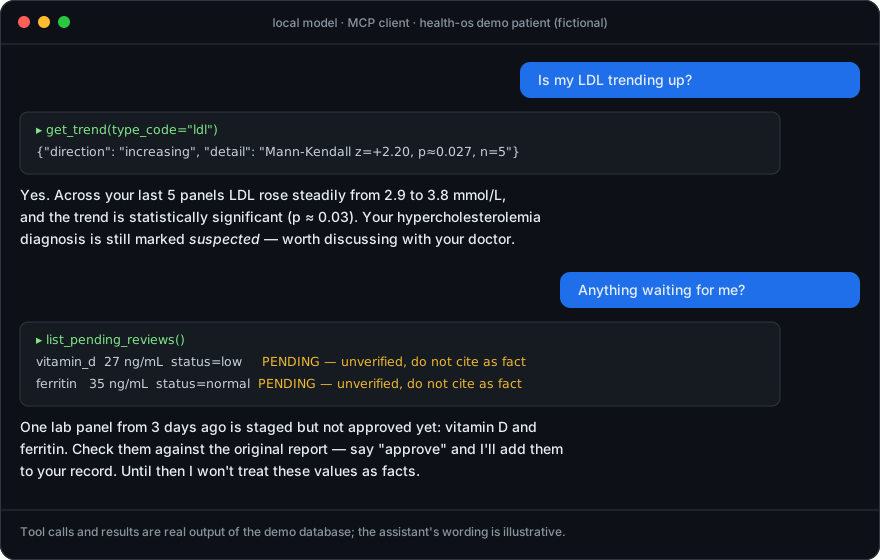
- Lab results — drop a PDF or photo into your MCP client; the model extracts the values, health-os normalizes names (uk/ru/en/Latin synonyms) and units, and stages the panel as pending. Nothing counts as fact until you approve it.
- Safety net in code — critical values alert immediately (log, macOS notification, optional Telegram); critical findings in narrative reports are flagged; drug-interaction questions are refused and redirected to a doctor/pharmacist (only deterministic checks run: total daily paracetamol across products, biotin before lab tests); a crisis tool returns a fixed response with hotlines, independent of the model.
- Trends and analytics — Mann-Kendall trends, personal baselines and anomalies, age-gated risk calculators, a screening calendar, a weekly report, a doctor-visit brief.
- Food log — meals with a 41-nutrient profile, %RDA, deficiency/excess flags, meal templates.
- Devices — Apple Health export and Garmin import.
- 28 MCP tools + server instructions — the safety rules are sent to every client on connect; see mcp_server/README.md.
Try it in one command
Only Docker needed. Starts a throwaway database with a fictional patient — two years of labs (LDL creeping up), blood pressure, medications, a food log and a lab panel awaiting approval:
git clone https://github.com/andronaft/health-os && cd health-os/demo
docker compose up -d --build
Point your MCP client at it:
{
  "mcpServers": {
    "health-os-demo": {
      "command": "docker",
      "args": ["run", "-i", "--rm", "--network", "health-os-demo",
               "-e", "DATABASE_URL=postgresql+psycopg://health:demo@db:5432/health_os",
               "health-os:local"]
    }
  }
}
Ask "show my health summary", "is my LDL trending up?", "what's pending review?",
"what am I short on nutritionally?". Remove it all with docker compose down -v.
Install for your own data
Requires Docker and Python 3.12+.
git clone https://github.com/andronaft/health-os && cd health-os
cp .env.example .env                  # set the passwords
docker compose up -d db               # Postgres 16 + pgvector
python3 -m venv .venv && .venv/bin/pip install -e ".[dev]"
.venv/bin/alembic upgrade head        # schema
.venv/bin/python -m seed.load         # marker catalog, synonyms, units, nutrients
.venv/bin/python -m seed.demo         # optional: a fictional demo patient to play with
Then connect an MCP client — config for LM Studio, Open WebUI, Ollama CLI and Claude is in mcp_server/README.md. Try: "show my health summary", "LDL trend", "what am I short on nutritionally this week?".
Local models: the server speaks standard MCP over stdio, so any MCP client that runs a local model can use it. Verified so far: the server itself with the official MCP Python client (CI + the Docker demo). Not yet verified end-to-end with a local model — see #9; reports welcome.
How it works
MCP client (local or cloud model)
        │ stdio
   mcp_server/  ── read tools ──▶ approved views (read-only role, 5s timeout, row limits)
        │        ── write tools ─▶ core/services: normalize → status → critical rules → pending
        │
   safety/    critical values, narrative flags, interactions, crisis, alerts
   analytics/ trends, baselines, calculators, screening, nutrition, weekly report
        │
   PostgreSQL 16 + pgvector  ◀── ingestion/ (Apple Health, Garmin, embeddings)
| Directory | What's inside |
|---|---|
core/ | config, DB, normalization, services, dedup, health summary |
mcp_server/ | MCP server, read and write tools |
safety/ | deterministic safety rules and alert delivery |
analytics/ | trends, baselines, calculators, screening, nutrition, reports |
ingestion/ | extraction schema, confidence scoring, device importers, embeddings |
migrations/ | Alembic schema |
seed/ | reference catalog + the demo patient |
evals/ | red-team scenarios (injections, hidden critical values, unit tricks) |
scripts/ | backup/restore (restic + launchd), read-only role setup, importers |
Privacy / local-first
- Your data stays in your own database. Postgres runs locally in Docker;
data/and.envare outside git. Nothing is sent anywhere by health-os itself. - What leaves the machine depends on the MCP client you connect. With a local model (LM Studio, Open WebUI + Ollama, …) nothing does. With a cloud assistant, whatever the tools return is sent to that provider — use one whose terms fit medical data (no training on your data, zero/short retention).
- The goal is fully local: local models for chat and extraction, local embeddings for search (already supported via fastembed). Cloud clients remain optional.
- Optional alert channel (Telegram) sends only a generic "check your health system" text, never values.
- Encrypt the disk (FileVault / LUKS / BitLocker) — the database files are plaintext at rest.
- Never put real medical data in issues, PRs or tests — synthetic data only.
Tests
make test              # everything (needs Postgres for the integration part)
make test-unit         # pure unit tests — no database needed
make test-integration  # only tests marked `integration`
Integration tests never touch the working database: tests/conftest.py drops and recreates
<POSTGRES_DB>_test on the same server (migrations + seed) on every run. Override with
TEST_DATABASE_URL (the name must end in _test). Without Postgres, integration tests are
skipped locally; CI sets REQUIRE_DB=1 so they fail instead.
Development history: PROGRESS.md.
License
AGPL-3.0-or-later. You may use, modify and fork health-os; if you distribute it or run a modified version as a network service, you must publish your source under the same license.
Want to use it in a closed-source or commercial product without those obligations? A separate commercial license is available from the author — reach out via GitHub (@andronaft).
Contributions are welcome — see CONTRIBUTING.md (includes a short CLA).