ghost-qa
Servidor de QA autónomo y sin interfaz gráfica de Playwright con un motor de inspección del navegador de 8 trampas que cubre errores de consola, fallos de red, colisiones de diseño, objetivos táctiles de 44px, accesibilidad WCAG, rendimiento de Core Web Vitals y paridad entre los modos oscuro y claro.
Documentación
👻 ghost-qa
Autonomous headless browser QA & self-healing verification loop for coding agents. v2.1.1 — the 8-Trap Deep Browser Inspection Engine: 3 viewports × light/dark, QA Health Score (A+…F), interactive HTML dashboard, and regression diffing.






⭐ If this tool helps your AI coding workflow, please give this repository a Star! It helps more developers discover the project.
🧰 The VibeFoundry Agent Suite
One command each — star all three and keep the whole suite free & maintained:
- 🎨 unslop — UI Design DNA & Anti-Slop Engine (
npx -y unslop-mcp@latest init) - 🛡️ vibe-shield — Security Scanner for AI Code (
npx -y @vibefoundry/vibe-shield@latest scan .) - 👻 ghost-qa — Autonomous Headless Browser QA (
npx -y ghost-qa@latest test http://localhost:3000)
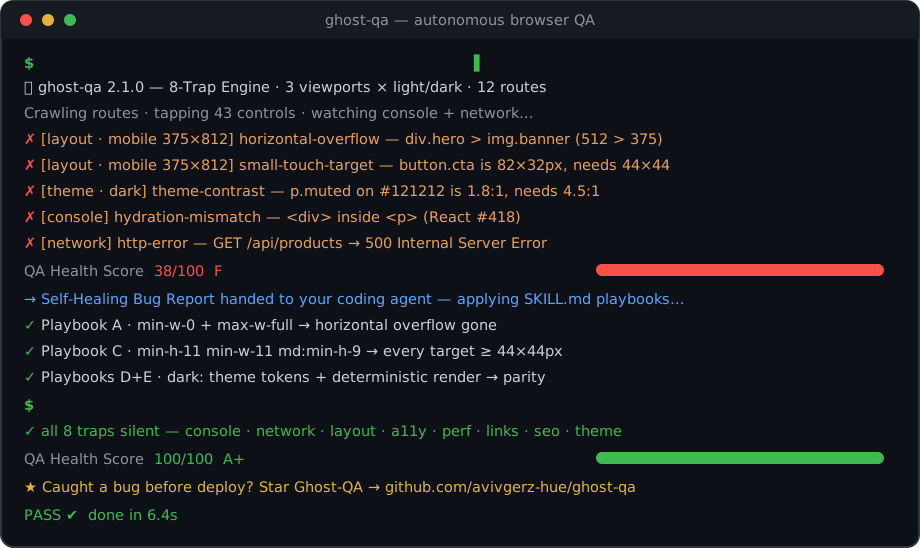
npx -y ghost-qa@latest test http://localhost:3000
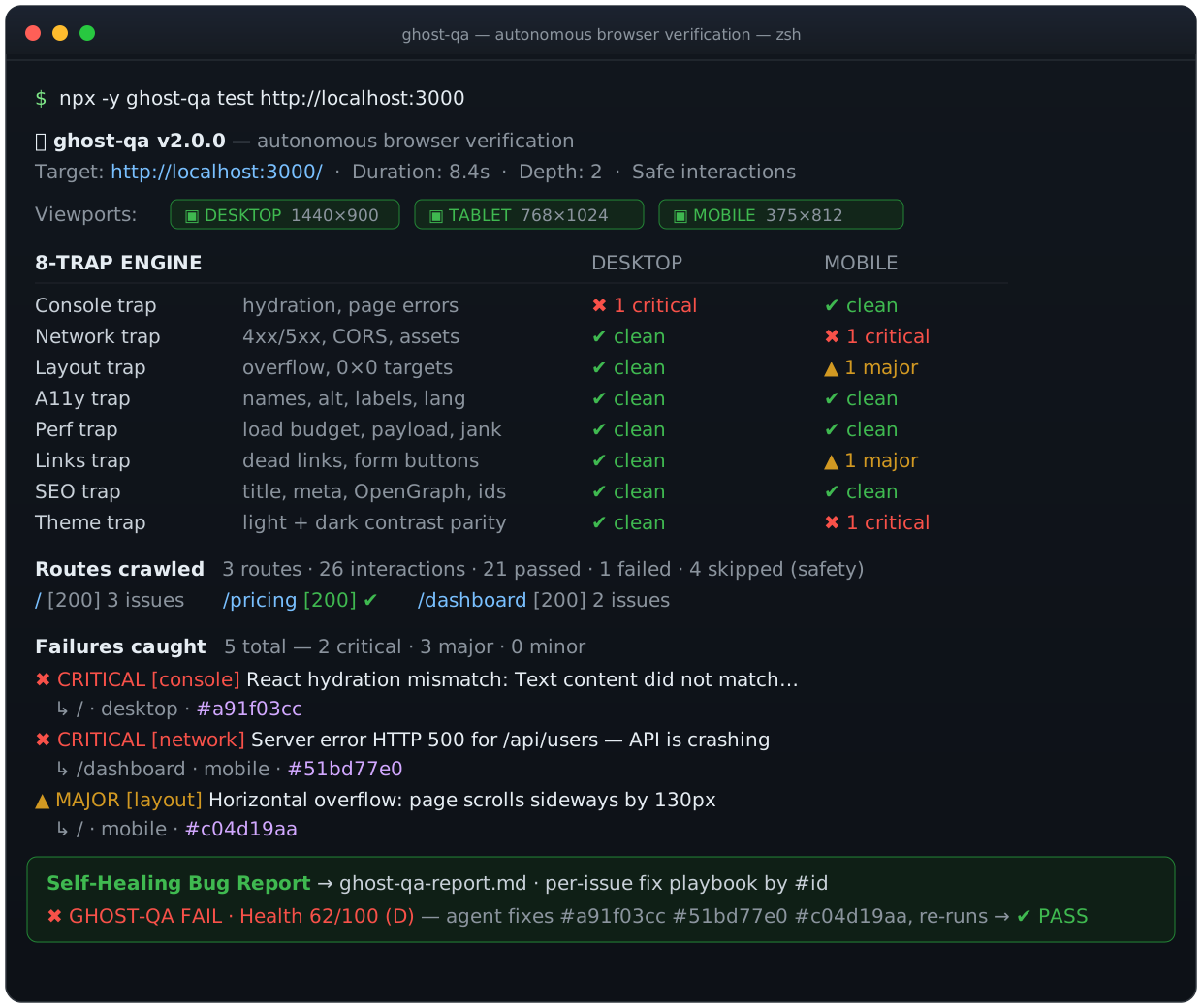
Coding agents (Claude Code, Codex, Cursor, Windsurf) write code blind — then declare victory while the actual browser has React hydration errors, broken buttons, 500ing APIs, or mobile layout overflow.
ghost-qa fixes that. One command launches a headless browser against your running app, crawls the live DOM, safely pokes every button, traps runtime/network/layout failures, and hands the agent a structured Self-Healing Bug Report so it fixes its own bugs before telling you it's done.
npx -y ghost-qa test http://localhost:3000
No test scripts. No config. No mercy for "it works on my machine".
Prefer running straight from GitHub instead of npm?
npx -y github:avivgerz-hue/ghost-qa test http://localhost:3000works identically — every command in this README accepts either package source (ghost-qa mcp,ghost-qa init, …).
⚡ Quickstart
# 1. Start your app as usual
npm run dev            # → http://localhost:3000

# 2. Verify it in a real browser (one-time: downloads Chromium)
npx playwright install chromium
npx -y ghost-qa test http://localhost:3000

# 3. Teach your coding agent to do this automatically, forever
npx -y ghost-qa init
ghost-qa init installs .claude/skills/ghost-qa/SKILL.md and appends the strict "Verify in Browser Before Done" protocol to CLAUDE.md, AGENTS.md, and .cursorrules. From then on, your agent runs ghost-qa itself, fixes what it finds, and only reports completion on a PASS.
🔁 The Autonomous Self-Healing QA Loop
                        ┌──────────────────────────────────────────┐
                        │            CODING AGENT                   │
                        │  Claude Code · Codex · Cursor · Windsurf  │
                        └───┬──────────────────────────────▲───────┘
              writes code   │                                │  Self-Healing
                            ▼                                │  Bug Report
                    ┌───────────────┐              ┌─────────┴──────────┐
                    │   DEV SERVER   │              │  AGENT DIAGNOSTIC   │
                    │ localhost:3000 │              │  verdict · #ids ·   │
                    └───────┬───────┘              │  fix playbook       │
                            │ serves live DOM      └─────────▲──────────┘
                            ▼                                │ Markdown / JSON
                    ┌────────────────────────────────────────┴──────────┐
                    │                   👻 ghost-qa                      │
                    │                                                    │
                    │   Route Crawler ──► Interaction Runner             │
                    │        │                    │                      │
                    │        ▼                    ▼                      │
                    │   ┌─────────┐  ┌──────────┐  ┌─────────┐          │
                    │   │ CONSOLE │  │ NETWORK  │  │ LAYOUT  │          │
                    │   │  A11Y   │  │  PERF    │  │ 8 TRAPS │          │
                    │   │  TRAP   │  │  TRAP    │  │  TRAP   │          │
                    │   └─────────┘  └──────────┘  └─────────┘          │
                    │   Desktop 1440×900 · Tablet 768×1024 · Mobile 375×812 │
                    └────────────────────────────────────────────────────┘
                                          │
                          fix bugs ───────┘  re-run until ✔ PASS
- The agent writes code and starts the dev server.
ghost-qa testcrawls every internal route on Desktop 1440×900, Tablet 768×1024 and Mobile 375×812, in light + dark colour schemes, exercising interactive controls.- Eight traps capture everything the browser actually experienced, scored into a deterministic QA Health Score (0–100, Grade A+…F).
- Failures return as a token-efficient diagnostic (
GHOST-QA-REPORT.md+PATCH-PROMPT.mdwith exact selectors); the agent fixes root causes and re-runs. ghost-qa compare before.json after.jsonproves the fix: the loop ends only at score 95–100 (A+), zero critical/major remaining, and zero new regressions.
🪤 The 8-Trap Deep Browser Inspection Engine (v2.0.0)
1. Console & Framework Runtime Trap — src/traps/console-trap.ts
- Uncaught
pageerrorexceptions with stack traces - Unhandled promise rejections
- React hydration mismatches ("Text content did not match", "A tree hydrated but…")
- Duplicate-key warnings and Content-Security-Policy violations (new in v2)
console.error(major) andconsole.warning(minor) — with dev-server noise ([vite], HMR, React DevTools banners) filtered out
2. Network & Asset Integrity Trap — src/traps/network-trap.ts
- HTTP
5xxAPI crashes (critical) and4xxresponses (major) - Failed
fetch/XHRrequests, timed-out requests, and connection failures - CORS-blocked requests and failed CORS preflights with remediation guidance
- Broken static assets, broken images (
naturalWidth === 0), broken inline SVGs (0×0), >500KB unoptimized payloads, and missing favicons (minor)
3. Layout, Responsive Geometry & Collision Trap — src/traps/layout-trap.ts
- Horizontal overflow:
scrollWidth > innerWidth, with the offending elements named (critical on mobile) - Overlapping interactive elements via bounding-box collision math, with exact selectors + boxes (new in v2)
- Touch targets < 44×44px on touch viewports (WCAG 2.5.5 / Apple HIG), clipped text, and off-screen interactives (new in v2)
- Zero-dimension interactive elements — buttons rendered at 0×0 that no human could tap
- Missing
<meta name="viewport">on mobile
4. Accessibility (WCAG 2.1 AA) & Keyboard Focus Trap — src/traps/a11y-trap.ts
- Buttons and links with no accessible name (icon-only controls screen readers can't identify)
- Images missing
altattributes (descriptive alt, oralt=""for decorative) - Form inputs with no associated label — a placeholder is not a label
- Real computed contrast ratios (
getComputedStyleforeground vs effective background, WCAG formula) (new in v2) - Heading hierarchy (missing
<h1>, h1→h3 skips) and automated Tab-order verification — simulated Tab presses catch invisible or dead focus states (new in v2) - Missing document
<title>and missing<html lang>
5. Performance & Core Web Vitals Trap — src/traps/perf-trap.ts
- Core Web Vitals: TTFB, FCP, LCP estimation, and CLS (Cumulative Layout Shift) (new in v2)
- Slow page loads via Navigation Timing (DOMContentLoaded / load budgets, 2× = critical)
- Oversized resources (> 1MB single asset), unoptimized >500KB images/scripts, and excessive total payload (> 3MB)
- Main-thread jank / layout-thrashing indicators from the Long Tasks API
- Render-blocking
<head>resources, excessive DOM size (>1500 nodes) and DOM depth > 32
6. Safe Interactive & Link Integrity Trap — src/traps/links-trap.ts (new in v2)
- Placeholder links (
href="",href="#",javascript:void(0)) and dead anchors/routes found during crawling - Buttons inside
<form>with notype(they silently become submit buttons) - Disabled/stuck interactive controls — all observational, this trap never clicks anything
7. SEO, Metadata & Social Graph Trap — src/traps/seo-trap.ts (new in v2)
<title>(missing, <10 or >60 chars), meta description,<html lang>, viewport meta, canonical tag- OpenGraph set (
og:title,og:description,og:image) for link unfurls - Duplicate
idattributes in the live, post-hydration DOM
8. Dark / Light Theme Emulation Trap — src/traps/theme-trap.ts (new in v2)
- Every page also renders under
colorScheme: 'dark'and'light'emulation - Computed contrast is re-evaluated per scheme — invisible dark-mode text (dark-on-dark) is caught automatically and tagged with the failing scheme
Plus a safety-first Interaction Runner: it fills forms with inert data (ghost-qa@example.com), opens tabs/modals/menus, and clicks ordinary buttons — but never destructive ones (delete, checkout, pay, logout, publish… are blocked by a tested safety gate).
📊 QA Health Score, Artifacts & Interactive Dashboard (new in v2)
Every run computes a deterministic QA Health Score (0–100) and Letter Grade (A+ … F): each trap starts at 100 and loses 25 per critical, 10 per major, 3 per minor finding; the overall score is the mean of the eight trap sub-scores (Console, Network, Layout, A11y, Performance, Links/UX, SEO/DOM, Theme Parity).
npx -y ghost-qa test http://localhost:3000 --out-dir ghost-qa-out --screenshots
| Artifact | Contents |
|---|---|
report.json | Complete machine-readable telemetry: per-trap scores, viewport matrices, exact DOM selectors (#id, data-testid, CSS path) and bounding boxes |
GHOST-QA-REPORT.md | Human + agent Self-Healing Bug Report with root-cause analysis and the fix playbook |
PATCH-PROMPT.md | Copy-paste remediation prompt: every finding with selector, bounding box, parent-component hints and the compare loop |
report.html | Self-contained, zero-dependency, dark-mode interactive QA Dashboard: Grade hero (A+…F), 8-Trap Scorecard, Route & Viewport Matrix, filterable findings (severity/trap/viewport), embedded screenshots when captured |
🔀 Regression Diffing — ghost-qa compare / ghost_qa_compare (new in v2)
npx -y ghost-qa test http://localhost:3000 --json > before.json   # baseline
# …agent fixes the bugs…
npx -y ghost-qa test http://localhost:3000 --json > after.json    # re-audit
npx -y ghost-qa compare before.json after.json                    # Regression & Verification Delta Report
The delta matches findings by stable fingerprint id and reports scoreDelta, fixedFindings, newRegressions, remainingFindings — so a coding agent can prove its fix resolved the bug without introducing regressions. verified requires score ≥ 95, zero regressions and no blocking findings left. Also available as the ghost_qa_compare MCP tool.
🔌 Native MCP Server
ghost-qa ships a zero-dependency Model Context Protocol server (JSON-RPC 2.0 over stdio), so MCP hosts can invoke browser verification as a native tool instead of shelling out:
npx -y ghost-qa mcp
| MCP tool | What it does |
|---|---|
ghost_qa_audit_url | Runs the full 8-trap deep inspection (3 viewports × light/dark) and returns the Self-Healing Bug Report + QA Health Score (structured content includes the full report for baselining) |
ghost_qa_compare | (new in v2) Diffs two report JSONs into the Regression & Verification Delta Report (scoreDelta, fixedFindings, newRegressions, remainingFindings) |
ghost_qa_doctor | Verifies Node, Chromium availability, and runs a live browser smoke test |
npx -y ghost-qa init writes the ready-to-use .mcp.json entry for you (merging with any servers you already have):
{ "mcpServers": { "ghost-qa": { "command": "npx", "args": ["-y", "ghost-qa", "mcp"] } } }
Works with Claude Code, Claude Desktop, Cursor, Codex — any MCP host.
Docker / Glama: the repo ships a production Dockerfile whose entrypoint is the MCP server (node dist/bin/ghost-qa.js mcp). Registry introspection (initialize + tools/list over stdio) answers instantly with no Chromium present — a browser is only launched when a tool is actually called:
docker build -t ghost-qa .
docker run -i ghost-qa   # MCP JSON-RPC over stdin/stdout
🖥️ Zero-lifecycle testing with --server-cmd (new in v1.1.0)
Don't even start the dev server yourself — ghost-qa will spawn it, wait for the URL to respond, audit, and terminate the whole process tree afterward:
npx -y ghost-qa test http://localhost:3000 --server-cmd "npm run dev"
Pair it with --html ghost-qa-report.html for a self-contained, dark-mode visual evidence dashboard (routes, interactions, every trap finding per viewport) you can attach to CI artifacts or PRs.
📟 Example output
👻 ghost-qa — autonomous browser verification
Target: http://localhost:3000/
Duration: 14.2s · Viewports: desktop + tablet + mobile · Schemes: light + dark · Depth: 2

Routes crawled
  /                            Home                 [200] 3 issues
  /pricing                     Pricing              [200] ✓
  /dashboard                   Dashboard            [200] 2 issues

Coverage
  Routes visited:       3
  Interactions tested:  21 passed · 1 failed · 4 skipped (safety)
  Issues:               5 total — 2 critical, 3 major, 0 minor
  QA Health Score:      62/100 — Grade D (8 traps · per-trap: console 65 · network 75 · layout 90 · a11y 100 · perf 100 · links 100 · seo 100 · theme 65)

Failures caught
  ✖ CRITICAL [console] React hydration mismatch: Text content did not match…
      ↳ / · desktop · #a91f03cc
  ✖ CRITICAL [network] Server error HTTP 500 for /api/users — backend/API is crashing on this route.
      ↳ /dashboard · mobile · #51bd77e0
  ▲ MAJOR [layout] Horizontal overflow on mobile: page scrolls sideways by 130px…
      ↳ / · mobile · #c04d19aa

✖ GHOST-QA FAIL — blocking browser failures found. Fix them and re-run before reporting done.
The agent-facing report (--report ghost-qa-report.md) groups the same bugs by route with a per-category fix playbook and the exact re-run command.
🚀 CLI reference
| Command | Description |
|---|---|
ghost-qa test <url> | Crawl a running app and trap browser failures. Exit 0 = PASS, 1 = blocking issues, 2 = runner error |
ghost-qa init [--force] | Install .claude/skills/ghost-qa/SKILL.md, verification protocol (CLAUDE.md, AGENTS.md, .cursorrules) + MCP config (.mcp.json) — all idempotent |
ghost-qa compare <before.json> <after.json> | Regression & Verification Delta Report between two report JSONs. Exit 1 if new regressions appeared |
ghost-qa mcp | Run the native MCP server (JSON-RPC 2.0 over stdio) exposing ghost_qa_audit_url, ghost_qa_compare and ghost_qa_doctor |
ghost-qa doctor | Diagnose Node ≥ 20, Playwright and Chromium setup, with a live browser smoke test |
ghost-qa --version / --help | Version / usage |
test flags
| Flag | Default | Description |
|---|---|---|
--max-depth <n> | 2 | Link-following depth from the start URL |
--max-routes <n> | 25 | Maximum routes to visit |
--timeout <ms> | 15000 | Per-navigation timeout |
--viewport <name> | all | all | both (desktop+mobile) | desktop | tablet | mobile |
--color-scheme <name> | both | both | light | dark — colour schemes emulated per viewport |
--screenshots | off | Capture a screenshot per route/viewport for the HTML dashboard |
--out-dir <dir> | — | Write report.json + GHOST-QA-REPORT.md + PATCH-PROMPT.md + report.html into this directory |
--no-interactions | off | Load pages only; don't click or fill anything |
--headed | off | Show the browser window (debugging) |
--fail-on <severity> | major | Exit 1 on critical | major | minor issues |
--json | off | Print the full machine-readable JSON report to stdout |
--report <file> | — | Write diagnostic to a file (Markdown, or JSON if the name ends .json) |
--html <file> | — | Write the self-contained dark-mode HTML visual evidence dashboard |
--server-cmd <cmd> | — | Spawn a dev server, wait for the URL, audit, then terminate the server tree |
--server-timeout <ms> | 30000 | How long to wait for --server-cmd to start responding |
--quiet | off | Suppress the terminal summary (report file + exit code only) |
Works with any stack that serves HTML on localhost — Next.js, Vite, Remix, Astro, Create React App, plain static servers, Rails, Django… if a browser can open it, ghost-qa can judge it.
🤖 The Agent Skill
SKILL.md (repo root) is the master Staff QA Engineer Protocol. One command — npx -y ghost-qa init — connects it, plus the 8-trap MCP server, into every major coding agent in its native dialect. All writes are idempotent (marker-delimited protocol blocks, JSON merges that preserve your existing servers/settings):
🔌 Supported Coding Agents (Claude Code, OpenCode, Codex, Cursor, Windsurf, Copilot, Cline, Zed)
| Agent | What ghost-qa init installs |
|---|---|
| Claude Code | .mcp.json, CLAUDE.md, .claude/skills/ghost-qa/SKILL.md, .claude-plugin/plugin.json |
| OpenCode | opencode.json (mcp → ghost-qa), AGENTS.md |
| OpenAI Codex CLI & universal agents | AGENTS.md, .agents/skills/ghost-qa/SKILL.md |
| Cursor | .cursor/mcp.json, .cursor/rules/ghost-qa.mdc, .cursorrules |
| Windsurf | .windsurfrules |
| VS Code / GitHub Copilot | .vscode/mcp.json, .github/copilot-instructions.md |
| Cline / Roo Code | .clinerules |
| Zed | .zed/settings.json (context_servers → ghost-qa) |
Every dialect wires the same MCP command (npx -y ghost-qa mcp) and the same 5-phase protocol: doctor → baseline audit → DOM-to-source mapping → remediation → ghost_qa_compare delta verification until QA Health Score 95–100. This repo dogfoods it: root AGENTS.md, CLAUDE.md, opencode.json, and .claude-plugin/plugin.json are committed, so Claude Code, OpenCode, and Codex CLI auto-discover ghost-qa here immediately.
⚖️ Scope & limitations (read this — we mean it)
ghost-qa is a local development verification tool, and we'd rather be honest than viral:
- Not a WCAG audit. The Accessibility Trap catches common machine-checkable failures (names, alt, labels, title, lang). Full WCAG conformance still needs assistive-technology testing.
- Not a replacement for your test suite. It complements unit/E2E tests by checking the live app the way a browser experiences it — it writes no persistent tests for you.
- Heuristic safety. The Interaction Runner refuses destructive-looking controls (delete, checkout, pay, logout…) and fills only inert data, but "destructive" is ultimately a word list. It is designed for localhost dev servers.
- Auth-gated apps. Without credentials, ghost-qa audits what an anonymous visitor sees (often the login page). Authenticated crawling is on the roadmap, not in the box today.
- Performance numbers are local-machine heuristics. Borderline perf findings on a loaded CI box deserve a re-run, not a panic.
- Never point it at production systems or sites you don't own or have explicit permission to test. It clicks real buttons.
- The MCP server is stdio-only (no network ports). Only wire it into MCP hosts you trust.
Found a trap flagging a healthy page? That's our most valuable issue type — file it with the report attached. Security reports: see SECURITY.md. Release history: CHANGELOG.md.
🧑💻 Development
npm install
npx playwright install chromium
npm run build     # tsc → dist/
npm test          # Vitest: trap evaluators, crawler policy, safety gate, reporters
node dist/bin/ghost-qa.js doctor
See CONTRIBUTING.md for the "pure evaluator first" architecture rules.
📄 License
MIT © VibeFoundry — see LICENSE.
Part of the VibeFoundry Agent Suite
| Tool | Description |
|---|---|
| 🎨 unslop | Studio-grade UI design systems & Anti-Slop engine for coding agents. |
| 🛡️ vibe-shield | Automated security scanner & MCP guard for AI-generated codebases. |
| 👻 ghost-qa | Autonomous headless browser QA & self-healing verification loop. |