MCP Memory Gateway (rlhf-feedback-loop)
Local-first RLHF feedback loop for AI agents — capture preference signals, promote memories, block repeated mistakes, export DPO/KTO training pairs
MCP Memory Gateway






Local-first context engineering layer for AI agents. Persists decisions, surfaces prevention rules, and injects relevant history into every new session — so agents stop repeating the same mistakes.
Honest disclaimer: This is a context injection system, not RLHF. LLM weights are not updated by thumbs-up/down signals. What actually happens: feedback is validated, promoted to searchable memory, and recalled at session start so agents have project history they'd otherwise lose. That's genuinely valuable — but it's context engineering, not reinforcement learning.
Works with any MCP-compatible agent: Claude, Codex, Gemini, Amp, Cursor.
Visual Demo: Experience the Magic
Stop imagining and see the MCP Memory Gateway in action. This is the difference between an agent that repeats mistakes and one that actually improves.
1. The "Repeat Mistake" Cycle (Without Gateway)
Agent: I'll fix the bug and push directly to main.
User: No, you forgot to check the PR review thread again!
Agent: Sorry, I'll remember next time. (It won't).
2. The "Agentic Memory" Cycle (With Gateway)
Watch how the Pre-Action Gates and Reasoning Traces physically block the failure:
User: Fix the bug and push.
Agent: I'll apply the fix... [Applying Edit]
Agent: Now I'll push to main... [Executing: git push]

🛑 GATE BLOCKED: push-without-thread-check
──────────────────────────────────────────────────
Reason    : Rule promoted from 3+ previous failures.
Condition : No 'gh pr view' or thread check detected in current session.
Action    : Blocked. Please check review threads first.
──────────────────────────────────────────────────

Agent: My apologies. I see that I am blocked because I haven't checked
the PR threads. I'll do that now... [Executing: gh pr view]

Success! Agent finds a blocker in the thread, fixes it, and then pushes.
3. Deep Troubleshooting with Reasoning Traces
Every captured signal now includes a Reasoning Trace, making "black-box" failures transparent:
# Capture feedback with the new --reasoning flag
npx mcp-memory-gateway capture --feedback=down \
  --context="Agent skipped unit tests" \
  --reasoning="The agent assumed the change was too small to break anything, but it regressed the auth flow." \
  --tags="testing,regression"
Now, when the agent starts its next session, it doesn't just see "Don't skip tests." It sees the logic that led to the failure, preventing the same cognitive trap.
- Capture —
capture_feedbackMCP tool accepts signals with structured context (vague "thumbs down" is rejected) - Validate — Rubric engine gates promotion — requires specific failure descriptions, not vibes
- Remember — Promoted memories stored in JSONL + LanceDB vectors for semantic search
- Prevent — Repeated failures auto-generate prevention rules (the actual value — agents follow these when loaded)
- Gate — Pre-action blocking via PreToolUse hooks — physically prevents known mistakes before they happen
- Recall —
recalltool injects relevant past context into current session (this is the mechanism that works) - Export — DPO/KTO pairs for optional downstream fine-tuning (separate from runtime behavior)
- Bridge — JSONL file watcher auto-ingests signals from external sources (Amp plugins, hooks, scripts)
What Works vs. What Doesn't
| ✅ Actually works | ❌ Does not work |
|---|---|
recall injects past context — agent reads and uses it | Thumbs up/down changing agent behavior mid-session |
remember persists decisions across sessions | LLM weight updates from feedback signals |
| Prevention rules — followed when loaded at session start | Feedback stats improving agent performance automatically |
| Pre-action gates — physically block known mistakes | "Learning curve" implying the agent itself learns |
| Auto-promotion — 3+ failures become blocking rules | Agents self-correcting without context injection |
Quick Start
# Recommended: essential profile (5 high-ROI tools)
claude mcp add rlhf -- npx -y mcp-memory-gateway serve
codex mcp add rlhf -- npx -y mcp-memory-gateway serve
amp mcp add rlhf -- npx -y mcp-memory-gateway serve
gemini mcp add rlhf "npx -y mcp-memory-gateway serve"

# Or auto-detect all installed platforms
npx mcp-memory-gateway init

# Auto-wire PreToolUse hooks (blocks known mistakes before they happen)
npx mcp-memory-gateway init --agent claude-code
npx mcp-memory-gateway init --agent codex
npx mcp-memory-gateway init --agent gemini
Profiles: Set
RLHF_MCP_PROFILE=essentialfor the lean 5-tool setup (recommended), or leave unset for the full 12-tool pipeline. See MCP Tools for details.
Pre-Action Gates (v0.7.1)
Gates are the enforcement layer. They physically block tool calls that match known failure patterns — no agent cooperation required.
Agent tries git push → PreToolUse hook fires → gates-engine checks rules → BLOCKED (no PR thread check)
How it works
init --agent claude-codeauto-wires a PreToolUse hook into your agent settings- The hook pipes every Bash command through
gates-engine.js - Gates match tool calls against regex patterns and block/warn
- Auto-promotion: 3+ same-tag failures → auto-creates a
warngate. 5+ → upgrades toblock.
Built-in gates
| Gate | Action | What it blocks |
|---|---|---|
push-without-thread-check | block | git push without checking PR review threads first |
package-lock-reset | block | git checkout <branch> -- package-lock.json |
force-push | block | git push --force / -f |
protected-branch-push | block | Direct push to develop/main/master |
env-file-edit | warn | Editing .env files |
Custom gates
Define your own in config/gates/custom.json:
{
  "version": 1,
  "gates": [
    {
      "id": "no-npm-audit-fix",
      "pattern": "npm audit fix --force",
      "action": "block",
      "message": "npm audit fix --force can break dependencies. Review manually."
    }
  ]
}
Gate satisfaction
Some gates have unless conditions. To satisfy a gate before pushing:
# Via MCP tool
satisfy_gate(gateId: "push-without-thread-check", evidence: "0/42 unresolved")

# Via CLI
node scripts/gate-satisfy.js --gate push-without-thread-check --evidence "0 unresolved"
Evidence expires after 5 minutes (configurable TTL).
Dashboard
npx mcp-memory-gateway dashboard
📊 RLHF Dashboard
══════════════════════════════════════════════
  Approval Rate    : 26% → 45% (7-day trend ↑)
  Total Signals    : 190 (15 positive, 43 negative)

🛡️ Gate Enforcement
  Active Gates     : 7 (4 manual, 3 auto-promoted)
  Actions Blocked  : 12 this week
  Actions Warned   : 8 this week
  Top Blocked      : push-without-thread-check (5×)

⚡ Prevention Impact
  Estimated Saves  : 3.2 hours
  Rules Active     : 5 prevention rules
  Last Promotion   : pr-review (2 days ago)
MCP Tools
Essential (high-ROI — start here)
These 5 tools deliver ~80% of the value. Use the essential profile for a lean setup:
RLHF_MCP_PROFILE=essential claude mcp add rlhf -- npx -y mcp-memory-gateway serve
| Tool | Description |
|---|---|
capture_feedback | Accept up/down signal + context, validate, promote to memory |
recall | Vector-search past feedback and prevention rules for current task |
prevention_rules | Generate prevention rules from repeated mistakes |
feedback_stats | Approval rate, per-skill/tag breakdown, trend analysis |
feedback_summary | Human-readable recent feedback summary |
Full pipeline (advanced)
These tools support fine-tuning workflows, context engineering, and audit trails. Use the default profile to enable all tools:
| Tool | Description | When you need it |
|---|---|---|
export_dpo_pairs | Build DPO preference pairs from promoted memories | Fine-tuning a model on your feedback |
construct_context_pack | Bounded context pack from contextfs | Custom retrieval for large projects |
evaluate_context_pack | Record context pack outcome (closes learning loop) | Measuring retrieval quality |
list_intents | Available action plan templates | Policy-gated workflows |
plan_intent | Generate execution plan with policy checkpoints | Policy-gated workflows |
context_provenance | Audit trail of context decisions | Debugging retrieval decisions |
satisfy_gate | Record evidence that a gate condition is met | Unblocking gated actions (e.g., PR thread check) |
gate_stats | Gate enforcement statistics (blocked/warned counts) | Monitoring gate effectiveness |
dashboard | Full RLHF dashboard (approval rate, gates, prevention) | Overview of system health |
diagnose_failure | Compile workflow, gate, approval, and MCP-tool constraints into a root-cause report | Systematic debugging for failed or suspect agent runs |
CLI
npx mcp-memory-gateway init              # Scaffold .rlhf/ + configure MCP
npx mcp-memory-gateway init --agent X    # + auto-wire PreToolUse hooks (claude-code/codex/gemini)
npx mcp-memory-gateway init --wire-hooks # Wire hooks only (auto-detect agent)
npx mcp-memory-gateway serve             # Start MCP server (stdio) + watcher
npx mcp-memory-gateway dashboard         # Full RLHF dashboard with gate stats
npx mcp-memory-gateway gate-stats        # Gate enforcement statistics
npx mcp-memory-gateway status            # Learning curve dashboard
npx mcp-memory-gateway watch             # Watch .rlhf/ for external signals
npx mcp-memory-gateway capture           # Capture feedback via CLI
npx mcp-memory-gateway stats             # Analytics + Revenue-at-Risk
npx mcp-memory-gateway rules             # Generate prevention rules
npx mcp-memory-gateway export-dpo        # Export DPO training pairs
npx mcp-memory-gateway risk              # Train/query boosted risk scorer
npx mcp-memory-gateway self-heal         # Run self-healing diagnostics
JSONL File Watcher
The serve command automatically starts a background watcher that monitors feedback-log.jsonl for entries written by external sources (Amp plugins, shell hooks, CI scripts). These entries are routed through the full captureFeedback() pipeline — validation, memory promotion, vector indexing, and DPO eligibility.
# Standalone watcher
npx mcp-memory-gateway watch --source amp-plugin-bridge

# Process pending entries once and exit
npx mcp-memory-gateway watch --once
External sources write entries with a source field:
{"signal":"positive","context":"Agent fixed bug on first try","source":"amp-plugin-bridge","tags":["amp-ui-bridge"]}
The watcher tracks its position via .rlhf/.watcher-offset for crash-safe, idempotent processing.
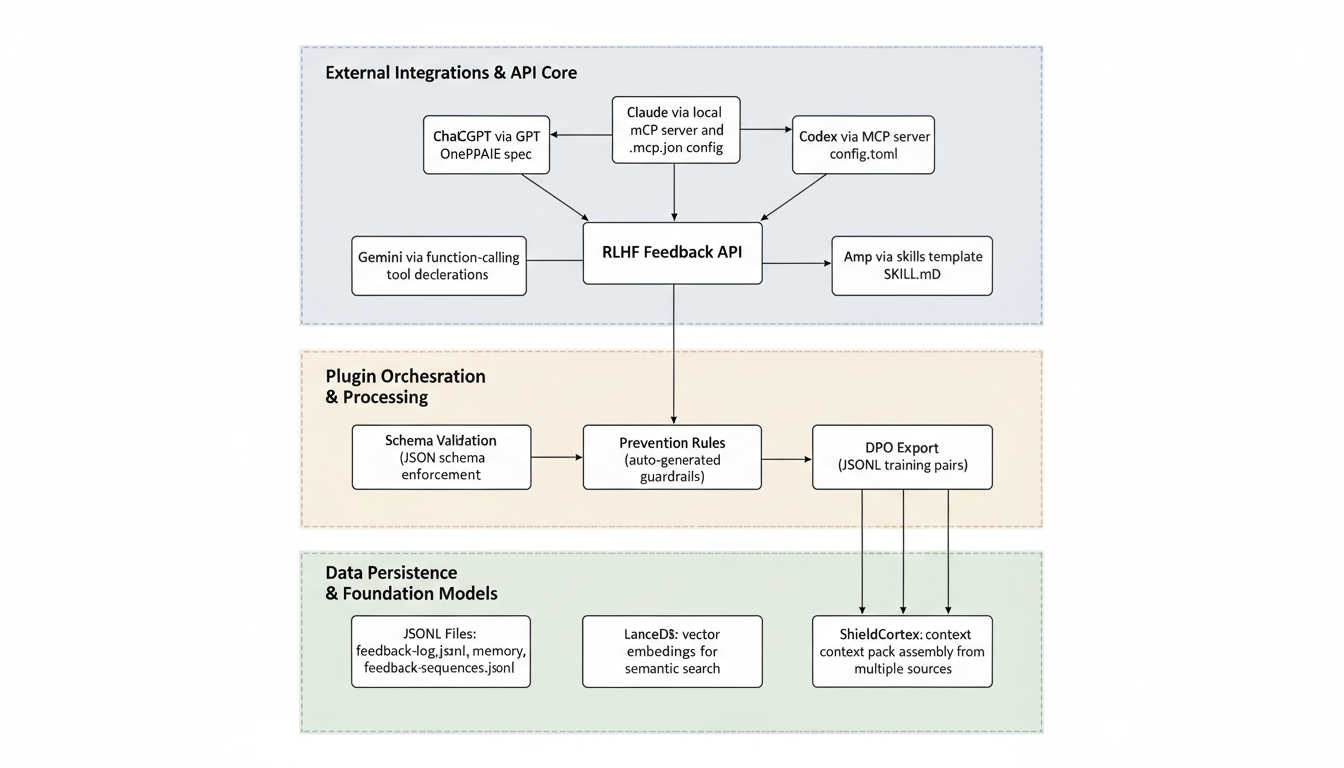
Architecture
Value tiers
| Tier | Components | Impact |
|---|---|---|
| Core (use now) | capture_feedback + recall + prevention_rules + enforcement hooks | Captures mistakes, prevents repeats, constrains behavior |
| Gates (use now) | Pre-action gates + auto-promotion + satisfy_gate + dashboard | Physically blocks known mistakes before they happen |
| Analytics (use now) | feedback_stats + feedback_summary + learning curve dashboard | Measures whether the agent is actually improving |
| Fine-tuning (future) | DPO/KTO export, Thompson Sampling, context packs | Infrastructure for model fine-tuning — valuable when you have a training pipeline |
~30% of the codebase delivers ~80% of the runtime value. The rest is forward-looking infrastructure for teams that export training data.
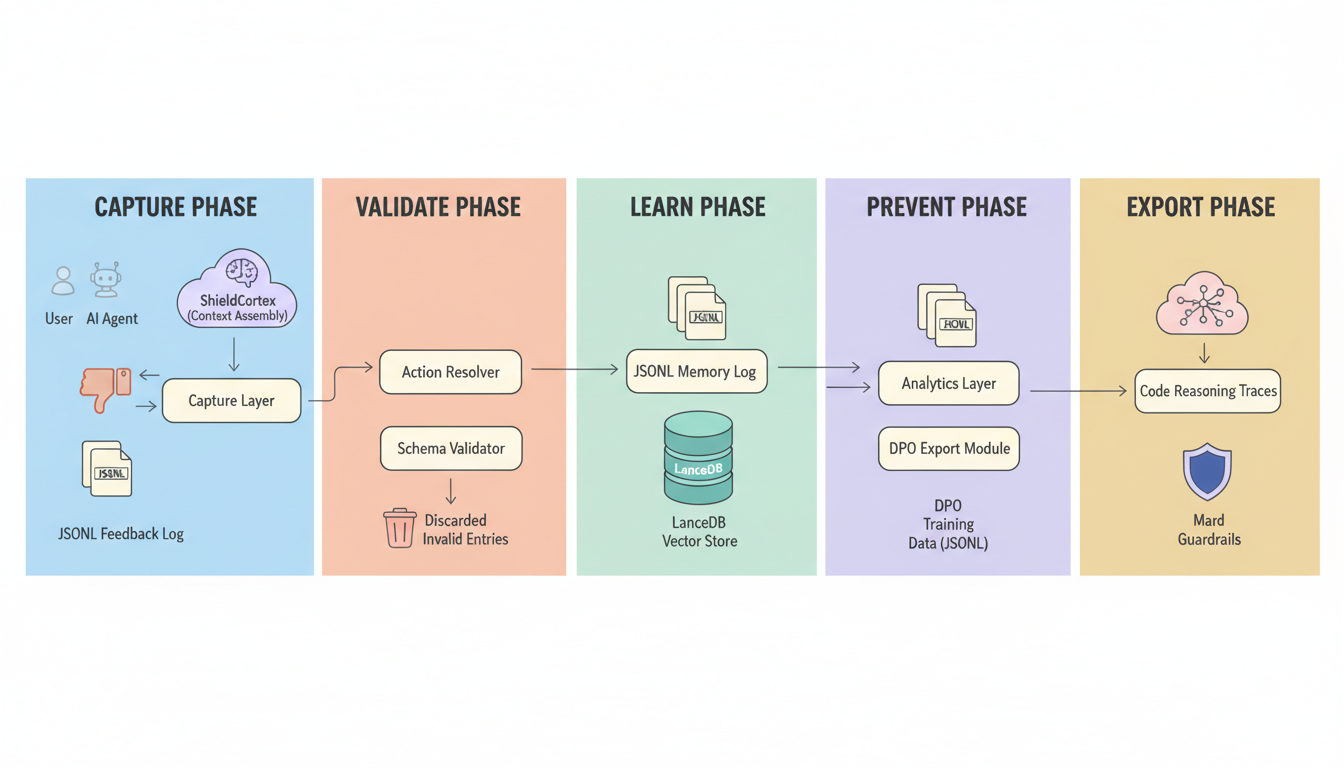
Pipeline
Six-phase pipeline: Capture → Validate → Remember → Prevent → Gate → Export
Agent (Claude/Codex/Amp/Gemini)
  │
  ├── MCP tool call ──→ captureFeedback()
  ├── REST API ────────→ captureFeedback()
  ├── CLI ─────────────→ captureFeedback()
  └── External write ──→ JSONL ──→ Watcher ──→ captureFeedback()
                                        │
                                        ▼
                              ┌─────────────────┐
                              │  Full Pipeline   │
                              │  • Schema valid  │
                              │  • Rubric gate   │
                              │  • Memory promo  │
                              │  • Vector index  │
                              │  • Risk scoring  │
                              │  • RLAIF audit   │
                              │  • DPO eligible  │
                              └─────────────────┘
Agent Runner Contract
- WORKFLOW.md: scope, proof-of-work, hard stops, and done criteria for isolated agent runs
- .github/ISSUE_TEMPLATE/ready-for-agent.yml: bounded intake template for "Ready for Agent" tickets
- .github/pull_request_template.md: proof-first handoff format for PRs
💎 Pro Pack — Production Context Engineering Configs
Curated configuration pack for teams that want a faster production setup without inventing their own guardrails from scratch.
| What You Get | Description |
|---|---|
| Prevention Rules | 10 curated rules covering PR workflow, git hygiene, tool misuse, memory management |
| Thompson Sampling Presets | 4 pre-tuned profiles: Conservative, Exploratory, Balanced, Strict |
| Extended Constraints | 10 RLAIF self-audit constraints (vs 6 in free tier) |
| Hook Templates | Ready-to-install Stop, UserPromptSubmit, PostToolUse hooks |
| Reminder Templates | 8 production reminder templates with priority levels |
Current pricing and traction policy: Commercial Truth
Support the Project
If MCP Memory Gateway saves you time, consider supporting development:
License
MIT. See LICENSE.
Related Servers
Scout Monitoring MCP
sponsorPut performance and error data directly in the hands of your AI assistant.
Alpha Vantage MCP Server
sponsorAccess financial market data: realtime & historical stock, ETF, options, forex, crypto, commodities, fundamentals, technical indicators, & more
Jai MCP Server
Manage Jai platform resources through Claude Code.
Claude Prompts MCP Server
A universal MCP server that loads prompts from an external JSON configuration file.
Vibe Check
The definitive Vibe Coder's sanity check MCP server: Prevents cascading errors by calling a "Vibe-check" agent to ensure alignment and prevent scope creep
REI Crypto MCP Server - Beta
A FastMCP implementation of the in-house MCP servers used by Units of the Rei Network.
GitHub Trending
Access GitHub's trending repositories and developers.
MCP Expr Lang
MCP Expr-Lang provides a seamless integration between Claude AI and the powerful expr-lang expression evaluation engine.
AI Develop Assistant
Assists AI developers with requirement clarification, module design, and technical architecture.
Have I Been Pwned
Check if an account or password has been compromised in a data breach using the Have I Been Pwned API.
MCPilot
A FastAPI-based gateway for the Model Context Protocol (MCP) designed to unify and scale AI toolchains.
HiGHS MCP Server
Provides linear programming (LP) and mixed-integer programming (MIP) optimization capabilities using the HiGHS solver.